

Introduction
When I first requested the Kendal archives to retrieve the 1965 Scrapbook of Casterton prepared by the Casterton Women’s Institute as part of that national institution’s 50th Jubilee celebrations, I was given an unexpected document. It was a handwritten essay titled ‘Casterton’, collected together in a blue-grey file. It offers a look at ‘Casterton Today’, as well as a review of some of the history of the village. It is illustrated with some hand drawn pictures and postcards. Unfortunately, the file does not mention who the author is or the date that it was written.
On a second visit I successfully managed to access the 1965 Scrapbook.[1] This will be used as a source for a later Sketch. For this month’s Sketch however, I will use the blue-grey file as a starting point to try to draw out what it was like to live in Casterton in the 1950s.[2] To differentiate between the two documents which share a catalogue number, I will refer to them as either ‘Scrapbook’ or ‘Essay’. I will also reference other sources to help paint the picture.
Possible Date
Based on information within the essay, it would appear to have been written about 1955. It was certainly written after 1954, it mentions this year in the text, but before 1960 because Mr [Edgar] Hutton was recorded as the Landlord of the Casterton Hotel, he left there in 1960.
Possible Author
Included within the essay are illustrations by Jane Ewbank. She was local scholar Jane Margaret Ewbank, born about 1942 and a pupil of Casterton School.[3] She was the daughter of the Reverend (later Venerable) Walter Frederick Ewbank. He was the vicar at Casterton and Chaplain to Casterton School from 1952 to 1962.[4] It is possible that she is the author of the essay, perhaps as part of a school project.
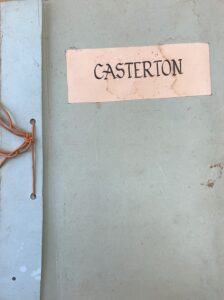
Front Cover of the C1955 file[5]
For this Sketch, where I have quoted directly from the essay, the direct quotes will appear in red. I will add some context to these quotes using other sources and also use these additional sources to widen the breadth of the essay.
Overview
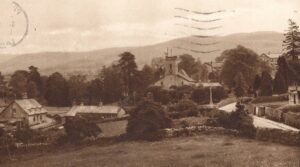
A 1947 view of Low Casterton, from left to right the buildings are, the local primary school, the Post Office, (now Ghyll Cottage), the Church, Church Cottages, War Memorial, various Clergy Daughters School buildings and the Village Hall.[6]
The essay starts, ‘Casterton is a pleasant village on the High Road from Sedbergh to Lancaster. One and a half miles from Kirkby Lonsdale, it lies between the Lancashire boundary, the parish of Barbon and the River Lune, and is divided into the two hamlets of High and Low Casterton.
The parish covers roughly 4,300 acres, much of which is farm and fell land. The soil is a light subsoil, limestone being the prevalent stone.
On the east of the parish lies Whernside the third highest peak of the Pennines.[7] The Casterton Fells are rich in caves and potholes…
…Springs on the fells serve Casterton with water, and every house has a piped water supply. The majority of the houses have electricity for lighting and cooking purposes, and gas is supplied from Kirkby Lonsdale.’
At this time, the village relied on the natural springs for their piped water. In his, as yet unpublished review of the Casterton Parish Council Minutes, Richard Murray, noted that in the 1950s ‘Approximately 23,000 gallons was consumed daily in Casterton: Casterton School used 15,000 gallons and the farms and houses in the village 11,000. A new water main was built in 1953 from Lime Craggs to High Casterton but this did not reduce the incidence of gastro-intestinal diseases suffered by village children at the time: the local doctors blamed the poor water supply. South Westmorland District Council Medical Officer was asked to investigate the problem: he and Councillors walked to the water source on an allotment owned by a Mr. Williams, opposite Dockriggs – on the left of the Green Lane walking towards Whelprigg, but subsequent tests showed the water to be of good quality: there the matter rested! However, issues regarding low water pressure during the drier summer months continued for many years thereafter.’
In June 1974, Casterton’s water supply was finally connected to the Manchester supply that originated from Haweswater via the Kendal water treatment works.
Housing
‘Ten council houses have been built recently, bringing the total number of houses built during the last thirty years to fifteen. Two houses were pulled down a few years before the war so that the road could be widened.’
As noted in a previous Sketch, this was the building that had once been two cottages, one of which had been the Blamire’s grocers shop. The Blamire Sketch notes that ‘Records show that the house[s] had almost certainly been removed by April 1937. An OS map surveyed in 1936 shows the house still present, but in an updated map of 1938, it is no longer there.[8]
The Casterton Parish Council Minutes shed further light on the matter. At a meeting on 1 April 1937, during a discussion about building some council housing in the village, in particular for a ‘farm man’, it was noted by Councillor J Robinson that ‘the County Council had demolished two houses in the village which were very suitable for such needs and if they were replaced would meet the present needs.’[9]
The note above suggests that setting aside the ten council houses, another five houses had been built in the years 1925 to 1955. Comparing old maps, census information and trade directories, two of these would have been Laitha Cottage on Laitha Lane and Uplands on Chapel House Lane. On the stretch of road from Colliers Lane to the Church it appears that Laneside, Loftwood (subsequently rebuilt) and Woodlands were also built in this period. This stretch of road had been referred to locally as ‘Nob’s Row’, a nob being a person of wealth or high social position, hinting at the community’s view on the recent inhabitants.[10]
The Church
‘Holy Trinity Church, founded in 1833, by W. W. Carus Wilson, is situated on the east of the main road in Low Casterton. The Vicar, Rev. W. F. Ewbank, is also chaplain of Casterton School, both Houses of which are situated in Low Casterton.’
The Reverend George Chapman Potts was the vicar from 1946 to 1952. As noted above he was replaced by the popular Reverend Walter Frederick Ewbank who stayed until 1962.
Jean Shearsmith (nee Wharton) who lived at Kirfit Hall from 1950, recalls that the Reverend Ewbank ‘encouraged us to go to Sunday School at the Church where we learnt the different aspects of the Service. We took the collection and rang the bells. Mr Ewbank visited all families at home fairly regularly, he was like a Social Worker he cared about all in the Village with the help of his wife’.
Stephanie Vickers nee Blaylock, whose family moved to Casterton in 1949 remembers also that ‘Mrs. Ewbank would often be seen around the village on her bicycle, which had a basket on the front. She would visit the villagers and take home-made soup to the sick.’[11]
Jean remembers that the Ewbanks set up a small club in the Vicarage Conservatory where the children, including the vicar’s daughters Jane and Clare, did craft activities. Jean learned to embroider tablecloths which were sold to raise money for the Pestalozzi Children’s Village, a charity established in the UK in 1957.[12]
Stephanie adds that ‘We predominately made baskets to sell and raise money. We used to soak the reeds, for weaving, in the beck at the bottom of the vicarage garden. He [the Reverend Ewbank] also arranged rambles and fell walks, which were great fun and educational, as he taught us map reading and how to use a compass. On occasion he used to take us up the church tower and point out significant landmarks.’
There was exciting news in the July 1955 Parish Newsletter.[13] ‘The Parochial Church Council has entered into an agreement with the Kirkland Bridge Church Restorations Ltd. for the redecoration of the whole interior of the church for the sum of £600.[14] First the wall pictures are to be expertly cleaned and restored, and then the rest of the interior is to be repainted in harmony with the colours which appear in the pictures. The walls are to be plain, and the question of some simple framing to the pictures, in place of the present heavy stencillings, is left over until we can see what the general effect turns out to be. The church has not been decorated for some forty years, and we trust that the work which we are putting in hand will also last for a generation.’
Fund raising was most successful. In the November Parish newsletter it was recorded that ‘The outstanding item of news this month is the complete redecoration of the interior of the church, in such a way as to render it most beautiful, and at the same time to retain its intangible atmosphere of quiet devotion… The Cross on the Altar has been repaired and lacquered. It is very important that no polish should be applied to it for the future, but that it should only be rubbed with a dry cloth, as polish will take off the lacquer at once.’
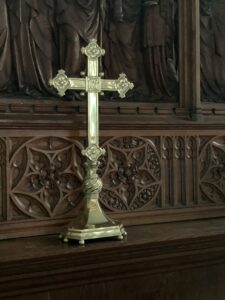
I assume that the cross that still stands on the altar today is the same as one mentioned above. It seems the correct size when compared with the interior photo below. Remember – rub it don’t polish it!

The interior of the newly renovated Casterton Church
In the essay there follows a lengthy passage about Holy Trinity Church, most of which can be found on the Holy Trinity Church website.[15] More specifically it adds ‘After World War II, Mrs. Robert Bickersteth presented the Church with a pair of candlesticks in memory of her husband, and of Thomas Parker, who lost their lives whilst serving in H. M. Forces, and whose names were added to the 1914 – 18 War Memorial, which stands at one corner of the Churchyard.’
Stephanie Vickers has memories which add to the picture. ‘The Clergy Daughters’ School, together with Bronte House School, attended morning service every week in term-time, filling the entire left-hand side of the Church. They also provided an amazing choir, and their music teacher played the organ. During holiday periods Mrs. Crossley played the organ, and villagers and children made up the choir. Mary Makinson, Billy’s sister, had a good soprano voice and starred in many concerts including the Mikado.’[16]
‘In 1952 the Anglican Young Peoples Association presented a gate to the Churchyard. It is pleasingly made in oak, and is the work of one of the members.’
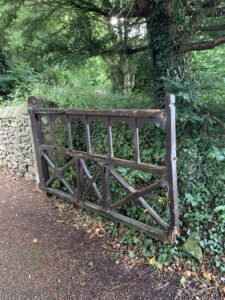
There are two gates in the churchyard. The one above certainly looks about 70 years old.
The Pageants
In his reminiscences, Billy Makinson went into some details about the Pageants. ‘I’m going to tell you a little bit now about the pageants that were in Mr. Ewbank’s time. The pageants near almost involved the whole village really: actors, and of course a lot of backstage people: dressers and the likes. I’ll tell you one rather funny – well, it wasn’t funny at all – it involved poor Rob Major who was playing the part of Judas – and of course after the betrayal of Christ, he had to run down church, head bowed, and out into the night, but it was rather a windy, stormy night (this was only at a rehearsal, thank goodness) and somebody had closed the outer door, and so as he burst through the doors he went bang into the outside door which was, well, you probably know it’s a hard, solid door. It wasn’t very funny at the time – but fortunately we’re better with the real things.
We did these pageants on two or three occasions. People from Kirkby and Barbon – the church was full. It was really not surprising it was full because there were a lot of artists [artistes?] really – Mr. Ewbank seemed to get everybody in the village to take part: people who never went to church even were part of the pageants.
One of the pageants – the first one was up to the birth of Christ (all the old prophets and things in the Old Testament) and the second one was from the New Testament which was up to the Crucifixion – not actually the Crucifixion but up to that time.
After this pageant the BBC seemingly heard about it and so we did a broadcast. It was broadcast in a programme – I think it was called “Calendar”, a religious programme that was on the wireless in those days. I don’t know whether there’s such a programme as that now, but we all did our little bits, and it took us about an hour I think, but when it was broadcast it was very cleverly edited and it only lasted twenty minutes – but it was quite an occasion. All the schools came: some boys from Sedbergh School and Cressbrook School, and of course the girls from Casterton School. I really – I would say they were quite a success, although I remember in the first place I didn’t really think it was the thing (I didn’t think we were good enough actors to be acting in church, and I was brought up that church was church, it wasn’t a stage) but anyway I think really it was a success.
I must tell you that before the pageants Mr. Ewbank – which I thought was very amusing – he put an advert in the parish leaflet for a cock to crow! I was St. Peter so the cock… I was greatly involved with the cock, you see. Anyway Mr. Ewbank got two applications for a cock, and at rehearsals I sometimes had one cock, sometimes the other cock, but Joan Jackson who worked at school was the cock in the real programmes – she did very well – she was in behind the organ I think, crowing. I must tell you that after we did the broadcast the BBC insisted on paying us… the people who took part were paid 5 guineas, and of course everybody gave their money to the church, so I think it was really quite a boost to Casterton Church.’

A photograph of one of the Pageants possibly celebrating the Passion. The Reverend Ewbank is sat in front right behind the man in white with black beard.[17]
The Parish Council
As noted above, Richard Murray has written an unpublished paper reviewing the Casterton Parish Council Minutes during the reign of Queen Elizabeth II. He noted that during the 1950s, the Council comprised six members: W. Thompson, (Chair); G. Hutton; W. Dennison; G. Spencer; Miss Smith and W. Robinson who also acted as Clerk to the Council. The Clerk was not paid for any services he provided, but in 1955 he was given £8 to cover all the expenses he had incurred during his time in Office. From 1956, he was paid an annual fee of five guineas.
During the 1950s, the ‘annual precept’, the amount given to the Parish from the household council tax to cover the costs of the Parish Council, was £8, rising to £10 in 1954 and to £12 four years later.[18]
The Village School
‘Since 1932, the Church of England school, has been a junior school. Scholars of eleven years proceed to one of the Kirkby Lonsdale schools. Miss Hayton is headmistress, assisted by Mrs Hayhurst, and there are upwards of forty scholars on roll.’
The village school existed from well before 1932. Its establishment also owns its origins to the Reverend William Carus Wilson. In 1841, he sold a plot of land between the Clergy Daughters School and the Servant’s School across the road from the church and built a single roomed school of 500 square feet.
Writing a letter to his cousin in 1846, Henry Fitzwilliam observed that as well as the Clergy Daughters School and the Servants School, ‘There are also two village schools for the native children; and, altogether the desire to educate those among the young whose parents are too poor to afford it seems to have found a congenial climate in Casterton, and flourish amazingly under the fostering care of the [Carus-] Wilsons.’[19]
A second room was added in 1913. The school finally closed in 1972 when local children were provided with a bus to take them to school in Kirkby Lonsdale.
Miss Gertrude Hayton the headmistress, possibly joined the school in 1950 on the retirement of Mrs Forbes who had been headmistress since 1932.[20] The 1965 Scrapbook notes that the then headmistress was a Mrs Laidman, presumably Hayton had by then retired. Mrs Mary Hayhurst was the assistant when Mrs Forbes retired and was still there in 1965.
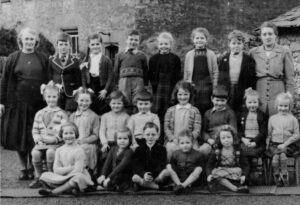
Class of C1956[21]
Back Row: Miss Gertrude Hayton, Gavin Hutton, Julia Cairns, Alan Begg, Sheena Major, Carol Hird, Robert Livingstone, Mrs Mary Hayhurst
Middle Row: Rose Gott, Judith James, Susan Wayne, Michael Smart, Claire Ewbank, Shaun Feeney, Jean Wharton, Pamela Blaylock.
Front Row: Christine Holden, Sylvia Taylor, Les Maddocks, Valerie Hird, Sheila Duxberry.
Jean Shearsmith had fond memories of attending the school in the 1950s.[22] She recalls, she had to walk from Kirfit Hall up through Casterton Woods wearing clogs rather than wellies. When she started school in the early 1950s, her sister took her there for the first few days, helping her put her school shoes on at the school gate. Very soon though she was walking there herself, recalling that she loved to meander home past Mrs Roper’s house [The Old Manor] and loved the gardens made by the Bronte House Schoolgirls on the opposite side of the stream.
Jean added that the school teacher was Mrs Hayhurst. There was a coal fire in the room. Everybody sat in double desks with fold up seats and learnt to write with a pen dipped in ink ‘joined up’ with loops in the ‘Marian Richardson’ style. After lunch at the Village Hall, the younger students had fold up beds and a blanket to have a short sleep. Thanks to Mrs Hayhurst, the ‘3 Rs’ [Reading, Writing and Arithmetic] were mastered. Later we went into the “big class” with Miss Hayton. Jean recalls that the schools radio programme ‘Singing together’ was a highlight. Broadcast on the BBC Home Service, the programme ran from 25 September 1939 to 29 March 2001. An example of it can be found here https://www.bbc.co.uk/sounds/play/p02czt1h .
As she progressed through the school, Jean and her peers were given more responsibility. For example, older students were expected to tend the grazed knees of the younger children, collect the National Savings money and take it up to the Post Office to buy six pence special savings stamps with Princess Anne on. There was also a stamp worth 2 shillings and six pence (Half a Crown) which had a picture of the then Prince Charles on it. These were diligently stuck in a book and when there was 15 shillings worth a savings certificate was obtained.
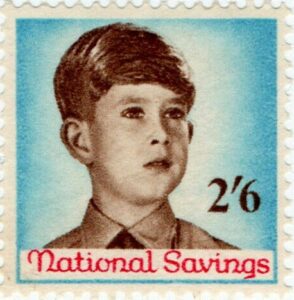
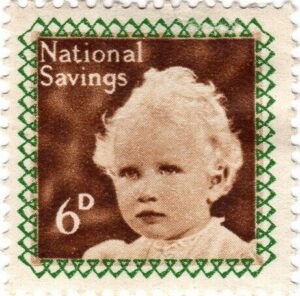
National Savings Stamps from the 1950s
Jeans adds that they were also responsible for taking the younger ones to lunch across the main road to the Village Hall. The meals, which Jean recalls as being exceptionally good, were delivered from Queen Elizabeth School.
Stephanie Vickers also remembers her schooldays fondly. She recalled that if one of the teachers was absent for any reason, Mrs Hutton from the Casterton Hotel (now The Pheasant) used to come and cover for them. Stephanie recalls playing with Mrs Hutton’s sons David and Gavin Hutton in the barn to the left of the Hotel which has since been converted into a house. She recalled that the school Caretakers were Mr and Mrs Robert (Bob) Wright who lived above the schoolrooms.
Bob Wright had moved to Casterton as a gardener in the 1920s, originally to Hole House. He and his wife were caretakers at the school for 34 years.[23]
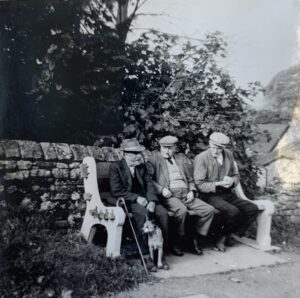
Bob Wright on the left is sat on the bench opposite the bus stop next to the Village Hall. He is sat next to Fred Coward in the middle and Billy Airey[24]
Stephanie Vickers recalls that the pupils at the school numbered about 26-28, split between the two classes, of whom five or six came from Kirkby Lonsdale. As for the classrooms themselves, there were double bench desks with a central inkwell and two separate compartments for books, with a shared lid.
The school day ran from 9am until 4pm with two 15-minute play times and a lunch break. For lunch, the pre-cooked lunches were delivered to the Institute [the Village Hall] and we pupils filed up there from school when the church clock struck twelve. Under the supervision of Mrs Hayhurst we walked in single file up beside Mrs Waller’s orchard [past what is now Ghyll Cottage] and through the stile opposite the bus stop.
At morning break, the pupils were each given individual small bottles of milk delivered by Mr Hird.
Mr Anthony Hird lived a stone’s throw away from the school at Holly Bush with his wife Lavinia and children Doreen, Carol and Valerie, who all attended the school.
Mr Hird, who also ran the only taxi in Casterton, owned the Folly, opposite Casterton School (now rebuilt) and had cattle on the field behind the buildings, which were the source of his village milk round.
Jean Shearsmith’s older sister Betty married Eric Mason at Casterton Church in 1958 and lived at Yew Tree Cottage. She worked as a cook at Bronte House while her husband worked for Mr Hird and also drove the taxi.
The school lessons included sums, writing, weekly times tables, reading, some geography and history, art and nature walks. For the junior class, there was also a weekly religious education lesson from the Vicar.
Stephanie recollects the outside toilets and the playground which was fronted by the beck. Play time mainly involved skipping ropes, hopscotch, marbles, balls and definitely conkers! The annual Sports Day took place on what is now the Prep School playing fields opposite the Folly. Parents’ races were highly competitive!
Stephanie concludes her school memories, ‘It is a shame the village school had to close but I feel blessed to have enjoyed my early education in such surroundings. I never really got into trouble but I always seemed to be “the chosen one” to retrieve any balls that landed in the beck – being both slim and agile (oh to be again !!)’[25]
The Folly mentioned by Stephanie must have been a ruin in the 1950s, it no longer appeared as a building on the 1951 Ordnance Survey map and today is simply a mount in the field adjacent to the Vicarage.

The Folly House / Farm buildings on the 1862 Ordnance Survey Map
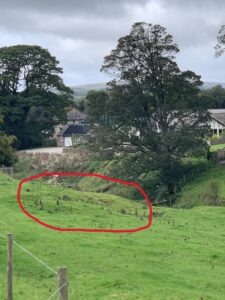
Today, the Folly buildings are hidden beneath the earth. In the dip emerges Casterton Beck, the photo overlooking the field towards the A683, behind the tree is the redeveloped property that was once the barn belonging to the Folly and behind that the school playing fields.
Village Hall
‘Miss Lucy Bickersteth, of Casterton Hall, was until her death in 1930, a great benefactress of the village… A Church Room for the use of the Church and the Parish, was built at her expense, in memory of her sister.’
The Bickersteths had been resident at Casterton Hall since at least 1857. Katherine Bickersteth died in 1878 but her spinster daughters Emma and Lucy remained at the Hall. Emma died in 1907, Lucy in 1930.
The other donor, Mary Lilian Bickersteth, born in Bombay, India, was the daughter of John Pares Bickersteth, the eldest brother of Emma and Lucy.
Ellen, also mentioned on the plaque, moved into the Hall in 1939 with her daughter Ailsa. Ellen’s husband was Edward Ralph Bickersteth, the great nephew of Lucy. He was Curate of Christ Church, Waterloo, Liverpool 1928-1931. Edward retired to the Hall in 1941 and died there in 1945. Ellen died in April 1959 at Casterton Hall.

Plaque in the Village Hall commemorating its construction
Shops
‘A Post Office and General Store is kept at Church Cottage by Mrs. Bell, and a shop and Petrol Filling Station at Town End is kept by Mr. Dixon.’
The first clear indication that there was a shop at Church Cottages was in the 1891 Census. It would have been in competition with the store run by the Blamire family which was covered in the Sketch noted above. The Church Cottages Store was run by various people since then.
Norman and Marjorie Bell who lived in nearby Warton took over the store from Mrs Sarah Robinson nee Gill, in the early 1940s. On Saturday mornings they used to drive their van to Bronte House and sell sweets to the schoolgirls. The Dixons took over in the 1950s until the early 1960s and then handed over to Frank and Edie Mellor in 1963.
Stephanie Vickers remembers that ‘We had a village shop near the church, which also doubled as a post office. It sold most of the necessary supplies to content a small village but I cannot claim to be the most reliable shopper in those days. As an avid reader my imagination was always filled with tales of the Famous Five, White Fang or Heidi, acting out the scenes from these in my playtime. A short trip to the shop could have me imagining great adventures, so by the time my errand was fulfilled I returned home with a bag of sugar instead of a loaf of bread – many return journeys were made to that shop with strict orders to concentrate on the task I was given!’
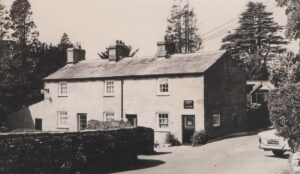
Mid 1960s postcard view of the Casterton Post Office and Shop
The aforementioned Petrol Station is still there, now called Town End Garage. It was formerly the village smithy. Stephanie remembers that when the blacksmith’s was closed and reopened as a garage, the blacksmith’s customers were taken over by Jonty Wilson in Kirkby Lonsdale.
In October 1956, Joan, the daughter of the garage proprietor Mr C. Dixon was married by the Reverend Ewbank in the local church to Duncan Macdiarmid. The Dixons were living at 1 Fern Croft, one of the council houses noted earlier, and next door to the garage. The bride wore a ‘ballerina-length dress of white nylon organza with a circular veil of witch-craft lace, held in place by a head-dress of orange blossom and pearls.’ Joan’s sister Norah was one of the bridesmaids and her uncle Albert Dixon one of the Ushers.[26]
Stephanie remembers a possibly unique tradition which happened for every wedding at this time. ‘The village children tied string around both church gates and the groom, pre-warned, threw coppers over the gate – only then was the string cut and the bride and groom released!’
The Pub
‘The proprietor of the Casterton Hotel, The George and Dragon, is Mr. Hutton.’
The Pheasant Inn was previously named The Casterton Hotel and before that The George and Dragon. It is possible to trace landlords of this establishment to just before 1800 when George Metcalfe was there with his wife Bella. The Mr Hutton mentioned above was Edgar Hutton who ran the pub from about 1939 to 1960. He was the son of Frederick Hutton who was also Landlord from about 1902. It was Frederick who changed the name from the George and Dragon to The Casterton Hotel C1914.
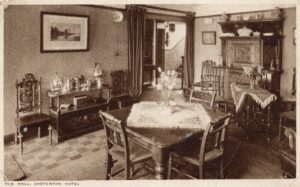
A postcard showing a photograph of the hall in the Casterton Hotel. It is believed that the photos were published in the 1930s by Edgar Hutton but were still for sale in the 1950s [27]
With its proximity to the church, the Hotel was often used as the venue for wedding receptions. For example, in August 1955, the verger at the church, William Robinson, married Miss Rawlinson, the church organist with their reception at the Casterton Hotel. The newly married couple stayed in Casterton, living at ‘Yew Tree’, presumably Yew Tree Cottage.
Farms and Population
‘[In 1913] there were 19 farms as against 16 today. Excluding the Schools, the population of Casterton now about 250.’
The population of Casterton excluding the Schools has been remarkably consistent since records were first kept. For example in the censuses of 1801 to 1831, the years before the school was there, the population ranged from 266 to 302.[28]. The 1841 Census showed the local village population as 348 people, the Servant School population of 125 and the Clergy Daughters School with 250 persons.
Subsequent censuses of the non school population were 1851 = 305, 1861 = 404 (with an additional 25 Railway Contractors working on the recently completed railway). In 1871 the population was 282, 1881 = 336, 1891 = 249, 1901 = 265, 1911 = 242, 1939 = 239. In 1955 the population was estimated at about 250 and in 1965 at 268.
As noted in the table below, in a 1914 Trade Directory, there were 18 farms listed in Casterton. For some reason, although we know it was being farmed, Old Manor Farm was not included in the directory, this would make up the 19th farm noted above.
There is little change recorded in a 1939 Directory with only Newlands not listed as a farm. The 1968 Women’s Institute Scrapbook shows that other farms not listed are Fern Cottage, Langthwaite and Old Hall.
| Farm | 1914 Directory | 1939 Directory | 1968 Scrapbook |
| Bee Nest | Y | Y | Y |
| Bell Gate | Y | Y | Y |
| Bindloss | Y | Y | Y |
| Bull Pot | Y | Y | Y |
| Chapel House | Y | Y | Y |
| Cragg House | Y | Y | Y |
| Fell Garth | Y | Y | Y |
| Fell Gate | Y | Y | |
| Fell Yeat | Y | Y | Y |
| Fern Cottage | Y | ||
| Gale Garth | Y | Y | Y |
| Hole House | Y | Y | |
| Holly Bush | Y | Y | Y |
| Kirfit Hall | Y | Y | Y |
| Langthwaite | Y | Y | |
| Newlands | Y | ||
| Norwood | Y | Y | Y |
| Old Manor | Not noted in Directory but was being farmed Y | Y | Y |
| Smithies | Y | Y | |
| Old Hall Farm / Beckside | Y | Y | |
| Total | 19 | 17 | 15 |
The Railway
The railway which had arrived in the village in 1861, was closed to passengers on Saturday 30 January 1954, although there were ‘special trains’ along the line for some years for the benefit of pupils at Sedbergh School, Casterton School, Cressbrook School and Queen Elizabeth School at the start and end of each term.
On the last day of the general passenger service, Lord and Lady Shuttleworth invited a number of people to join them for a private party on board the 6:52pm from Ingleton. The party boarded the train wearing Victorian Costume. As the train arrived at Kirkby Lonsdale, the brass band, led by band leader James Dennison, joined the party, reprising the Band’s performance at Ingleton Station when the line opened 93 years earlier.
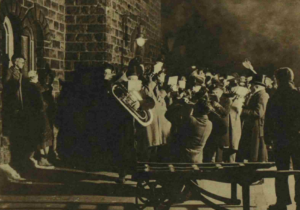
The Kirkby Lonsdale Band being filmed by a television newsreel cameraman plays ‘Will Ye No Come Back Again?” at Ingleton station on 30 January 1954[29]
A freight service ran until 1st October 1964. After this, the track was kept in good repair in order that it could be used as a relief line if needed. During the ‘Big Freeze’ in the winter of 1962/3, the Settle to Carlisle line was completely blocked by snow. For several weeks the line was used by a large number of diverted trains. The end finally arrived in Spring 1967 when it was decided that the tracks should be dismantled. It really was the ‘end of the line’.[30]
Billy Makinson had warm memories of the railway which ran past his home at Old Manor Farm. He recalled that ‘our railway station was Kirkby Lonsdale, and after all, Kirkby station was a great deal nearer Casterton than it was Kirkby Lonsdale although Kirkby station was in a different parish, a different county, a different diocese! But nevertheless it was our station, and at one time it was a very busy station: there were passenger trains; the passenger trains that went down were at twenty past the hour and the passenger trains that came up were five minutes to the hour. They kept very regular times: you could certainly set your clock by the five minutes to seven at night – it was never late. There were also goods trains – there was a local goods train that stopped at every station; there were express goods trains that went through that didn’t stop at any of the stations. I think there would be five passenger trains in each direction during the day.’
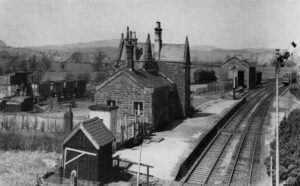
Kirkby Lonsdale Station in 1955 looking North
Employment
‘Many of the inhabitants of Casterton follow country pursuits, whilst others follow trades and professions in Kirkby Lonsdale, or further afield in Kendal or Lancaster, despite travelling difficulties.’
‘The Casterton Schools employs [Sic] local labour, both male and females.’
An interesting reference to ‘travelling difficulties’, presumably a reference to a lack of public transport. Following ‘country pursuits’, presumably, shooting, riding, fishing and other such pastimes would be in addition to farming which as can be seen was still the main occupation.
Social Activities
The Women’s Institute
‘Social Activities in Casterton are numerous. The Casterton Branch of the Women’s Institute had its first meeting in April 1919, and is a flourishing organisation, drawing members from outside the parish boundary. Of recent years, winter courses in Embroidery, Dressmaking and Scottish dancing have aroused much interest. Some of the founder members are still active members, one of whom, Mrs. Roper is the President.’
Mrs Martha Roper lived at Old Hall, where today the Headmaster of Sedbergh Preparatory School lives. It has been the subject of an earlier Sketch – https://www.castertonparishcouncil.org.uk/old-hall/ .
A history of the Casterton Women’s Institute was written by Claire Wildsmith in 2009 to celebrate the 90th year of its founding in 1919.[31] It first met in the Church Room, now the Village Hall, on 12 March 1919. Mrs. Mabel Williams was elected President and Martha Roper – a future President from 1941 to 1963- as Treasurer. The Casterton Women’s Institute is still part of village life, now under the Presidency of Gill Sykes.[32]
In 1954, the Parish newsletter noted that the Women’s Institute was arranging nine Scottish Dancing classes during the first part of the winter. ‘They are to be taken voluntarily by Miss Unsworth, deputy director of physical education for Westmorland… Miss Unsworth specially requests that the men-folk will come… if 15 attend, the cost would be approximately 6/- each for the 9 lessons.’
Mothers’ Union
‘A well established branch of the Mothers’ Union meets regularly, and among its many good works has been most active in conjunction with other organisations, in arranging sales of work, and various activities towards the redecoration of the Church and for missions and Diocesan appeals.’
The national Mothers’ Union was founded in 1876 by Mary Sumner. It was an organisation for women that brought together rich and poor to build a network that would support mothers of all kinds as they brought up their children in the Christian faith. The Casterton Mothers’ Union was first established in 1896 or 97.[33]
Billy Makinson recalled that the Reverend Potts wife ‘started up the Mothers’ Union again in Casterton.’ The Reverend Potts was at Casterton from 1946 to 1952. The Union was not mentioned in the Women’s Institute Scrapbook so had presumably folded by 1965.
Anglican Young Peoples’ Association
‘In 1942 a branch of the Anglican Young Peoples’ Association was formed in Casterton. Several other branches were formed locally about this time, and the Ewecross Local Council came into being. During the later war years, when so many young people had to leave the village, great difficulty was experienced in keeping the Branch alive, memberships for a long time being as low as four. Now this branch is believed to be the only surviving branch in Westmorland. Works for the Church is a regular feature of the programme, and for many years the A.Y.P.A. has supported a school in [The] Gambia. Annual activities include sales of work, and concerts, arranged, acted and written by the members. Rounders, cricket and table tennis tournaments, as well as debates with neighbouring youth groups are part of a varied programme, and successes have been scored in the Public Speaking Competitions organised by the Young Farmers’ Clubs.’
In Billy Makinson’s reminiscences he recalled that the AYPA was started by Rev. [Robert Austin Meire] Harris and that it lasted about 15 years, [i.e. it finished around 1957].
At Christmas 1950, the AYPA were reported as spending an evening going around the village carol singing. They managed to raise more than £2 for the Church of England Children’s Society. In the same report it was recorded that Mary Makinson was the President of the AYPA.[34]
Stephanie Vickers has detailed memories of such occasions. ‘We had a very long night carol singing yearly all round Low and High Casterton, always stopping at Miss Smith’s house where her maid – Bessie Day – served mince pies and cups of tea in the library fronting a warm log fire. I called them expeditions as, in one evening, we covered the whole village from the central community, down the wood and up to the Grange – High Casterton and farms such as the Bensons up towards Bullpot and Gotts over towards Barbon Bracken. (Barbon Bracken is the terrace found along the Roman road running from the railway bridge to Dent – it overlooks Barbon village.) Arriving back in the village with sore throats and blisters but exhilarated and excited about the arrival of Father Christmas!’
An extract from the Parish Casterton letter of March 1954 shows that there were two AYPA events. One on the 5th March was ‘Mr. Boyd’s Film’ at 7.30pm and two weeks later on the 19th, a talk by Mr. Acland about the National Trust, also at 7.30pm.’
The following year, in May 1955, the group was reported as beating Keastwick Men’s Institute in a table tennis competition. Members of the successful team were, D. Howarth, R. Good, R. Hird, B. Preston, the Misses M. Howorth, B. Preston and M. Makinson and the Rev. Ewbank.[35]
Once again, the club was not mentioned in the Women’s Institute Scrapbook so had presumably folded by 1965.
Men’s Club
‘A Men’s Club, which was functioning for many years pre-war, was revived three years ago. Inter club tournaments are arranged, as well as lectures and film shows. Since its reorganisation the club has purchased much apparatus, which include a billiards table, and a table tennis table.’
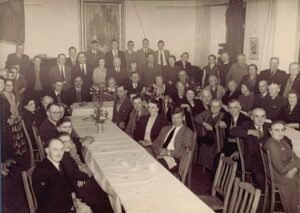
The Men’s Club dinner C1951[36]
Billy Makinson noted that the Club was restarted by the Reverend Ewbank. He seems to have been a very energetic community led vicar.
The September 1954 Parish newsletter reported that ‘The Men’s Club opened their season on Sept. 28th, with a Tatie Pie supper which was well attended. Mr. Jonty Wilson gave a most entertaining account of his ride along the Fosse Way. The Club is going to admit boys between 13 and 15 years old this year. The subscription for adults is reduced to 7/6, and that for boys is to be 3/6…’.
Jonty Wilson was a very well known resident of Kirkby Lonsdale, a blacksmith, he often broadcast with the BBC including a series about his 200 mile horse ride along the Fosse Way. He travelled with two companions and each night they broadcast about the day’s events.[37]

Jonty on the right, is pictured with Nancy Spain and John Peel on the first leg of their journey[38]
Casterton Football Club
‘The Football Club, which has been in existence for three years, has for two seasons been affiliated to the North Lancashire League. The Club attracts membership from a wide area. An enthusiastic group of juniors shows much promise for the future.’
The History of Casterton Football Club has been published in a previous Sketch – https://www.castertonparishcouncil.org.uk/sketch-of-casterton-football-club/ .
Village Choir
‘Another organisation which is well known beyond the bounds of the parish is the Village Choir. Under the training of Mr. Rich the choir performs at local concerts, and numbers among its ranks many fine soloists. The Cantatas performed in Church draw large congregations, and are much appreciated. Several Castertonians support the Barbon Operatic Society and at its recent production no less than four Casterton people sang in principal parts.’
In 1954, members of the village choir gave a wedding present to Joyce Elizabeth Briggs, twin daughter of the late Mr W. Briggs from Garden Cottage. Miss Briggs was a member of the choir.[39]
A few years later, the choir participated in the 1956 Remembrance Sunday service officiated by the Rev. Ewbank. The choir led the congregation from the church to the War Memorial.[40]
Queen’s Coronation
The village celebrated the Queen’s coronation in 1953. As illustrated below in photographs previously featured in the 2018 Casterton History exhibition, women of the village dressed up as Elizabethan ladies.
The following year, the Parish newsletter noted that ‘We are pleased to notice that the Coronation Oak Tree, planted last year by Mrs. R. Bowring, has struck root well and is flourishing, and we hope it is a good omen of a long and prosperous reign for our Queen. The Queen’s picture has been temporarily removed from the Church Room, to have the inscription put on it, as decided by the Coronation Committee.’


A Tragedy
The April 1954 Parish newsletter recorded that ‘Dr. Harold Rutledge, married seven years ago in our church, was among those killed in the Singapore air-crash.’
Dr. Rutledge had married local girl Audrey Elma Johnstone in December 1946. In April 1952 they travelled to Australia on the P&O ship Himalaya with their two year old son Phillip for Harold’s work as a Senior Lecturer at Sydney University. He was travelling back to the UK to visit his sick father when the B.O.A.C. Constellation plane burst into flames shortly after landing at Kallang Airport in Singapore. Thirty one passengers were killed including Harold aged only 33.[41]
Childhood Pursuits
Springtime
Stephanie Vickers paints a vivid picture of springtime in Casterton. She recalls a short spring day stroll through the stile opposite the Village Hall, turning left into the wood and encountering ‘a carpet of vivid blue covering the woodland floor opposite the beck. The authentic English bluebells never fail to take my breath away – I have always loved their simplicity and perfection… later, but no less stunning, we enjoyed the pungent smell of the wild garlic with its petite and delicate white flowers. Often, on these treks, I took my tiny fishing net and bucket and enjoyed a quiet time catching tiddlers in the beck. On completion of my expedition I set my catch free and picked some bluebells, carrying them home in my bucket- a rather limp and soggy gift for my mother!’
Summer Months
‘We would also spend time, in the summer months, in a field near Wharton’s farm (also found down said wood) having a picnic under the oak tree – playing French cricket or rounders – and devouring our sandwiches. We also picnicked and played by Barbon Beck and we had a swing attached to a tree on the left, at the entrance by the cattle grid.
We would often watch the steam train from Kirkby Lonsdale station as it disappeared under the bridge to continue winding its way north.’
Foraging in Autumn
Stephanie recalls accompanying Mr Harold Needham -local gamekeeper and gardener who lived at 3 Fern Croft – as he tended his hens just beyond the railway bridge after the Prep School- now looked after by Edward Begg. She remembers that ‘A field opposite this site was a much-coveted spot to find mushrooms and, on occasion, my father and I would go mushrooming early on a Sunday morning. A very tasty breakfast! Other times we would pick fruit from the hedgerows but, in my early days, most villagers grew their own vegetables and fruit bushes.
In later years most gardens reverted to pretty flowerbeds and shrubs. Mrs Waller, who lived in the house beyond the wall opposite the bus shelter, had quite an extensive orchard and we used to help her pick the apples (and eat a few!) etc on a yearly basis. We also had an old apple tree on the common (now called the village green) beside our garden and I could regularly be found up there, much to the despair of my mother.’
Guy Fawkes
‘Our annual bonfire night was held at Manor Farm. There was a roaring fire in the field adjoining the farmhouse with the BIGGEST Guy – or so it seemed to the youngster I was! There was great excitement amongst the children awaiting the explosions of fireworks. The menfolk tended the fire and the fireworks and there were sparklers for all. The women handed round Parkin cake and treacle toffee. There were-roasted potatoes at the base of the fire, tossing them between our fingers, they were so hot. All so simple, but oh so thrilling. The trek home in the blackest of darkness tired, smelling of woodsmoke but having experienced a wonderful village occasion.’
Summary
Casterton 70 years ago was so very different and yet familiar. It is clear that in the 1950s, it retained many of its traditions from before the war, the Vicar was an integral part of the community and the church a centre of village life. Casterton School was an important part of the village providing work for some villagers and bringing the sounds of children to the village. It merged with Sedbergh School in 2013 and is now Casterton, Sedbergh Prep School educating pupils up to Year 8 who can be heard enjoying their breaks on the main site and playing many sports on the pitches adjoining the pavilion.
The Village Hall was more extensively used than it is today, by the Village School, the Men’s Club and other village institutions including the Casterton Women’s Institute which still meets there today as it did back then.
Many of the farms, including where I am sat writing this, are now converted into houses but would still be recognisable to the old hands who sat on that bench in the photo above. They too would be able to walk the same lanes, pray in the same church and have a drink at the same pub.
We are privileged today to have running mains water unlike our predecessors in the 1950s. Sadly today we cannot cast our gaze on the steam train as it passes through the village, a daily occurrence in the 1950s, but we can still walk under the railway bridges. So too can we still forage for berries and mushrooms in the autumn, admire the bluebells in the spring and, a few weeks later smell the heady scent of garlic in Casterton Woods. A walk along the night time lanes still requires a torch but we are more likely to meet a private car rather than Mr Hird’s taxi cab.
We are still surrounded by sheep, hedgerows laid out before and during the Enclosure awards and, as for the residents in the 1950s derive a great affection and feeling of privilege that we can share the same space that they shared.
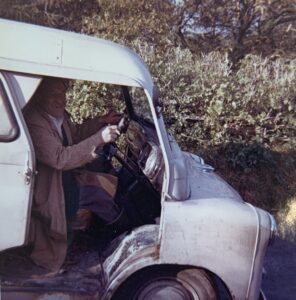
Anthony Hird photographed in the 1960s just prior to his retirement as village farmer, milkman and taxi driver[42]
Simon Drakeford with special thanks to
Jean Shearsmith and Stephanie Vickers for their memories
September 2023
References
[1] Cumbria County Archives (Kendal), WDX 139/29 [Scrapbook]
[2] Cumbria County Archives (Kendal), WDX 139/29 [Essay]
[3] Jane M. Ewbank, The Life and Works of William Carus Wilson (1791 – 1859), Titus Wilson & Son, 1959, Foreword
[4] Source: https://www.churchtimes.co.uk/articles/2014/9-may/gazette/obituaries/obituary-the-ven-walter-frederick-ewbank . Accessed 10 October 2022
[5] Cumbria County Archives (Kendal), WDX 139/29
[6] Image courtesy of Jean Hamlett, from a postcard sold at the Casterton Hotel to guests titled ‘Casterton Village From The Hotel’.
[7] This is not correct, Whernside has a height of 736 metres, making it the 9th highest peak in the Pennines – see https://www.ukhillwalking.com/logbook/set.php?sort=m&id=1898 .
[8] See https://www.castertonparishcouncil.org.uk/a-sketch-of-blamires-grocery-store-and-post-office-later-known-as-pear-tree-cottage/
[9] Cumbria Archive Centre (Kendal), WPC 40 – Parish Minutes, 1 April 1937
[10] The term appears in Billy Makinson’s reminiscences page 8 which can be found here https://www.castertonparishcouncil.org.uk/wp-content/uploads/2021/10/Billy_Makinson_reminiscences.pdf
[11] Stephanie Vickers’s memories were shared with Jean Hamlett and Enid Hastings and are used with permission
[12] Personal reminiscences and notes by Jean Shearsmith shared with Jean Hamlett and the author 2023
[13] Transcribed from original copies in Mrs Benson’s collection by Jean Hamlett
[14] This would be about £20,000 in 2023.
[15] See https://www.castertonchurch.org/ .
[16] Stephanie Vickers
[17] Courtesy of Stephanie Vickers
[18] For context, the 2023-24 precept is £83.76.
[19] The letters written by Henry Fitzwilliam are discussed in this Sketch https://www.castertonparishcouncil.org.uk/a-sketch-of-an-1846-visit-to-casterton/
[20] 29 December 1950, Lancaster Guardian, p2
[21] Photo and names courtesy of Jean Shearsmith
[22] Jean Shearsmith memories
[23] Cumbria County Archives (Kendal), WDX 139/29 [Scrapbook]
[24] Courtesy of the Casterton Women’s Institute taken from their 1965 Casterton Today scrapbook
[25] Stephanie Vickers
[26] Lancaster Guardian, 19 October 1956, p4
[27] Courtesy of the author.
[28]Census Office, Population: Comparative Account of the Population of Great Britain in the years 1801, 1811, 1821, and 1831, House of Commons. p276. Note that these censuses did not provide as much detail as those from 1841 onwards.
[29] Taken from Illustrated London News, 13 February 1954, p18
[30] Taken from, Robert Western, The Ingleton Branch A Lost Route to Scotland, The Oakwood Press, 2018, pp80-86
[31] Casterton’s Women’s Institute The First 50 Years – 1919 to 1969, Claire Wildsmith, privately printed
[32] See https://www.castertonparishcouncil.org.uk/casterton-wi/
[33] Lancaster Standard and County Advertiser, 9 April 1897, p7
[34] Lancaster Guardian, 29 December 1950, p6
[35] Lancaster Guardian, 20 May 1955, p10
[36] Courtesy of Stephanie Vickers
[37] An account of the journey can be found in T. Wilson Goad, My Valley: The life and times of Jonty Wilson Kirkby Lonsdale blacksmith, 1993, pp73-74
[38] Photograph taken from, Jonty Wilson, A Cumbrian Blacksmith, Dalesman Books, 1978, p 46
[39] Lancaster Guardian, 10 September 1954, p12
[40] Lancaster Guardian, 16 November 1956, p4
[41] Lancaster Guardian, 26 March 1955, p11
[42]Courtesy of the Casterton Women’s Institute taken from their 1965 Casterton Today scrapbook