

A Sketch of an 1846 Visit to Casterton
Introducing Mr Fitzwilliam
In May 1846, more than 175 years ago, Henry Fitzwilliam travelled from Leeds to Casterton, the place of his birth. He was an old man on a nostalgic trip, recording his visit in letters to a cousin in Leeds. Four of his letters were published in the Westmorland Gazette. Henry does not name his cousin, referring to her as ‘Miss F. C———-h’, from Fulneck near Leeds. Fulneck being a small village to the west of Leeds, south of Pudsey.
I cannot find a Henry Fitzwilliam in the published transcripts of the Kirkby Lonsdale parish records,[1] or indeed any Fitzwilliams.[2] It seems likely that Fitzwilliam was using a pseudonym. ‘Fitz’ meaning son of, possibly he was Henry son of William. What is not in doubt is that Henry certainly had a good knowledge of old Casterton and a keen eye for details of both the past and the present. Henry also appears well read, he clearly had access to what was at the time modern literature. His prose certainly suggests that he was a well educated person. His language was very much of its time and to modern eyes might appear rather ‘affected’, but to readers of nineteenth century literature it is not so unusual.
The fact that during his visit, he is staying at the George & Dragon would imply that there are no members of his family still living at Casterton or its vicinity. This is supported by the fact in his letters to his cousin he does not mention seeing family, or even old friends, during his stay. Surely something he would have commented on had he done so.
Piecing together the scant evidence, it seems that Henry was born in Casterton, to a family that was able to afford to educate him. He and his family left Casterton when he was relatively young, but old enough to have formed a deep affection for the village of his birth and to remember detailed facts about the place of his birth.
As I can’t identify Henry in any records, for the sake of this Sketch, I shall assume that he is about 60 years of age, i.e. born in 1786. With the exception of the long poem in the third letter, this sketch will include his letters in full, and coloured blue. I will however divide them into different sections for ease of reading and to introduce my written and pictorial annotations and explanations about Henry’s narrative.
Word of Explanation
The similar names of the Carus Wilson family can lead to confusion as to who is being referred to. For the sake of clarity, only two Carus Wilsons are referred to in this Sketch. The man who first took Wilson as his surname was born William Wilson Carus in 1764. In 1793 he was obliged to use Wilson as his surname in order to inherit the original Casterton Hall (Also known as Old Hall – see my Sketch about Old Hall for more details). His name therefore was William Wilson Carus Wilson when he died in 1851. His son was named William Carus Wilson. He was born in in 1791 and died in 1859. It was he who became the Reverend and was responsible for founding the Clergy Daughters’ School, the Church and the Servants School all in Casterton.
The First Letter[3]
A Return
The letter starts ‘My dear Cousin – I arrived at this place from Leeds last evening, after a pleasant journey on a delightful day. How my heart swells as I drew near the place of my nativity, you, who have so often heard me describe it, may well imagine. My minds eye retained each beauty like a treasured gem.
Every point of vantage had been indelibly fixed, in spite of change and distance, and lapse of years. And now, when I have again cast my eager gaze over each well remembered upland and dell, and feasted my sight with the dream beard flowing of beautiful Lune the feelings of childhood pervade every sense, and I am happy – oh! How intensely happy.
But time has been busy here as elsewhere. Many “old, familiar faces” have disappeared- some, forever- others, to live again in the features of child and grandchild.’
Here Henry sees in the faces of the people he meets in the lanes of Casterton shadows of faces that he knew as a boy perhaps their children or grandchildren. This would make Henry at least 50 years of age, more likely 60 years old, perhaps older.
First Observations
He continues, ‘Changes are obvious in the scenery and in many places they have sprung up decided improvements. For instance, the inn, under whose roof I am now sojourning, is the “George and Dragon”, for so many years kept by old Bella Metcalfe. But it is no longer Bella’s “George and Dragon”. True, the old Sycamore yet flourishes at the front door, flinging it’s grateful shade upon the threshold, and inciting to drowsyhood, with the ceaseless humming of the insect inhabitants; but the house has been altered, and in many places rebuilt. Instead of the low, dingy kitchen, with its Hearthstone fire, we have an airy light apartment, furnished with a modern fire range. Sanded parlours have given place to carpeted drawing rooms; and instead of the ancient lady in her old arm chair by the hearth, issuing her orders to the “lass” in a voice like a hurricane, we are waited on by a polite, chatty, tidy hostess, whose attentions are divided between her guests and her beautiful children.
Truly, this same inn is a right pleasant place, and the attractions of the neighbourhood render it excellent headquarters.’
The Metcalf Family
This sentimental section reveals so much. The George and Dragon is the original name of what is now the Pheasant. The old sycamore at the entrance of the inn to which Henry refers could still be seen in a photograph some sixty years later.
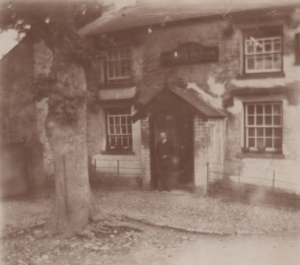
Circa 1904, landlord Frederick Hutton stands in front of the George and Dragon under the sycamore tree
There is mention of ‘old Bella Metcalfe’ who Henry recalls kept the pub for ‘so many years’. Bella is also referred to as ‘an ancient lady in her old arm chair by the hearth, issuing her orders to the “lass” in a voice like a hurricane.’
A search of the Kirkby Lonsdale Parish registers reveals Bella and tells us that George was her husband. The birth and deaths of George and Bella Metcalf’s children are recorded in the registers, in all instances the record shows that they are living at Casterton. The earliest child identified is Alice, who was born 8 February 1790. Children follow at regular intervals, Margaret in 1791,[4] John in 1794, Bella in 1795 and William in 1797. In 1799, Bella gave birth to twins – Elizabeth and Frances- who sadly died the following day. In 1801, a second daughter was named Frances, but she died aged three. There was a Mary born in 1802 and finally another daughter, Ann, in 1805. In two instances, the records add additional information, in 1801, George’s occupation is listed as a ‘carrier’ but in 1805, he is an ‘innkeeper in Casterton’, as there was only one inn at this time it must have been the George & Dragon.
Further Records
In 1798, a new land tax was introduced and records compiled to collect the tax. Unfortunately, the records do not specifically identify the property showing only the owner, the tenant, the assessed tax and the date of the rental contract. George Metcalf appears three times in the list confirming that he was living in Casterton at the turn of the century. One property was owned by John Taylors heirs, another, owned by William Wilson Carus Wilson, was shared with David Crayton. The third one, also belonging to the Reverend’s father, had multiple occupiers suggesting perhaps a community building or land.
An 1829 Trade Directory, shows that George Metcalf was still at the inn, he was listed as victualler of the George and Dragon. A newspaper reports that George, an innkeeper, died at Casterton in December 1831 aged 73. He was therefore born about 1758.[5]
In the 1841 Census, there was a 78 year old Isabella Metcalf –of independent means- still living in Low Casterton, but not at the George and Dragon.[6] She was therefore born about 1763. The Census shows that she was not born in Westmorland. There is no record of George being born in Kirkby Lonsdale, perhaps he too was not local.
Hypothesis One
There was a George Metcalf who married Isabella Thackstone in Hawes in Yorkshire in late March 1788. This was less than two years before Alice was born, perhaps they are our couple, moving the 23 miles from Hawes shortly after they were married. But then again – perhaps not!
Isabella died in Caton on 11 February 1844 aged 81 years of ‘natural decay’. Her profession was recorded as ‘Widow of George Metcalf – innkeeper.’ Isabella therefore took on running the pub when her husband died. This is confirmed from a newspaper cutting from November 1837, giving notice of a meeting ‘at the House ISABELLA METCALFE, in Casterton’.[7] The meeting was for the local large landowners or their agents ‘for the purpose of making an AGREEMENT for the COMMUTATION of GREAT TITHES’ in Casterton.
Hypothesis Two
I am curious about Henry’s statement remembering Bella as an ‘ancient lady’. She was born in 1763, and took over running the pub in 1829 aged about 66. Why did Henry not recall George as the landlord? Assuming Henry was born in 1786, Bella was only 23 years older than Henry. Would she have really appeared ancient to Henry? Perhaps, he was recalling another Bella, the mother of George? It is not inconceivable that George took over the inn from his mother soon after 1801, when he was noted as being a carrier in the parish register and before 1805 when he was recorded as innkeeper. Henry’s memory of Bella as an ancient lady therefore could have been George’s mother before she died, when Henry was in his late teens and before he left the village of his birth.
The New Landlords
Henry notes that when he visited the pub in 1846 he was ‘waited on by a polite, chatty, tidy hostess, whose attentions are divided between her guests and her beautiful children’. This would have been Jane Nelson who was living at the pub in 1841 aged 20, with her husband Richard who had been born around 1812 in Kirkby Lonsdale. At this time they had one child, also named Richard. They were still at the pub in 1851 listed in the Census as innkeeper and farmer, by then with six children, Richard (10), Anne (8), William (5), Frederick (4), Henry (3) and John (1). The beautiful children that Henry referred to were therefore Richard, Anne and William.
Casterton Church
Henry then moves onto to rhapsodise about the relatively new church. ‘The first point to which the stranger is inevitably drawn in is the Chapel. It is built on a rocky-eminence by the road side, yet not so lofty as to debar the passing traveller from viewing the beauties of the place. The building is of the modern ecclesiastical style, and stands in an area, or grave-yard, which at first view looks like a miniature “Pere la Chaise”[8], so abundant are the floral and horticultural ornaments scattered around. The grave’s loathsomeness is hidden by blooming flowers. Each narrow house, from the tiny bed, no longer than a tea-tray, to the full-sized “lap of earth”, is a perfect bouquet of loveliness. The turf, where not broken by the spade, is as fine as an eastern carpet, and being of an undulating nature, and kept remarkably trim, presents a beautiful surface. The walls of the chapel are nearly concealed by Ivy and jessamine[9], mingled with a variety of other creeping plants.’

Print of the newly built Casterton Church and Clergy Daughters’ School C 1836 note that the Ivy has not yet grown[10]
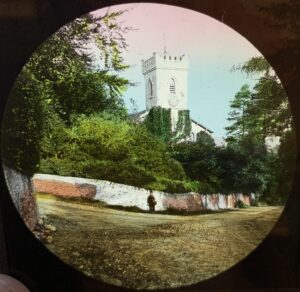
This photograph of the Church taken about 40 years after Henry visited. It shows the ivy clinging to the tower.[11]
The growth of the ivy was not a sign of inadequate maintenance. Based on his experiences of building the church, the parsonage and the school, William Carus Wilson published a book in 1842 explaining how to build such properties as cheaply as possible, or in his words ‘at a moderate expense’. He wrote that the church walls ‘might very soon be covered with Irish Ivy, which has always a pretty effect upon a church; and so far from being injurious, has been clearly proved to be beneficial: the large leaves acting like slate to throw off the rain; and the tendrils sucking out the damp from the wall.’[12]
Directing his attention to the inside of the church, Henry writes, ‘the interior, though plain, is pleasing; and there is, somehow, an air of sanctity about the whole not often felt in similar places. It is comparatively a new structure, having been erected in the year 1834[13], and endowed by William Wilson Carus Wilson, Esq., of Casterton Hall.[14] The quiet beauty of the burial-ground reminds me of Dickens’s lines-
“And when I die, oh, let me lie
Where trees above me wave,
Let wild-flowers bloom around my tomb-
My quiet country grave!”’
Anti Popery
Henry noted that the church was plain. Had Henry met him, the Reverend would have been pleased that this trait was noted. The Reverend inherited from his father a deep evangelical faith with a Calvinist flavour. His father had been influenced by, and was one of the first followers of a noted evangelist called Charles Simeon. The Reverend’s biographer Jane Ewbank observed that the Reverend’s early writings reverberated ‘with his evangelical hatred of popery, with horror of sin and with fearful warnings of hell-fire.’[15]
There was indeed a deep loathing of Catholics. During the Irish Potato Famine (1845 – 1852), Carus Wilson gloried in the opportunity it presented to convert the Irish from Popery to Protestantism. In January 1847 he wrote a letter from Casterton Hall to the Editor of the Lancaster Gazette. ‘It is cheering too, to hear from all quarters, that out of the mass of unparalleled distress on suffering, there is a rising and increased confidence in Protestant guides, under increased conviction of the fallacies of Popery. The poor famishing creatures now see who are their best friends, who it is that count not their lives dear to them, if they can’t but minister to their necessities and save them from starvation.’[16]
A few months later, a letter he wrote to the Editor of The Warder was republished in the Lancaster Gazette, again written from Casterton Hall. He wrote, ‘Truly Ireland is in great misery, but the Lord often brings good out of evil, and he has now made her open to the gospel (which he has commanded to be read and obeyed by everyone), for the faith of the poor is shaking in the [Catholic] priests who promised they would ward off the potato rot; and the Protestant clergy are now loved and listened to, as being their real friends.’[17]
The Reverend therefore had an intense dislike of the Catholic Church. He saw the decoration common in catholic churches as ostentatious and unnecessary for the worship of The Lord. His own church had no stained glass, no statues, no chancel, and no art. There was a single bell in the belfry and a simple pulpit, while this ensured an economic build, it also suited his Calvinist evangelical leanings.
Charles Dickens
The quotation above about the ‘quiet country grave’ is from very early Charles Dickens (1812 – 1870). By 1846, Dickens had become a household name, already having published The Pickwick Papers, Oliver Twist, Nicholas Nickleby, The Old Curiosity Shop, Barnaby Rudge and Martin Chuzzlewit. The Dickens’ quote however pre-dates all of these. It comes from a comic opera titled The Village Coquettes, with words by Dickens and music by John Hullah. The play was premiered on 6 December 1836 in St. James Theatre, London for nineteen nights before transferring to Edinburgh.[18] Dickens soon disowned this early work. A year before Dickens died he was asked by Frederick Locker-Lampson -a well known English bibliophile and poet- whether he possessed a copy of The Village Coquettes, Dickens’ reply was, ‘No; and if I knew it was in my house, and if I could not get rid of it in any other way, I would burn the wing of the house where it was!’[19]
The Clergy Daughters’ School
Moving from the Church to the School, Henry made the following observations, ‘Adjoining the chapel-yard, but situated in spacious pleasure-grounds, stands the Clergy Daughters’ School. The house itself has something of a workhouse appearance, notwithstanding its verandahs and venetians; but its situation is beautiful, healthy, and admirably adapted for the purpose to which it is devoted. I did not seek to pry into the interior, as I understand that no male visitors are admitted, unless they are friends of the Rev. Carus Wilson, or relatives of the inmates. Indeed I believe the seclusion in which they are kept is a nearly monastical as English exclusivism can make it. The ladies -would not “sisters” be a better name?- dress in a peculiar uniform, namely, nankeen frocks, and straw bonnets with one piece of plain purple ribbon over them, in summer; and in winter, a purple dress and tartan cloak. For my own part, I dislike “charities” which parade their recipients in a peculiar garb. It always reminds one of “The pride that apes humility.”’[20]
Henry’s words here suggest a degree of disapproval. His comment that the school had the appearance of a workhouse was not far from the mark, at this time it still had only two floors. He also suggested that the ‘inmates’, the subject of charity, were more like nuns in a convent and that the stylised uniform was more for the pride of the founder rather than the humility of the pupils.
The first history of the school published in 1935 records in detail the uniform that the pupils were obliged to wear. They included the items that Henry observed as well as the addition of a nankeen[21] tippet or cape, white cotton stockings and strong shoes.[22]
Henry concludes his first letter in a more conciliatory manner, ‘Attached, is a preparatory school; below, at the entrance into the woods is the Orphan’s School.[23] All these institutions are of very late standing; and their establishment confers great benefit, and is a lasting honour to their founder. There are also two village schools for the native children; and, altogether, the desire to educate those among the young whose parents are too poor to afford it seems to have found a congenial climate in Casterton and flourish amazingly under the fostering care of the Wilson’s.
The Parsonage House stands contiguous to the chapel, in a lonely situation. Indeed, the sites of all the buildings have been chosen with a due regard to propriety and taste; and a village more beautiful in detail for its size is not often seen even in beautiful England.
There are many things and places to describe about Casterton which I must put off to another opportunity. In fact, my dear Cousin, I will correspond with you weekly, and jot down all worth notice in my excursions, that, as I cannot have the pleasure of your society, you may have the gratification of accompanying me in spirit, and walking with me in unseen communion through the most beautiful and romantic valley in England.
yours very truly
H.F.‘
The Servants School
Henry’s reference to the ‘Orphan’s School’ is the Servant’s School which had been first established in 1820 in Tunstall to train poor girls for domestic service. It moved to Casterton in 1837. It was later known as Lowood or Low Wood.
By the 1890’s the school was being advertised as ‘a good Boarding School for the Middle classes, where a sound Education, good religious, moral, and physical training are given at a moderate cost.’[24] Due to low numbers in both schools, it was amalgamated with the Clergy Daughters’ School in 1921. After the war, it became the Junior School of the Clergy Daughters’ School and was renamed Bronte House.
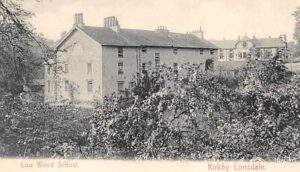
Low Wood School C 1904
The Second Letter[25]
A Country Walk
A few weeks later, a second letter was published in the Westmorland Gazette. Most of the letter waltzes lyrical over the circular walk Henry took from the George and Dragon (1) where he was staying. The start of the walk can be traced today, while later sections are now ‘out of bounds’, but in his day, were free to roam. I have marked an extract of the 1862 OS Map with numbers in red, my best estimation of the location of the points of interest, which correspond with the numbers I have placed within the text of Henry’s letter.

Extract from the 1862 OS Map
‘My dear Cousin,- I commence this letter with difficulty, scarcely knowing where to begin. Suppose, however, we take a stroll through the woods- and a more beautiful stroll can hardly be conceived.
Passing by the Village (2)[26] and Orphan’s Schools (3) we proceed along a road by a brook side, thickly overhung with trees; flanked on the left, by a long rocky bank, covered with numberless creeping plants, and ferns. Wild flowers bloom in abundance; and, at this time of the year, when the blossom is on the fruit trees, both sight and smell are regaled with beauty and fragrance. Presently we reach a point where the three roads converge, (4) namely, the one which we have approached,- one leading to the right towards some lime-kilns, (5) – and another to the left, which leads to the [Casterton] Hall, (6) and other places hereafter to be described. We pass over the little bridge to the right hand, (7) and turn down to the left, and pursue a romantic path which brings us to the bath-house. (8) This scene always reminds me of the melancholy Jacques in “as you like it”, when he apostrophizes the wounded deer, which came to drink at the stream “which brawls along yon wood”. It is true that there are no deer; but there are the stream and the “gnarled roots” of huge trees; and this is just such a spot as one might suppose Shakespeare to have had in his mind’s eye when he wrote his beautiful scene.
On passing the bath-house, we find ourselves in a pleasant little dell, over which is thrown a rustic bridge, (9) beside a small cascade.’
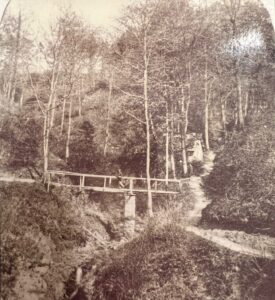
Photographed 16 years after Henry visited and looking upstream, the footpath and the Bridge are clear to see. Just behind the bridge to the left is the bath house. In front of the bridge -if there were sufficient water- would be the cascade.[27]
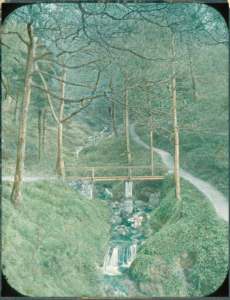
This photograph from C 1900 shows that the bath house is no longer there, but you can see the cascade.[28]
‘Leaving this bridge and continuing on the path by which we have hitherto proceded, we thread the winding of the gravelled foot-way, and are delighted with the luxuriant beauty of everything around. At length we arrive at “the hermitage”- small open hut built of bark laths, and thatched with ling.
It stands up on the shoulder of an eminence at a considerable elevation above the river, (10) of which we have a beautiful view; and it also commands a picturesque waterfall in the bottom of the dell, which here terminates, and lends its streamlet to swell the waters of the Lune.’
Bark laths are strips of wood which in this case were used to build a primitive wall. ‘Ling’ is an old name for heather. I think that this location was also called the Moss House as depicted in a print from 10 years before Henry’s visit. The description in his letter of the location corresponds with the image in the print.

This 1836 print shows a view over the Lune far below[29]
To The River
Henry continues, ‘Now gradually opens upon us a scene unequalled in England for characteristic loveliness. Descend from the hermitage into the dell, and, crossing the wooden bridge at the bottom (11) ascend the opposite bank, and a couple of hundred paces brings us to another hut, (12) so situated as to embrace a very extensive landscape. We stand upon the summit of a precipice formed of red conglomerate rocks. (13) Beneath, at a depth of at least one hundred and twenty feet, flows the river under a rocky bank, fringed with trees. Immediately under foot is deep ravine, the area of which is filled with huge boulders and fragments fallen from the surrounding precipices,- except one spot in the centre, which rises like an oasis in the desert- being a kind of holme or island thickly overgrown with forest trees and underwood. This is the “Trowel Air” or area, (14) and takes its name from the adjacent pool in the river, just at the turn to the right, yeleped [Sic] “Trowel Hole.” I believe this is the deepest part of the Lune, being, as I’m given to understand, upwards of sixty feet deep. The extreme right of the picture takes in a beautiful reach of the river emerging from the shade of the woods which surrounds Underley Hall, the seat of Alderman Thompson M.P.; and the background is formed of distant hills and wooded height. The middle distance embraces Underley Hall (15) and its noble park, while far away into the horizon, faintly looms the summits of some of the Lake mountains.’
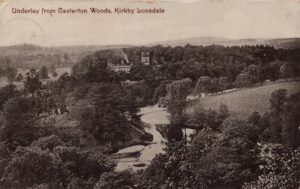
An approximation of the view described by Henry from C 1910.[30]
‘To the left, with the river still for a foreground, and at a distance of about a mile, stands Kirkby Lonsdale; whose church tower is just seen above the magnificent trees which surround its graveyard. Beyond this again are the heights, thickly clad with trees which form the Biggins demesne. These are the chief features of the scene, but how faint are words to describe its tout ensemble. See it as I have often done, by the softening light of a summer’s sunset, when the sound of the distant bells comes wooingly on the ear, blended with the murmuring of the river, and you will say with me that earth can produce nothing lovelier.
From the Hut just mentioned, we can extend our walk to the end of the woods, and ascend by a winding path into the area below. Each step of the way presents some new beauty to the eye, which is never wearied by gazing on the varying scene. We know pass over the Trowel Air, after sauntering about its romantic glades for awhile; and, taking the lower path under the cliffs, at length emerge at the other extremity of the wood, near to Kirkfit hall, (16) a farmhouse in the olden style, and placed in a charming vicinage.
Here a fancy garden, hermitage, cascade, and fountain, all very beautiful, and laid out with considerable taste. It is a sweet secluded place, where a poet might retire for a while from the outward, every-day world, and indulge in dreams of faery and romance. Casterton Hall (6) is just on the adjacent hill, but I did not intrude upon its precincts.
From hence we can return to the inn through the woods, or extend our walk along the river side to Kirkby Lonsdale Bridge.’
Henry resumes his narrative, recording the events from another day. ‘One Sunday I attended service at the Chapel, but was disappointed at not hearing the celebrated [Reverend] Carus Wilson, who I understand, was very unwell. But the service was beautiful and impressive; and the music beyond anything one hears out of a Moravian chapel. The full rich flow of female voices, and the pealing of a mellow-toned organ, played in a devotional and dignified style, cannot fail to make a deep impression; and I think I shall never forget the sensations I experienced, as long as I live.’
The Reverend was indeed unwell. His biographer noted that in the spring of 1845 he was summoned to the bedside of one of his daughters where she lay ill. He devotedly and continuously watched over her for five or six weeks, rarely resting. This on top of his incredible, self imposed work load led to an attack of sciatica, causing him many years of suffering.[31] His family observed that after 1845, ‘he never seemed to feel the elastic vigour as before.’[32]
A Melancholic Moment
Moving from the church to its grounds, Henry commented that ‘I was now more than ever struck with the spirit of the place, when, in the course of my perambulations round at the chapel yard after service, I stumbled on a little grave at the north side, furnished with a small headstone, on which was inscribed “Rose Drew,”, with the age of the youthful occupant. A single white rose bloomed over the mould the meetist memento of one so fair and frail.
Oh! the graves of childhood: The tears suffuse my eyes when I gaze upon them- but not of sorrow, for of them are the angels that stand before the face of the Eternal. Adieu.
Ever yours
My dear Cousin
H.F.-‘
The grave over which Henry stood and pondered the inevitability of death is still there. The gravestone reads,
ROSE DREW
died May 21 1835
aged 13
Life is uncertain, death is sure
Sin is the wound, and Christ the cure.
The evangelical epitaph on her grave could have been chosen by the Reverend but was presumably chosen by Miss Drew’s guardian.
Rose Drew
Rose had first enrolled at the school when it was at Cowan Bridge on 13 August 1830.[33] She was the 189th girl in the register and one of the 90 girls who made the move to Casterton. Her parent, or presumably guardian, was listed as Mrs Smith from 5 Downing Terrace in Cambridge. However the person responsible for the fees was listed as a Mrs Lane who paid the twice yearly £7 fee for boarding and education. In the first weeks Rose was at the school, Mrs Lane also paid for a trip to the Reverend’s abode at Silverdale, a regular treat for girls who were resident during school holidays. It seems that Rose regularly stayed at school during vacations. Payments of £1 and 1 shilling were made in 1831, 1832 and 1833 for ‘Midsummers Vacation’.
In February 1835, the biannual charge and payment of £7 was entered into the accounts, but the full half year’s payment was not required. The credit for the remaining time at school after her death was transferred to defray funeral expenses. The final entry in the school register read, ‘Died in the Clergy School of Consumption May 21st 1835.’[34]
From Cowan Bridge to Casterton
The main reason for the move to Casterton was the illness and sadly, the deaths of students at Cowan Bridge. It was noted that ‘many, sadly too many, had left School in ill-health or died of decline, or of typhus fever or its after effects.’[35] Four girls who had left Cowan Bridge before the move to Casterton were the Bronte sisters who were numbers 17 (Maria), 18 (Elizabeth), 30 (Charlotte) and 44 (Emily) in the school register. The register had recorded its first girl on 30 January 1824, and the Bronte’s arrived later that year.[36]
The sisters had all departed the school by the summer of the following year, Maria succumbed to the ‘low fever’, thought to be a kind of influenza, leaving school on 14 February and dying on 6 May. Elizabeth was sent home on 31 May, dying two weeks later. Charlotte and Emily stayed, probably until the end of the summer term, but did not return.
Before the move to Casterton, 244 girls had been registered at Cowan Bridge, and 90 were still there when the relocation to Casterton took place, the pupils moving on 23 September 1833.
A Second Burial
Also on the gravestone are the details of another student, Emily, born five years after Rose’s death, she shared Rose’s grave.
Also of
EMILY RICHARDSON
Who died October 25, 1859
Aged 19 Years
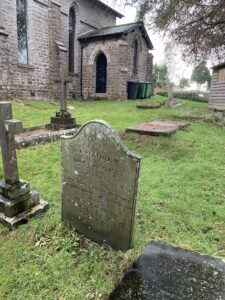
Rose and Emily’s gravestone as it looks today, situated at the rear of the church, alongside the graves of other students
The Third Letter[37]
Kirkby Lonsdale Bridge
Henry’s third letter focuses on Kirkby Lonsdale Bridge, which we know better as Devil’s Bridge.
‘My dear Cousin,- in order to reach the town of Kirkby Lonsdale from Casterton, it is necessary to cross Kirkby Lonsdale bridge over the Lune. This structure has been the admiration of all travellers, and is indeed the pride of the neighbourhood. No one, I am sure not even the most callous-minded, can stand on its centre and gaze at the views up and down the river without an instinctive sense of the beautiful pervading every feeling. Dr. Whittaker, in his “History of Richmondshire”, remarks that “it is a noble specimen of masonry and architecture, of which I regret that its antiquity is unknown. Its appearance is very fine; As the best possible situation was chosen, where a chain of projecting rocks thrown across the Lune afforded a groundwork as durable as the earth itself, for the piers of the arches. On the eastern side, according to a tradition mentioned in the register of the Parish Church, was a chapel intended, undoubtedly, for the celebration of early mass for travellers, and dedicated to St. Coom, or St. Columba.”[38] The bridge is built of a hard gritty stone, and it’s three arches, two large and one small, curiously ribbed. The height of the coping from the water is forty-one feet; and from this height, a few years ago, a drover named Joseph Donald precipitated himself into the river and was drowned.’
Over the Edge
Henry’s facts about Joseph Donald were not quite correct, he was indeed a drover, but that underplayed his business dealings. He was a well known cattle dealer, one of the largest in the county. The events happened in February 1841 and ‘excited considerable intertest in the neighbourhood.’[39]. Joseph was visiting Kirkby Lonsdale from Hayton, Cumberland. He was arrested for forgery with respect to some bills of exchange. The Magistrates said that rather than be held in the local ‘lock-up’, he could be kept in a local public house. He was detained overnight in the Green Dragon (now the Snooty Fox), watched over by James Coulson who made nails for his living. During the night, Joseph professed his innocence and appeared sound of mind. In the morning, Nelson proposed to Coulson that they should take breakfast at Up Hall [Whoop Hall] and that he would pay for it. Coulson readily agreed and they set off to walk the mile or so to the Hall. Coulson takes up the story, ‘When we had preceded nearly to the middle of the bridge, without any previous information, he threw his left leg over the bridge, and raised himself upon it, and then inquired if it was deep, looking into the water. I said “Oh, dear, you’re not going to throw yourself over!” To which he replied “Good morning.” and cast himself into the river.’[40] Coulson ran to the riverside to try to rescue his charge, calling out for help. He observed Nelson swimming, apparently strongly, under the bridge, continuing down stream. About 150 yards further along he appeared to weaken and his head went under the water, he raised his head several times but after another 50 yards he disappeared from view. His body was pulled from the water by a gentleman named Thomas Garnett and it was taken to the local work house.
Myths and Legends
Henry then turns his attention to the legend of Kirkby Lonsdale Bridge, ‘As Dr. Whittaker mentions, the antiquity of the structure is so great, that, as yet, no traces have been discovered either of its founder or the time when it was founded, though in Burn and Nicholson’s “History of Westmorland and Cumberland” mention is made of a rate of pontage being granted for repairs in the third year of the reign of Edward 1.[41] Tradition, however who is always ready to lend a helping hand to the puzzled antiquary, assigns its origin to evil agency, and the following legend may throw some light upon the matter.’
The legend to which he refers is a very long poem concerning a myth about how the bridge was built. It concerns an ‘ancient wight’ who on his journey,
‘in search of rest within some kind of abode,
Sith he all day had travelled by the Lonne, [Lune]
Ev’n from its first small spring, to lovely Casterton.’
Using a book of spells and an ebony wand, the wight invoked the spirits who responded to his command to build a bridge. The mountain spirits ‘hewed and shaped the stone… from the brown, rugged fell, hight Casterton.’ Carrying them to the site of the bridge in an apron. The spirits laboured all night until at dawn, the bridge was built. The poem and the letter concludes with,
‘Thousands since then have pass’d the lovely spot
But never knew its founder till this hour!
His was a name that ne’er can be forgot.
The Wizard of the North: the wond’rous Michael Scott:’
Michael Scott was a real person, a wandering Scottish mathematician and scholar from the middle ages. He had a reputation as a magician and was mentioned in Dante’s Divine Comedy, featured in the Eighth Circle of Hell amongst other sorcerers and false prophets, enduring horrific tortures.[42]
The poem was first published in Bentleys Miscellany in 1843.[43] It was written, or more likely recalled by a Henry H. Davis in an article called Legends of the Lune. Davis recalls that in his youth his grandparents told him many legends from the Lune Valley. He also had a friend who ‘used to horrify me with the narrations of ghosts and dobbies, till I dared not pass a lonely bridge or solitary barn;’
The Fourth Letter[44]
Kirkby Lonsdale and its Peculiarities
In the last published letter, Henry focuses primarily on Kirkby Lonsdale. He expresses some interesting thoughts about the town’s folk and also makes observations about events that the villagers of Casterton would no doubt have attended.
Thoughts on Kirkby’s Architecture
‘My dear Cousin- from the old bridge there is an excellent gravel-walk to the town of Kirkby Lonsdale and by the way one pause to admire the pretty villa of Lunefield, the residence of Mrs. Carus, which is charmingly situated on a rising ground clad with shrubberies, the path I speak of leads into the market-place which is rather too spacious, I should think, for the size of the town, which contains from twelve to thirteen hundred inhabitants. There are some good houses in the place; but the streets present a curious appearance, from their want of uniformity. The houses are in such a position that one would imagine the builders knew nothing of straight lines. Some stand boldly out, others shrink modestly back. Here one shoves its ugly gables halfway over the pavement, as if determined to assert its prerogative to notice; and the next door neighbour is bashfully hanging back, as though it were ashamed to be seen in such genteel society. Their outward appearance, too, is variable as the world of fashion. Every sort of window, from the plate-glass shop, to the leaden casement, is there; and this, added to the difference in the number of stories, gives the streets a kind of higgledy-piggledy look that is very amusing. On the whole, it is a very clean little spot, notwithstanding its being so ill planned.’
Note that the pretty villa that Henry saw was an earlier version of Lunefield built for Roger Carus in 1815. Roger was the brother of William Wilson Carus, the Reverend’s father. When this was demolished, a new Lunefield was built some 50 yards to the north in 1869 – 70. It was demolished, in 1959.

The original Lunefield House[45]
Slow to Change
Henry seemed to have a dim view of some of Kirkby Lonsdale’s citizens. ‘The spirit of change seldom visits Kirkby Lonsdale. The inhabitants for the most part do as their fathers did. They buy and sell; eat, drink, and sleep by the clock; “go to bed soon and get up at six”; keep in business till they are worth two or three hundred a year, and then sit down to their otium cum dignitate[46] and the newspaper. Now and then someone bolder than usual may be impelled by the spirit of the age to come out of the shell of monotony, and strike out a plan different from everything around him; But the wiseacres shake their portentous heads, and lift up there Willet-like eyes, prophesying evil upon the daring innovator.’
The Retailers of Kirkby
‘I have often wondered, since Kirkby Lonsdale is “a nation of shopkeepers” (for every other house is a grocery or drapery establishment) where all the traffic comes from to keep them going. If one stands in the street for a whole day, (except, of course the market day, “which begins at twelve, and ends at noon,”) it is really amusing to see the manner in which these worthy individuals make their periodical visits to the door, to have a look up or down the street, as the case may be. First pops out the grocer, in his clean white apron, and with both hands stuck into his nether pocket; and he looks up at the sky, observing to the woman who is passing with a can full of water, that the weather is fine or wet, or neither, as may happen. Then he looks up the street, then down, and perhaps takes out his box, and enjoys a nasal titillation, the effects of which being sternutatory, bring out his next door neighbour, the butcher who has also a remark about the weather. The noise of their talking brings out the saddler, and the druggist, and the barber, and the draper, and the knight of the scissors, and last, though not least, the shoemaker with hammer in one hand and lapstone in the other. And there they all are at their different doors, taking such a friendly chat in the middle of the forenoon, as if such a thing as business never disturbed their waking thoughts. In a little while the druggist has a customer calling, and he breaks up the meeting. Each retires into some favourite station inside and the street seems suddenly to have dropped into a nap for ten minutes, when some chance passenger breaks the stillness, or a troop of boys and girls come bounding out of school. But theirs is an industrious class. They “keep their shop, and their shop keeps them;” for there are no temptations (so-called) to entice them from their duties, and society is limited chiefly to family connexions. I can imagine that shrug, and that lifting of the eyebrows as you exclaim, “And have they no amusements?…” ‘.
Social Activities
The social events that Henry mentions with respect to Kirkby Lonsdale would certainly have been attended by the residents of Casterton. ‘…Most assuredly they have. In the first place there are the periodical fair days; days which to them combine amusement with profit, especially the Whitsuntide fair and the “club walk.” Then there is a Floral and Horticultural Society, which holds its exhibitions twice a year, and does credit to its promoters. Also an Agricultural Association on an extensive scale, who hold their annual show on the 7th of October. Sometimes juvenile ball calls forth the terpsichorean propensities of the youth of both sexes, and the staid and elderly sit and look on, or exchange gossip, while the light hearted youngsters foot the poker, or thread the contre dance. And sometimes,- but oh! how seldom- a wandering star embraces Kirkby Lonsdale in his or her orbit; and then for one long-to-be-remembered night the people listen to the soul-thrilling harmonies warbled by the nobility of song.
Then there are the out-of-door amusements. The delightful walks and excursions which are bound in the neighbourhood, are well appreciated by the inhabitants who, to a man, are proud of their native place. And in the glorious spring months there is the Lune open to the angler, and a strange fish is he who, living in Kirkby has not the rod and tackle or is ready for an hour or two’s sport.’
The Whitsun Club Walk was a major social event in the town’s calendar. This report from 1839 offers a glimpse into the day’s proceedings.
‘Kirkby Lonsdale WHIT-TUESDAY – on this day the different societies in Kirkby Lonsdale had their annual display. From a spirit of rivalry betwixt the Odd Fellows and Free Gardeners, the public were led to expect a grand shew, nor were they disappointed. At an early hour in the morning the flags were flying out of the different Inns where a society was held. At ten o’clock the Loyal Lonsdale Lodge of Independent Odd Fellows turned out from the Fleece Inn [the Orange Tree], preceded by the Kendal cavalry band… They proceeded down the street to the Red Dragon Inn, where they were joined by the Rose of Lonsdale’s Lodge of Free Gardeners, with the Kirkby Lonsdale brass band. Both then went opposite the Talbot Inn, where the New Union Friendly Society hold their meetings.’
They then marched to the Church.
‘After service they left the church… [and] again went to the top of Fairbank and down again, when they opened ranks and the Gardeners took the lead down the street to the Talbot, where the New Union Society entered to dinner… Excellent dinners had in the meanwhile being provided for all, at the different club houses, and we have no doubt that the members enjoyed themselves. The numbers in the procession were – Odd Fellows, 94; Free Gardeners, 60; Union Society, 74; exclusive of bands. After dinner was fairly over, they all again turned out, but in separate parties, each society going the road they thought most likely to gain attention. All the splendour belonging to their lodges were bought out to attract the notice of the multitude. The Free Gardeners had a splendid addition of the bower in Paradise; with a real Adam and Eve, drawn by two horses… The Odd Fellows marched first to Underley Hall, the residence of A. Nowell, Esq., who was highly delighted with the sight, and ordered everyman to have as much ale as he had a mind to take. When there the band played several favourite tunes and concluded with the “Fine Old English Gentleman”.[47] From Underley they proceeded through the town to Lune Field the residence of Mrs Carus, who made them a handsome present towards their Widows’ and Orphans’ Fund… After they had all got tired of parading the streets, they entered their respective club houses, where the toasts and songs went round until an early hour next morning. It is but justice to say that all was conducted in a manner which reflects the highest credit upon those that concern to.’[48]
Academic Pursuits
Henry concludes, ‘And thus the good folks seem to jog on in primitive style, about half a century behind their neighbours. There are two reading societies, or book clubs, but they are only attainable by a certain class. The artizan has no institution (unless of very late establishment) to which he may sojourn for mental improvement after daily labour; and seldom, indeed, do any scientific public lecturers visit the spot, for, sad to say, it Is barren ground both as respects the meus and the pecunia. Those who can afford to encourage science won’t, and those who can’t afford care nothing about it. Of course I speak this in general, for there are a few honourable and worthy exceptions on both sides.
If it is to be presumed however, that In a short time the Railway King will introduce himself into the vale of Lune and beget a spirit of competition and improvement.[49] The “go-a-head” style seems to be the prevailing one of the present day, and Kirkby Lonsdale must, sooner or later, share in the general excitement, and that I hope, to its profit and advantage.
In my next I shall give you some account of the antiquities of the town and neighbourhood; and until then,
I remain, dear cousin, yours faithfully,
H.F.’
And so ends the published letters of Henry Fitzwilliam. As he noted in signing off the fourth letter, he had every intention of continuing his correspondence but, for whatever reason, the Editor of the Westmorland Gazette chose not to publish his later letters.
Simon Drakeford
With the help of Henry Fitzwilliam
January 2023
References
[1] Copies of the transcripts can be purchased from the Cumbria Family History Society at https://cumbriafhs.com/ .
[2] At the time of his birth, Casterton was in Kirkby Lonsdale Parish.
[3] Westmorland Gazette, 22 August 1846, p4.
[4] Margaret married Thomas Brennan (Branan), also from Casterton, in 1815. She was recorded as living at ‘Holly’, Casterton in the 1851 Census with her son, also named Thomas.
[5] Westmorland Gazette, 24 December 1831, p3.
[6] Casterton was divided into High and Low Casterton. High Casterton is still referred to as that but Low Casterton is simply called Casterton, it is the area around the church.
[7] Westmorland Gazette, 14 October 1837, p1.
[8] The famous cemetery in Paris.
[9] That is to say Jasmine.
[10] Copy of print courtesy of Sedbergh Preparatory School Headmaster Will Newman.
[11] Photo taken from a Magic Lantern Slide INGLETON AND ITS WATERFALLS C1887, owned by author.
[12] Helps to the Building of Churches, Parsonages and Schools – 2nd edition, The Rev. W. Carus Wilson, M.A., A Foster, 1842, p17.
[13] It was actually 1833.
[14] This is the Reverend’s father, He donated the land from his estate.
[15] The Life and Works of William Carus Wilson – 1791 – 1859, Jane M. Ewbank, Titus Wilson & son, Ltd, 1959, p4.
[16] Lancaster Gazette, 23 January 1847, p2.
[17] Lancaster Gazette, 6 March 1847, p1.
[18] The Poems and Verses of Charles Dickens, F. G. Kitton (Ed.), Harper & Brothers, 1903, p5-6.
[19] Poems and Verses of Charles Dickens, p8.
[20] Quote from The Devil’s Thoughts, by Samuel Taylor Coleridge first published in 1799 and later appearing in several collected works.
[21] Nankeen is a durable, firm-textured cotton cloth originally made in China. The name is derived from Nanjing, the city in which the cloth is said to have been originally manufactured.
[22] Notes on the Clergy Daughters’ School, Casterton, M. Williams, Beverley, Wright & Hoggard, 1935, p18-19.
[23] He is referring here to the Servant’s School built in 1837. It was later known as Lowood or Low Wood. It was amalgamated with the Clergy Daughters’ School in 1921. After the war, it became the Junior School (not the village school) and was renamed Bronte House.
[24] Westmorland Gazette, 5 April 1890, p4.
[25] Westmorland Gazette, 8 August 1846, p4.
[26] Just off the map.
[27] Taken from the 2018 exhibition in the Holy Trinity Church.
[28] Sourced from https://redrosecollections.lancashire.gov.uk/view-item?i=265325&WINID=1674580432528 . Accessed 24 January 2023.
[29] Copy of print courtesy of Jean and Duncan Hamlett
[30] From author’s collection.
[31] The Life and Works of William Carus Wilson – 1791 – 1859, Jane M. Ewbank, Titus Wilson & son, Ltd, 1959, p14-15.
[32] Brief Memoir of the Late Rev. W. Carus-Wilson, reprinted from The Christian Observer, Seeley, Jackson and Halliday, 1860, p11.
[33] The Clergy Daughter School records are now held at the Cumbria County Archives Kendal. The sources for this section were WDS 38/1 Ledger (accounts with parents and guardians), 1824-1841, WDS 38/2 Household account book 1832-1839 and WDS 38/38 Admission Register Date 1823-1843 duplicate copy
[34] Consumption is now known as tuberculosis.
[35] Notes on the Clergy Daughters’ School, Casterton, M. Williams, Beverley, Wright & Hoggard, 1935, p18.
[36] Maria and Elizabeth arrived on 21 July 1824, whereas Charlotte arrived on 10 August and Emily on 26 November.
[37] Westmorland Gazette, 5 September 1846, p4.
[38] This is at Chapel House Farm.
[39] Kendal Mercury, 8 March 1841, p2.
[40] Westmorland Gazette, 27 February 1841, p2.
[41] The Annals of Kirkby Lonsdale and Lonsdale Today, A. Pearson, D. Kyle, A. Phillips and M. Gresson, Parthenon Publishing Group, 1996, p120 – 123 casts doubt on this reference of 1275. It prefers the 1365 record of a grant of pontage as the first mention of the bridge at Kirkby Lonsdale adding that this record was most likely referring to a wooden bridge sited further upstream.
[42] The Scotsman, Michael Scott: the Scottish Borders Wizard, 26 February 2016.
[43] Bentleys Miscellany, Vol 13, pp156 -60.
[44] Westmorland Gazette, 26 September 1846, p4.
[45] A Guide to the Country Houses of the North West, John Martin Robinson, Constable, 1991, p280
[46] Meaning ‘leisure with dignity’.
[47] You can hear o version of the song at this link https://www.youtube.com/watch?v=P7pFP2iQnVU .
[48] Westmorland Gazette, 25 May 1839, p3
[49] The arrival of the railway had been a topic of speculation since the early 1840s. However, for various reasons, it did not arrive until 1861.
What a Fantastic amount of History, Thank you for compiling this information and the pictures that go with it too.
William Carus Wilson is my 4th Cousin and my 4th Gt.Grandfather William Garnett (1786-1864) who gave a lot of service to the Servant Schools is buried at The Holy Trinity Church in Casterton along with many other ancestors there. I’m just trying to find all the information I can about the history of Casterton, Kirkby Lonsdale and surrounding area’s.
Thanks again for the work put in here.
Adey Garnett.
Hi Adey,
Thank you for your kind words.
The Garnett family go back a LONG way in Casterton. As I research more about Casterton’s farms, their name will feature more.
Do you know if you are related to Professor Thomas Garnett born in Casterton in April 1766 and dying in London July 1802?
Regards Simon
I thought I’d already replied to this somewhere else, Yes he’s my 2nd Cousin 6x Removed. 🙂