

A Westmorland Village School 1947-53
by David Hutton
David kindly sent his reminiscences about the school in Casterton to Jean Hamlett. Please note that David wrote it for himself many years later, from the point of view of a little boy of six in postwar England, recollected by the same individual seventy-four years later.
The brass front-door knob had six sides and it was so big that when you were little it took both hands to turn it and open the school door. That was the back of the Big Room and, as you went in at the start of the day, there was a smell of disinfectant because Mr W., the frightening, grumpy caretaker, had been sweeping treated sand over the wooden floorboards. There were six or eight wooden desks with bench seats attached to them, each one made to hold two children. The windows were on the left side of the room, too high to see out of when you were sitting in your desk. On the right was the stove. It was round with a black domed top and a white metal eagle and it ate coke. There was a high, protective metal guard round three sides and it got extremely hot, sometimes even red-hot in places. The other classroom, the Little Room, which was along a short passage and up three steps, was heated by an open fire with a fireguard to prevent the infants falling into it.
At the front of the Big Room on the left there was the piano with the canes behind it and the prayer-books on top. In the centre stood Miss H.’s high, Dickensian clerk’s desk, with her very high stool behind it. The square, black, leatherette top of the stool was small and very sunken because Miss H. was fat and perched on it to preside over the school-room. The children arrived on foot, by the old Ribble bus from Kirkby or even by Land Rover in the case of two children who lived at the back of the fell, ten miles off. Altogether there were twelve children from seven to ten years of age in the Big Room and seven younger children in the Little Room. At about nine o’clock Mrs M., who taught the little ones, brought them down the three steps into the Big Room for prayers. There was a hymn with the piano. It was often ‘Jesus, good above all other’ or ‘Ye holy angels bright’ with squeaky high notes. ‘City of God, how broad and far’ contained the line ‘In vain the surge’s angry shock’ which made me imagine a violent Surge rather like the Caliph of Baghdad in a story-book. Then there was a prayer, often the prayer of St Ignatius Loyola ‘Teach us, Good Lord, to serve Thee as Thou deservest’ which seemed very tough with all that fighting and toiling, the Lord’s Prayer, and a reading. Miss H. was keen on the lives of David Livingstone and Edith Cavell for whom ‘Patriotism was not enough’.
But before the rituals of the Big Room came the infant world of the Little Room. You didn’t get to it through the front door with the brass knob because you had to go round the back, along a sunken stone-flagged passage with Mr W.’s onion beds high up on the other side. The lavatory for the little class was a bit further on. The Little Room was rather dark because it was built into a slope. Mrs M. had her seat beside the fire with the fire-guard and the children had their little tables and chairs. We did our reading with Janet and John (‘Run, Nip, run!’) and our sums with small, rather fibrous brown buttons. In the afternoon we had to unfold the metal and canvas beds and lie down for half an hour for the story. In the winter it was often quite dark before home-time and the gas-lights had to be lit. A wooden spill or a tongue of folded paper was lit from the fire and held up to each of the two or three gas mantles which then hissed and made shadows. This must have come to an end by 1950 because I was still in the Little Room when electricity arrived. Green metal light-shades were hung from the ceilings in both rooms, and an electric geyser provided hot water in the tiny cloakroom off the Big Room. But above all, electricity brought the Wireless. It was a big black metal cube with crinkly paint and a huge, circular, white dial and those silver switches like teardrops and it sat on the one flat, high window-sill behind Miss H.’s desk in the Big Room. It worked a loud-speaker in a huge wooden case at the end of a long, long wire. When the loudspeaker was carried up the steps for us little ones we had Music and Movement. That involved pushing the tables and chairs out of the way and then prancing about. The best bit was Toreadors (the Bizet tune) and we were told we had to be bulls and toreadors although we didn’t know what toreadors were but dashed about anyway with our hands held against our heads for horns. Following the command ‘And relax!’ unrestrained exuberance gave way to an opportunity to lie down on the floor and surreptitiously push bits of pencil through a knot-hole. This led to tough investigations about the missing pencils and buttons and serious recriminations, which meant smacking. My major misdemeanour, however, was what I claimed as a piece of misguided logic but which was probably really just badness. Beside the door at the top of the steps down to the Big Room, Mrs M. had placed a tear-off calendar showing a single date in large numerals for which I was eventually to learn the charming French name of ‘éphéméride’. The idea was to tear off a single sheet each day until the Christmas holidays started, and each child was granted his or her turn to do the tearing-off with some ceremony. My undercover enterprise of removing all the sheets at once when no-one was looking, and usefully advancing the end of term, did not unfortunately remain secret when the next child was invited to change the date. Further recrimination followed.
Schools Broadcasts must have transformed rural education as well as the daily lives of the teachers. Apart from dancing as toreadors we Sang Together with William Appleby (and Miss Avis as a treat at the special end-of-term broadcast performance) and even Listened with Mother. In the Big Class we became travellers in imagination as we listened to wonderful BBC dramatisations of history and literature. Yet none of this was allowed to interrupt the more serious routine of primary school life. With morning prayers an inflexible programme was already under way. The prayer-books from on top of the piano were distributed for silent reading; ‘except for t’ funeral service and t’ Churching of Women’. We hence became expert in the former office but remained unclear as to the purpose of the latter one, never daring to ask questions about what we were forbidden to read. Afterwards there was the occasional puzzling foray into the catechism: ‘What is your name?’ requiring the reply ‘N or M’. Then the prayer-books went back and we started ‘Mental’. This meant the times-tables, of course, with hard ones like nine nines and seven twelves, then special short-cuts. To multiply by eleven you had to add the multiplier up and put it in the middle. So 13 times 11 is 1+3=4, giving 143, 15 times 11 is 165 and so on (until you got to 19 times, which I couldn’t do). After Mental it was Problems for which Miss H. had cards to work through. You had to do the sums on the question page and then Go to the Front to see if your answer was right by checking from a special book. Going to the Front was always risky and chastisement could easily follow an unwise move. This varied from merely standing behind the blackboard (mild), or in t’ Porch (less mild), to being caned on the hands (not mild at all). But by this time it was about half past ten and consequently playtime, which takes reminiscence outside.
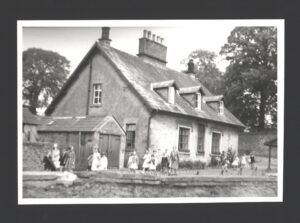 The village school had been founded in the 1840s by the Rev. William Carus Wilson whose portrayal as the sanctimonious, tyrannical, evangelical parson Mr Brocklehurst in Charlotte Brontë’s Jane Eyre had developed into national notoriety with the publication of Elizabeth Gaskell’s Life of Charlotte Brontë in which he is seriously savaged. The Brontë sisters had attended his Cowan Bridge school which is the connection here. The ancient Carus Wilson family had lived for some time in our village, had moved their Clergy Daughters’ School there from Cowan Bridge in 1833, built the village church for £750 in 1833 and the parsonage for £800 in 1837. William Carus Wilson founded the village school a little later for local children, with special rooms for the ‘aged poor’ above the schoolroom. A resident Christian schoolmistress was intended to keep an eye on these old folk, read to them and collect them together for daily worship. A hundred years later the buildings had not changed except that the school caretaker, Mr W. and his family, now lived upstairs. The school was built into a steep hollow beneath the parish church and the vicarage which stood together on the other side of the main road. The village beck flowed through a tunnel beneath the road and down the side of the school playground from which it was protected by tall, green, metal railings with upright bars spaced sufficiently close to make it very difficult, but not impossible, to push one’s head through. I should like to be certain that a distant recollection of the vigorous application of soap to the neck and ears of one little boy (not me) thus jammed was real and not my wishful recalling of that escapade of Peepy Jellaby or his brother in Bleak House. The metal railings were, however, too high to climb over when the playtime ball went into the beck and this led to serious dramas when the water floated the ball into the sinister lower tunnels carrying the stream towards The Wood, where we were also forbidden to go. The main playground was a gravelled yard which had a covered area on metal pillars for when it rained. The rest was a rough earth slope and a very steep embankment beneath the main road. It was very difficult to run up and down this embankment without falling over and the resulting cuts had to be washed and the gravel theatrically removed by Mrs M. with much use of Dettol, an appreciative audience and even hot lint compresses later at home. The marks are still visible on my knees.
Playtime came to an end when Miss H. banged on the window. Then it was English which meant spelling and Fundamentals of English (Book 2: Aesop’s Fables). We learnt stationary and stationery, desiccate and Mississippi. Aesop must have been comprehension exercises. It was also time for the Wireless and so we soon reached twelve o’clock and Dinner Time. The food had arrived by van earlier in the morning in a big, insulated, aluminium container with an impressive guillotine-like lock. Two folding tables had to be set in place at the back of the room and Miss H. and Mrs M. served up the food. We particularly hated the tapioca pudding (‘frogs’ eyes and jellybags’ we said) but for some children those dinners were important. I can remember that for playtime a few children brought sugar sandwiches and that as a little boy I felt quite envious. One of those sugar-sandwich eaters, I realised years later, came from a subsistence-level farm-worker’s family in a home with no bath and only cold water, a stone sink and a stone-flagged floor. He and his sister picked huge quantities of rose-hips which were collected from schools at the end of the war to make rose-hip syrup. They got three old pennies per pound for them. Eight pounds would earn them a modern tenpence. Several of the children came from farms but some of the others came on the local bus from the nearest small town, almost two miles away, because Miss H. had a great reputation for getting her children through ‘t’ scholarship exam’. By the late 1940s it was really the eleven plus but that changed nothing in Miss H.’s approach and we practised daily every exam paper that had ever come her way. The younger children meanwhile ‘did’ Plasticine – as a treat and in complete silence.
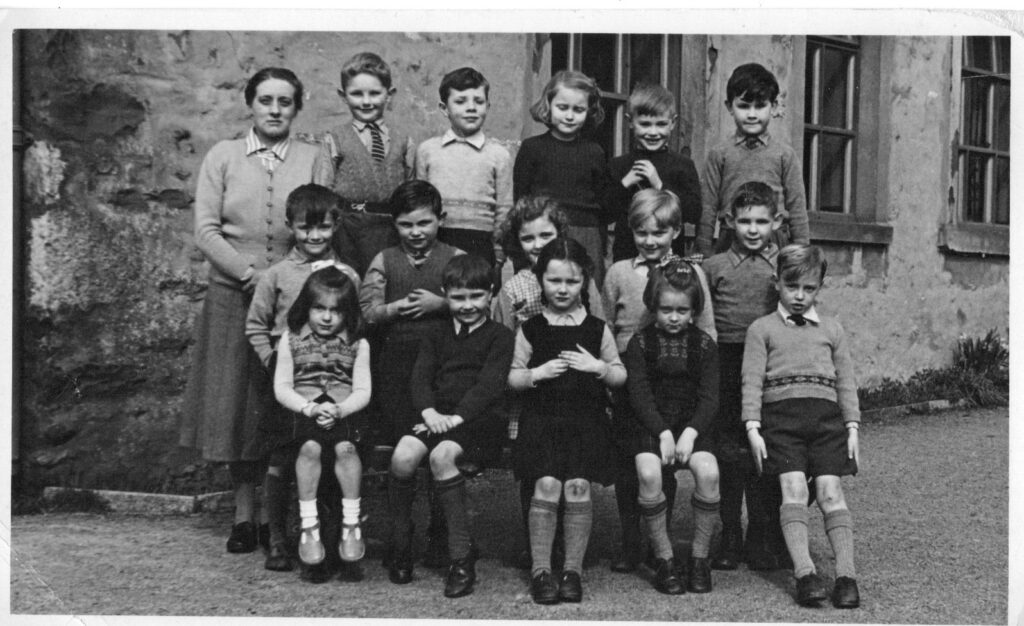 The educational diet was not totally unvarying. I can remember two attempts at P.T. in the school yard which involved throwing ‘bean-bags’ which our parents had been asked to make. It may be that india-rubber balls were scarce in the 1940s or that those little sewn-up packets of dried beans were thought more manageable for young children. There was a smelly sack of assorted, black gym-shoes but our one attempt at finding even a single one that fitted was soon abandoned and we wore our ordinary clothes and shoes just as we did for the school sports sometimes held annually on the cow-field above the school. Indoors there was also at least one occasion on which we were taught country dancing. That was when the new electric gramophone was used, although the puzzle of setting it up nearly drove our teacher to abandoning the attempt. The dance was called ‘Gathering Peascods’ and we were required to form two rings and skip in opposite directions, stop, reverse, twizzle round another dancer and then resume the rings. There was plenty of opportunity for stamping before the end of the 78 record and the dust raised was impressive. Then there was the vicar who came weekly, except for those weeks when he didn’t. We mostly read about Moses in the Bullrushes and drew the story with wax crayons on thin post-war sugar-paper torn into little squares. Mr Carus Wilson would not have approved. For infrequent public performances in front of our parents we had to learn chunks of Hiawatha and The Pied Piper. A library van started to bring boxes of books which we soon got through and which added variety to the pre-war remnants on the book-shelf or offered something more modern than Lamb’s Tales from Shakespeare which Miss H. sometimes read to us. Frog-spawn was brought in although Mr Carus Wilson’s high window-ledges sloped and there was nowhere obvious to put it. Nature-study was encouraged and once or twice the Big Room children were even taken a little way down the path into The Wood so that we could learn to name the wild flowers which we picked, brought back and put in water in old Shippam’s meat-paste jars beside the rather smelly frogspawn balanced on the Nature Table. Gestures to curriculum beyond the three Rs permitted time-honoured ritual excursions. Geography inevitably presented Eskimos in their igloos and Red Indians in their wigwams. History meant the shortcomings of Kings Canute, Alfred and John and the wives of Henry VIII, especially since the last one, Catherine Parr, had some connection with Kendal and Henry was supposed (wrongly) to have spent a night in an ancient fortified farm near to our village. Occasional dramas took place. Village idiots still existed and ours once came in with a bunch of flowers for the teacher. And then Mrs R.’s driving was irresistibly exciting. She was a grand old lady who lived in a Tudor mansion below the school and drove an enormous, black, pre-war car with a real klaxon hooter. She had to drive up the steep hill parallel to the school and join the main road at the top. Since there was no question of her stopping to check if there was anything coming she simply roared up the hill with the klaxon honking to warn off anyone foolish enough to get in the way. Current affairs did not touch us, although there was the occasional veiled reference to The War. Mrs M. said that she didn’t think she could ever speak to a German. We were even shown how the red on the school globe went all the way round – nearly – and told that the Empire was now called the Commonwealth. However on one day in 1952 both our teachers looked very solemn indeed and when they switched on the Wireless there was gloomy music and the announcement that the King was Dead. Things quickly cheered up as the year progressed and we followed closely the arrangements for the Coronation and had to prepare a tableau for presentation at the fête in the village hall. It was called Children of the Empire (or Commonwealth) and involved much in the way of thin cotton from mothers’ work-bags and even dark make-up. We had previously knitted optimistically-described ‘squares’ to make up into a blanket to send to Nyasaland for the poor people there and were told that they had black faces, although that took a bit of swallowing. I wonder what happened to the blanket. I had learnt enough knitting to be able to do lines but not to ‘cast off’, so I knew that any holes in the finished article would eventually be blamed on me.
And after the Coronation came the ‘scholarship’ results and a present from Miss H. to the successful candidates for the Grammar School. In my case it was the tiny Collins Gem French Dictionary. Maybe Miss H. had second sight since I ended up going in for French. Perhaps she had a second life too, away from the school, but I doubt it. From what my parents occasionally told me, for she had also taught my mother a generation earlier in a neighbouring village, I pieced together some slight sketch of her life. My father knew of the poor fell-farming family into which she had been born and whose lonely, by then ruined, house I remember seeing. I think she once spoke of attending a dame-school herself and, it was surely a great achievement when she got into Ripon Teacher Training College. She must have been quite a young woman when she was appointed to Middleton, where my mother’s family lived. That was a one-teacher Church School and my mother always spoke happily of it although I think the children would be quite wary of Miss H. herself. She was a tough Westmorland woman who stood for no nonsense. That meant talking in class or throwing snowballs with stones in or swearing and being caned. The punishment for swearing might even involve having the soap brought from beside the sink in the cloakroom to be put in your mouth in front of the whole class. She lived alone, always ate her evening meal in the same local café, which meant a short bus journey in one direction and then a long one right back up the valley to her home. She had iron-grey hair, thin lips seldom if ever enhanced by lipstick, a solid jaw set in a determined expression and a big leather bag. I saw her a few years ago, half a century after the childhood reminiscences above and shortly before her death. She must have been ninety and she was ordering some plants from a stall in the local market-place. ‘What name is it, Mrs ?’, asked the salesman. ‘Nay lad’, she replied, ‘don’t go giving me titles I’ve no right to. It’s Miss, Miss H……. and it always has been.’ Perhaps I should have spoken to her.
January 2016