

Introduction
Old Manor and Old Manor Farm are now two private residences. As will be seen in this Sketch, for centuries, they were a single residence. In the distant past it was the Manor House, although as shown later, few, if any, Lords of the Manor used it as their primary residence.
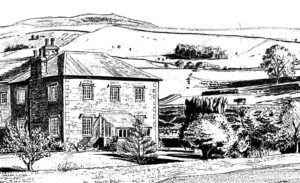
A drawing of Old Manor by Hilary Moore late 1980s[1]
As I describe later, the building you see today is a much later building, albeit in the same location as the original Manor House, most likely rebuilt in the eighteenth century.
An internal inspection of Old Manor Farm shows evidence of medieval remains. For example, now mostly below floor level, there is a segment of what was clearly a large fireplace, with the stone flue running to the roof.

View of the stone flue from fireplace looking to the roof[2]
The current owners of Old Manor Farm discovered a stone window frame, again partly below the current ground level. This appears to date back to the 16th century or before. Finally, the beams in the roof are clearly very old, roughly worked by an adze. Before renovation, the owners took advice from a historical surveyor who also noted evidence of fire damage on some of the external stones.
Through the years, Old Manor was also referred to as Casterton Old Hall. This was to differentiate itself from Old Hall, Casterton, another old building in Casterton near to Beckside, near to Holy Trinity Church. This Old Hall in Low Casterton was named because it was replaced by the current Casterton Hall in the late nineteenth century. I have already written about this Old Hall. Details can be found here https://www.castertonparishcouncil.org.uk/old-hall/.
In this Sketch I will refer to the building as Old Manor but will note when it was referred to as something else in the historical records.
The Manorial Title of Casterton
There was indeed a Manor House in Casterton where perhaps for a time, the Lord of the Manor resided. However, very early on, due to changes in ownership, and the owners having substantial properties elsewhere, the Lords of the Manor lived elsewhere.
Before the Norman conquest of 1066, Casterton was associated with Earl Tostig’s lordship of Whittington. By the late 12th century, Casterton belonged to the de Kabergh family, the lords of Kaber and Warcrop. Robert de Kabergh’s sons Torfin of Waitby and Robert of Warcrop seemed to own a share of Casterton.
This is an early indication that the village of Casterton was under the stewardship of different families. Each of these parcels of land had complicated ownership trails through the centuries. The lands that were eventually owned by the Wilson and later Carus Wilson families for example, were not where Old Manor was located. More details can be found in the Victoria County History Westmorland – Lonsdale Ward.[3] The parcel of land in which Old Manor was located was part of the so called ‘Burneside Lands.’ The details of how these lands changed hands are explained below, but before this…
King Edward I Visits
King Edward I visited Casterton in October 1292. Why he ended up there is summarised below, the details taken from Marc Morris’ biography of Edward I.[4] In the few years before he stopped off in Casterton, the succession of the Scottish crown had been thrown into turmoil by the deaths of Alexander III and later, his chosen successor, his granddaughter Margaret, then only three years old.
It had been proposed that she would be married to Edward’s youngest son Edward Caernarfon, then only two years old, a union potentially uniting the two kingdoms of England and Scotland. Negotiations were held to work out how this political alliance would be achieved, with the plans eventually approved in August 1290. Edward had promised that after the marriage, Scotland would remain ‘free in itself, and without subjection, from the Kingdom of England.’ Sadly, Margaret died on her way from Norway before arriving in Scotland, throwing the country’s succession wide open.
Diving deep into the Scottish family tree, a certain John Balliol was identified as the next in line to the Scottish throne by virtue of Scottish connections on his mother’s side. However, his entitlement was disputed by Robert the Bruce who felt that he had a better claim to the throne.
Sensing an opportunity to gain a political advantage, in the spring of 1291 Edward I travelled north to meet the Scottish Guardians and other leading figures to discuss the succession crisis. He arrived at Norham, England, only five miles from Berwick, then in Scotland, on 10 May. To the great surprise of the Scots, Edward suggested that it would be he who would be deciding who the next King of Scotland would be. Unsurprisingly the Scots resisted this idea, enraging the English King who threatened to lead an army against the Scots. Counsel prevailed and a three-week adjournment was agreed to allow the parties to take stock. Three weeks passed but the Scots refused to travel back to Norham. Over the next few months, Edward pressured the squabbling Scots by displaying military force near the border and at sea.
On 12 June, an agreement was reached. Edward again promised to maintain the laws and customs of Scotland. The following day, the Scots swore fealty to Edward in his capacity of Scotland’s temporary caretaker until a king were appointed. Numerous contenders for the crown now came into the mix. It was hoped that a resolution could be quickly found. However, perhaps with the connivance of Edward, there were significant delays.
In August, with no conclusion to the discussions, Edward headed back to England dealing with other matters including the burial of his mother Eleanor, and border disputes in Wales. It was not until 1 June 1292 that Edward returned to Berwick where more convoluted hearings were held to decide who the crown should go to, again without success. On 25 June, the court disbanded, being asked to convene in thee months time. Edward returned to England where he passed his time by touring the north of his kingdom.
This was why, on 2 October 1292, King Edward I visited Casterton. He was on his way back to Berwick to attend the next court to decide the next King of Scotland. He travelled there via Appleby, Morland, Brougham, Hutton in the Forest, and Carlisle, arriving in Berwick 11 days later. These royal trips would have required a long baggage train and therefore required a good quality road surface to travel over. In his trip through Casterton, where he most probably stayed the night, he was probably using the old Roman road.[5]
The negotiations dragged on and on. It wasn’t until 17 November that Edward finally decided that John Balliol would be the next King of Scotland. It became apparent very quickly that Edward’s intent all along had been to ensure that Scotland was wholly subservient to England. History would show that this was not the end of the matter.
The Burneside Lands
Before the Bellingham family inherited the property, the Manor House was part of the Casterton estate known as the Burneside Lands. These lands were described as being either a third or a quarter of the village of Casterton as a whole.[6]
By the late 13th century, the lands were in the hands of the de Brunolvesheads of Burneside. This family had the right to nominate a member of the clergy to the bishop to be vicar of St Columba’s Chapel. This is the chapel that Chapelhouse Lane is named after.
When Gilbert de Brunolveshead died in 1347, his only heir was his young, unmarried daughter Margaret. Because she was still a minor, her inheritance was awarded to John de Gray of Ruthin who later demised (transferred) it to John de Coupland while Margaret was still a minor. Margaret’s inheritance was subsequently acquired by the Bellingham family in the late 14th century, staying with that family for several centuries.
The Bellingham Lords of the Manor
The Bellingham family originated at the village of the same name in Northumberland, where William de Bellingham was sheriff of Tynedale in 1279 and forester to King Alexander III (1241 – 86) of Scotland, the very same Alexander whose death caused the succession crisis discussed above.
In the 14th century, Richard de Bellingham moved to ‘Burnside’ in Westmorland, when he married Margaret, the daughter and heiress of Sir Gilbert de Burnside.[7]
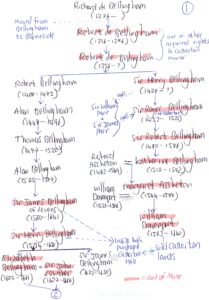
Family Tree of the Bellingham family showing the line of inheritance and acquisition of the Casterton Manor from C 1360 / 1390 to 1650
It seems either Richard’s son, Robert de Bellingham (1316 – 1376) or his grandson, Robert de Bellingham (1356 – ? ) acquired the right to Casterton Manor, possibly by marriage.
Historical documents show that Richard’s great grandson, Sir Henry Bellingham of Burneside (1428 – after 1471) was in possession of the Manor in 1461. He was a Lancastrian in the War of the Roses and paid for it when his properties were granted to Sir William Parr and his brother Sir John Parr in 1463. However, in 1485, Henry’s son and heir, Sir Roger Bellingham (1453 – 1533) was able to retrieve his family properties. Sir Roger was a Sheriff of Westmorland. In 1508, he was described as ‘of Casterton’. Perhaps indicating that he actually lived in the Manor House.
In 1552, a juror recalled how in 1529, Sir Roger Bellingham was in the process of building a tower ‘near St Columba’s Chapel’. A later owner of Old Manor, William Makinson (1921 – 2007), recalled being told that part of Old Manor was a pele tower.[8] A pele tower is a small, fortified stone tower, built between the 14th and 16th centuries in the Anglo-Scottish borderlands. They served as a defensive refuge for families and villagers during attacks by raiders known as Border Reivers. The site of Columba’s Chapel to Old Manor is only about 900m as the crow flies. If this were the case, the pele tower would have been added to the existing building.
Roger was succeeded by his son, Sir Robert Bellingham (1453 – 1533). A rental from the reign of Henry VIII describes Lady Bellingham as possessing the ‘Burneslysde lands.’
Sir Robert’s son, also named Sir Robert Bellingham (1480 – 1586) had four daughters, one of whom was Katherine Bellingham (1512 – 1572). In 1560 she was recorded as owing 8 shillings of rent to Queen Elizabeth I. Katherine married Richard Assheton (1433 – 1549) and had a daughter Margaret Assheton (1544 – 1588). When Katherine was widowed in 1549, her estates were passed on to her daughter Margaret.
The Davenports
Margaret married William Davenport of Bramhall, Cheshire (1521 – 1576) in 1550. They had a son, also named William Davenport (1563 – 1640).
In 1593, Margaret Davenport, by now a widow, was fined for ‘recusancy’, presumably refusing to deny her Catholic faith. The fine was £12 and 5 shillings and one eighth of her estate at Casterton Hall (i.e. Old Manor), together with one eighth of her properties in Casterton, Lambrigg and Grayrigg totalling £260.
When Margaret Davenport died in 1609, she still owned a ‘demesne messuage’ (Lord’s property) in Casterton as well as 40 other properties, 200 acres of land, 100 acres of meadow, 200 acres of pasture, 300 acres of furze and heath and 100 acres of turf in Casterton.
The Bellinghams Return
Margaret’s son William inherited her Casterton lands, selling them in 1638 to Sir James Bellingham of Levens ( – ) and his son Sir Henry Bellingham (1594 – 1650). As well as buying the Casterton Hall (i.e. Old Manor) and other properties, they also acquired almost 300 acres of land in Casterton, Barbon, Lambrigg and Kendal, for £200.[9]
These Bellinghams were distant relatives of the Bellinghams who had previously held Casterton Manor, sharing a common ancestor in Robert de Bellingham (1356 – ) who was the grandson of Richard Bellingham (1276 – ?), who had made the move from Bellingham to Burneside when he married Margaret, the daughter and heiress of Sir Gilbert de Burnside.
Sir Henry Bellingham (1594 – 1650) was a Royalist. When the English Civil War broke out in 1642, Sir Henry was nearly 50, but he raised troops for the King’s army and took an active part in the conflict. He had chosen the wrong side and was fined for ‘delinquency,’ being penalised by Parliament with a large fine.[10]
Henry’s son, Sir James Bellingham (1623 – 1650) died a few days after his father, suggesting that both men succumbed to a virulent infectious disease. Sir James was married but childless. On his death, his estates passed to his uncle, Alan Bellingham (1600 – 73). This inheritance was disputed and one of Sir Henry’s daughters, Elizabeth Bellingham (1625 – 1661) successfully litigated against Alan, winning back the Casterton estate.
Elizabeth was married to Sir John Lowther (1627 – 1668). Her inheritance began the Lowther connection with Casterton Manor which continued until 1979 when the Lowther family sold the rights to the Manor to an unnamed buyer. It was through the archives of the Lowther family, now deposited at the Cumbria County archives, that we learn more about Old Manor.
Casterton Manor Rolls 1662 – 1707
In the Kendal Archives there is a copy of a transcript of the Casterton Court Manor Rolls from 1661 to 1707. They were transcribed by Dr. T. G. Fahy sometime in the early 1970s.[11]
The Manor Court was most probably held in the Manor House. In the case of these specific records, the court was held to record changes in tenancies of the lands owned by the Lord of the Manor. As noted below, in this period, it was the early years of the Lowthers’ tenure. The day to day running of the Lord’s properties were normally administered by a Steward.
The Manorial Court Rolls were the formal records that documented and validated land transfers. The new tenant was given a copy to hold, which served as their evidence of title to the property. The land in question was known as ‘Customary Tenures’ or ‘Copyhold.’ This system of land tenure was not governed by common law but by the specific customs of the individual manor. Such ancient arrangements continued to be practised until they were finally abolished in 1922.
Every change in tenancy was recorded in the Manor Court Roll. There were two main types of land transfer. Most commonly there was the ‘Alienation.’ This refers to the transfer by sale, gift, or exchange of land by one tenant to another.
A second type of transfer of land was inheritance which in the records was called, a ‘Descent’ from a deceased tenant to their heir. Upon the death of a copyholder, their heir(s) were required to appear before the manorial court to report the death and ‘pray to be admitted’ as the new tenant. In cases when the tenant died, the tenant’s estate was required to pay a fee to the Lord of the Manor known as a ‘heriot,’ a kind of death duty or levy. The payment was recorded in the court rolls as part of the formal legal process, necessary for the deceased tenant’s heir to be admitted to the land holding. The deceased’s land was then formally surrendered to the Lord and then re-granted to the heir upon payment of a fee, known as a ‘relief’ or ‘fine.’
Examples of each type of transfer can be found in the transcript. For example, on 16 October 1662, new tenants were admitted to the court. This was an example of ‘Alienation.’ Robert Mansergh was admitted as the new tenant of two closes called Great Riggs and Little Riggs, amounting in area to 16 acres. The land had been purchased from Johanna Towlson. The annual Customary Rent payable to the Manor on this land was 3 shillings and 8 pence and the transfer of the land resulted in a ‘fine’ of 11 shillings.
In 1668, the Manor Rolls include an example of a ‘Descent’. Samuel Wilson was admitted as a new tenant of a piece of ground called Bents which he had inherited from his father, Richard Wilson. The annual rent payable to the Manor was 3 pence and the transfer ‘fine’ was 9 pence. The field name Bents appears several times in the 1843 tithe map, one of which is owned by George Wilson, presumably an ancestor of Samuel and Richard, and leased by Thomas Sarginson who was farming at Gowrey farm (field number 412, adjacent to the original Gorah Farm).
In 1669, the transcript shows that the Lord’s Steward was R Rowlandson. A few years later there was a ‘Descent’ involving 23 ‘cattel gates’ [Sic] on Casterton Fell. These “cattle-gates” (sometimes called a “beast-gate”), refer to a specific type of pasture right, not as it might suggest a physical gate. It represents the right to graze one cow (or an equivalent number of other livestock, such as sheep) on the common pasture or waste land of the manor.
In 1669, the unnamed heir received the ‘gates’ and other grounds and parcels of land at Binsol Raines and a parcel of wood at Birket Wood and a tenement beyond that. This was a substantial transfer of land. The annual rent was £1, 7 shillings and 2 pence, while the transfer ‘fine’ amounted to more than £4.
In the 1843 tithe document, Birket Wood was no longer a wood, it was three fields (numbers 361, 371 and 375), either arable or pasture, which were separately owned by Ann Cragg, James Bayley from Town End Farm and the Earl of Lonsdale, respectively. The fields are to the south of what is now called Norwood Farm, suggesting that Birket Wood was the wood after which Norwood took its name.
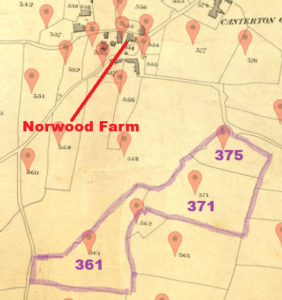
Fields referred to as Birket Wood in the 1843 tithe map and the 1671 Casterton Manor Roll
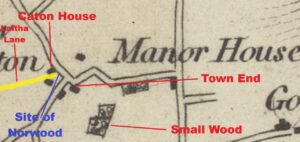
Extract of the 1823 Greenwood map showing area around Norwood, likely the remains of ‘Birket Wood’
A Derelict Building
Antiquarian, the Reverend Thomas Machell, visited Casterton in the summer of 1692. He was on a journey travelling on horseback all over the Barony of Kendal, as far north as Grasmere and far south as Tunstall. He recorded all that he found in a journal that was later transcribed by Jane Margaret Ewbank, the daughter of the Reverend (later Venerable) Walter Frederick Ewbank. He was the vicar at Casterton and Chaplain to Casterton School from 1952 to 1962. Jane attended Casterton Girls School.
Machell made several observations about Casterton’s principal sites including Old Manor. He wrote, ‘Casterton Hall is an old ruinous building, now only fit to contain a farmer, but formerly the seat of Sir William Davenport, a judge in this nation and lately purchased by Sir John Lowther, Baronet.’[12] [13] Machell states that the Lowthers purchased the property. Based on the records, it appears that they actually inherited it, as described below.
The Lowther Lords of the Manor
When Elizabeth died around 1661, the Lowther family inherited the Casterton estates that had previously belonged to the Bellingham family. Various branches of the Lowther family inherited Old Manor over the next 300 years. As one succession line died off, another one took over.
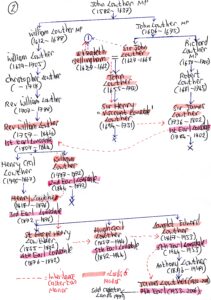
Family Tree of the Lowther family showing the line of inheritance and acquisition of the Casterton Manor from 1650 to 1979
The first Lowther line passed from Sir John (1627 – 1668), who was a Baronet, to his son another Sir John (1655 – 1700), who was also a Baronet, as well as the 1st Viscount Lonsdale. Sir John’s son, Sir Henry ‘Viscount Lonsdale’ Lowther (1694 – 1751), died without an heir.
A second Lowther line therefore took over the inheritance. Their line derived from Sir John’s (1627 – 1668) brother, Richard Lowther MP (1638 – 1703). Richard’s grandson Sir James Lowther MP (1736 – 1802) took on the inheritance on the death of his great uncle Henry in 1751. In 1773, Sir James was the second largest landowner in Casterton. He was created the first Earl of Lonsdale on 24 May 1784. When he died in 1802, having sired no children, his earldom and baronetcy became extinct.
A third Lowther line then took over. When Sir James (1736 – 1802) died, he was succeeded as Viscount Lowther, according to the special remainder, by his third cousin William Lowther the 2nd Viscount Lowther (1757 – 1844). He was later advanced to Earl of Lonsdale of the second creation. Becoming the second named first Earl of Lonsdale in 1807. It is from this Lowther line that the current Earl of Lonsdale is directly descended. As noted above, the seventh Earl of Lonsdale, James Hugh William Lowther (1922 – 2006), sold the Casterton manorial title in 1979 to an unnamed buyer.
This concludes looking at who were the Lords of Casterton Manor some of whom may have lived in Old Manor. The next section starts to look at who actually lived in the house over the years.
Evidence About Residents of Old Manor
1674 Hearth Tax
The details noted about the Casterton properties included in the 1674 Westmorland Hearth Tax are insufficient to identify Old Manor itself. As noted above, Machell observed that in 1692 Old Manor was in ruins, ‘only fit to contain a farmer’ and so it is possible that it was not assessed as being taxable.
1732 Lease
We know that Old Manor was leased out in 1732. This would suggest that it had been made habitable under the stewardship of the Lowther family sometime between 1692 and 1732. The lease was for a period of 11 years. The tenant was James Stainbank of Barbon who leased the Demesne (Old Manor), Casterton Colliery and Casterton Fell Farm.
The 1732 lease mentions that the Demesne and Colliery had previously been rented by Rowland Tatham and the Fell Farm by Ruth Brown. There is no record of these earlier leases, but it would suggest that the rebuilding of the property happened well before 1732.
The annual rental of the Colliery was only £5 a year, suggesting a very small business, and that of the Old Manor and Casterton Fell Farm the sum of £65 per year.[14]
The Kirkby Lonsdale parish records offer more information about the Stainbank family. In 1726, James Stainbank and Sarah Garnett, both of Barbon were married. Their son Joseph was born there in 1729 and their daughter Sarah in 1731, just prior to moving to Casterton.
When Sarah was baptised in 1738, her parents were recorded as living in Casterton i.e. they had moved there at the time of the lease. Their subsequent children, Mary (baptised 1740), Dorothy (baptised 1745), and Thomas (baptised 1747) were also referenced as being from Casterton.
1754 Lease
There is another lease document continuing James Stainbank’s lease of the properties, this time for seven years. I assume that when the 1732 lease finished in 1743, it was renewed for another 11 years until 1754.
The 1754 lease document includes a lot more detail than the 1732 lease. The total annual rent is still £70 but we learn that it would consist of two equal payments of £35 on Lamma Day and Candlemas Day.[15] The lease was between James Stainbank, now of Casterton rather than Barbon, and Katherine Lowther, a widow who was married to Robert Lowther (1681 – 1745). She was therefore the mother and guardian of the infant Sir James Lowther (1736 – 1802) who, as noted above, would inherit the property from his great uncle Henry Lowther (1694 – 1751), when he reached 21 years, the age of majority.
The 1754 lease contract agreed that in return for the annual rent and various covenants the tenant would be demised the ‘demesne farm’ called Casterton Demesne in Casterton and also the farm tenement called ‘the back of the Fell Farm’ situated on the back side of Casterton Fell, and all the houses, outhouses, buildings, orchards, garths, gardens, folds, closes, parcels of ground. It also included the colliery and veins of coal that ‘may be found in within the piece of Waste Ground called Casterton Fell,’ with full rights to dig and carry away coal. The tenant also had rights to level out and drain land for the convenience of extracting coal. The tenant was only allowed to mine one pit at a time and employ no more than three men to work the pit.
The contract also included various covenants regarding applying good farming practice. It recorded that if the tenant cut down or damaged an oak, elm, or ash tree, they would be charged £5. The tenant was also obliged to keep items such as buildings, ditches, walls, water courses, and gates in good repair, but the principal walls or timber on the roofs of the buildings were the landlord’s responsibility.
1760 Estate Map
The earliest detailed map of Old Manor is from a map showing the various possessions of the Lowther Estate titled ‘Plan of Casterton Demesne near Kirkby Lonsdale.’ The plan was surveyed in 1760 by John Flintoff.
The map has several points of interest. The field named Addy Croft is shown as a single field. In the 1843 tithe map, it had been divided to for Great Addicroft and Little Addicroft. The field named Birket Wood is the same one as number 375 on the extract of the tithe map above.
The layout of the buildings shown are similar to those on the 1843 tithe map below. You can see Old Manor and the outbuilding known today as Hayloft and Cedar. Missing from the 1760 map is a second set of outbuildings (today’s garages).
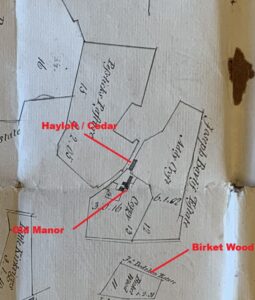
Extract of 1760 Lowther Estate Map showing Old Manor and surrounding fields[16]
Financial Woes
In 1765, it appeared that James Stainbank of Casterton Hall was in some financial difficulties. He had been living at Old Manor for the past 33 years. A draft correspondence indicated that James would be allowed to continue to rent the hall for the next year if he paid his rent arrears and the next rent due and the subsequent rents. A James Backhouse provided a surety for these payments.
Things came to a head in June 1769. James agreed to leave the old manure and compost on the farm as well as peat, coal, and wood, when he left the farm the following spring, presumably as security for his debt. This agreement was witnessed by Rowland Tatham and two new guarantors, John Dodgson and William Smorthwaite.
In another document dated 10 October 1769, the now of age, Sir James Lowther consulted with a W. Robinson from Appleby about whether Stainbank had followed the terms of his lease in general and more specifically, regarding the workings of the colliery. It was noted that if he had not done so, he and John Dodgson, his guarantor, would be served notice. Robinson also recommended that because the colliery was a long way from Old Manor, it would be worthwhile building a small house by the colliery where the colliery manager could live. He also recommended that Fell Farm and the colliery be rented separately from Old Manor Farm.[17]
Within the large bundle of documents, there are records individually detailing the lease of the Colliery and Fell Farm. These will be reviewed in a later Sketch. However, I have found no documents after 1769 which show Old Manor being leased.
Examining several other documents, what seems to have happened is that individual fields with the Casterton Demesne were leased to separate tenants for one year for the periods 1771 to 1772. Within these documents, it is not possible to specifically identify whether the Manor House itself formed part of the rent charged. For example, in a document dated 15 July 1771, titled ‘Conditions on which the Demesne at Casterton will be let to farm together or in parcels from the dale.’ Mary Wadeson rented Birket Wood for 10 shillings and 6 pence, while James Wilkinson rented Great Kirkriggs for £2 and 18 shillings.
In these documents, there were two annual rents which were much more expensive, perhaps indicating that the rental included buildings such as Old Manor. One of these was rented to Edward Taillon for more than £11 which comprised fields around Chapelhouse Farm, being Braeslack, Chapel Head Well Close and Gill, while the other, amounting to £24, was rented to John Benson and Henry Wadeson. It included the field adjacent to Old Manor, Addy Croft, Peslicks in two parts (Peslicks Pasture and Peslicks Close). The following year the field Copy (today’s Bull Copy) was added.
1769 Repairs
In the Carlise Archives there is a document from 1769 which is an estimate for repairs to Old Manor amounting to £25 4s. 8d.[18] The work was being done was to the fabric of the building, the responsibility of the landlord. The estimate included materials and labour.
The roof was repaired including a quote for ‘6 Rood 35 yards of Slate taking of and laying on again’ at a cost of £5, 14 shillings and 6 pence and ‘3 Rood of New Slate’ at £2, 12 shillings totalling £7, 16 shillings. Walls were also being refurbished. There was a quote for ‘1100 Hart Laths at 4 s and 6 pn pr 100’ totalling £2, 9 shillings and 6 pence and ‘7000 Lath Nails’.[19] The work required ‘30 Bushels of lime’ and ‘10 stones of hair’, probably horse hair, which strengthened the lime mixture.
Also being repaired were some beams and timber and there was a charge for taking up and relaying 49 yards of floor, as well as acquiring 20 yards of floorboards.
1777 Windows Tax
In the 1777 Windows Tax documentation, it is not possible to identify Old Manor within the 35 assessed persons. The record shows only the name of the resident and how many windows were being taxed. It would be a surprise if it were not one of the 35 buildings because the substantial repairs had been done only eight years before.
1798 Casterton Land Redemption Tax
The Earl of Lonsdale is listed as proprietor of a property three times in the 1798 Land Redemption Tax records. Occupiers of his houses are recorded as;
- Late Dodgson (now) Thomas Hobson
- William Glover
- Thomas Huck / William Tatham
Of these individuals, a Dodgson, a Hobson, and Thomas Huck are mentioned 21 years earlier in the windows tax record. In my Sketch about Norwood Farm I have identified that Thomas Huck was living at what later became known as Norwood Farm.[20] If Old Manor is included in the windows tax records, the likely named candidates are therefore James Dodgson or Edmond Dodgson both assessed as having seven windows, or possibly John Hobson, also with seven windows.
1823 Greenwood Map of Westmorland
Old Manor, recorded as Manor House, is marked on the 1823 Greenwood map but with minimal detail. We know from the 1760 map above that it was much substantial than indicated on the 1823 map.
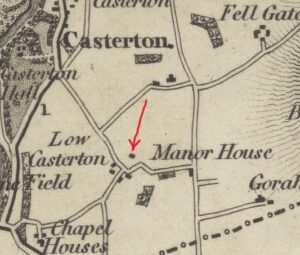
Extract of 1823 Greenwood map showing area around Old Manor (Manor House)
The 1828 Hodgson Map of Westmorland
Old Manor, called Casterton Old Hall on the 1828 map, appears in slightly more detail than on the Greenwood map, and more closely reflects what was shown on the 1760 map.
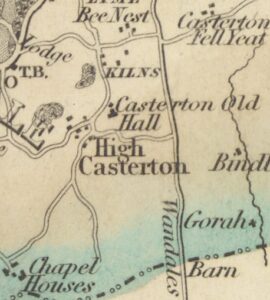
Extract of 1828 Hodgson map showing area around Old Manor
The Briggs Family
The next firm evidence of a family living at Old Manor after James Stainbank left in 1769 is from the early nineteenth century which identifies the Briggs family as living there.
The earliest record, an 1826 Electoral Poll, shows Edward Briggs as being resident in Casterton and living in a freehold house. A year later we learn that Ann Briggs, wife of Edward Briggs, died at Casterton Old Hall aged 55.[21]
Ann Cragg and Edward Briggs were married on 4 February 1788. Edward was ‘of full age’ meaning that he was older than 21 years. Ann was not yet of age. By reference to her age when she died, she was 16 years old when she married, therefore requiring her father’s permission. At the time of their marriage, Ann was recorded as living in Casterton, while Edward was from Netherhall in the chapelry of Mansergh in the parish of Kirkby Lonsdale. At some point after they were married, they moved into Old Manor. An 1829 Trade Directory confirms that Edward Briggs (1757 – 1842) was a farmer at Old Hall.
In 1833, a newspaper records that Mr Cragg Briggs, a farmer ‘late of Casterton Old Hall’, died aged 38.[22] This was Robert Cragg Briggs, the son of Edward and Ann. Perhaps he had taken over the farm from his father.
A copy of Robert’s probate held at Lancaster Council Archives, tells us that he was a bachelor when he died intestate on 15 November 1833, suggesting that he had a sudden death. The probate confirms that Edward Briggs was Robert’s father who was living in Kirkby Lonsdale at the time of the document. Robert’s estate was noted as being less than £300 and was inherited by his father.[23]
There is a family chest tomb [H52] in Kirkby Lonsdale graveyard. Now overgrown with brambles with the top broken, the church records show that it reads,
‘Sacred to the memory of Ann wife of Edward Briggs of Casterton who departed this life July 30th 1827 aged 56 years. Also of Robert Cragg Briggs son of the above Edward and Ann Briggs who departed this life Nov. 15th 1833 aged 38 years. And of two other sons of the said Edward and Ann Briggs. Richard who died December 3rd 1838 aged 49 years, and John who died September 10 the 1840 aged 31 years. Likewise of the said Edward Briggs who died August 22nd 1842 aged 85 years.’
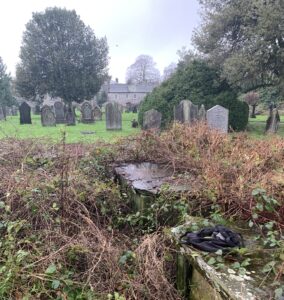
Above and below, site of Edward Briggs in Kirkby Lonsdale graveyard[24]

The Hodgsons
As noted above, the Briggs were at Old Manor from before 1826, possibly as early as 1788 when they were married, until sometime around 1833. The next evidence points towards the Hodgson family as being at Old Manor from at least as early as 1836. A newspaper report from that year states that John Hodgson of Casterton Old Hall was a judge at the Lancaster Agricultural Show.[25]
The following year, another newspaper recorded that ‘Mr. Hodgson, of Casterton Old Hall’ and James Harrison of Lowfields were ‘stopped by two men of suspicious appearance on Kirkby Lonsdale Bridge [Devil’s Bridge] as they were proceeding home on horseback.’ One of the men grabbed at Harrison’s leg, whereupon he shouted to them that he knew who they were and they ran off. Harrison gave chase but being encumbered by a great coat and overalls lost the assailant as he jumped into a field owned by Mrs Carus.[26]
A few weeks later, around Christmas, a Mr. Hodgson of Casterton Old Hall, was one of about 20 people who attended a celebratory dinner at the King’s Arms in Kirkby Lonsdale in honour of the birthday of the Earl of Lonsdale.[27] The guests were ‘formed chiefly of the respectable tradesmen and farmers of Kirkby Lonsdale.[28] It is not clear whether it was Robert who was attending the dinner or his brother or father. If it were Robert, that he was ‘respectable’ had been questioned.
In 1840, a lengthy newspaper article reported that Robert Hodgson was part owner of a farm with his brother and father and that they paid £150 per year rent. The 1841 census confirms that Robert Hodgson lived at Old Manor which was referred to as Casterton Old Hall in both the census and the newspaper report. He was aged 25, a farmer, but not born in Westmorland. Also living at Old Manor were his servants John Glaister aged 30, Christopher Sandee, aged 30, Septimus King, aged 15 and Ellen Abbott aged 20.
The aforementioned newspaper reported how Robert Hodgson was being asked to reimburse the town of Kirkby Lonsdale for the maintenance of ‘a bastard child, born of the body of Jane Dobson, of which he was the reputed father.’[29]
I have written about this situation in a lot more detail in my Sketch about Rock Cottage (see https://www.castertonparishcouncil.org.uk/a-sketch-of-rock-cottage/ ). In brief, Robert acknowledged the child was his but fought in the law courts using legal technicalities to avoid paying money. He took no responsibility for the child, his daughter Mary. Later, Jane found happiness when she married a Kirkby Lonsdale man. She lived for many years but her first born daughter died tragically young.
Robert Hodgson soon moved on from shirking his responsibilities. He was reported as obtaining a game certificate (licence) costing £4 and 10 pence, a huge amount for those days, showing he could have easily afforded to support his illegitimate child had he wanted to.[30]
1841 Census
The 1841 census records that Robert was the Farmer at Old Manor, the head of the household, and born outside of Westmorland, (possibly near Wigton, Cumberland).
The 1843 Tithe Map of Casterton
Just two years later, the 1843 tithe map shows that the occupier of the property at Manor Farm (Casterton Old Hall), property number 378, was now Joseph Hodgson. The landowner was the Earl of Lonsdale, at this time William Lowther, the 1st Earl (1757 – 1844).
The tithe map illustrates the house and outbuildings in more detail than the previous maps. The footprint on the map is moving towards how it looks today. Of note is that there was a large building or outbuilding attached to Old Manor in the space that is now the access road to the garages.
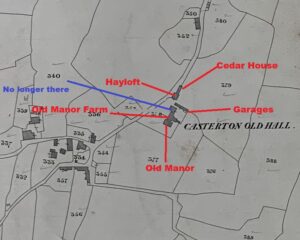
Extract of 1843 tithe map showing area around Old Manor annotated to show current names of buildings
As noted below, later records show that Robert remained connected with Old Manor. In 1844 Joseph Hodgson married Grace Lambert. The marriage record stated that his father was named John, and a Robert signed the register as witness. This implies that John was therefore the father of both Joseph and Robert.
In the marriage record, Joseph’s residence was recorded as Biggins Hall, I presume the one in Kirkby Lonsdale. A notice in the local newspaper state that the married couple would honeymoon in Cumberland.[31]
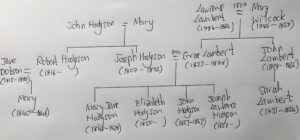
Partial family tree of Hodgson family
Over the next few years, Robert of Casterton Old Hall regularly appears in newspaper reports. He was winning various prizes at different agricultural shows. For example, his Leicester Lambs won prizes in the Lunesdale Agricultural Association show in October 1845.[32]
In September 1845, Joseph left Biggins Hall, selling off his stock and presumably moving into Old Manor.[33]
In 1847, Joseph was reported having a near fatal accident. He was riding his horse along Fearenside road near Kirkby Lonsdale when his horse stumbled and threw him off. He landed on his forehead which caused a ‘considerable injury,’ and he was reported as being ‘in a very precarious state.’[34]
The last mention I have found about a Hodgson from Casterton winning a show prize was in the Autumn of 1849. A Trade Directory from that year lists Joseph Hodgson as still farming Old Hall, but an 1850 newspaper refers to Joseph Hodgson as ‘Formerly of Casterton Old Hall’. He had moved to Hornby and started a business as an auctioneer, appraiser, and land valuer. In an advertisement he announced that he would attend the Green Dragon Inn at Kirkby Lonsdale every Thursday where people could write to him for his attention.[35]
We therefore find Joseph and his wife Grace in Hornby, with their first two children, Mary and Elizabeth. Also living with them is Sarah Lambert, one of Grace’s elder brothers’ daughters.
The Mattinsons
After the Hodgsons moved away from Old Manor, the first evidence of there being a new resident there was in an 1850 newspaper which reported that an annual ploughing match run by the Lunesdale Agricultural Society took place in a field on the Casterton Old Hall estate occupied by John Mattinson. The newspaper reported that after the competition, John gave a dinner at Uphall [Whoop Hall] to the ploughmen and ‘several members of the society.’[36] Perhaps John was taking an early opportunity to introduce himself to his new community as a generous fellow.
The 1851 census confirms that the Mattinsons were now in residence. They stayed there for more than 40 years. As with the previous farming families noted above, the Briggs and the Hodgsons, the Mattinsons were Yeoman farmers, a class of small to medium-sized landholders, ranking below the gentry but above agricultural labourers. In this role they were frequently active in the social activities of the day.
In the census, the people listed at Casterton Old Hall were Sarah Mattinson, nee Nicholson, aged 50, a farmer’s wife, born in Newchurch, Watermillock, Cumberland. Next listed were her children, Jane Mattinson aged 12, born in Longsleddale Westmorland and Joseph Head Mattinson, aged 9, born in Grayrigg Westmorland. Sarah’s niece, Mary Ann Nicholson, aged 27, an annuitant, was also there, born in Newchurch.
There were four farm servants also living at the farm. There was Edward Dowthwaite, aged 27, Thomas Dowthwaite aged 18 and Elizabeth Dowthwaite aged 20, all three born in Longsleddale, Westmorland as well as John Clark, aged 20, born in Kendal.
The John Mattinson mentioned above, giving a dinner to his neighbours, was not recorded as being at Old Manor in the 1851 census. It turns out that this John was not the husband of Sarah, but her brother-in-law. Sarah’s husband was James Mattinson who had been staying elsewhere on the night of the 1851 census. He was visiting the house of John Haygarth, a farmer in Whitwell, Selside. Sarah and James were married at New Church, Watermillock on 27 May 1837.[37]
An 1858 Directory confirms James Mattinson as being the farmer of Old Hall in ‘South Casterton’.[38] Sadly he died at Casterton on 1 February 1861 aged 57 of consumption (tuberculosis).
James Mattinson’s Will
James Mattinson, a Yeoman, wrote his will in April 1855 while living at Old Hall in Casterton. In the will he appointed his Trustees as John Mattinson (his brother), Robert Mattinson and William Key, the faithful steward of the Carus Wilson family for 35 years until his death in 1876.
On James’ death, his wife Sarah inherited ‘the use and enjoyment of his household Furniture Plate linen China books prints and pictures and his other household effects until his son Joseph attained the age of twenty one years when he gave and bequeathed the same to him (except two beds and so much and such part of the said household effects as his said wife might select for the purchase of furnishing a house in case she and his said son should not continue to live together.’ The will added that the items that he had given to his wife during their married life could still be used by her until either her death or marriage, at which point his daughter Jane would inherit them.
With respect to James’ farm estate, called Mid Dale in Longsleddale, and his farm implements, his live and dead farm animals, his money securities and his real and personal effects, he asked that the Trustees hold in trust in order that, with the assistance of his wife, they would carry and manage the farm business at both Old Manor and at Mid Dale until his son Joseph reached the age of 21, at which point, the properties would become his.
Until this happened, the will stated that the income deriving from the farming business would be split. One half would go to his wife until her death or marriage, and the other half in equal share to his two children Joseph and Jane. If his wife died or remarried, the Trustees were instructed to give £800 to his daughter Jane, with his son Joseph being given the estate and the property previously held in trust. The will was proven on 15 April 1861.
1861 Census
In the 1861 census, Sarah was recorded as a widow and as the head of the family, her son not yet having reached the age of 21. She was recorded as farming 194 acres and employing 20 men.
Her son Joseph was also living there, now aged 19. Visiting the farm was John Mattinson, Sarah’s brother-in-law, aged 58, still trustee of his brother’s estate. He was recorded as a landed proprietor, born in Kendal. His wife Ann Mattinson, aged 55 was also at Old Manor. They were no doubt visiting Sarah to offer emotional and practical support following the death of her husband only two months earlier.
The census also shows that Sarah had three servants living at Old Manor. There was Elizabeth Boothe, a house servant aged 17, born in Kirkby Lonsdale, John Stainton, aged 32, a farm servant born in Kendal and Thomas Hewittson, an 18-year-old farm servant born in Langdale.
1862 Ordnance Survey Map

Extract of the 1862 OS map showing the area around Old Manor annotated to show modern houses
The footprint of Old Manor on the 1862 OS map compared with the 1843 tithe map is almost identical, suggesting that there were no significant changes in the building between these years. The additional building noted above on the 1843 tithe map is still there.
Exhibiting
Joseph Mattinson was highly active in the years following the death of his father. In 1863, he was one of the inspectors at the Kirkby Lonsdale Agricultural Association annual show. He won second prize in the best three-year-old colt or filly held for husbandry purposes category. A newspaper report listed him living at ‘Old Hall Casterton,’ differentiating him from another successful participant a Matthew Birkett from ‘Casterton Old Hall,’ i.e. the building in Casterton near Beckside.[39]
A year later he had more success in the annual Lunesdale Agricultural Show. He achieved second place for the best short horned bull aged over two years, another second place for best three-year-old colt or filly horse, and yet another second place for best brood mare with foal at foot.[40]
Joseph was clearly a leading Yeoman farmer in the area. He attended a meeting of the Kendal Union Insurance Association in October 1865 which included ‘several of the leading farmers in the neighbourhood.’ The meeting was held to try to obtain commitments from farmers so that they would collectively take out insurance on 4,000 head of cattle, and if successful, form the Association.[41] A report the following year suggested that the Association had been successfully started and an insurance policy set up.[42]
An 1869 directory lists Joseph Mattinson as farmer. In the same year, his name was included in an advertisement for agricultural machinery testifying as to the merits of ‘Howard’s Horserake.’
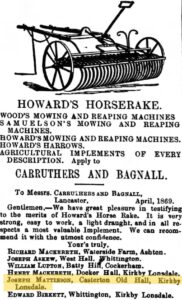
An 1869 advertisement for agricultural machinery advocated by inter alia Joseph Mattinson[43]
The following year, at a fortnightly fair in Kirkby Lonsdale, it was reported that Messrs. W. and H. M. Goulding, manure manufacturers of Cork, offered prizes to farmers who could show the best crop of turnips manured exclusively with their manure. Normally this event would have been included in the Lunesdale annual show, but it had been cancelled due to there being foot and mouth disease in the neighbourhood.
Determined to not to lose the marketing opportunity, Goulding’s local agent, James Mattinson (possibly a relative?), offered prizes at the fair. Independent judges were appointed, and two farmers, one being Joseph Mattinson won prizes. Joseph was awarded ‘a gilt eight day’s timepiece for the best crop of turnips.’[44]
1871 Census
The 1871 census records Joseph Mattinson as the 29-year-old head of the house, farming 194 acres. His mother Sarah, now aged 72, was still living at the farm. With them were, Sarah Thornborough, a Dairy Maid aged 24, born in Underbarrow, Elery Thornborough, aged 13, a General Servant, born in Kirkby Lonsdale, Thomas Farrer, aged 24, a Farm Servant, born in Preston Richard, and John Stephenson, aged 26, a Farm Servant born in Millon, Cumberland.
More Exhibiting
It was not only with cattle where Joseph was attempting to win prizes. In September 1872, he received a silver cup and £3 for a winning pair of draught horses, and a second prize in the same category, adding an additional £1 and ten shillings to his coffers.[45]
The following year he came fourth in the half-bred sheep category. The category required that he show three one-shear gimmers from a black faced mountain or Herdwick ewe by a tup of any breed.[46] In that year, the 1873 Land Register recorded that Joseph was farming 169 acres 1 rood 20 perch, with a gross estimated rental of £56 and 9 shillings.
Marriage
In 1878, Joseph married Mary Ann Morton, the eldest daughter of John Morton of Skelsmergh Hall at Skelsmergh Church.[47]
1881 Census
The first fruit of the marriage was recorded in the 1881 census, taken on the 3 April of that year. Alongside Joseph and his wife Mary Ann Mattinson, aged 26, was their daughter Sarah Francis Mattinson, aged 9 months, born in Casterton. Sarah was named after her grandmother who was still living at Old Manor, recorded as an annuitant, aged 82. She died later that year on 8 August. (A relative of Sarah advised me that Sarah Frances, known as “Safie”, eventually emigrated ‘to Canada in the spring of 1915, and married John “Jack” Leo Shelford’.
There were still four servants living at the farm. There was Margaret Shepherd aged 18, a General Domestic Servant, born in Syeh?, and three farm servants, Elizabeth Blenkham, aged 13, born in Skelsmergh, Richard Harrison, aged 24, born in Winster and Lawrence Hind aged 21 from Hutton Roof.
Life Continues
Joseph continued to visit and participate in local shows. In 1883 he was reported as attending a ‘substantial dinner’ at the Greyhound Assembly Room, near Shap, as part of the 21st exhibition of the Shap Agricultural Society held in September 1883. He spoke at the dinner saying that ‘he had had a very pleasant day for many reasons; they had charming weather, and excellent stock placed before them.’[48]
An 1885 Directory shows that Joseph Mattinson is still the farmer at Old Hall and adds ‘and landowner’. The next year, Joseph could be found at the Kirkby Stephen Agricultural Show fulfilling the role of a Judge for cattle and Leicester long-wooled sheep categories.[49]
He had a highly successful day at the Lunesdale Agricultural Show in September 1887. The report of the day stated that Mr J. Mattinson of Casterton carried all before him in the various bull classes, securing chief prizes and the challenge cup for the third year in succession for the best male animal. Having won the cup a third time, it became his sole property, in addition to the substantial prize of 5 Guineas.[50]
In 1888, Joseph was further afield in London, Hanover Square, at the Shorthorn Society Council meeting where the great and good of England’s shorthorn cattle breeders were represented.[51] He had travelled to the capital city in the capacity of a newly elected member of the Society.[52] Further expanding his role in public life, he was nominated as a member of the Kendal Board of Guardians, securing the role with no election necessary.[53]
All Change
The turn of the decade saw changes afoot. It started with the proposed sale of the Old Casterton Hall Estate by the Earl of Lonsdale.[54] The proposed sale, to take place in December 1890, seemed to have prompted Joseph Mattinson to sell his entire livestock.
Before the estate sale, James instructed the auctioneer Thomas Sisson to ‘Sell By Auction, on Wednesday, the 24th of September 1890, at Old Hall, Casterton, the undermentioned valuable FARMING STOCK, &c comprising
53 HEAD OF SHORTHORN CATTLE.
(Including Nine Pedigree Animals), viz :-
14 Present Calving Cows and Heifers
10 Spring Calving Heifers
2 Spring Calving Cows
3 Cows in Milk
7 Bulling Heifers
4 Yearling Heifers
1 Yearling Bullock
6 Heifer and Bull Calves
5 Bulls, nine to twelve months old
1 Bull, in use, Royal Ingram’s Rose 56479’[55]
He was also selling two horses, a black mare, and a two-year-old roan filly and 110 sheep comprising 50 half bred ewes and 60 three parts bred lambs. The sales details stated that the herd of shorthorns had been established 40 years before from one of the most eminent herds in Northumberland which had been used to improve the breed. He was also selling his crops, notably the oat crop from 9 acres of land and 1 stack of meadow hay.
A detailed auction programme for the Casterton Old Hall (Old Manor) and Casterton Fell Estates was prepared by the auctioneer Mr M. W. Mounsey of Penrith to take place at the Royal Hotel in Kirkby Lonsdale on 4 December 1890.[56]
The sale particulars provided a lot of information about the Old Hall Estate. It referred to Casterton Old Hall as ‘Being the Manor House and Demesnes of the Manor of Casterton in the Barony of Kendal), … comprising a substantial DWELLING-HOUSE, FARM BUILDINGS, and several closes or inclosures of LAND of superior quality, containing by the Ordnance admeasurement 197a. 2r. 14p. or thereabouts, and now in the occupation of Mr. JOSEPH MATTINSON, as Tenant.’
Lot 1 included the house and outbuildings and seven fields in the immediate vicinity. The catalogue noted that this lot was subject to a right for Alfred Harris of Lune Field to maintain a pipe conveying water to adjoining land on a yearly tenancy costing 6 pence.
A further nine lots of single or groups of fields aligned to the Old Manor Estate were also offered for sale. The sales particulars also included detailed coloured maps of the lots. The buildings on this map were the same footprint as those shown on the 1862 OS map.
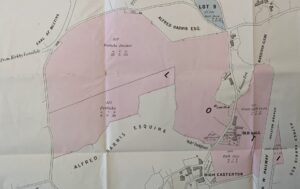
Extract of the 1890 Auction programme for the proposed sale of Old Casterton Hall[57]
1891 Census
The 1891 census was taken on 5 April. Joseph Mattinson, now aged 49 was still living at Old Manor with his wife Mary Ann and now five children. There was Sarah Francis Mattinson, aged 10 who had appeared in the previous census, as well as Annie Jane Mattinson, aged 8, Mary Dorothy Mattinson, aged 7, Michael Cecil Mattinson, aged 5, John Morton Mattinson, aged 3, James Hugh Mattinson, aged 1 and Richard Septimus Mattinson aged 3 months, born 4 January 1891, all born at Old Manor.
As before, there were servants living at the farm. There was Mary E. Blenkarn aged 23, a Domestic Servant born in Skelsmergh, Mary Martindale, aged 18, also a Domestic Servant born in Selside and James Atkinson, aged 21, a farm servant born in Levens.
The Mattinsons went on to have another child, Edith Margary, born 25 June 1893 at Ghyll Cottage, Hugill near Staveley, showing that they had moved away from Old Manor after living there for more than 40 years.
No Sale
The auction was not a success. The day after the sale a local newspaper reported that there were few bidders, and the land was not sold. Alfred Harris had offered £8,800 for all the lots including the Casterton Fell Estate. The individual lots were then offered up for sale. Lot one being Old Manor with adjoining fields received a bid of £2,000, with all individual lots collectively achieving only £7,295.[58] With no sales, the Earl of Lonsdale kept ownership.
The following September the same estates were advertised to be let by tender. One of the tenders was for what had been Lot 1 in the previous year’s unsuccessful auction. Casterton Old Hall (Old Manor) was described as ‘a good Dwelling House, well supplied with water, together with large and convenient Outbuildings, and the Land includes very valuable accommodation land situate near Casterton and the market town of Kirkby Lonsdale.’[59]
The advertisement stated that ‘James Croft, at the Old Hall, High Casterton, will show the Property… Persons wishing to view the Property are requested to write to JAMES CROFT as above, stating when they will call.’ It would appear then, that for a short while at least, James Croft was living at Old Manor sometime after 5 April 1891. He was listed in an 1894 and 1897 Directory as the head gamekeeper to Alfred Harris.
On 24 August 1893, Edward William Rawlinson (1893 – 1980) , the son of Edward Rawlinson (1859 – 1938), farmer, and Sarah Jane Rawlinson nee Haythornthwaite was born at Old Hall High Casterton. The records suggests that they were living at Old Manor at this time but only for a few years; no earlier than 1891 and no later than 1899. I will expand on this narrative later.
The Applegarth Family
The next mention of somebody else living at Old Manor is in an auction programme for a sale to be held on 15 June 1899. The auction was selling the substantial estate of Alfred Harris. Included in the estate, as lot number 24, was ‘Casterton Old (Manor) Farm situate at High Casterton, and forming a model holding for a Gentleman Farmer.’[60] Lot 24 included more than 56 acres of land including many of the fields that had featured on the 1760 map above including Bull Copy, Great and Little Addy Croft, Peslicks, Peslicks Meadow, part of Birkett Wood, Wandales and an allotment on Casterton Fell.
The auction details stated that it was ‘Let, together with other Lands, to Mr. and Mrs. APPLEGARTH, on a Yearly Candlemas Tenancy, at the apportioned Rental value of the above of £113 per annum, which, together with the Sporting Rental, which is estimated at £3, makes a total Rental value of £116 per annum.’
If Alfred Harris were selling Old Manor as part of his larger estate, he must have bought it sometime after he failed to acquire it at the auction in 1890. Given that Alfred’s gamekeeper was recorded as showing off the property in 1892 to prospective tenants, it would appear that he had bought Old Manor sometime before this.
In an old copy of the Lowther Estate catalogue in the Carlisle archive centre is a reference to a duplicate conveyance document regarding the sale of Casterton Old Hall from James Lowther to Alfred with a date range 1838 – 1891, suggesting a sale date of 1891. The original document cannot be found.
It is not clear when Joseph Applegarth moved into Old Manor. He and his wife were married in Casterton on 9 November 1892. The announcement in the newspaper read ‘Casterton, Holy Trinity Church, on the 9th inst., by the Rev A. D. Burton, Joseph Applegarth, son of John Applegarth, West Auckland, to Nora [Sic] Broughton, only daughter of the late Rev W. L. Broughton, vicar of St. Helens, Auckland.’[61]
An 1894 Directory records Joseph as living at Norwood Cottage (now Norwood House), in High Casterton, only a few hundred metres from Old Manor. Their eldest daughter, Dorothy Latham Applegarth, was born 28 December 1893 at Norwood Cottage. The birth certificate confirmed that Joseph was a farmer and that his wife was Leonora Sarah, nee Broughton, commonly known as Laura. Joseph and Leonara’s eldest son, William Broughton, was also born there on 2 March 1896. They must have moved from Norwood Cottage after March 1896, but before 10 June 1899, because their son John Oliver Applegarth was born at Old Manor on that day.
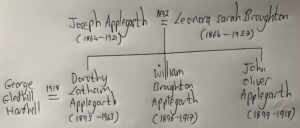
Applegarth family tree
Parish Council Elections 1896 – 1898
At the Casterton Parish Council meeting held in the village schoolroom, one of the seven candidates to be elected the Chairman was J. Applegarth. He received 18 votes. The winner was the incumbent Chairman who received 23 votes.[62]
The following year, there was an election for five parish councillors. The successful candidates were T. Parker a farmer who received 40 votes, E. Wilson, also a farmer, with 39 votes, J. Collinson the blacksmith, with 30 votes, M. Harris, a gentleman, with 30 votes and J. Applegarth who was listed as a gentleman, with 29 votes. The unsuccessful candidate was R. Brennan, a platelayer with 27 votes.[63] At a meeting later in the month, Mr. J. Applegarth was elected as an overseer on the Casterton Parish Council and at the same meeting, he was elected as a Trustee for the poor’s money.[64] He was re-elected onto the Parish Council on the following year.[65]
1898 newspaper
Joseph’s wife Laura was an important member of the Casterton Choral Society. An 1898 newspaper reported that the Society gave their annual concert on Easter Monday ‘in the new room of the Clergy Daughters’ School. There was a large attendance, many coming from Kirkby Lonsdale and the neighbourhood. The performance was highly successful, as evidenced by the warm applause of the audience… “Corydon Arise,” a part-song of classic excellence, received a well-merited encore.[66] Mrs. Applegarth was accompanist, and as usual played in grand style. Too much praise can hardly be given to her and Mr. Burton, who have worked hard to bring the society to such a state of efficiency.’[67]
1899 OS Map
The 1899 OS map shows that additional buildings had been added to the farm when compared with the 1890 auction programme plan of the estate. The new buildings are today known as The Croft and Lavender Cottage. They were built sometime after 1890 but before 1899 by the new owner Alfred Harris. The section of the building attached to Old Manor noted above as not being there today was still there in 1899.
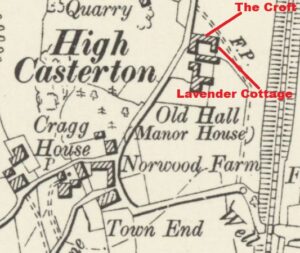
Extract of the 1899 OS Map showing the addition of two buildings onto the outbuildings of Old Manor, today known as The Croft and Lavender Cottage
1900 – A Case of Slander
Joseph found himself in court in 1900 in a very curious legal case. He was reported as being the Casterton Vicar’s warden and living and farming at Old Manor (referred to as Old Hall in the newspaper report), just down the road from Newlands, the home of the defendant Henry Bownass. Joseph was seeking to recover the sum of £500 from Bownass (about £70,000 in 2025).[68]
It appears that Henry had written some letters and made some statements about Applegarth that he had taken exception to.[69] In court, Henry had stated that at the time he wrote the letters, he honestly believed his statements to be correct and that before the case came to court he had corresponded with Applegarth and his solicitor to try to reach an agreement about a term of settlement. Henry had already acknowledged that, ‘There was no foundation for them [the statements] and he had made a mistake, as he was led by information which was evidently not correct.’ And that he now, ‘unreservedly withdrew everything he had said both in the letters and postcards.’ He told the court that, if he had in any way affected the plaintiff’s character by the accusations he regretted it.
Applegarth’s solicitor stated that, ‘The libel and slander were of the very worst nature,’ and that, ‘There was absolutely no proof, so far as they knew, that the defendant had been misled by information from any body.’ He added that he was willing, ‘to accept judgment for £75 because they thought it would be sufficiently large to make people in the neighbourhood believe that there was no foundation whatever for these charges,’ The judge agreed that the ‘substantial sum of £75’ would be sufficient to clear Applegarth’s name and agreed to the settlement. As to what was being alleged… the report remained silent.
1901 Census
The 1901 census provides additional details about the Applegarth family. In the census, Joseph Applegarth was listed as head of the household, He was aged 37, a Farmer, born in Bishop Auckland, County Durham. His wife Laura (Leonora) Sarah Applegarth, nee Broughton, also aged 37, was born in Hartlepool. As noted above, their children were born in Casterton. There was Dorothy Latham Applegarth, aged 7, William Broughton Applegarth aged 5 and John Oliver Applegarth, aged 1.
Also living at Old Manor was 28-year-old Agnes Rowson. She was a Governess, hailing from Aylesbury, in northeast Lincolnshire. There was also Robert Smith, aged 20, an Agricultural Labourer from Windermere, and Margaret Parker, a 20-year-old General Domestic Servant born in Auckland St Helen in County Durham.[70]
1903 Auction Catalogue
In 1903, Casterton Old Manor Farm in High Casterton was again offered up for auction. It was Lot 1 in the auction that was set to take place on 8 October, at the Royal Hotel in Kirkby Lonsdale.
Other lots included the Old Toll Bar Cottage, Cragg House Farm, Town End House, The Cragg[71] and Elm Tree Cottages. The auction was ‘BY ORDER OF THE TRUSTEES OF THE LATE ALFRED HARRIS,’ who had died… the implication here is that the auction held in 1899 did not result in the sale of Old Manor Farm.
As they had in 1899, the auction details observed that it was ‘A Model Holding for a Gentleman Farmer.’[72] It described the property as ‘A SUPERIOR DWELLING-HOUSE, well built, in excellent repair, and containing on the upper floor, approached by two staircases, Four Best Bed-rooms, and one Man-servant’s Bed-room; and on the ground floor – Dining-room, Drawing-room, and a roomy Kitchen, fitted with modern range, whilst at the side is a capital Dairy, Pantry, Scullery, and Wash-house, etc. The extensive range of Farm Buildings includes a Three-stall Stable, with Loose Box adjoining, Cart Shed, Two Large Barns, Two Shippons (each for twelve cows), Two Calf Boxes, a Loose Box for young cattle, a Shippon for six young cattle, another Shippon for twelve head of cattle (now used as a store house) Two Piggeries, and a Poultry House.’ The lot also included 64 acres, 1 rood and 28 perches of land, ‘the greater portion of which is exceedingly rich and fertile Pasture and Meadow Land.’
The copy of the auction programme held at Kendal Archives, includes handwritten notes by the auctioneer J. S. Roper. They suggest that the original reserve price of £3,300 was not reached, but that afterwards Lot 1 was included with Lot 2 (Old Toll Bar Cottage) and Lot 7 (The Cragg – plot of land) as a package acquired by ‘Makinson’.
Curiously, a 1905 Directory still lists Joseph Applegarth as farmer at Old Manor Farm. This may have been because either the directory had not been updated, or that there was a delay in the Makinsons moving into the farm, instead deciding to rent it to the Applegarths before they moved. Circumstances detailed below suggest that the latter scenario seems to be the correct one.
An interesting award was made at the Lunesdale Agricultural Show in 1905 for long service, which suggests that the Applegarths were still at Old Manor in that year. The prize category was for an unmarried female servant aged under 25 working for a bona fide tenant farmer, who has been employed ‘without intermission the longest period on the same farm or with the same master’. Second prize was awarded to Margaret Parker who had served Joseph Applegarth at Old Manor for 6 years 6 months.
The Applegarths therefore left Old Manor around 1905 to 1906. The 1911 census shows that they had moved to Springfields in Scorton near Garstang.
A Sad Postscript
Joseph Applegarth died in 1921 in Scorton, near Garstang, leaving £1,448 to his wife Leonora. Leonora died in 1927 in Scorton, Garstang, leaving an estate of £2,653 to her only surviving child, Dorothy who at this time was the wife of George Hardhill. Dorothy was the sole heir of her parent’s estate because, tragically, both her brothers had been killed in the First World War.
William was a member of the Machine Gun Company of the Coldstream Guards. He was killed in action on 17 January 1917 at Combles, France. He is buried at Combles Communal Cemetery Extension, Somme, France.
John (called Jack in the 1911 census) was a Private in the 2nd Battalion of the Coldstream Guards. He died on 9 October 1918 at Forenville near Cambrai, France. He is buried at Forenville Military Cemetery near Cambrai, France.
Both are recorded on the Scorton War Memorial.
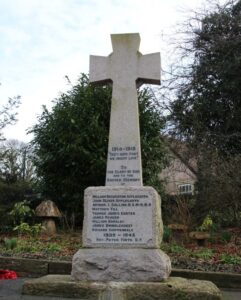
The War Memorial at Scorton recording the Applegarth brothers sacrifice
The Makinson Family
A possible reason for the delay in the Makinsons arriving at Old Manor was the tragic death of William Walker Makinson (1852 – 1905), one of the best-known Lunesdale cattle breeders of his day. It was he who had purchased the property at the auction in October 1903 but at the time of his death was still living at Lane Foot Farm, Newton, Whittington.
Several newspapers reported on his death. He was helping to unload a cart of timber and that while picking up a rope, a three hundred weight (about 150kg) log fell on him. He immediately exclaimed “It has done for me!,” which proved prophetic, he died soon after.[73]
In 1993, William’s grandson William ‘Billy’ Makinson recorded his reminiscences about living in Casterton his entire life. He stated that ‘my grandfather bought Old Manor but unfortunately he was killed in an accident before they came to Casterton – and so my grandmother farmed with her three sons for several years…’[74]
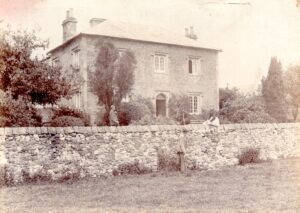
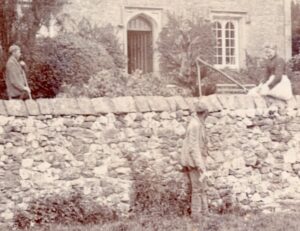
The front of Old Manor C1905 showing the front door before the conservatory was added. From left to right are siblings John Makinson (1889 – 1967), William Makinson (1885 – 1945) and Esther Walker Makinson (1882 – 1947)
1911 Census
At the time of the 1911 census, the Makinsons had been at Old Manor for a few years. The census records that Agnes Makinson, nee Rigg (1855 – 1920), was still the head of the household, a widow, aged 56, born in Middleton, as were all her children. They were William Makinson (1885 – 1945) in the photograph above, aged 26, Alice Makinson (1887 – ), aged 24, John Makinson (1889 – 1967), in the photograph above, aged 22 and Richard Makinson (1891 – 1924), aged 20, all working on the farm.

Agnes Makinson nee Rigg (1855 – 1920)[75]
In a 1910 and 1914 Directory, Mrs Makinson was listed as a private resident living at the farm. Her three sons were still farming but were not listed in the local directory.
1914 OS Map
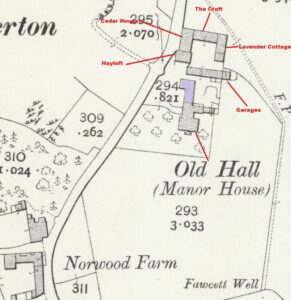
Annotated extract of the 1914 OS Map
A review of the 1914 OS map shows that the configuration of the building remains the same as in 1899. The section shaded in purple still extant. In the photograph below, part of that structure can be seen on the left.
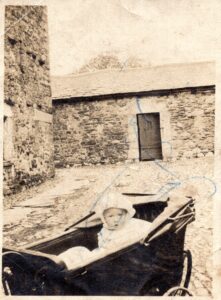
A photograph of Billy Makinson (1921 – 2007) in his pram C1922. The building at the rear of the photograph with the door is today’s garages. On the left is the section of Old Manor shaded purple in the 1914 map above which was later demolished.[76]

The Makinson Family Tree
Early 1920s
In 1920, John Makinson (1889 – 1967), married Elizabeth ‘Elsie’ Rawlinson (1890 – 1984) in Barbon. Elizabeth’s father was Edward Rawlinson (1859 – 1938). He married her mother, Sarah Jane Haythornthwaite (1856 – 1896) in 1889. A newspaper reported that Elizabeth was the only daughter of Mr. E. Rawlinson of Beckside Farm in Barbon, adding ‘The bride will be much missed as a parish worker and especially in Sunday schoolwork. The Rev. J. Harrison, vicar, officiated, assisted by Canon Burton of Casterton… Mr. Dick Makinson was best man, and the bride was given away by her father. Mr. H. Makinson, F.R.C.O., was at the organ and played suitable music, including Mendelssohn’s Wedding March. A reception was held at Beckside, after which the happy pair left for the south.’[77] Following their honeymoon, Elizabeth made her married home at Old Manor. As I will describe later, she had previously lived there as a child some 25 years before.
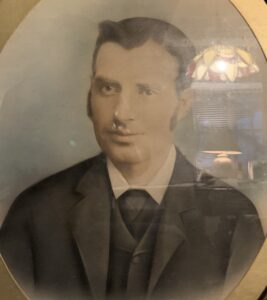
Edward Rawlinson (1859 – 1938), Elizabeth’s father
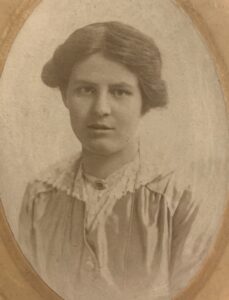
Edward’s daughter, Elizabeth ‘Elsie’ Rawlinson (1890 – 1984), married John Makinson (1889 – 1967) in 1920
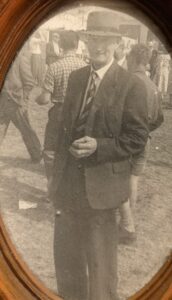
John Makinson (1889 – 1967), Eliazbeth’s husband, at the Kirkby Lonsdale Agricultural Show
A 1921 trade directory no longer listed Mrs [Agnes] Makinson (1855 – 1920) as a private resident at Old Manor, she had died there in 1920. The directory now recorded that her recently married son John was farming at Old Manor. He was listed as farmer in subsequent directories through to 1938, the last one available.
The 1921 census
In the 1921 census, John Makinson is therefore listed as head of the household, aged 32 and 5 months. With him is his new wife Elizabeth nee Rawlinson (1890 – 1984) aged 31 and 5 months. There were no children yet, their first born would arrive within the year. Also in the household was Richard Garnett Fisher, a servant performing general farm work, aged 18 and born in Casterton, and Helena Lucas, a domestic servant age 20 born in Burrow, Lancashire.
John and Elsie’s children soon arrived. First was William Edward Makinson (1921 – 2007), known as ‘Billy’, one of the great 20th century characters of Casterton, followed by Richard Rawlinson Makinson (1928 – 2007), and Agnes Mary Rigg Makinson (1931 – 2022). In time, they all attended Casterton primary school, as did Billy’s children.

The next generation C1921, Billy as a baby, being held by his father John (1889 – 1967). Billy’s mother Elizabeth ‘Elsie’ Rawlinson (1890 – 1984) is on the left. Elsie’s Aunt is the white-haired lady sat on the right, Mary Elizabeth Rawlinson (1859 – 1940). Standing behind Elsie is her brother Edward Rawlinson (1893 – 1980) who had been born at Old Manor[78]
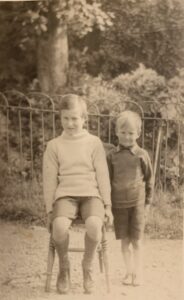
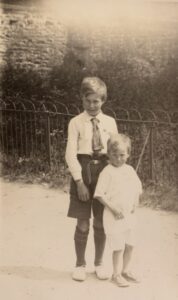
Billy and his younger brother Richard outside Casterton School, C 1933 and C1935[79]
Reminisces
As noted above, Billy Makinson recorded his reminiscences about his life in Casterton. I have included below a few paragraphs relevant to his life on the farm.
Billy recalls that the railway ran within a stone’s throw of Old Manor. ‘Our railway station was Kirkby Lonsdale, and after all, Kirkby station was a great deal nearer Casterton than it was Kirkby Lonsdale although Kirkby station was in a different parish, a different county, a different diocese! But nevertheless it was our station, and at one time it was a very busy station: there were passenger trains; the passenger trains that went down were at twenty past the hour and the passenger trains that came up were five minutes to the hour. They kept very regular times: you could certainly set your clock by the five minutes to seven at night – it was never late. There were also goods trains – there was a local goods train that stopped at every station; there were express goods trains that went through that didn’t stop at any of the stations. I think there would be five passenger trains in each direction during the day.
Of course you must remember that most people went by train, even when I was young… I must tell you about the milk that went from Kirkby station. Milk from this area mostly went to Bradford or Leeds and the milk went on the twenty past six train at night and all the milk was taken to the station by milk floats, not perhaps a lot of farmers in Casterton but two anyway… there were about seventeen milk floats at Kirkby Station waiting for the twenty past six train. Then you’d to cross the line; get across before the five minutes to seven train came with the empty kits.’
He also remembers how at busy times of the year, the farmers helped each other out. One such time was when the corn was being threshed, or as Billy pronounced it ‘thrashed.’ Before the war they used a steam powered thresher. ‘You went round to perhaps… a dozen farms – because you needed well into the teens of men to do a thrashing – there was the pitching of the sheaves, and feeding the thrasher, which was an important job; cutting the bands on the sheaves, carting the throw-away, and straw in the beginning was loose and so it had to be forked by hand – you had to have about three men forking the straw out of the way and then there were the corn bags – well you always had – it always seemed to be an oldish man who looked after the corn bags, and he perhaps had a couple of young men to carry the bags – because they filled the bags, oh there would be 10 or 12 stone in each bag… you tried to get as much corn in a bag as you could.[80]
And then of course after that, along came the war, and all farmers had to produce food, and so thrashing became an even more important business…. Nobody of course was paid because you helped each other, and they were really big occasions – I think the men used to arrive about 9.00 in the morning and some of them had their drinking – their drinking was, what shall we say? Lunch: elevenses – which was about 9.00 before they started and sometimes you perhaps did half an hour/an hour’s work before. Then dinner – you all marched into the farmhouse for dinner. The drinking in the morning and tea in the afternoon was taken out to the men, but dinner of course everybody came in – and there might be about, oh, it would be up to about 20 men, and they were all fed, and I think they were fed exceedingly well: I think every farmer tried to do it better than the last – big occasions, anyway – but I think happy times.’
He also proudly remembers his bicycle. ‘Well, everybody had bicycles as soon as you could – well, you had a second hand bicycle to begin with, which you could get for just a few shillings – but the height of people’s ambition was to buy a new bicycle, and you could buy a new bicycle – the price was £3.19s.6d – I can remember that because that’s what my first bicycle cost – and of course you saved up to buy the bicycle or you bought it on HP – you paid over perhaps twelve months for the bicycle – and everybody had a pride in the bicycles – you looked after them and cleaned them – and if you had a good new bicycle, well, you really were somebody!’
The 1939 Census
The ‘War Census’ shows that the family had grown larger in the years since 1921. John was listed as Dairy Farmer, his wife Elizabeth performing domestic duties. ‘Billy,’ born 15 Oct 1921, assisting his father on the farm, Richard Rawlinson Makinson, born 29 June 1928, was still at school. One person was redacted, presumably, Agnes Mary Rigg who was born in 1931. Also listed on the census was Mary Elizabeth Rawlinson, born 20 June 1859, and retired. She was the spinster aunt of Elizabeth, her father’s twin sister, who died the following year.
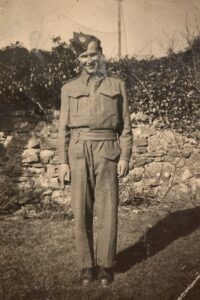
‘Billy’ during the war in his Home Guard uniform c. 1943
Shared Ancestor
In 1948, Billy Makinson married Elsie Hope (1921 – 2013). As will be explored below, Billy and Elsie were half cousins, sharing a grandparent. That grandparent was Sarah Jane Haythornthwaite (1856 – 1896). The Haythornthwaites were well known residents of Kirkby Lonsdale. When Sarah Jane was born, her father William was running a chemist and a grocer’s store in the town.
In 1884, Sarah was unmarried but became pregnant. The following year she gave birth to a son, Wilfrid Hope, a long way from Kirkby Lonsdale, at Cross Park in Bideford, Devon. On the birth certificate, the father was named as John Hope, a Land Surveyor. Sarah was recorded on the birth certificate as Sarah Jane Hope, formerly Haythornthwaite. This was a fiction, there was no John Hope, he had been invented.
The Makinson family story was that Sarah’s twin sister Elizabeth Haythornthwaite was married to a land agent called John Bateman, at Chapel Le Dale on 31 December 1879. Their first child, John Tory Bateman, was born 28 May 1880, only five months after his parents’ marriage. In the 1881 and 1891 censuses, John’s occupation was listed as a Land Agent in Clapham.
In fact, Sarah and Elizabeth were not twins. Sarah Jane was born 12 June 1855, whereas her sister Elizabeth was born 29 August 1856.
The family understood that after Elizabeth and John Bateman’s child named Arnold was born, Sarah Jane went to help her sister after the birth. The scandal that cast a veil of secrecy for more than 100 hundred years was that John Bateman was the father of Wilfrid. Again, the story has some minor inaccuracies which don’t change this underlying premise.
Arnold Wilson Bateman was born 11 March 1885 while Wilfrid was born three months later, on 3 June 1885 which meant that Sarah Jane was already pregnant when Arnold was born However, it might well be that Sarah Jane went to help her sister after the birth of another son, Sydney Bateman, who was born 6 April 1884.
Land Agents, sometimes called Stewards, were professional managers responsible for the entirety of a large landed estate, acting as the crucial link, or sometimes buffer, between the often aristocratic landowner and their tenants. They held a significantly high social position, a result of their education, considerable responsibilities, and close association with the powerful landed aristocracy and gentry. Because of this, John Bateman’s career would have been at risk if it were discovered that he was the father of a child out of wedlock and that the mother was his wife’s sister.
The reputation of both John and Sarah Jane needed to be protected. Family secrecy was paramount. This was why Sarah gave birth so far from home in Bideford.

Portrait of Sarah Jane Haythornthwaite (1856 – 1896)
Wilfrid’s Story
Sarah Jane kept the baby and returned to the north. More family turmoil was to follow. On 10 December 1889, Sarah’s sister died aged only 33, while giving birth to a premature baby. It was her ninth child in the nine years since her first child. The baby, named Octavius, died after only six hours. Curiously, John Bateman was not listed as being present on the mother and child’s death certificates, rather, it was William Metcalfe, Elizabeth’s cousin.
Life with all its complexities continued for the living. In the 1891 census, Sarah and Wilfrid were living at Gibson’s Farm in Quernmore. By this time, Sarah had married Edward Rawlinson (1859 – 1938) in 1889 and they had had a daughter, Elizabeth Rawlinson (1890 – 1984), born in 1890, in Caton. Living with them at the farm was Sarah’s mother, Elizabeth Haythornthwaite, nee Metcalfe. The subterfuge continued. In the 1891 census, Wilfrid Hope was described as a visitor, born in Devonshire. Also at the house was Arnold Wilson Bateman, also listed as a visitor.
As noted above, Sarah Jane and Edward’s second child, Edward William Rawlinson (1893 – 1980), was born at Old Manor in August 1893. It is likely therefore that their three-year old daughter Elizabeth Rawlinson also lived there. This is the Elizabeth who, as noted above, returned to Old Manor when she married John Makinson in 1920. Because he had been living with the Rawlinsons two years earlier at Quernmore, it is possible that Wilfrid Hope also lived at Old Manor for a while.
Sadly, Sarah Jane died in May 1896 aged 40. Her son Wilfrid was 11 years old, her daughter Elizabeth just six and Edward only two. She died at Beckside, Barbon of ‘pernicious anaemia,’ at the time a fatal disease. Her brother-in-law Richard Bownass Rawlinson attended the death.
Perhaps Sarah Jane had moved away from Old Manor before her death, or perhaps she was being cared for by the Rawlinson family while her family remained at Old Manor. The 1901 census shows that the widowed Edward and his own two children were living in Beckside, Barbon with his brother Richard.
After Sarah Jane’s death, Wilfrid went to live with the Bownass family at Newlands in Casterton, attending Casterton School. Wilfrid was distantly connected to the head of the household Henry Bownass, through his stepfather Edward Rawlinson (1859 – 1938).
Wilfrid’s move to Newlands may be the reason for the 1900 scandal noted above, involving Henry Bownass and Joseph Applegarth, a previous tenant at Old Manor. Could it be that Henry Bownass was accusing Joseph Applegarth of being the father of Wilfrid? Perhaps Henry was aware that Wilfrid was illegitimate, but not aware who the Rawlinson’s believed the father was. We will never know, but the fact that Wilfrid had moved into Newlands after the death of his mother in 1896, and not long after, Henry was making accusations of the ‘very worst nature’ about Joseph Applegarth ultimately leading to the court case in July 1900 does raise this as a possibility.
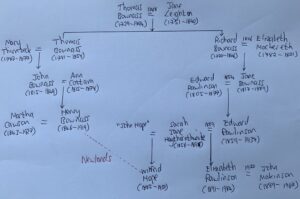
Tree showing how Wilfrid Hope was connected with the Bownass family at Newlands through his stepfather Edward Rawlinson and Jane Bownass

Jane Rawlinson (1817 – 1889) nee Bownass, with Richard Bownass Rawlinson (1856 – 1936), c. 1858, the older brother of Edward Rawlinson (1859 – 1938)
In the 1901 census, Wilfrid was 15 years old, living and working at Fell Gate Farm in Casterton as a farm servant. His birthplace was now recorded as Westmorland. He was working for Robert Postlethwaite. The family story is that some of the Haythornthwaites came to Casterton and found that Wilfrid was being mistreated. They took him away and moved him to Harrogate, obtaining him a place in an orphan school run by the Police.
While there, he lodged with a gardener at a big house and trained as a gardener. The 1911 census shows him living at Bleak House, 35 Belle Vue Bank, Low Fell, in Gateshead. The head of the household was John William Wilkinson, a gardener. Wilfrid was listed as a boarder at the large family home.
Later that year, in November, he married Emily Robinson (1883 – ) in Bilton, Harrogate. The marriage certificate records that Wilfrid’s father was John Hope, an Estate Agent, continuing the fiction that started at his birth. His new wife’s father was Charles Robinson, also a gardener.
Things were at last working out for Wilfrid. After an itinerant life, being passed from pillar to post, he was at last able to settle down. In the 1921 census, he and Emily were living at Gardener’s Cottage, Whitley Bridge, Eggborough, with their children Edith Mary aged six, Iris aged four and Wilfrid junior, just one year old. Also in the house was 72-year-old Charles Robinson, still a jobbing Gardener. A year later, they had another child, Elsie Hope, born at the cottage on 14 July 1922.
A Disturbing Uncertainty
As noted above, Elsie Hope married William Edward ‘Billy Makinson’ in 1948. Billy was the son of John Makinson (1889 – 1967) and Elizabeth Rawlinson (1890 – 1984). As described above, Elizabeth was the daughter of Edward Rawlinson (1859 – 1938) and Sarah Jane Haythornthwaite (1856 – 1896). Elsie and Billy were therefore half cousins.
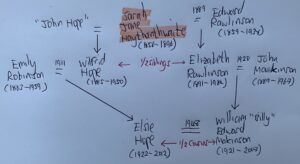
Tree showing Elsie and Billy’s shared grandparent
Sadly, through their long and happy marriage, Elsie and Billy were concerned that because they were half cousins, their marriage was at worst illegal or at best would be subject to social condemnation. Their fears must have been accentuated by the keen desire of their forebears to hide the secret that Wilfrid was illegitimate. If that were to be revealed, it would also come to light that Elsie and Billy were very closely related.
Sadly, their fears were baseless. It was and remains legal and not uncommon for even full cousins to be married. They erroneously lived in dread of their secret being discovered and a government or church official arriving to force them to separate. Their son William Andrew, known as Andrew, recalls that they became experts at deflecting conversations away from Elsie’s family past.[81]
Billy was very knowledgeable about the history of Casterton, learning a great deal from his father. He was proud to have been born and bred in Casterton and in Westmorland. He often joked ‘but then I married a Yorkshire Lass’, drawing a veil over the fact that his wife had lived at Old Manor with both her parents, her younger brother and possibly her step brother Wilfrid, around ten years before the Makinsons had even arrived!
Poignantly, knowing the anxiety that their parents had lived with about being forced apart, their children chose two words to appear on their gravestone ‘Together Forever’. Andrew reflected that in these more enlightened times, it is hard to understand how in Victorian times, families went to such great lengths to hide their secrets and how the perceived stigma allowed the story to continue through the generations, starting in 1885 and not ending until 2013 when Elsie Makinson, nee Hope died, 128 years later.[82]
Elsie’s War Service
Before they were married, ‘Elsie’ served with the WAAF during the war. She wrote an account of her time there which was published in the 578 Squadron website. In brief, on her twentieth birthday, on 14 July 1942, as an unmarried lady, she was required to register for National Service. One week before Christmas, she travelled to Gloucester to join the Air Force. She was given three weeks’ basic drill at Compton Basset in Wiltshire, after which she was posted to Brandesburton on the east coast. While there she started training as a Wireless Operator, returning to Compton Basset for a six months’ training course. By the time she finished the course, the role of Wireless Operator had become redundant because it was no longer considered a secure form of communication.
After her training, Elsie was asked where she would like to be posted. Taking a chance, she chose the nearest aerodrome to her family home. She felt very lucky when she succeeded in being posted to Snaith, Yorkshire to work in the Signals. After a few months she was then posted to Burn, which lies two miles south of Selby in North Yorkshire, a satellite station to Snaith, which was only 3 ½ miles from her home.
Elsie on the right at Burn Aerodrome c. 1945[83]
She remained there for the next 18 months. Her story records in detail her time there, how she had to work hard to convince sceptical chauvinists that, as a woman, she was able to perform technical tasks. She was also nostalgic about her cycle trips visiting home and many other stories from her single life.
In March 1945 she reluctantly returned to Snaith to serve out the war. Operations at Burn were wound down as the war was reaching its conclusion. Before she left Burn, ‘the Signals Officer arranged for us to have our photos taken next to a Halifax. It had been a very wet morning and there were large pools of water on the ground. It was suggested that one photo of the WAAF’s should be taken sitting on the aircraft’s tail. A ladder was produced and we all climbed up. Some of us were a little afraid of falling off. Then one of the airmen took the ladder away and we were stranded. It was a long drop down into the puddles. They left us there for a while and then some kind person brought the ladder back and we landed safely.’[84]
Elsie, fourth from right, at Burn Aerodrome late c. 1945[85]
After The War
After the war, the Makinsons continued farming at Old Manor. In the mid 1950s, Cumbria’s first known polished jade axe was found by Richard Makinson in a field called Addi Croft. It was picked from the surface while lifting a crop of potatoes, close to the railway that ran behind Old Manor. The axe was thought to have been Neolithic and imported from the continent. It was deposited at the Craven Museum in Skipton.[86]
On the farm, c. 1955, on top of the Haywain is John Makinson (1889 – 1967), from left to right, holding the horse, Elizabeth ‘Elsie’ Rawlinson (1890 – 1984), sat on the ground is William Andrew Makinson. Standing is Agnes Mary Rigg Makinson (1931 – 2022), with John Wilfred Makinson and Susan Mary Makinson in front of her. Leaning on the fork is ‘Billy’ Makinson (1921 – 2007) and not forgetting Roger the horse.[87]
A corner field by the crossroads, with Newlands in background C1960. The oats are being harvested for Roger the horse. From left to right John Makinson (1889 – 1967), John’s wife Elizabeth ‘Elsie’ nee Rawlinson (1890 – 1984), with shirt off John Makinson, with scythe Billy Makinson (1921 – 2007), and Elsie Hope (1921 – 2013), who had just delivered the tea.
1956 OS Map, 1960 and 1964 Aerial Photographs
The 1956 map shows that the building shaded in purple in the 1914 OS map above was no longer there. Billy Makinson remembered it being taken down when he was a young boy. Other than that, the footprint was very much the same as before and substantially the same when aerial photographs of the farm were taken in 1960 and 1964.
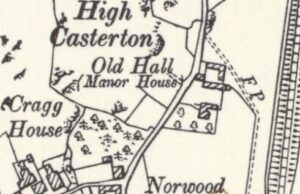
Extract of 1956 OS Map
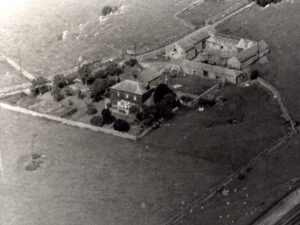
c. 1960 aerial view of Old Manor. Note that the large Shippon, today’s The Croft, is being re-slated. The conservatory glass roof has been whitened to deflect the sun.[88]
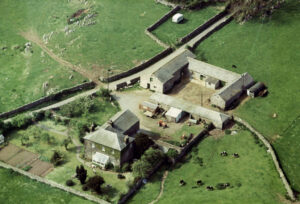
A 1964 aerial photograph of Old Manor[89]
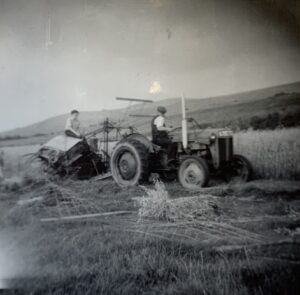
Subcontractors cutting the corn at Old Manor c. 1964[90]
The Makinsons continued farming at Old Manor for many decades. They were heavily involved in village affairs, regularly attending church and actively supporting social events. For many years, Billy was the church warden.
Elsie’s obituary from 2012 offered a window into how active they were. ‘Holy Trinity had a packed congregation last Saturday for Elsie’s funeral. Elsie was born on July 14th 1922 and died on December 28th, aged 90. She came to live with the Makinson family at Old Manor Farm on her marriage to William (Billy) in 1948 and lived there for the rest of her active life. Elsie and Billy had 3 children; John, Susan, and Andrew. Elsie threw herself into village life as well as helping the family on the farm. During her life Elsie was on the committees of the W.I., Mothers Union, Village Hall and more recently Cancer Research. She was a keen church-goer and involved in all village and church activities. She helped with the village school, was involved in amateur operatics and on the occasion of the Queen’s Silver Jubilee she helped organise village celebrations. She will be greatly missed by her family and all who had the good fortune to make her acquaintance.’[91]
Moving On
When John Makinson died in 1967, his wife inherited the farm. When she died in 1984, to keep the farm, Billy needed to raise funds to pay death duties. One way to do this was to divide Old Manor into two, with Billy and Elsie moving into the north side of the building, to be renamed Old Manor Farm, and the south block being converted into a standalone house, keeping the name Old Manor. In preparation for the changes, Billy and Elsie’s son Andrew improved the previously little-used rear of Old Manor Farm so that they could move in there.
New Owners
John and Gill Sykes moved into Old Manor, next door to what was now called Old Manor Farm, on 12 August 1985. After their arrival, they immediately did extensive renovations to the property.
After 40 years, Gill still lives there and, like Elsie before her, has made a huge contribution to village life.
Gill recalls that soon after they had moved into the house, their beagle introduced himself to the Makinsons. The bathroom window is at floor level, and it did not take long for the dog to fall out of it, through a broken windowpane. He landed in the rockery and was found wandering and injured in the lane by Elsie, who could not work out how he had escaped.
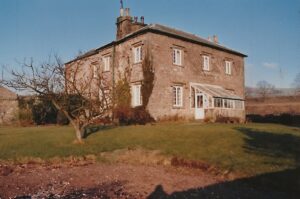
Old Manor (front) and Old Manor Farm (rear) c. 1985[92]
End Of An Era
A few years before Billy died in 2007, the family decided that they would sell Old Manor Farm’s outbuildings and convert them into new houses. John and his wife Elizabeth moved from Pearset Park back across the road into Hayloft, while new residents acquired the other three houses. Elsie continued to live at Old Manor Farm until not long before she died in 2013.
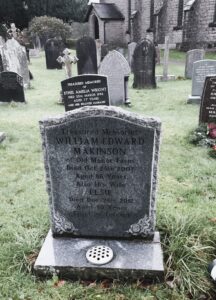
The gravestone of Billy and Elsie Makinson with the words ‘Together Forever’[93]
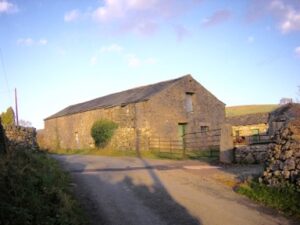
The Hayloft and Cedar House prior to redevelopment
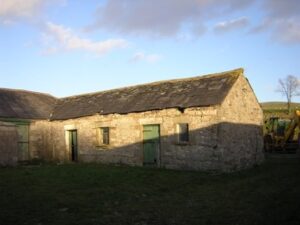
Lavender Cottage and on the left part of The Croft prior to development
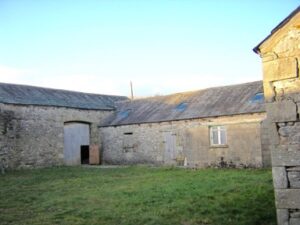
With your back against the current garages, on the left with the barn door is Cedar House, in the centre the old shippon now The Croft and on the right, the corner and gable end of the small shippon, now part of Lavender Cottage.[94]
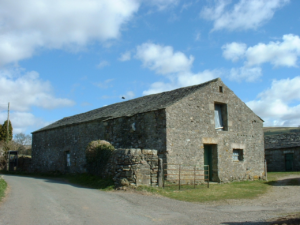
The Hayloft and Cedar House prior to redevelopment[95]
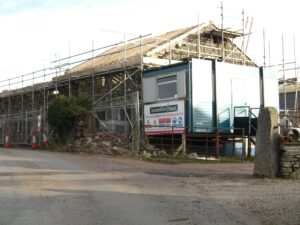
The Hayloft and Cedar House under development C2004[96]
Today
The aerial view of the farm in 2025 shows that the buildings that were there in 1964 are still there, but with recent additions to what were the original outbuildings. These additions are highlighted in red below.
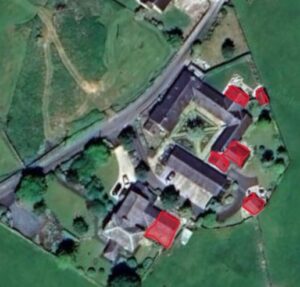
2025 Aerial view of Old Manor Farm and its old outbuildings with recent additions highlighted in red
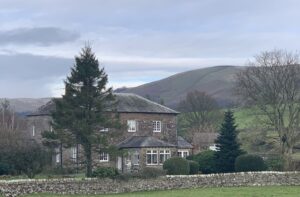
Old Manor in 2025[97]
‘I’ve known some wonderful people over the years who’ve lived in Casterton: not all were born in Casterton, but after living in Casterton for a few years they became part of Casterton, and I’m very proud to be a Castonian.’
Billy Makinson, 1993. Born and died in Casterton, 1921 – 2007
With thanks to Andrew Makinson for his time and support in preparing this sketch and for the loan of photographs
Simon Drakeford
December 2025
References
[1] Courtesy of Gill Sykes. Billy Makinson claimed that he recognised the cow!
[2] Courtesy of the author
[3] Garnett, E. and Rose, S., Victoria County History of Westmorland I: Lonsdale Ward. Victoria County History, 2025, pp.121-3.
[4] Marc Morris, A Great and Terrible King: Edward 1 and the Forging of Britain, 2021, pp229 – 261
[5] Brian Paul Hindle, ‘Medieval Roads in the Diocese of Carlisle’, Transactions of the Cumberland & Westmorland Antiquarian & Archaeological Society – 2nd Series, Vol. LXXVII, 1977, pp83-95.
[6] The prime source of the Bellingham section is Garnett, E. and Rose, S., Victoria County History of Westmorland I: Lonsdale Ward. Victoria County History, 2025, pp.121-3. This has been supplemented with various online family pedigree trees. Many of the birth and death dates are approximate.
[7] Source https://landedfamilies.blogspot.com/2023/05/546-bellingham-of-levens-and-castle.html . Accessed 8 October 2025
[8] Reminiscences of William Makinson, dictated to Margaret Pilkington, 23 August 1993, https://www.castertonparishcouncil.org.uk/reminiscences-by-william-makinson/ . Accessed 9 October 2025
[9] Cumbria County Archives (Carlisle), DLONS/LS/1/KL bundle 4 (This is a reference in written Lowther Estate record. The documents can’t be found in digital record)
[10] “Delinquency” was the formal charge used to justify the seizure of a Royalist’s assets (both personal property and landed estates) by the victorious Parliamentarian side to fund their war effort and consolidate their power during the Interregnum period.
[11] Cumbria County Archives (Carlisle), WDX/352
[12] Jane M. Ewbank ed., Antiquary on Horseback – The Collections of the Rev. Thos. Machell, Titus Wilson & Son, 1963, p27
[13] This was presumably John Lowther (1655 – 1700)
[14] Cumbria County Archives (Carlisle), DLONS/L/5/4/15 bundle 9. Lease of Demesne, Colliery and Fell Farm
[15] Lammas day is on 1 August. Candlemas day is on 2 February.
[16] Cumbria County Archives (Carlisle), DLONS-L-5-4-15 bundle 3, 1760 Casterton Demesne Map, Courtesy of the Lowther Estate Trust.
[17] Cumbria County Archives (Carlisle), DLONS/L/5/4/15 bundle 3. Note regarding lease terms complied with and advice re new house
[18] Cumbria County Archives (Carlisle), DLONS/L/5/4/15 bundle 3. Note regarding repairs
[19] A Lath is a narrow strip of wood nailed horizontally across wall stud or ceiling joists as a base for a layer of plaster.
[20] See https://www.castertonparishcouncil.org.uk/a-sketch-of-norwood-farm/
[21] Carlisle Patriot, 11 August 1827, p3
[22] Westmorland Gazette, 30 November 1833, p3
[23] Lancashire County Archives, WRW/L/R640/57
[24] Courtesy of the author
[25] Kendal Mercury, 7 May 1836, p3
[26] Westmorland Gazette, 9 December 1837, p3
[27] This would have been William Lowther, 1st Earl of Lonsdale (1757 – 1844)
[28] Westmorland Gazette, 6 January 1838, p3
[29] Kendal Mercury, 24 October 1840, p4 ‘Bastardy Case’
[30] Kendal Mercury, 4 September 1841, p2
[31] Westmorland Gazette, 30 March 1844, p3
[32] Kendal Mercury, 11 October 1845, p2
[33] Westmorland Gazette, 27 September 1844, p1
[34] Lancaster Gazette, 22 May 1847, p3
[35] Westmorland Gazette, 13 July 1850, p2
[36] Lancaster Gazette, 9 March 1850, p6
[37] Kendal Mercury, 3 June 1837, p3
[38] This is the only time I have seen High Casterton referred to as South Casterton.
[39] Westmorland Gazette, 26 September 1863, p8
[40] Westmorland Gazette, 1 October 1864, p8
[41] Lancaster Observer and Morecambe Chronicle, 14 October 1865, p2
[42] Cumberland and Westmorland Advertiser, and Penrith Literary Chronicle, 09 October 1866, p4
[43] Lancashire Gazette, throughout 1869
[44] Lancaster Gazette, 22 October 1870, p8
[45] Westmorland Gazette, 21 September 1872, p 6
[46] Lancaster Gazette, 20 September 1873, p8
[47] Lancaster Gazette, 23 November 1878, p5
[48] Penrith Observer, 18 September 1883, p6
[49] Lakes Chronicle and Reporter, 1 October 1886, p5
[50] Lancaster Gazette, 17 September 1887, p3
[51] North British Agriculturist, 8 February 1888. P12
[52] Soulby’s Ulverston Advertiser and General Intelligencer, 9 February 1888, p7
[53] Westmorland Gazette, 5 April 1890, p6
[54] Carlisle Journal, 12 December 1890, p3. This would have been Hugh Cecil Lowther, 5th Earl of Lonsdale, (1857 – 1944)
[55] Westmorland Gazette, 20 September 1890, p4
[56] Cumbria County Archives (Kendal), WDB135/1820
[57] Courtesy of Cumbria County Archives (Kendal), WDB135/1820
[58] Westmorland Gazette, 6 December 1890, p8
[59] Penrith Observer, 1 September 1891, p8
[60] Courtesy of Cumbria County Archives (Kendal), WDB22/2/1/12
[61] Newcastle Courant, 19 December 1892, p4
[62] Lancaster Standard and County Advertiser, 13 March 1896, p2
[63] Lancaster Standard and County Advertiser, 9 April 1897, p7
[64] Lancaster Observer and Morecambe Chronicle, 23 April 1897, p8
[65] Westmorland Gazette, 19 March 1898, p2
[66] Composed by Charles Villiers Stanford, 1852-1924. Listen here: https://www.google.com/search?q=Corydon+Arise&oq=Corydon+Arise&gs_lcrp=EgZjaHJvbWUyBggAEEUYOTIKCAEQABiABBiiBDIKCAIQABiiBBiJBTIKCAMQABiABBiiBDIKCAQQABiABBiiBDIKCAUQABiABBiiBNIBCTM4ODVqMGoxNagCCLACAfEF2ZK0CME4IxA&sourceid=chrome&ie=UTF-8#fpstate=ive&vld=cid:dc726af0,vid:zpjIQuW2MQs,st:0
[67] Westmorland Gazette, 16 April 1898, p6
[68] I have written a Sketch about Newlands. A fuller account od the legal case and about Henry Bownass can be found at https://www.castertonparishcouncil.org.uk/newlands/
[69] Lancaster Standard, 13 July 1900, p6
[70] Lancaster Standard and County Advertiser, 15 September 1905, p3
[71] This was not the house of that name, but the land on which the Cragg was later built.
[72] Courtesy of Cumbria County Archives (Kendal), WDB22/2/1/18
[73] Manchester Evening News, 14 February 1905, p4
[74] See https://www.castertonparishcouncil.org.uk/reminiscences-billy-makinson-part-1/ Reminiscences by William Makinson, accessed 30 October 2025.
[75] The Makinson Archive, Courtesy of William Andrew Makinson
[76] The Makinson Archive, Courtesy of William Andrew Makinson
[77] Unattributed newspaper clipping
[78] The Makinson Archive, Courtesy of William Andrew Makinson
[79] The Makinson Archive, Courtesy of William Andrew Makinson
[80] 10 Stone is about 63kg
[81] Susan and Andrew, the two surviving children of Elsie and Billy have confirmed that they are content for the story to be told, as is Elizabeth the wife of John.
[82] Taken from written notes of Andrew Makinson.
[83] The Makinson Archive, Courtesy of William Andrew Makinson
[84] Source http://www.578squadron.org.uk/squadron/waaf.html Accessed 6 November 2025
[85] The Makinson Archive, Courtesy of William Andrew Makinson
[86] Transactions of the Cumberland & Westmorland Antiquarian & Archaeological Society, Series 2, 1979, vol79, p143
[87] The Makinson Archive, Courtesy of William Andrew Makinson
[88] The Makinson Archive, Courtesy of William Andrew Makinson
[89] Courtesy of Jean Hamlett
[90] Cumbria County Archives (Kendal), WDX 139/29, 1965 scrapbook
[91] Casterton Village Newsletter, January 2013, p2
[92] Courtesy of Mrs Gill Sykes
[93] Courtesy of the author
[94] Courtesy of Jean Hamlett
[95] Courtesy of Gill Sykes
[96] Courtesy of Gill Sykes
[97] Courtesy of the author
Thank you for your precise and comprehensive story of the Casterton Manor House – fascinating.
I am particularly impressed and informed by the story of one of the tenants, the MATTINSONS. We have
been researching the SHELFORD family of British Columbia, Canada and were having trouble locating
the origin of Sarah Frances Mattenson (note spelling) born about 1880 in England. At least five variations
of her maiden name are registered in B. C. Vital Statistics, only one, in the death certificate of her son,
Hugh Morton Shelford, on 21 May 1986, spells MATTINSON. The marriage of another son, David Myles
Shelford, on 7 July 1942, listed his mother’s birth place as CASTERTON, England. Your webpage seems to
have confirmed her origin.
Sarah Frances, known as “Safie”, came to Canada in spring of 1915, and married John “Jack” Leo Shelford
Hi Jim,
Sorry for my late reply, I have been on a long trip to Australia to see my son. Thank you for taking time to write. I am very pleased that my sketch was able to help you pinpoint your relative. I will add the fact about ‘Safie’ to the sketch.