

A Review of Pre 1828 Maps
Unlike the previous houses I have written about, Rock Cottage was not a ‘grand house’ such as Old Hall or Norwood House, nor was it a substantial farm such as Gowrey, rather it was a house of modest means where a labourer rather than a Lord, ‘Gentleman’ or Yeoman Farmer would have lived.
The 1823 Map of Westmorland by Greenwood shows the area around Rock Cottage quite differently. Neither Rock Cottage nor Lane End are shown as indicated below by the red circle. Nor are Bray Barn (now called Owl Barn) or Elm Tree, but Bee Nest (purple arrow) and Manor House (blue arrow) are shown.
There is another omission. The road by Rock Cottage is not shown as a crossroad. The dotted blue line on the map below shows the approximate route of the missing road, that is to say Colliers Lane, that now heads down to the current A683 towards Toll Bar Cottage.
This is interesting because Billy Makinson in his reminiscences suggests that the road from Rock Cottage towards the school past North Heads, which he referred to as ‘Nob’s Row’, used not to be there. He recalled ‘Well, I’ve been told that Casterton was really two separate hamlets, both in the parish of Kirkby Lonsdale – but there was High [Casterton] and Low Casterton. There was no road connecting the two hamlets – not the road that we know it now, by North Heads, Laneside and suchlike [i.e. Nob’s Row]. The only connections were you went up Bee Nest [i.e. up Gate Heads Brow] and along the old Roman road and down past the school, or down Colliers Lane and [turn right] up to Town End. All the houses on the road between are all comparatively new.’[1]
We can see that the road Billy mentioned ‘Nob’s Row’ was definitely there in 1823, I wonder whether the story he was told was muddled and it was in fact Colliers Lane that was not there?
The 1815 Inclosure Map[2], which does not include the area around Rock Cottage, does show the current A683 running past Casterton Hall and on through the village. What it does not show is the road intersection where Colliers Lane starts near Toll Bar Cottage (which was not built in 1815) running towards Rock Cottage, agreeing with the layout of the 1823 map.
Billy, born in Casterton in 1921, his family moved to the village some time after 1901 when the Applegarth family are recorded as living there on the Census, but before 1909, when a report of a wedding mentions that the Makinsons lived there. ‘Nob’s Row’ therefore was definitely in existence some 85 years before Billy’s family arrived in Casterton and at some point, perhaps 110 years before Billy was told that at one time it had never used to be there. The person telling him would it seems, have also been told by somebody else.[3] ‘Nob’s Row’ therefore was definitely in existence some 80 years before Billy arrived in Casterton and at some point was told that at one time it had never used to be there. Room therefore for some confusion… it could be of course that years, decades or centuries earlier neither Colliers Lane or Nob’s Row existed and that indeed, to travel by cart from Old Manor Farm to, say Holly Bush, it was necessary to go up Gate Heads Brow past Bee Nest, turn left down the unnamed road towards the school and to Holly Bush.
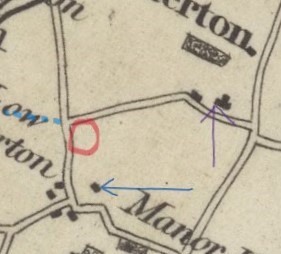
Extract from 1823 Greenwood Map of Westmorland showing Manor Farm (blue arrow), Bee Nest (purple arrow), Colliers Lane as dotted blue mark and site of Lane End / Rock Cottage with red circle
First Evidence
Despite not being a very large house, it is possible to find information about the history of the Rock Cottage through the years. The first written evidence of the house’s existence is on the 1828 Hodgson map where there is a building clearly identifiable where Rock Cottage sits today. Comparing this map with the 1843 Tithe Map (see below), it would appear that the footprint of the building on the 1828 map is actually only the barn suggesting therefore that the barn was built before the house.
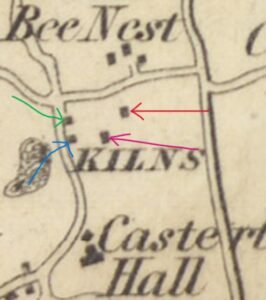
Extract of 1828 Hodgson Map of Westmorland. The blue arrow points to Rock Cottage, the green to Lane End Cottage, the red to Elm Tree and the pink to what was called ‘Brays Barn’ on the 1843 Tithe Map on what appears to be the site of today’s Owl Barn. What is called Casterton Hall is now Old Manor Farm and Old Manor
Mid Nineteenth Century
The next records of the property are found in the 1841 Census and the 1843 Tithe Map.
In the Census records, the property name is not specifically mentioned but with reference to the order in which the listed properties are recorded within the Census, and cross referencing this to the Tithe Map, it is possible to deduce who was living at the house at this time.
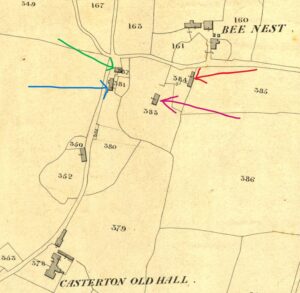
Extract of 1843 Casterton Tithe Map. The blue arrow points to Rock Cottage, the green to Lane End Cottage, the red to Elm Tree and the pink to ‘Brays Barn’ on what appears to be the site of today’s Owl Barn. What is called Casterton Old Hall is now Old Manor Farm and Old Manor
Rock Cottage is plot 381 on the Tithe Map. When compared to the Hodgson map of 1828, the footprint of the building is different. It appears that the cottage with its front porch had been added to the original barn. Examining the outer wall today, it is clear to see where the original barn and later house were joined.
The Tithe record shows that the enlarged building was owned by William & Joseph Cantrell and that the occupant was Deborah Braithwaite. The 1841 Census is less clear. Lane End is identified and so is Elm Tree Cottage. Lane End seems to have several households living within it, one of which I believe is actually Rock Cottage. In that household are Joseph Braithwaite, aged 60, an agricultural labourer, his wife Deborah Braithwaite aged 45 and their children William aged 7 and Thomas aged 3.
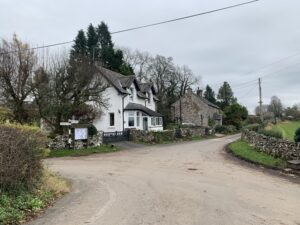
The crossroads photographed by author in 2023, Lane End at the front with Rock Cottage behind.
Braithwaite Family History
William was baptised at Casterton Church on 8 June 1834, only 8 months after it had been consecrated by the Bishop of Carlisle. His brother was also baptised there on 27 May 1838 with his name recorded as Thomas Turner Braithwaite, his mother was aged 42!
Joseph and Deborah Armistead were married in Kirkby Lonsdale on 20 January 1834 which, given the baptismal date of their son William suggests a hastily arranged wedding. Nevertheless, their wedding was announced in the local newspaper which observes that they were both residents of High Casterton.[4]
This was Deborah’s second marriage, her first husband was Robert Armistead. They were married in Tatham in 1812. Robert died in 1821 but they had had four children, all born in Gressingham. Deborah’s maiden name was Turner, hence William and Deborah’s second son’s middle name.
A Case of Bastardy
In 1840, Joseph’s name was mentioned in the local newspaper as part of a Bastardy Case involving his neighbour Robert Hodgson who, in the 1841 Census lived at Casterton Old Hall [today’s Old Manor]. The case was lengthy but worthy of comment as it sheds light on social attitudes towards illegitimate children and how the unmarried mother was treated.
On 3 September 1840, an application was made by the Board of Guardians of the Kendal Poor-law Union to the magistrates holding Petty [Court] Sessions at Kirkby Lonsdale. The application was placed on Robert Hodgson to reimburse the township of Kirkby Lonsdale for the maintenance of ‘a bastard child’, born of the body of Jane Dobson, of which he was the reputed father.’[5] Robert’s attorney objected to the application on several technical legal grounds but these were overruled and the hearing continued.
Conception and Pregnancy
Jane Dobson was called to speak. Holding the baby in her arms she told the court that ‘I am a single woman, and was confined [gave birth] of the child in my arms on the 2nd of March last; Robert Hodgson is the father of it; I lived [as a] servant with him; I went to him in Martinmas[6], 1838, and lived with him twelve months; I became pregnant whilst there; the child is female, and baptized Mary; before leaving Mr Hodgson’s service, I told him my situation; I told him in hay-time, 1839, and in October I told him again. In October he wished me to go, and take something to put the child away, and said that five or ten pounds were no object to him.’
This indicates that Robert was encouraging Jane to have an abortion. This course of action was illegal and risky for the mother, but nevertheless was a common practice in nineteenth century England.[7] Jane is talking about dates by referencing religious festivals and agricultural periods. The fact that Robert had told Jane that £5 or £10 pounds was no problem for him suggests arrogance or wealth or both. £10 in 1838 would be about £1,380 today.
Jane refused to terminate the pregnancy, she continued to tell the court about her experience. ‘At Martinmas[8] he paid me my wages; I left his house a few days after Martinmas; he then gave me three sovereigns above my wages. I went to Joseph Braithwaite’s, a neighbour, on leaving Mr Hodgson’s;
Mr Hodgson came to Braithwaite’s on the night of the day on which I left his house. I could not sleep at Braithwaite’s, and Mr Hodgson said, go back, and you shall have a bed; I went back and slept there three or four nights. At Braithwaite’s, he said that the child was his, and that he was sorry that he had brought [Sic] her to that situation; this was said in the presence of Braithwaite, his wife, and daughter.’[9]
Pregnancy and Birth
‘I afterwards came to Kirkby Lonsdale, and remained there till I was confined. I was conveyed hither by Robert Hodgson’s horse and cart; he also gave me some potatoes, and said I was welcome to them, or anything else I wanted.’ Jane delivered their baby on 2 March 1840 at Queen Street, Kirkby Lonsdale. Queen Street is no longer on the Kirkby Lonsdale maps but examining the 1841 Census where it does appear, I think it might be the short stretch of road currently part of Mill Brow between Main Street and Horse Market.
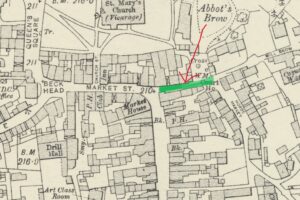
Extract from 1914 OS Map showing shaded in green possible location of Queen Street
Jane continued ‘I remained at Mr Willan’s till three weeks before Whitsuntide,[10] during the time I was there, Mr Hodgson came to visit me; he came about December, and Edward Gibson was with him; Edward Gibson said Robert Hodgson wanted me; I went out to him, and remained perhaps an hour with him in the yard. I remember being there a month ago; in the evening of that day Mr Cragg relieved me; I had no money nor credit, and the woman with whom I had lodged before, refused to take me in again, without [unless] I took her something; I cannot support the child and myself, I could support myself without it. [i.e. without the baby] Mr Hodgson kept two men servants and a boy, but kept no other female servant than myself’.
In the 1841 Census there is an Edward Gibson living in Casterton, he is aged 30 and listed as a Blacksmith, probably operating out of what is now Town End Garage. At this time Robert is aged 25 making him about 22 when he made Jane pregnant. In 1841 he had living with him three male servants and one 20 year old female servant.
Motherhood
In the court session Hodgson’s attorney cross examined Jane. According to the reporter, in a ‘long, tedious and irrelevant’ way, trying to prove that she was depraved and that ‘she had intercourse with other men.’ Having been subjected to the invasive cross examination, Jane explained that after being unable to remain in Kirkby Lonsdale with her newborn child, she went to her home town of Dalston in Cumberland to try to get the ‘child affiliated’, this was refused and she was sent to the local workhouse in Carlisle for 14 days.[11] While there, Jane told the governor of the workhouse that she ‘wanted to father the child’, but that the governor replied that it would never be fathered at the workhouse because the father was so far away and therefore Jane might consider to go back to Casterton and take the child with her, ‘as the father of it was bound to keep it, he being a householder.’[12]
Hodgson’s attorney continued his cross examination ‘on to a most tedious length, and in the most preposterous way, in order to prove that she could not be in a state of destitution’. The attorney contended that when the application was made on 3 September Jane could not be destitute because on 14 September she would have been able to earn 1 shilling and 7 ½ pence for a day’s shearing. The Magistrates rejected this argument.
Edward Gibson was called to bear witness, he confirmed Jane’s account of what had happened and added that Hodgson had said to him ‘if he was not the father of the child in question, he had done enough to father it.’
Judgement
Nicholas Bailey who lived at Town End Farm in Casterton, was an Overseer of the Poor, he told the court that Hodgson was the joint holder of a farm with his father and brother.[13] The farm was rented out at £150 a year. The Magistrate ordered Hodgson to reimburse Kirkby Lonsdale township the money it was owed and to pay Jane 2 shillings a week ‘as long as the child might be burdensome.’
Better Times
Jane’s daughter Mary was baptised in Kirkby Lonsdale on 15 May 1840. In the 1841 Census, a one year old Mary Dobson is recorded as living on Mitchelgate, Kirkby Lonsdale. Further investigation offers a happy outcome for Jane. On that 1841 Census is Jane Atkinson, aged 26. She was born Jane Dobson and had married David Leeming Atkinson, a stonemason, in Kirkby Lonsdale on 29 May 1841, just one week before the Census was taken on 6 June. The couple went on to have six children and remained there on Mitchelgate until Jane’s death in 1888.
Tragedy
The story for young Mary however had a tragic outcome. In 1846, alone at home, while lighting a candle with lucifer matches, Mary’s clothes caught fire, she screamed but when no one came she ran out of the house onto Mitchelgate. Robert Howson saw her, threw her to the ground and extinguished the flames. Her clothes were nearly all burnt off, she was taken back into the family home. She died two days later, the Coroner’s verdict was ‘Accidentally burned to death’.[14]
Educating the Poor
Returning to Rock Cottage and the Braithwaite family. In 1847, Joseph was awarded a kind of scholarship by the ‘Westmorland Society’.[15] The Society celebrated its 101st anniversary at the London Tavern in Bishopgate, London. The ‘great and good’ of Westmorland were in attendance including Lord Lonsdale. In the morning, an election took place of seven children who were to be ‘clothed, maintained, and educated by the Society’. Joseph Braithwaite of Casterton came second in the ballot receiving 342 votes. He and his family will have been overjoyed but also relieved, the previous year Joseph had missed out on the vote coming ninth in an election for five students with only 62 votes.[16]
The Westmorland Society had been running this charitable venture for many years, the accompanying report to the 1847 meeting observed that to that point 140 children had been appointed of whom 24 were still ‘under the fostering care of the institution.’ In 1846 at the centenary celebration, those under the Society’s care were paraded in front of the members, ‘The children, maintained, clothed, and educated by the society were now introduced, and, under the guidance of the chaplain and the secretary, walked round the room. Their neat and healthy appearance gave great satisfaction, and, by the permission of the guest, they carried off a large proportion of the fruit from the tables.’[17] The same report noted that the society’s key role was to help the younger children of agricultural workers who were in distress but that with the society’s limited funds it could only ‘assist the most unfortunate by maintaining and educating their offspring, and thus enabling them to repair the misfortunes of their parents. It is not pretended that we can elevate them in the ranks of society, but we can teach them, however humble their position in life may be, to conduct themselves honestly and respectably, and as becomes the descendants of those springing from the honest grey coats of the county.’
Aspirations For a School
For many years, the Society had been trying to raise funds to build a school for poor children of Westmorland on the outskirts of London, but for the time being they were ‘allowed to attend different schools provided by their parents.’
In 1849, the school was still unbuilt but for the first time, the Society elected a girl as one of the students to be educated. Sadly for the Braithwaites, what I presume to be Thomas’s sister Ann Agnes Braithwaite came fourth and did not earn a place.[18] Nor did she fare better the following year.[19] Nor in 1851.[20]
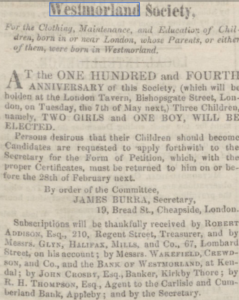
An1850 advertisement in the Westmorland Gazette requesting nominations for candidates to be elected to receive the educational support of the Westmorland Society.[21]
A New School
Finally, in May 1852 a foundation stone was laid for the Society’s school at Norwood Lane, Tulse Hill in Lambeth, (now Norwood Road) and opened for business on 17 January 1854.[22]
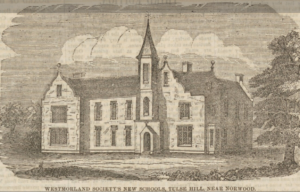
The Westmorland Society’s new school built for the poor children of Westmorland[23]
Back to Square One
Deborah experienced the death of her husband for a second time when Joseph died in 1845 aged 66. Once again she was left with young children to care for. In 1851, Deborah was living with her father Joseph Turner, a farmer of 12 acres, at Halton with Aughton, but by 1861 was listed as back in Casterton in an unnamed house, her former occupation listed as Dairy Manager. She died in 1868 in Kendal aged 76.
1851 and 1861 Censuses
It is not possible to identify Rock Cottage on the 1851 Census, the flow of the houses on the record is somewhat random. However it is possible to identify the house on the 1861 Census. Following the flow of the properties being recorded, the probable record of Rock Cottage is number 22 on the return. It records the Wilson family and three boarders. There were Joseph Wilson, head of the house aged 36, an Agricultural Labourer born in Casterton. With him were his wife Ann Wilson, aged 24 born in Hornby Lancashire. Joseph married Ann Mason at Melling near Hornby on 21 January 1856. On the Census was listed their children. There was Thomas, aged 4, born in Hornby Lancashire and Betty, aged 2, born in Casterton.
There were also three boarders. James Parrington, age 28 a Carter born in Melling, Lancashire, William Cook, age 24, a Carpenter, born in Carnforth and John Cragg, age 16, a Railway Labourer born in Ingleton.
Possible Sighting
On the Glorious Twelfth in 1857, a Joseph Wilson possibly the one living at Rock Cottage, was reported as bagging 5½ brace of grouse on Casterton Fell.[24]
1871 Census
The Wilson family were still at Rock Cottage in 1871. In the Census, Betty is recorded as Betsy and the family had grown. There was Richard born in 1862 and Edward in 1864.
A 1873 directory records a Joseph Wilson as a farmer at Norwood Farm. By 1881 however ,the family had moved to Bee Nest Farm where Joseph died 29 December 1889 leaving his estate of £410 to his wife Ann.

Extract of 1862 Ordnance Survey Map. The blue arrow points to Rock Cottage, the green to Lane End Cottage, the red to Elm Tree and the pink to ‘Brays Barn’ on what appears to be the site of today’s Owl Barn. What is called Old Hall is now Old Manor Farm and Old Manor
The 1881 and 1891 Censuses
In the 1881 Census it is difficult to identify Rock Cottage, but the 1891 Census offers more clues. It seems likely that record number 38 on the Census, referred to as ‘Cragg Cottage’, is what later became Rock Cottage. Record number 37 is referred to as ‘Four Lanes Cottage Town End’ i.e. Lane End Cottage and Newlands is record number 39.
In the Tithe Map above, the field name for plot 380 adjacent to Rock Cottage is called ‘Cragg’ and is the field where The Cragg was later built.
Living at Cragg Cottage in 1891 is Agnes Atkinson, age 50, a dress and mantle maker born at Hutton Roof. She was recorded as being married but I can find no record of who her husband was. Ten years later in 1901, she was living at Middleton as a retired dressmaker, still married and still living on her own.
The 1899 Sale of Rock Cottage
In 1899 Rock Cottage was offered up for auction as part of the sale of the Lunefield Estate which included large parts of Casterton. A Mr Hewitt was living there at this time. Rock Cottage was lot 26 and described thus;
The Very Desirable Small Property
known as
“Rock Cottage”
situate at HIGH CASTERTON, in the Township of that name, a little to the North of Casterton Old (Manor) Farm. The
Cottage is built of stone and roofed with slate, and contains Three Bed Rooms, Sitting Room, Kitchen and Scullery, whilst at
the side is a large Store Barn fitted with copper, and at the rear a small Garden.
It is numbered 115 on Plan No. 2, and in all occupies an area of about
0a, 1r, 15p.
Let to Mr. -, HEWITT on a yearly May Day tenancy at the rental of
£8 10s. per Annum.[25]
The Whitaker Family
By 1901, Rock Cottage is clearly identifiable on the Census return, once again listed between Newlands and Lane End Cottage. Mr Hewitt had moved on, living there was Joseph Raby Whitaker, age 42 born in Quernmore, Lancashire who was a General Labourer. With him were his wife Mary, age 43, born in Borwick, Lancs, and their children Thomas Mason, age 12, born in Capernwray, John Henry, age 11, born in Quernmore, and George Robert, age 4 born in Casterton. Finally there was Dorothy Mason, age 67, a widow and Joseph’s mother in law.
Before they moved to Rock Cottage they had previously lived at Town End in High Casterton. While there, in 1893, Joseph and Mary had had twin boys named Edward and Richard. Sadly, on 1 April 1894, Richard died and his twin brother Edward died in the first quarter of 1895. The birth of Robert on 30 August 1896 would have offered some solace.
They were still living at Town End in 1898. In April of that year Joseph sang and played an instrument at the Annual Casterton Choral Society show on Easter Monday in the new room at the Clergy Daughters’ School. A newspaper report recorded that ‘There was a large attendance, many coming from Kirkby Lonsdale and the neighbourhood. The performance was highly successful, as evidenced by the warm applause of the audience… “Corydon Arise”[26] a part-song of classic excellence received a well-merited encore… It was on the whole the best concert that has been given in Casterton by local effort…’[27]
Joseph Whitaker of Town End, High Casterton was listed as the contact person to show people around his next door property, Norwood Farm which was advertised to be let in Spring 1899.[28] In the 1899 sale catalogue, Town End was also listed for sale and Mr Whitaker was recorded as living there, paying an annual rent of £15. It would seem likely that after living at Town End for a few years, the Whitakers moved into Rock Cottage after it was sold in the 1899 auction, perhaps they had bought it.
Moving On
By the time of the 1911 Census Joseph and Mary Whitaker had moved away from Rock Cottage. At this time they were living on 2 Strickland Gate in Kendal. Joseph was the caretaker at the Liberal Club. Their youngest son George Robert was still living in Casterton. Now aged 14, he had moved into Holly Bush with the Bownass family working as a farm labourer.
Local Industry
Billy Makinson told the present occupiers of Rock Cottage a story about some of the previous occupants. He mentioned that a family lived there who were Carters, that is to say transported goods on a horse and cart. It is not clear when this was but if it were in Billy’s memory, as it appears to be, then the Whitakers are the most likely candidates. Billy mentioned that the horse and cart were kept in the attached barn and that the Carter transported sheep to Lancaster and on their return journey bought back candles and lamp oil which they sold from their door step.[29]
The Scott Family
In the 1911 Census living at Rock Cottage were the Scott family who had been there since about 1907. The head of the family was Thomas Richard Scott, age 37, born in Cowan Bridge. At the time of the census he had been married 14 years and had had six children. He was working at Kirkby Lonsdale Post Office as a Sorting Clerk and Telephonist. With him were his wife Margaret, aged 40, who had been born in Barbon, and their children Margaret Alice, age 13, Eleanor Monica, age 12, Gertrude Isabel, age 10, May age 7 and Norah aged 5 all born in Kirkby Lonsdale.
When Norah was born in 1903 the family were living at Town End Farm in High Casterton. The youngest child was John William aged 3 who was born at Rock Cottage in September 1907.
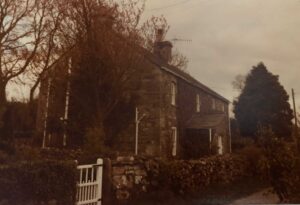
Photograph of Rock Cottage unknown date from Scott family[30]
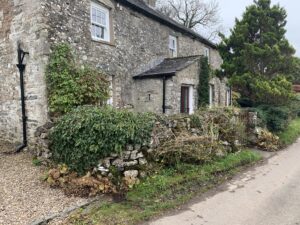
Rock Cottage photographed by author in 2023 from similar view
A Post Office Career
When Thomas Scott retired in Burnley in 1933 he had been with the Post Office for 45 years. His working career was summarised in a newspaper clipping held in his family’s archives.[31] He started working in 1888 in Kirkby Lonsdale and later moved to the Ingleton Post Office as a sub-office assistant before returning to Kirkby Lonsdale in 1891 as a sorting clerk and telephonist.
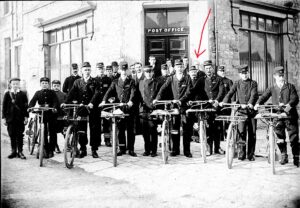
This wonderful photograph shows Post Office workers outside the Kirkby Lonsdale Post Office C1910. Thomas Scott is indicated with the red arrow.[32]

Detail from above photo.
In 1913 he moved to Burnley fulfilling a similar role. In a farewell speech at his leaving event a Mr Beetham spoke a few words. He said that “Mr. Scott had been a real plodder, and if there was a man unwilling to arrive at four o’clock in the morning, he had only need ask Mr. Scott to act as a substitute. It was perhaps that willingness to assist others that had affected his health [leading to his retirement].” This appears to modern eyes to be a slightly strange address. Presumably being a plodder was seen as a compliment! Next to speak was a Mr. Cooley who was equally oblique. He recalled that “Mr. Scott as a sorting clerk and telephonist appeared to have been taken out of his natural surroundings. He would appear to have been more at home as a successful country farmer or as a chairman of a parish council… His outstanding characteristic was his willingness to assist anybody. He was known to have spent hours of his time helping juniors and it was probably due to that fact that he was now retiring on medical advice after 45 years service”.
Despite having retired due to ill health aged 60, he lived for another 25 years.
The Shepherd Family
The 1921 Census records James Thomas Shepherd, age 50 years and 6 months living at Rock Cottage. Born in Middleton, he was a Platelayer, responsible for maintaining the track, for the London North Western Railway Company, working at Casterton. He had been performing this role with the LNWR since at least as early as 1901. Living with him was his wife Agnes, nearly 52 years of age who was born in Dent. With them were their two daughters, Agnes Jane Shepherd, age 25 born in Sedbergh and Ada, nearly 14 born in Middleton. They also had another four children who were not living with them. They had moved to Casterton from Barbon.
James and Agnes were still living at Rock Cottage in 1930 where they were recorded in a Local Directory but it appears that they moved from there soon after.
The Rawlinsons
On 15 July 1930 a John Rawlinson died at Rock Cottage having only recently moved there. He had been born 75 years earlier in Kirkby Lonsdale. John married Mary Preston in 1882.
The 1939 War ‘Census’ shows their daughter Mary Alice Rawlinson, born 8 July 1897, living by private means at Rock Cottage. Also living there was Jack Bilton, born 18 July 1927 who was at school. It is not clear whether Jack was a relative or a lodger.
Mary Alice was the spinster daughter of Mary Rawlinson, nee Preston. Mary died at Rock Cottage on 26 May 1938. She is buried at Casterton Church with her husband John who, as noted above, had died in 1930. They were later to be joined there by their daughter Mary Alice Robinson.
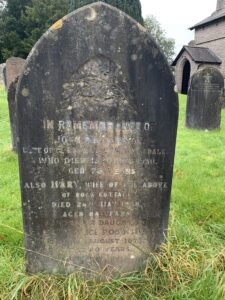
The grave of John and Mary Rawlinson and their daughter Mary Alice in Casterton graveyard taken by Author
The executors of Mary’s will were her son Edward Rawlinson who was living at Caldew Side Farm at Garstang and Mary Alice. The value of the estate was £1,936. Beneficiaries of the estate in equal measure were her daughters Jane Moore, Sarah Brewer and Mary Alice and her son Edward.
A local story says that Mary Alice had been betrothed to a gentleman living in Casterton but tragically, the person fell down some stairs and died before the marriage. On a happier note, in 1955 she married William Robinson two years her senior. Mary died August 1973, the same year as her husband William.
A Visitor
It is not clear when Mary Alice left Rock Cottage. The current residents recall a gentleman named Mallinson who knocked on their door one day asking to look around because he had lived there. He may well have been living there in between Mary Rawlinson and the Alexanders who as noted below moved there in the early 1960s.
A 1965 Scrapbook
In the 1965 Woman’s Institute Scrapbook Rock Cottage is shown with a very nicely painted watercolour. The description reads ‘Rock Cottage is a typical country cottage with a pretty garden. It is especially interesting in 1965 because alterations have been made during this year. A studio, bedroom, storeroom and garage have been made from a barn attached to the cottage.
Mr, and Mrs. Alexander, who use Rock Cottage for weekends and holidays, hope to live in Casterton in the not-too-distant future.’[33]
The Alexanders
Richard Rennie Alexander and his wife Gladys did indeed eventually move permanently to Rock Cottage. Mr Alexander was an architect, in fact the City Architect of Lincoln. He was the person responsible for the alterations mentioned above. He installed an office above the old Barn area of the house. The inscription on the painting reads ‘RRA 65’ which suggests that Richard painted it, using his architectural and artistic skills. Note that the painting shows that the ground floor of what had been the barn was the garage. In later years the garage was turned into living accommodation as shown in the 2023 photograph below.
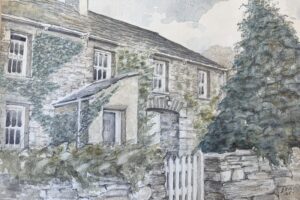
Sketch of Rock Cottage taken from the Casterton Women’s Institute ‘1965 Casterton Today’ scrapbook [34]
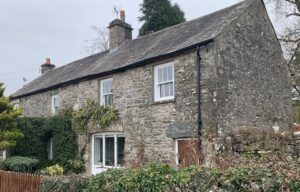
In this 2023 photograph taken by author the old Barn entrance, once a garage is now a large window.
The Alexanders’ son was a Conservative MP named Richard Thain Alexander. He served the Newark Nottinghamshire constituency from 1979 to 1997.
When Gladys was taken ill, she had to move to a care home in Cockerham where she died in 1990. Richard travelled to see her every day and after a while decided that the time had come to sell their house of more than 20 years. The current occupants, Nigel and Jennifer moved into the house on 14 February 1984.
Simon Drakeford
November 2023
References
[1] Billy Makinson’s reminiscences, p6, can be found here https://www.castertonparishcouncil.org.uk/wp-content/uploads/2021/10/Billy_Makinson_reminiscences.pdf
[2] Cumbria County Archives (Kendal), WPR 19/14/1/1
[3] Westmorland Gazette, 9 January 1909, p6
[4] Westmorland Gazette, 1 Feb 1834, p34
[5] Kendal Mercury, 24 October 1840, p4 ‘Bastardy Case’
[6] Martinmas day is 11 November
[7] See Lauren Boot, Reproductive rights and wrongs: Abortion as a crime in nineteenth-century England, 2017, an unpublished dissertation submitted in part fulfilment of the requirements for the degree of BA Honours in History at the University of Canterbury https://ir.canterbury.ac.nz/server/api/core/bitstreams/a7c53b0e-a24a-40fa-95a3-a4303e17f2ee/content
[8] This would have been mid November 1839
[9] This must have been a daughter from Deborah’s first marriage.
[10] She stayed at Willan’s from mid November until three weeks before Whitsuntide 1840, this would have been mid May 1840.
[11] Jane was trying to get her child attached to her home Parish.
[12] Having a child affiliated was to legally establish who the father was.
[13] For more details about Nicholas Bailey see my Sketch https://www.castertonparishcouncil.org.uk/sketch-of-town-end-farm-cottage-in-high-casterton/
[14] Kendal Mercury, 23 May 1846, p2
[15] Westmorland Gazette, 15 May 1847, p4
[16] Westmorland Gazette, 16 May 1846, p3
[17] Westmorland Gazette, 16 May 1846, p3
[18] Westmorland Gazette, 12 May 1849, p2
[19] Westmorland Gazette, 16 May 1850, p3
[20] Kendal Mercury, 17 May 1851, p5
[21] Westmorland Gazette, 12 January 1850, p1
[22] Kendal Mercury, 21 January 1854, p5
[23] Westmorland Gazette, 15 May 1852, p6
[24] Lancaster Gazette, 22 August 1857, p6
[25] Cumbria County Archives (Kendal), WDB / 22 / 2 / 1 / 12
[26] Corydon Arise was written in 1892 by Charles Villiers Stanford. A rendition can be heard here https://www.youtube.com/watch?v=_2offPo2I1Q
[27] Westmorland Gazette, 16 April 1898, p6
[28] Westmorland Gazette, 10 September 1898, p4
[29] Conversation between author and Nigel and Jennifer Sherring, 15 November 2023.
[30] Courtesy of Shelley Smart and family, Australia.
[31] Thanks to Shelley Smart from Australia for sharing this.
[32] Courtesy of Shelley Smart and family, Australia.
[33] Cumbria County Archives (Kendal), WDX 139/29 [Scrapbook]
[34] Courtesy of the Casterton Women’s Institute
Great reading Simon, thank you so much for the research, Shelley S
Joseph Raby Whitaker’s mother-in-law and Mary Mason’s mother, Dorothy Mason (1834-1904), who was living at Rock Cottage in 1901, was born a Rawlinson. She was cousin to John Rawlinson, 1855-1930, who subsequently lived at Rock Cottage with his wife Mary Preston, and their youngest daughter, Mary Alice, known as Alice.
My Great Aunt (Mary) Alice lived at home as the youngest, spinster daughter, looking after her parents, and played the organ at Casterton church, I believe. According to my mother, when she married Billy Robinson in 1955, they lived at Yew Tree, Casterton but when he died on November 30th, 1956, she sold up and built her own house, Marthwaite, where she lived until her death, as far as I know. She had left Rock Cottage some years before I was born, but we did go to her new house when I was a child in the 1960s.
Dorothy Mason, nee Rawlinson’s father, John Rawlinson, 1807-1890 was elder brother to my 2x Gt Grandfather Edward Rawlinson, 1804-1877.
Dear Anne, Thank you for the additional information. I will use it to update the Sketch. Do you know anything about Jack Bilton who was living at Rock Cottage in 1939 and going to Casterton Primary School? Perhaps an evacuee?
Regards Simon
Dear Simon,
I’m sorry I don’t.