

Old Hall – the first Casterton Hall
Also referred to as Beckside Hall, Casterton Old Hall, Old Manor House
No Record
It is worth noting that Old Hall, or as it was known as at that time Casterton Hall, was not mentioned by the Reverend Thomas Machell (1647 – 1698), a clergyman and antiquary. He pursued his antiquarian interest by travelling on horseback around the Cumberland and Westmorland in 1677 – 1678 and in 1691 to 1693. During his travels he wrote a Journal. On his visit to Casterton in 1692, he recorded details about the Manor House and the old Chapel at Chapel House but did not mention Old Hall. This is presumably because at the time of his visit it was far from being old and was therefore of no antiquarian interest; it also suggests that there was no building there prior to Old Hall being built. [1]
First Record
Old Hall, originally called Beckside Hall, sometimes confusingly referred to as the Old Manor House, or Old Casterton Hall, is one of the oldest surviving houses in the village of Casterton. For the sake of clarity, I will refer to the house as Old Hall unless quoting a source.
The house is first identifiable in the 1674 Hearth Tax return. The Hearth Tax, in existence from 1662 to 1689, was an unpopular and unsuccessful attempt by the Restoration Parliaments to compensate the Crown for feudal rights abolished during the Civil Wars, and to bring in a system of direct taxation so that the unpopular excise and monthly assessments developed by the governments of the Interregnum could be abolished. In theory, two shillings a year was due for each hearth in half-yearly instalments. Two shillings was four days wages for a man reaping in the Kendal area in 1667. By 1674, the tax had been in existence for twelve years and the records were in need of an update. Fortunately, a copy of the updated returns survived. It shows that in 1674, Casterton Hall i.e. Old Hall, had five hearths. It was owned by Mr Wilson (see below), but a Thomas Barker was living there. [2]
Second Record
Two houses, Casterton Hall i.e. Old Hall, and Kirfitt Hall (recorded as Kirk Foot), are shown on a 1770 map of Westmorland. Next to the image of Casterton Hall somebody has written ‘Wilson Esqr’. This old map also shows the oldest farmsteads in Casterton including Whilps Rigg (Whelprigg Lodge), Lang Thwaite, Fell Gate, Bindclose (Bindloss), Gorah (Gowrey) and Chapel Houses. [3]
 Extract from 1770 map of Westmorland showing location of Casterton Old Hall
Third Record
The next available record of the house is in the 1777 South Westmorland Window Tax returns. The Window Tax was first imposed in 1696 on house occupiers to help pay the cost of re-minting the damaged coinage of the realm and replaced the Hearth Tax. There was a standard charge of two shillings for all houses. A revised Act in 1747 provided that households with between 10 and 14 windows paid 6 pence per window on top of the old basic 2 shillings; those with between 15 and 19 windows paid 9 pence; those above that paid one shilling per window. In the South Westmorland 1777 return, it appears that the tax had been increased, the standard charge was 3 shillings. There was one house, Old Hall, with 37 windows owned by the ‘Rev Mr Place’ with a cost of £3 and 17 shillings! [4] The man paying the bill was the Reverend Marwood Place, the vicar of Kirkby Lonsdale who, as we shall see below, was the husband of the Reverend William Wilson Carus Wilson’s (1764 – 1851) aunt. The window tax was finally abolished in 1851, but not before many windows had been filled in to avoid it.
A New Hall?
In 1807, Old Hall is mentioned in a newspaper advertisement informing readers that it will soon be on the rental market. The advert notes that the farm, known as Casterton Hall, is owned by William Wilson Carus Wilson Esq. and was occupied by Richard Coates. It is described as, ‘consisting of a very good-dwelling-house, and convenient outbuildings, a large and productive orchard, with eighty-eight acres (customary measure) of valuable arable, meadow and pasture land.’ The farm also had a common right to access Casterton Fell and to use the adjoining limestone quarry and kiln. [5]
Auction Lots With a Tale
In 1920 a sale of furniture was held at Lady Henry Cavendish-Bentincks’s residence of Underley Hall. One of the lots offers an intriguing glimpse into some early history of the Old Hall. The highest price paid in the auction, £375, was for a fine old state bedstead dated 1570. It was claimed in the auction catalogue that the bed had been in Casterton Old Hall probably since it was made for Edward Wilson of Nether Levens (1557 – 1653), near Levens, Kendal. This was probably not the case, the bed was more likely to have been brought to the house after Old Hall was built.
The description of the bed in the catalogue said that Queen Katherine of Braganza, Princess of Portugal, wife of Charles II, stayed at Casterton Old Hall in 1668 and was reputed to have slept in it. [6] This is quite possibly correct. The Wilson family connection with Queen Katherine is described below.
 1920 Auction Catalogue of Items from Underley Hall
Recycling Furniture
Old Hall is thought to have been built in the late 17th century, certainly before 1674 when it is identifiable in the Hearth Tax records. Today it is a listed building with many notable architectural features. The ground floor has a Tudor fire place with an arched opening, twisted wood columns and an overmantel with relief panels of busts and dragons, probably dating from 1530-40. As with the royal bed, it was most likely brought to have been brought to Old Hall when it was built.

Photograph by Simon Drakeford in 2022 showing the Tudor fireplace
Another notable item, again probably reused from another house, is a built-in wooden cupboard with the carved inscriptions “HWA” and “1613”. [7] It has been hypothesised that the W is for Wilson, the H for Henry (Fisher) and the A for Agnes (Richardson). Agnes was the step daughter of Edward Wilson of Nether Levens (1557 – 1653). She married Henry Fisher and as noted below, their daughter Dorothy Fisher (1601 – 1672) married Thomas Wilson (1592 – 1656). [8] The family tree below gives more details about how they are related.


Photographs by Simon Drakeford in 2022 showing the cupboard with detail of date 1613 and initials HWA
From a Queen to the Reverend William Carus Wilson
In 1669, Queen Katherine of Braganza granted a 96 year lease of land estates reaching into Casterton to Edward Wilson (1618 – 1707). He was Dorothy Fisher and Thomas Wilson’s son. By the time Edward (1618 – 1707) wrote his will, he had purchased the previously leased lands and left them to the children of his second wife Dorothy nee Kirkby. This Edward was the Reverend William Carus Wilson’s three times great grandfather.

King Charles II and Queen Katherine of Braganza
Edward (1618 – 1707) was also ‘related’ to Edward of Nether Levens (1557 – 1653) mentioned above who died without children. His step daughter was Agnes Richardson (the ‘A’ on the cupboard) and she married Henry Fisher (the ‘H’ on the cupboard). Their daughter Dorothy married Thomas Wilson (1592 – 1656). When Edward of Nether Levens died in 1653, his heir was Thomas (1592 – 1656), and so the estates remained connected with the Wilson name.
Thomas and Dorothy’s elder son, also named Edward (1618 – 1707), built Old Hall for his son Roger Wilson (1662 – 1690). When Roger died in 1690 at the age of 27 he left his wife Jane nee Foxcroft a widow. She was four months pregnant with their third child who was also named Roger (1690 – 1755). When Roger and Jane’s first son, another Edward, died in 1726, Roger inherited Old Hall from his elder brother.
Roger went on to have six children. His eldest son Roger (1727 – 1769) died unmarried as did the younger son Thomas (1732 – 1733). Two of the daughters were also unmarried, Jane (c1728 – 1768) and Dorothy (c1729/30 – 1730. Of the two daughters who were married, Anne ( -1793) married the Reverend Marwood Place, whilst the younger daughter, Elizabeth Wilson (1728 – 1793), married William Carus (1738 – 1768). Elizabeth and William’s eldest son was named William Wilson Carus (1764 – 1851). The name Wilson in this case being a second forename, in recognition of his mother’s maiden name. It was he who built the new Casterton Hall, reputedly in 1811, but see below.
In 1793, William Wilson Carus (1764 – 1851) inherited Old Hall from his Aunt Anne, who as previously noted was the other married daughter of Roger (1690 – 1755). She was the wife of the Reverend Marwood Place noted above in the Window Tax section. It was this aunt who insisted that to gain his inheritance, William must change his name from William Wilson Carus to the rather unwieldy William Wilson Carus Wilson, ensuring that the surname Wilson continued its connection with Old Hall and other estates. [9]
William Wilson Carus married Margaret Shipphard and their first child was William Carus Wilson (1791 – 1859) who went on to be the well known Reverend, founder of the Casterton schools and the Holy Trinity Church and eventual inheritor of, amongst other properties, the old and new Casterton Halls and the lands associated with them.

Line of Inheritance of the Casterton Estates from Edward Wilson of Nether Levens to the Reverend William Carus Wilson [10]
When was the New Casterton Hall Built?
When the new Casterton Hall was built, the Old Hall was let out to various tenants. It has been suggested that the new Casterton Hall was built in 1811, however, the above reference in 1807 to the Old Hall being the former Casterton Hall suggests that the new Casterton Hall was built before 1811.
There is further evidence that the new Casterton Hall predates 1811. A newspaper report in 1811 offering an overview of events in Kirkby Lonsdale, noted that a bed of coal was first discovered in Whittington, ‘… on opening a stone quarry, about twenty years ago, for the purpose of building Casterton hall, the seat of W. W. Carus Wilson, Esq.’ [11] If the quarry was opened in 1791, it is reasonable to assume that the house would have been completed before 1811, most likely before 1800.
Old Hall – New Tenants
In 1829, William Durham was listed in a Trade Directory as living at Old Hall.
In 1833, it was noted that Mr Cragg Biggs died aged 38, he was a farmer and had at one time lived at Casterton Old Hall. [12]
It is not clear in the 1841 Census which property is Old Hall. There are two Old Halls recorded, one after the other. One shows the occupier as an agricultural labourer, John Taylor with his wife Margaret and a 15 year old Mary Harrison. The second Old Hall listing shows a James Cookson living there.
In 1848, it was announced that the wife of the Reverend Robert Couper Black gave birth to a son at Casterton Old Hall. [13] His wife was Elizabeth Anne Carus Wilson, the fourth daughter of the Reverend William Carus Wilson, they had been married in Casterton Church in 1846.
Contradictions
In the 1851 Census, a William Peterson, curate of Casterton Chapel and secretary and treasurer of the Clergy Daughters School was living at Old Hall with his wife, sister, daughter, two sons and four servants. Living next door, presumably at Beckside, was William Key, with his wife, son and six servants!
Contradicting this, the 1851 Trade Directory suggests that the Key family had already moved into Old Hall. This could have been explained by the fact that Beckside was also called Old Hall Farm and the directory was referring to Beckside, but in the same directory a Richard Atkinson recorded as a farmer at Beckside.
Whether the Key family were living in Old Hall or Beckside is therefore up for debate. Forty-two year old William Key was a farmer, land agent and steward to William Wilson Carus Wilson (1764 – 1851). Living with him were his wife Margaret (38) and their one year old son Thomas, along with six servants.
A few years later the position was no clearer. A notice published in the Westmorland Gazette in 1854 states that Casterton Old Hall Farm (Beckside) had William Key as a tenant. It was being offered for letting. The person to contact was William Key at Beckside, which I think in the case is referring to Old Hall. [14]
William had some success at farming. In 1857, it was reported that one of his cows from Old Hall had been slaughtered by a butcher in Silverdale weighing ‘an extraordinary weight of fourteen score sixteen pounds per quarter, and which was a first-rate character of beef, and very full of loose fat.’ [15]
At least the 1861 and 1871 censuses provide clarity, they clearly show that William and his family were living at Old Hall.

Unsigned watercolour of Old Hall dated 14 August 1858 still hanging in Old Hall. Courtesy of Will Newman
Long Service Award
In 1868, a meeting was held at the Royal Hotel in Kirkby Lonsdale to recognise the nearly 30 years that William Key had served as a valuer, land agent and farmer in the community. In a previous meeting it had been agreed that a collection should be made to present Mr Key with a testimonial. Some 461 subscribers donated a sum of more than £167 (about £21,000 in today’s money) which was used to purchase amongst other things a gold hunting watch, chain and key, a brass mounted oak plate chest containing numerous silver items for use at a dining table such as a coffee pot, toast rack, various serving utensils and lots of cutlery, together with a handsome illuminated vellum listing the names of the subscribers and a full list of the gifted items.
Celebration
Fifty people had said that they would attend the presentation dinner but bad weather prevented some from attending. The Chairman of the meeting summarised Williams’s early life, noting that Mr Key’s position had been, ‘won fairly and honourably by industry, perseverance, and integrity; the advantages of what the world calls birth, or a liberal education, were not his to start with, but he had succeeded without them, by self-culture and natural ability to raising himself to be respected by all who new him.’ William then took to his feet thanking the Chairman and the room for their kind words. He added that his guiding principle which had given him his success was, ‘To do his duty in that station of life in which it had pleased God to call him.’ [16]
Gas
In 1870, William joined a meeting of the Kirkby Lonsdale Gas Company at the Royal Hotel. At the meeting he confirmed that he was, ‘agreeable for pipes to be laid through land belonging to the Casterton Hall Estate, in order to supply the village of Casterton with gas.’ [17] In an 1895 court case arbitrating between the Gas Company and the Kirkby Lonsdale District Council about how much the gas works were worth, it was reported that in 1892, the Gas Company had supplied 413,000 cubic feet of gas to Casterton. [18]
Generational Keys
William Key died in 1876 and was buried in the Casterton church graveyard. His stone read, ‘Be thou faithful unto death and I will give thee a crown of life. For 35 years a faithful Steward in the Carus Wilson family’.
The 1881 Census records his son, Thomas William Key living at Old Hall. He was head of the household sharing the house with his widowed mother and three servants. By the time of the 1891 Census, Thomas had married, residing in the house with his wife Emma, his mother, a nephew named Robert, a niece called Clarice and two servants.
Thomas’ mother died in 1896. In 1901 he is listed as living at Old Hall Farm rather than Old Hall, this I presume is the property previously known as Beckside (as it is today). [19] He is there with his wife, a niece called Martha, and one servant.
A New Tenant
The new resident at Old Hall in the 1901 census was 58 year old Thomas Easton hailing from Melrose, Scotland. He was a land agent for an Edmund Potter Esq. Thomas was living with two servants, Mary Huck a cook and Jessie Rae a general domestic help. Various Trade Directories show that Thomas was linked with Old Hall from as early 1897 until at least 1910. In the 1881 and 1891 censuses he was recorded as living at Undermilbeck near Windermere, in 1881 with his wife Margaret as a land steward and in 1891 with his sister Mary as a farmer.
 Casterton Old Hall Circa 1907
The Ropers Arrive
In a 1914 Trade Directory, John Roper was recorded as living in Casterton at North Heads. He had moved to Casterton from Kirkby Lonsdale after his marriage to his wife Martha in 1912. The same Directory shows that Cecil Carus-Wilson F.R.S.A. was in Old Hall, albeit briefly. Cecil was the grandson of the Reverend, well known as a geologist and also as Mayor of Twickenham in 1928–29.
A Truncated Career
Born in Kirkby Lonsdale in 1869, John Roper was a solicitor and had been articled to the firm Pearson & Pearson in the late 1880s. [20] This was when he was still a student at Oxford University (reading law) from 1887 to 1890. On the 1891 census his occupation is given as ‘articled clerk to solicitor’, and ten years later as ‘solicitor’. John’s son Michael made notes of what his father told him about his life. He recalled his father telling him about Pearson and Pearson as ‘the family firm’. According to John, both his father, Richard Roper (1814-1871), and his great uncle James (1771-1817), were solicitors in Kirkby Lonsdale for their entire careers. Michael wrote about his father, “John Roper became a solicitor and joined the family firm (by now Pearson and Pearson), worked for six weeks and then went fishing, never to return to the office.” His granddaughter Ianthe Roper thinks that given the information in the census records that this was an exaggeration. However, he was described in the 1911 census as being ‘of private means‘, and it is certain that he never worked during his time at Old Hall. He kept himself occupied playing tennis, cricket and fishing, as well as growing daffodils and being a governor of Kirkby Lonsdale Grammar School, and probably many other voluntary roles. He was also a Freemason, joining the Underley Lodge aged 21 on 30 January 1891. Masonic records show he was still a member of the lodge in 1921 and most likely beyond this. In 1898 he was elected that year’s Worshipful Master of the Lodge. [21]
His ‘private means’ were from legacies left by various aunts. The family wealth came from the iron industry. His grandfather and great-grandfather were both directors of Backbarrow Iron works which lay next to the River Leven, between the villages of Backbarrow and Haverthwaite. [22]
Sporting Endeavour
Before he was married, John had played cricket for Kirkby Lonsdale. For example, in July 1892, he played against Lancaster. Kirkby bowled out their opposition for a miserly 48 with John taking a catch. What looked like a simple total to chase wasn’t. Kirkby were bowled out for 44 with Roper contributing only two runs batting at number nine. [23]
Roper was an occasional player; the next newspaper record of his appearance is in May 1897 when the opposition was Sedbergh School. Once again, Roper barely troubled the scorers, not bowling and being out for a duck batting at nine. [24] In that season he batted seven times, amassing a total of five runs with a highest score of two. [25] In the 1898 season he did not appear in the averages, having batted less than four times. [26] Despite his lacklustre performances, no doubt he was very much appreciated for his services on the cricket club’s general committee! [27] In 1900, he was the club’s President. [28]
He was also a member of the bowling club and is shown on a photograph of members of the club dating from 1897.
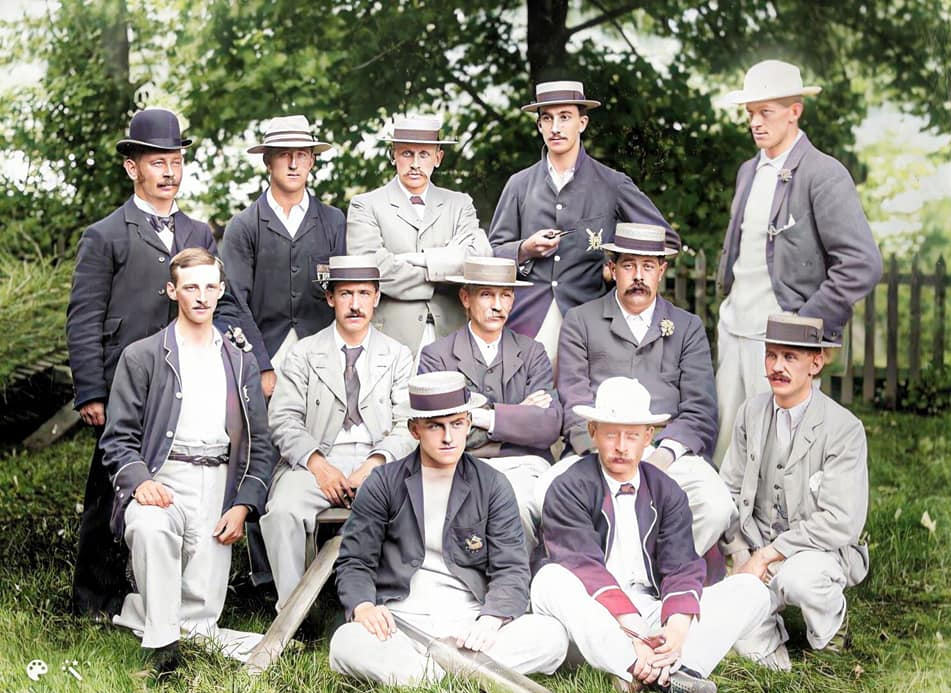
A colorised photo, of possibly the Kirkby Lonsdale Cricket team, but more likely a ‘gentleman’s team. Late 19th C. John Roper middle row,4th from left. [29]
Births, Marriage and Death
The 1921 Census reveals that the Ropers were by then resident at Old Hall, tenants of the Carus Wilson family: man of private means, John Roper (52), with his wife Martha (34) and their children John, known as Richard, who was nearly five, and Michael who was three. Both children were born at Old Hall indicating that the family were certainly living there in 1916.

 John and Martha Roper C1920s. [30]
In 1935 Mrs Roper placed an advert in the Morecambe Guardian seeking a domestic servant with the following words, ‘General (experienced), wanted, able to do plain cooking. Apply – Mrs Roper, Old Hall, Casterton, Kirkby Lonsdale.’ [31]
The Ropers were still at the house in 1939, but John died there in 1944. Just six months before his death, his son Michael was married in Casterton church in January 1944. Michael was living in London at the time, a medical student at Queen Mary’s Hospital. His wife Margaret was living with her mother who had returned from India following her divorce. On her visit to Casterton for her wedding, Margaret was amazed by the abundance of food in the village, compared to the strict rationing she had experienced in London. [32]


The marriage of Michael Roper and Margaret Carter in Casterton Church, January 1944 [33]
Martha was to remain at Old Hall until the late 1960s. Her grandchildren have vivid recollections of visiting the house at this time. Their collective memories are a revealing portrait of how a well to do middle class family lived at this time, although by the time Martha died in 1970, the family inheritances had all but run dry.
Childhood Memories
Ianthe Roper recalls that her memories of Old Hall date from when she was quite young. She reminisced that, ‘We didn’t visit Granny very often as we lived in North Yorkshire… What impressed me most about the house was that it had an attic and a cellar. One of the first things my sister and I did on arrival was to run up the stairs to the attic and then all the way down to the cellar. The attic particularly fascinated us as it contained some skulls of big game that Grandfather’s brother Roland had shot in India. [34] I was especially impressed with the tiger skull. I also remember that on the ground floor there was a scullery which still had a set of bells that connected to the main rooms in the house. I don’t remember if all the connections still worked, but we used to love playing with them. It also had a big stone sink.
Granny had a housekeeper who used to cook all her meals for her… [35] she basically looked after Granny, who had lived on her own since Grandpa died in 1944… I can remember the smell of furniture polish on the old wooden table. The living room had various family portraits, including one with a bullet hole in it (somebody obviously had it in for my ancestor!) I think the floors were stone, with rugs on them.’ [36]

Photo of Old Hall in 1963 showing a granddaughter of John and Martha
Ianthe went on to recall some of her father’s memories of growing up in Old Hall. She commented that, while some of the Teasdale children may have been a similar age to Richard (her uncle) and Michael, her father never mentioned them. However, it was apparent that they spent a lot of time on the farm. ‘I remember in particular Dad telling me how they used to wait on the high banks of the lanes until the cows were herded past, and then jump down onto their backs. So the poor animals had more than yew berries to contend with! Dad also learned how to hypnotise hens… I don’t know what William Teasdale [the farmer at Beckside] made of these antics. Granny was always adopting cats from the farm and had a large collection. She also had a little dog that regularly took the bus on its own into Kirkby Lonsdale to visit the local butcher.’ [37] Ianthe also added, ‘I suspect that there was little in the way of heating in the house at that time: perhaps one of the reasons why our visits there were always in the summer months, and granny’s visits to us were at Christmas!’

Photo of Old Hall in 1963 showing Martha Roper with her daughter in law
Jamie, another grandchild remembers staying with his Granny in Old Hall in the mid-1950s. He remembered that, ‘the front door led directly into the dining hall, with a very large polished table. To the left was the lounge. The main staircase was straight ahead, and up a few stairs off to the left was the morning room, or library, which contained our grandfather’s extensive collection of books as well as a stuffed puffer fish. The kitchen also led off the dining room and had a large pine table. Beyond it was the scullery with a traditional butler’s sink. A cramped back (servants’) staircase led upstairs from the kitchen, and at the top of the staircase was the ‘cylinder room’ which contained an enormous copper boiler that was completely uninsulated. Our grandmother used the cylinder room as her dressing room, as it was probably the warmest room in the house. Also in the scullery were the stairs leading down to the cellar… there was a large iron ring in the wall, which he was told had been used to attach slaves to. [38]
Jamie also recalled that, “The attic was fascinating, and slightly scary for us kids. As well as animal trophies from India, there was a rusty old claymore sword (jammed half out of its scabbard) and another ceremonial sword (plus various other bits of Masonic gear) which used to belong to grandad. He was a Masonic Grand Master as far as I know…The little library part way up the main stairs also had a glass display case containing a large brown trout, around 5.5lb, taken from the Lune many years previously.
More impressive was the huge stuffed tarpon hung over the fireplace in the main dining room. It was said to be 6′ 4″ long – coincidentally the exact same height as grandfather, who caught it somewhere in the Caribbean in the 1930s. Bits kept falling off this huge fish – fins and scales – here and there. After Granny died it was sold at auction, and was bought by owners of The Tickled Trout, a pub just off the M6 northbound near Preston.’
There was some debate about whether the Old Hall bedrooms were floored with highly polished wood, with thin carpet rugs where you would put your feet when getting in/out of bed, or covered with lino. Whether polished wood or lino there is a consensus that the thin rugs made great ‘toboggans’ for the grandchildren to slide across the slick floors at high speed. [39]
Another grandchild, Sheila, summarised her memories, ‘The gardener with a glass eye, the daffodil collection that grandpa had, the fact that the iron fencing I think had been melted down for the war effort, the trout in the stream running by, the fact that the front lawn was steep enough to somersault down, that the bathroom was so far away that potties under the bed were a must, the back stairs leading from the kitchen up to the nursery and grandma’s changing room, the trip stair leading down to the holding cells in the basement, the main stairs which passed the breakfast room set higher than the sitting room, the real stuffed heads and sabres in the attic… the dilapidated grass tennis court at the back… I certainly spent many a happy weekend staying with grannie, where I sat in the kitchen at the large scrubbed table, allowed to eat fish and chips from the newspaper. I don’t remember there ever being a fridge or cooker in those days, cooking still being done on the fireplace with it’s side ovens in the kitchen, and a hanging food cooler in the scullery. She was a frightening driver, but even the shortest trip seemed to be accompanied by a thermos and a blanket to keep one warm!’ [40]
A final memory from the youngest grandchild, also named John, ‘Obviously being the youngest I only have vague memories of the Old Hall however the one thing I do remember was the story of the ghost dog. Not sure if true or just a story told to scare a little boy. I remember being told that a ghost dog could be seen asleep floating above the floor in front of the main fireplace (the one with the tarpon above). The story was that the floor had been lowered and the dog was sleeping at the level of the old floor. Not too sure if any Roper had seen the dog or just if the story came with the house.’ [41]
Casterton Women’s Institute
‘Granny’ Martha Roper was a founder member of the Casterton Women’s Institute in 1919. She was a past President for many years and their only Life Vice-President. The first President was Miss Mabel Williams, headmistress of the Clergy Daughters’ School in Casterton and Martha was on that first committee. It wasn’t until the end of 1963 that the redoubtable Mrs Roper stood down from the Committee having been President for 22 years.
When the Casterton W.I. celebrated its Golden Jubilee Year in 1969 Martha was in a care home in Blackpool but was invited back for the celebration. The report in the Westmorland Gazette included a photograph showing Mrs Roper cutting a special cake made by the President, Mrs Aynscough, together with Miss M Wright, Secretary, and Mrs A Benson, Vice-President. [42]

New Owners
Martha Roper died on 28 November 1970 in Blackpool. Around this time, the expanding Casterton School purchased Old Hall together with Beckside, presumably from the Carus Wilson Estate, who, as we have seen, had owned the properties for more than 300 years. [43] After renovating the building using the school’s maintenance team supported by local builders Fred Hall & Sons, a plaque was installed in August 1970 recording the change of ownership.

The plaque marking the completion of the renovation of Old Hall in 1970

Photograph of Old Hall and Beckside at time of 1970s refurbishment
Pupils and staff alike had fond memories of living there. The house was used as accommodation for sixth form girls with a house master and mistress living next door in Beckside. Casterton School old girl Kim Allen remembers being there as a sixth former in 1975 and 1976, ‘We loved it as we didn’t have to go up to school for breakfast at the weekends, making copious amounts of toast in the kitchen instead.’ Former Housemistress Michele Emptage remembers, ‘All the girls had a real affection for Old Hall as it was quirky and quite independent!’
In 2013, the house became the home of the school’s Headmasters and their families, the first incumbent being Scott Carnochan and later Will Newman, the current resident. [44]
Simon Drakeford
Sketch 3
October 2022
References
[1] Antiquary on Horseback – the First Publication of the Collections of the Rev. Thos. Machell, Jane M. Ewbank, Titus Wilson & Son, 1963
[2] The Westmorland Hearth Tax – 1674, Cumbria Family History Society
[3] 1770, Thomas Jefferys Historic Map of Westmorland
[4] South Westmorland Window Tax – 1777, Cumbria Family History Society
[5] Lancaster Gazette, 26 September 1807, p2
[6] Penrith Observer, 11 May 1920, p3
[7] Source: https://historicengland.org.uk/listing/the-list/list-entry/1086900?section=official-list-entry . Accessed 15 Sep 2022
[8] Victoria County History of Cumbria : Interim Draft, Emmeline Garnet, [unpublished draft], 2014, p8
[9] The Life and Works of William Carus Wilson (1791 – 1859), Jane M. Ewbank, Titus Wilson & Son, 1959, family tree
[10] The Life and Works of William Carus Wilson (1791 – 1859), Jane M. Ewbank, Titus Wilson & Son, 1959, family tree and Edward Wilson of Nether Levens (1557 – 1653) and His Kin, R Percival Brown M.A., Titus Wilson & Son, 1930
[11] Westmorland Advertiser and Kendal Chronicle, 30 November 1811, p4
[12] Westmorland Gazette, 30 November 1833, p3
[13] Lancaster Gazette, 8 July 1848, p3
[14] Westmorland Gazette, 2 September 1854, p4
[15] Westmorland Gazette, 28 March 1857, p5. This would be 1,184 lbs which is about the average weight of a cow today.
[16] Lancaster Gazette, 7 March 1868, p10
[17] Lancaster Gazette, 27 July 1870, p4
[18] Westmorland Gazette, 5 March 1898, p6. About 11,700 cubic metres.
[19] Thomas Keys’ wife Emma died in 1910 and in 1911 he is still listed living at Old Hall Farm (Beckside) with another unmarried niece, Amelia Griffiths who was also the sole housekeeper. When Thomas died in 1934 he was living at Yew Tree in Casterton. He left his estate of more than £1,400 to Amelia Robinson his by now married niece.
[20] The Doings of a Country Solicitor, Alexander Pearson, Titus Wilson & Son, 1947, p23
[21] Westmorland Gazette, 15 January 1898, p5
[22] Source: Correspondence from Ianthe Roper, granddaughter of John and Martha Roper to author, 9 October 2022
[23] Lancaster Gazette, 23 July 1892, p7
[24] Lancaster Standard and County Advertiser, 28 May 1897, p7
[25] Lancaster Standard and County Advertiser, 15 October 1897, p2
[26] Westmorland Gazette, 24 September 1898, p6
[27] Lancaster Standard and County Advertiser, 25 November 1898, p7
[28] Lancaster Standard and County Advertiser, 9 November 1900, p7
[29] Courtesy Ianthe Roper family archive
[30] Courtesy Ianthe Roper family archive
[31] Morecambe Guardian, 1 March 1935, p1
[32] Source: Correspondence from Ianthe Roper, granddaughter of John and Martha Roper to author, 9 October 2022
[33] Courtesy Ianthe Roper family archive
[34] A Lieutenant in the Royal Artillery, Roland Roper died in India aged 24 in 1894 suffering from Typhus Fever. He was buried in Madras. His substantial estate of £8,317 went to John.
[35] The housekeeper was a Mrs Reid, who lived at Hutton Roof
[36] Source: Correspondence from Ianthe Roper, granddaughter of John and Martha Roper to author, 25 June 2022
[37] Source: Email from Ianthe Roper, granddaughter of John and Martha Roper to author, 26 June 2022
[38] Source: Email from Ianthe Roper, granddaughter of John and Martha Roper to author, 20 July 2022
[39] Source: Correspondence from Ianthe Roper, granddaughter of John and Martha Roper to author, 9 October 2022
[40] Source: Email from Sheila Bournia, granddaughter of John and Martha Roper to Ianthe Roper, 29 June 2022
[41] Source: Correspondence from Ianthe Roper, granddaughter of John and Martha Roper to author, 9 October 2022
[42] Source: www.castertonwi.co.uk/p/history-of-wi.html . Accessed 13 September 2022
[43] The History of Casterton School, Geoffrey Sale, Casterton School, 1983, p121 & 132
[44] Email from Katy de la Rivière, Sedbergh School Archivist to Author, 4 October 2022
Dear Simon,
I have unearthed a bible, presented by Rev’d W Carus Wilson to Margaret Key (nee Wright) “as a token of gratitude for her faithful and patient attendance on his sick daughter”.
I have no connection to the Wrights, Keys or Carus Wilsons that I know of, and can only assume that this bible was passed on somehow to my Great Aunt (Mary) Alice Rawlinson-Robinson (of Rock Cottage) through her association with Casterton church.
I would be happy to pass on this bible to a more closely connected family member or historical archive. Please feel free to contact me via my email.
Incidentally, my Rawlinson family married into the Makinson family. Mary Alice was cousin to Elizabeth Rawlinson, who married John Makinson, William (Billy) Makinson’s father. My mother was a second cousin to Billy and and his brother Richard Rawlinson Makinson.
Anne
Dear Anne,
I will email you directly.
Regards Simon