

Introduction
This sketch is about a building that is no longer there. The plot of land is on the site of the Village Green. Part of the footprint of the building was absorbed into the current road and footpath, apparently to help straighten the tight curve in the road just before the village hall and church.
So imagine there being two semi-detached houses next to Fern Cottage, directly opposite the Pheasant. The house which was closest to Fern Cottage was for decades a grocery store run by the Blamire family.
Orientation
The 1843 Tithe Map below shows the exact location of where Mrs Elizabeth Blamire had her grocery store (plot 182). Later it became the first village Post Office. The table below details the other plots description, owner, occupier and where appropriate its current name. To help with the orientation, I have included extracts from the 1951 OS Map and a copy of today’s Google Map.
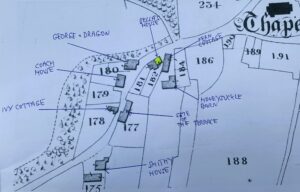
Extract of 1843 Tithe Map showing Plot 182, occupied by Elizabeth Blamire
| Plot | Description | Landowner | Occupier | Today Known As |
| 175 | Smithy House & Orchard | William Wilson Carus Wilson (WWCW) | Arthur Gibson | Garage & Shop |
| 177 | Cottage | WWCW | Thomas Brennand & Others | Site of The Terrace |
| 178 | Ivy Cottage & Garden | WWCW | Himself | Ivy Cottage |
| 179 | Garden | WWCW | Himself | |
| 180 | George & Dragon Inn | WWCW | Richard Nelson | The Pheasant & Coach House |
| 181 | House & Garden | John Kitchen | Jonathan Moore | Demolished |
| 182 | Cottage & Garden | Francis Pearson | Bella Blamire | Demolished |
| 184 | Carpenter’s Arms & Cottage, Garden & Outbuildings | John Carter | Alice Thornborrow & Joshua Hutchinson | Fern Cottage & Honeysuckle Barn |
| 186 | Housesteads | Earl of Lonsdale | Joshua Hutchinson | Village Hall |
| 188 | Great Croft | Richard Bownass and another Trustees of Kirk Allan | James Carter | |
| 189 | Housesteads | Richard Bownass and another Trustees of Kirk Allan | James Carter | Croft House |
| 190 | Old Pinfold | Thomas Clarke, Nicholas Bayley & Others. Overseers of the Poor | Anthony Sewart | |
| 191 | Gardens | Reverend Edward Wilson & Charles | Robert Proctor, John Hutchinson & Mrs Ann Arlay |
|
Summary of plots on1843 Tithe Map showing plot description, plot owner, plot occupier and where appropriate current building name
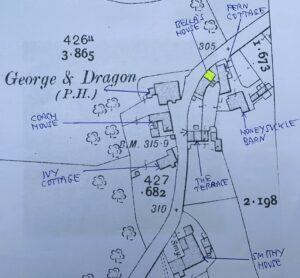
Extract of 1914 OS Map showing the site of the Blamire’s house / shop

Extract of 2022 Google Map showing former site of Elizabeth Blamire’s house / shop shaded yellow
The Blamire Family
The 1841 Census shows that Elizabeth Blamire was born in Kirkby Lonsdale in 1780. She was 60 years old and a grocer. She was living with her 30 year old son Thomas Croskell Blamire who had been born in Sedbergh. From a later mention in a local newspaper (see below), we know that they had arrived in Casterton before 1824, but they do not feature in a 1829 Trade Directory.
We know that she was running the store at least as early as 1838. A newspaper report shows that while she was at the Chapel on the Sunday before Christmas, somebody entered her house through a back window. They stole about 7 shillings in copper and about the same in silver. They also stole a fowling piece (a shotgun for shooting birds or small animals), but this was later found on the bridge about 20 yards away.[1] Curiously, a version of this story was published in the Kendal Mercury and referred to the owner as William Blamire.[2] The information on family genealogy sites is somewhat conflicting.
Family Connections
One family tree, on ancestry.com was prepared by somebody with a proven DNA connection with Isabel Bownas (1745 – ) from Sedbergh, the likely mother of Bella. It suggests that Elizabeth’s father was William Blamire (1744 – 1810) born in New Hutton. They were married in Sedbergh in 1774. Their first son, William Blamire (1775 – 1810) was born in Preston Patrick, followed by Peter Blamire (1777 – ) who was also born in Preston Patrick. Their sister Elizabeth (1779 – 1854) was born in Kirkby Lonsdale but baptised in Kendal. Given that her father died in 1810, the William Blamire mentioned in the newspaper article about the robbery was perhaps her brother.
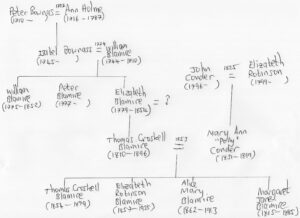
Family Tree of Elizabeth ‘Bella’ Blamire
Thomas’ Father?
If Elizabeth was unmarried when her son was born, the question arises, who was his father. There is a clue in the name given to her son; Thomas Croskell Blamire. It was common in those times, to use a relative’s surname as a second name. ‘Croskell’ therefore was possibly the surname of an important male relative, perhaps Elizabeth’s father’s mother’s maiden name, or possibly the surname of the father of Thomas. The Croskell name was important enough for her son Thomas to also pass it on to his own son. Note that Thomas and his wife Mary’s first born daughter was named Elizabeth after Thomas’ mother, with her second name as Robinson, which was the maiden surname of Mary’s mother, also named Elizabeth.
The Other Blamires in Casterton
There was another family of Blamires living in Casterton at this time. As far as I can see, they were not close relatives with the Blamire grocery up the road. The other Blamires were William Blamire (1832 – 1909) from Kirkby Lonsdale who was living at Low Lodge, the gatehouse of Casterton Hall, with his wife Alice (1832 – ), born in Casterton, and their children.
The Census records track the career path of William. In 1871 he was a labourer there, in 1881 a gardener and in 1891 he was the gamekeeper. His wife had died sometime before 1901 but William was still living in Low Lodge with his children and self employed as a market gardener. William died in 1911 but the family still stayed in Low Lodge. They were still there in 1939, some 70 years after they had first arrived.
Wider Role
Elizabeth was still running the grocery store in 1851 but had also added the role of Post Mistress to her portfolio. The Postal Service expanded greatly in the UK after the introduction of the Penny Post and the famous Penny Black by Rowland Hill in 1840. Thomas, her still unmarried son was there, now aged 41.
An illustrated advertising bill for her store reads;
‘CASTERTON
Bo. Of E. Blamire
Grocer
Genuine Teas, Fresh Roasted Coffees, Loaf Sugars etc.’

Letterhead or similar advertising Elizabeth’s store in Casterton
The source of the image is from ‘Snippets of History’, from the Village Newsletter, possibly October 2017, in a feature titled ‘The Shops of Casterton’. The article also stated that Thomas was ‘known first as Tommy Tassock, such was Blamire’s business acumen that he [also] became known as ‘split raisin’ as did his daughter subsequently.’[3]
Next Generation
By the time of the 1861 Census, Elizabeth had died. She was 75 at the time of her death in 1854. The newspaper announcement of her death said that she was ‘much and deservedly respected’.[4] This left her son Thomas in charge as grocer and sub post-master and he was joined by his wife.
He had married Mary Ann ‘Polly’ Conder in 1853. The 1851 Census records that Polly -born in Dent- was living in Barbon in the house of an uncle, but working as a house servant. Perhaps they had met in the post office when Polly was visiting?
In 1854 their first child, Thomas Croskell Blamire was born and was followed in 1857 by a sister named Elizabeth Robinson Blamire.
The 1861 Census, shows that William Bownass Hardacre was listed as a Post Messenger living across the road at Ghyll Cottage. Presumably he was employed by Thomas Blamire. It wasn’t until later that the Hardacre family turned Ghyll Cottage into a Post Office. This will be the subject of a future ‘Sketch’.
The Casterton Church Chancel Controversy
The year 1864 saw great excitement in Casterton. There was distinct flavour of ‘Town versus Gown’. Briefly, the headmistress of the Clergy Daughters’ School and the Trustees desired to make alterations to the church. They wanted to remove the gallery and enlarge the church by creating a chancel. The villagers were very much against this, as was the son of the Reverend William Carus Wilson. The reason the school wished to make the changes was that they believed that when the schoolgirls attended church in the gallery, which was their allotted space, they became very ill. This was vociferously disputed by the villagers.
Because the issue fell under ecclesiastical jurisdiction, it was heard at the Carlisle Consistory Court. At the court, Thomas Blamire made a brief appearance. Several parishioners, including Thomas, had sat in the gallery one Sunday to try to understand more about the health problem and were then presented at court to bear witness to what they had experienced. The newspaper reported in detail the words that Thomas spoke in court.
‘Thomas Blamire, postmaster, sworn, said- I have lived in Casterton upwards of 40 years. I have attended the Chapel ever since it was erected, upwards of 30 years. I have sat under the gallery and never felt the least inconvenience. I was in the gallery last Sunday. There were 147 there who had been pushed to go there for the last two or three weeks to try if they could be thrown poorly, but without success. It is all a dream, there is nothing of the kind. Last Sunday it was Thunder and it rained very sharp.’
[Questioned]
‘Did you feel any inconvenience from sitting in the gallery?
I felt nothing whatever. I tried my very best, but it was quite pleasant, though much fuller than usual. I would not have the gallery removed. I can see no fault in it. I would like no better place. I don’t see the least reason for its removal, nor anything the matter with the gallery nor anything else. The inhabitants are all against it. It is a beautiful edifice, and I should be very sorry to see it altered from any mere fancy of anyone’s when we have plenty of room to spare.
Cross examined by Mr J G MOUNSEY – When inside it was quite cool, though warm outside- Then you say it was cold inside the church and warm outside.
[Blamire] I did not take that particular notice.
[Mounsey] Would you be surprised if you learnt that it was from 70 to 72 degrees in the gallery?
[Blamire] I am not acquainted with such things; all I know is that it was very comfortable, and I could breathe well. I could not see how many were below. They all say that on Sunday last there were a great many more people than usual. Whenever I have sat in the gallery I have always found it very comfortable and very pleasant. I have stopped away in winter of late years because it was perishable when the windows were open. I did not see anything of the ventilation, but I heard of it. The windows being thrown open cause it to be cold.[5]
The court found in favour of the school and trustees which is why the church no longer has a gallery but does have rather poorly matched chancel at the west end.
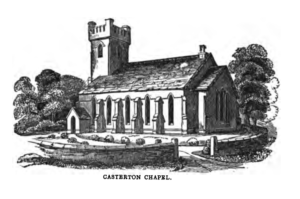
Print of Casterton Chapel C 1842 without the Chancel[6]
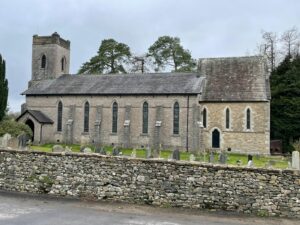
Casterton Church in 2023 with added Chancel
Two More Children
In 1871, the Census shows that the couple were graced with two more daughters. Alice Mary Blamire was born in 1862 and Margaret Jane Blamire in 1865. Thomas senior, now 61, is recorded as a Grocer and Annuitant, i.e. receiving an annual sum from a pension or other investment.
There is no mention of the Post Office role, but this was still before the Hardacres ran the Post Office from Ghyll Cottage. In the Census, William Hardacre was still listed as a Post Messenger. Thomas Croskell junior had by now left home. He was living in Kendal working as a Chemist, the three daughters were still at home.
Family Deaths
Come 1881, the same members of the family were still at home. Sadly, Thomas junior, who had died in 1879 aged 25.[7] Elizabeth and Alice, were both still working in the store with their 71 year old father.
Ten years later Thomas was retired. The family were still living in the same house with the exception of the youngest daughter Margaret who had died in 1885 aged only 20.
By the time of the 1901 Census both Thomas and his wife Mary had died, Thomas in 1896 aged 86 and Mary in 1899 aged 68.
Pear Tree Cottage
The 1901 Census therefore recorded only their two elder daughters. They were living together at Pear Tree Cottage which, based on the position within the Census return, was the same house as the unnamed one they had lived in before. The adjacent cottage, hitherto also unnamed, was recorded as ‘Heslop Cottage’. It appears that both sisters had retired from working -they are both described as ‘living on own means’.
In his 1993 reminiscences, Billy Makinson, a farmer at Old Manor House Farm, remembers that a Miss Blamire kept a shop opposite the Casterton Hotel [The Pheasant] which was pulled down.[8]
The 1911 Census records Pear Tree Cottage as two residences, Elizabeth and Alice remain in one, at the other is a 62 year old widow named Sarah Stephenson.
The Dynasty Ends
With the premature death of their son, and their daughters being unmarried, this particular Blamire family line was set to end. Through the years of working, the family had saved a substantial sum. When Alice Mary died in 1913 aged 52, she left more than £2,400 to her spinster sister.
The 1921 Census shows that there is a number 1 Pear Tree Cottage and a number 2. Elizabeth was living at number 1. At number 2 –Heslop Cottage- was Margaret Farrer, aged 40, also a spinster, born in Kirkby Lonsdale.
Elizabeth lived until the age of 78 dying in 1935, she was still at Pear Tree Cottage. At the time of her death, her estate was worth more than £16,000.
Building Demolished
In a letter written in 1974 by James Wilson who was born in Fern Cottage in 1885, he recalled that, ‘I left Casterton in 1910, and at that date there were two semi-detached Cottages in existence, almost adjoining Fern Cottage, and extending towards the George & Dragon Inn… One of them nearest the Inn, was indeed the Village Shop at that time, and kept by a Mr. Thomas Blamire. These Cottages were removed at some date, probably in or about the Second World War, with a view to widening the Road, and obviating a rather dangerous curve at that point.’[9]
Records show that the house had almost certainly been removed by April 1937. An OS map surveyed in 1936 shows the house still present, but in an updated map of 1938, it is no longer there.
The Casterton Parish Council Minutes shed further light on the matter. At a meeting on 1 April 1937, during a discussion about building some social housing in the village, in particular for a ‘farm man’, it was noted by Councillor J Robinson that ‘the County Council had demolished two houses in the village which were very suitable for such needs and if they were replaced would meet the present needs.’[10]
At meeting thirteen months later, on 18 February 1938, Councillor J Robinson commented that ‘complaints had been received respecting rubbish slates, bricks, branches of trees etc, had been left or deposited on land recently occupied by houses demolished by the County Council opposite Casterton Hotel and was very unsightly. It was agreed that the Clerk write to the authorities concerned and ask that it be removed.’[11]
And so there ended the story of Casterton’s first grocers the Blamires. All that remains are two headstones in the graveyard and a few sketchy reminiscences.
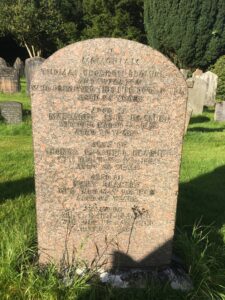
The Blamire gravestone in Holy Trinity Church Yard. This was presumably erected by Elizabeth before she died, her name and the grandmother she was named after were not listed on it.
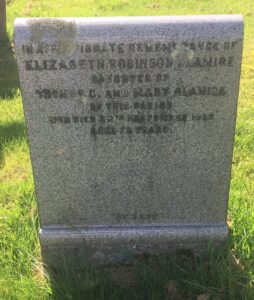
The grave of Elizabeth Robinson Blamire in Casterton Church Graveyard
Simon Drakeford
February 2023
References
[1] Westmorland Gazette, 22 December 1838, p3
[2] Kendal Mercury, 22 December 1838, p2
[3] If anybody has anymore information about the source of this image and the reference to Tommy Tassock or the Village Newsletter please contact the author using the comments function.
[4] Kendal Mercury, 18 November 1854, p5
[5] Carlisle Patriot, 18 June 1864, p4
[6] Helps to the Building of Churches, Parsonages and Schools – 2nd edition, The Rev. W. Carus Wilson, M.A., A Foster, 1842, p28
[7] Westmorland Gazette, 11 October 1879, p5
[8] The fascinating reminiscences can be found here https://www.castertonparishcouncil.org.uk/wp-content/uploads/2021/10/Billy_Makinson_reminiscences.pdf
[9] Note by James Wilson, 4 September 1975, courtesy of Jean Hamlett
[10] Kendal Records Office WPC 40 – Parish Minutes, 1 April 1937
[11] Kendal Records Office WPC 40 – Parish Minutes, 14 February 1938