

Introduction
In the Cumbria County Archives in Kendal lies a document from which the following quote was taken.[1]
Football Club
‘The Football Club, which has been in existence for three years, has for two seasons been affiliated to the North Lancashire League. The Club attracts membership from a wide area. An enthusiastic group of juniors shows much promise for the future.’
The document is a handwritten essay titled ‘Casterton’, collected together in a blue-grey file. It offers a look at ‘Casterton Today’, as well as a review of some of the history of the village. It is illustrated with some hand drawn pictures and postcards. Unfortunately, the file does not mention who the author is, or the date when it was written.

Front cover of the document
Probable Date
Based on information within the essay below, I can establish that the document was written in 1955 or 1956.
Possible Author
Included within the essay are illustrations by Jane Ewbank. She was local scholar Jane Margaret Ewbank, born about 1942 and a pupil of Casterton School.[2] She was the daughter of the Reverend (later Venerable) Walter Frederick Ewbank. He was the vicar at Casterton and Chaplain to Casterton School from 1952 to 1962.[3] It is possible that she is the author of the essay, perhaps as part of a school project.
1952 – 53 Season
Based on the above quote, the football club was established in Casterton during this season. It presumably played friendly fixtures before registering for the league in the following season.
From local memories, it appears that the new football club was in some way connected with the Casterton Men’s Club. In Billy Makinson’s recorded reminiscences he recalled that the Reverend Ewbank reformed the Casterton’s Men’s Club and was also Chairman of the Casterton Football Club.[4]
Rachel Begg, the wife of Edward Begg told Jean that ‘Edward remembers the Men’s Club (Ed was born in 1951) where they also had a rifle range in the woods, [and] played football near the ‘Whoop’ in John Wilman’s field (he remembers watching it).’
As noted later, the football was indeed played in a field ‘opposite’ Whoop Hall Inn on the A65.
1953 – 54 Season
A local newspaper confirms that Casterton was accepted into the North Lancashire and District Football League in this season.[5] The first mention of the football club playing a match I have found is 18 September 1953 when the results page shows that they were drawn against Levens in the first round of the North Lancashire League Senior Challengers Cup.[6] They went on to win the match 3:2.[7]
At the start of the New Year, Casterton Football Club were referred to as newcomers in a match report describing their 6:0 loss against Lansil in the Junior Challenge Cup.[8] Their regular league matches saw them competing in the 3rd division of the North Lancashire League.
A league table published towards the end of the season showed that Casterton had played 21 matches (out of a possible 22), winning just one, drawing three and losing the rest. They scored a total of 39 goals but conceded 100! They were placed securely at the bottom of the table.[9] However, as this was the lowest division in the league, there was no relegation.
At the bottom tier of the football league pyramid, a review of each year’s football league commentaries indicates that there were a lot of teams joining and withdrawing from the North Lancashire League each season.
1954 – 55 Season
Just before Christmas 1954, in their second season in the league the team had improved somewhat. The league table shows that they had played nine games winning four and losing five.[10]
A match report from April 1955 reveals where the senior teams played their games. ‘A football match arranged by the Rev. W. H. Cormack and the Rev. F. W. Ewbank [sic] between the boys of Leck and Casterton on the Whoop Hall field, lent by Casterton Football Club, on Saturday afternoon attracted a large crowd. Leck avenged their previous year’s defeat by beating Casterton 7-2… The Rev. F. W. [sic] Ewbank was referee.’[11]
Returning to the men’s team, a league table towards the end of the season showed that Casterton had played 22 games (out of 26), winning nine, drawing three and losing ten. They scored 45 goals and conceded 63. At this stage they were a much improved seventh in the table.[12]
1955 – 56 Season
A losing performance by Casterton in a league match in December warranted a lengthy match report. ‘Second-half honours in this thrilling game at Casterton went to the home side who although beaten for the second time this season by Trumacar put up a stout display against the Division 3 leaders. The Heysham side went ahead after 15 minutes through Munro after grand approach work by Dunne. After 30 minutes Challenger got a second but Casterton fought back to reduce the arrears. Just before half time Dunne made it 3-1 for Trumacar. Casterton came more into the picture on the re-start but from a break away the visitors increased their lead to 4-1 through Dunne. The home side began to press harder and threw everything into attack but after 30 minutes of the half Newton put Trumacar in a sound position with a fifth goal. With less than 10 minutes to go Casterton scored a second followed by a third. When full time came it was Trumacar who were hanging on grimly to their slender two goal lead.’[13]
A late season table suggests that Trumacar went on to win the League. In the table, Casterton were placed seventh. They had played 22 games out of 24, winning seven matches and losing the rest with no draws. They had scored 59 goals but conceded 92.[14]
1956 – 57 Season
The new season did not start too well. In October, Casterton faced Skerton in round one of the North Lancashire League’s Senior Cup. They lost 14-2![15] Despite this, the team photo a few weeks later shows them in good spirits.

A 1956 team photograph of the Casterton Football Club, members of Division 3 of the North Lancashire League.[16]
A Kirkby Lonsdale history includes the photo above, incorrectly identifying it as a team from Kirkby Lonsdale in the late 1940s. It also put all but one name to faces.[17]
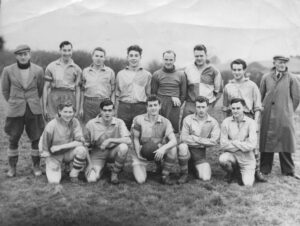
Back row left to right: Mr. [Harold] Needham, unknown, John Wyatt, George Wyatt, “Windy” Stevenson, Goff Casson, Melvern Troughton (“Pompey”), Harry Green
Front row left to right: Mike Hastewell, Stan Martindale, Les Gibson, Alan Woodward, Bill Blaylock.
The unknown person above has been identified as being Frank Brooks by Mike Hastewell when he talked with local historian Jean Hamlett.
The season improved. At the half way point, after 12 games, Casterton had won 4, drawn 4 and lost 4.[18] Towards the end of the season they were in a commendable sixth place. In the 21 games to date out of a possible 24, they had won 9, drawn 4 and lost 8. They scored 54 goals, conceding 66. Cartmel were winning the league and Skerton were placed third.[19]
1957 – 58 Season
The new season saw eight new teams join the North Lancashire League which meant that Casterton were placed in Division 2. The team who had been placed below them in the previous season -Galgate Reserves- stayed in Division 3, placing Casterton very much as underdogs.[20]
Things started off well. In September a match report had the headline ‘Casson hits four more’, describing the 5 – 1 defeat of the Civil Service. It read ‘Casterton’s free scoring inside left B Casson scored four of his side’s five goals, three of them in 15 minutes, against a weakened Civil Service team in a Division 2 North Lancashire League game. The previous week Casson hit four against Williamsons. [The Civil] Service missed several easy chances in the first half and they were handicapped by injuries to two players. For the whole of the second half they had only ten men… Casterton went ahead through Hastwell [sic] and in the space of three minutes Service missed three easy chances. After 20 minutes Barnes, Bell and Weston combined well and the latter equalised. Minutes later only a grand save by Boyd prevented the home side from going ahead. In the 35th minute Casson put Casterton ahead and at half time they led 2 – 1. The visitors quickly took control of the game in the second half and Casson hit three goals in 15 minutes.’[21] The Casterton team was listed as Boyd, G. Casson, J. Wyatt, Brooks, G. Wyatt, Troughton, Hastewell, Edwards, Conroy, B. Casson, Blaylock.
Later in the season Casterton again played the Civil Service, this time in a cup match. They would have been confident following their earlier big league win. Their confidence was misplaced, losing out three goals to two. The match report listed the Casterton team as, Boyd, [Goff] Casson, Wetheral, [Frank] Brooks, [John] Wyatt, [Melvern] Troughton, [Mike] Hastewell, Edwards, [‘Windy’] Stevenson, [George] Wyatt and Lowe.[22]
They achieved a much better result in November in the first round of the Westmorland Junior Cup. The match report told their readers ‘Casterton proved too strong a side for Troutbeck and easily won 6 – 1. Blaylock had an excellent game for the home side scoring four goals. The other two were scored by Wyatt.’[23]
A match towards the end of the season saw yet another defeat of Casterton by the Civil Service by 2-0. The match report suggested that if it were not for the efforts of Boyd, the Casterton goalkeeper, the score would have been less flattering. The team sheet was listed as; Boyd, Casson, Stephenson [sic], Brooks, Wyatt, Edwards, Hastewell, Flint, Conroy, Fee, Radcliffe.[24]
At the conclusion of the season, Casterton were third from bottom when they completed their 22 games. They had won five, drawn one and lost the rest. They had scored 44 goals and conceded 87.[25]
1958 – 59 Season
Despite their lowly position in the league, Casterton’s survival in Division 2 was confirmed in July. Four teams left the league structure and four teams joined, leaving Casterton safely in Division 2.
In the same newspaper report it was also agreed that the referee’s fees for each game would be increased by one shilling to 8 shillings and 6 pence.[26]
Before Christmas, Casterton agreed with their opponents Cartmel to postpone their league match. The reason was that Casterton’s John Wyatt was getting married to Miss Margaret Howarth of Hest Bank with several of his team mates attending.[27]
There are no match reports from the first half of the season. The first mention of Casterton Football Club I have found is from early 1959 in the illustration below.
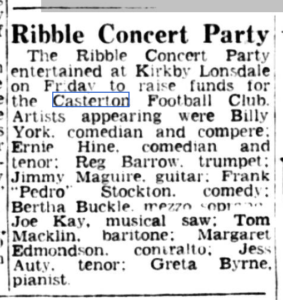
Newspaper clipping reporting on the fundraiser for the football club[28]
The Ribble Concert Party was founded in 1955 by Bill York, the comedian noted in the clip above. He was a Bus Inspector with Ribble Motor Services Ltd. He originally formed the group with four colleagues from the Lancaster and Morecambe bus depots. It expanded to a wider ‘versatile troupe’ of up to 15 performers. As in the example above, they performed for local charities.[29]
It is not clear whether the fund raising was borne out of necessity or was of a more general nature.
The day after the charity event, Casterton played a home Westmorland Junior Cup fixture against Castletown. Casterton won 5-4 scoring the winner with a few minutes to spare, earning their place in the semi finals.[30] Cup glory was elusive, they lost the semi-final match against Braithwaites 5-1.[31]
Towards the end of March, a newspaper reported that ‘Casterton and Grange seem destined for relegation.’ Casterton had not had a good season. Out of their 20 games they had won only two, drawn two and lost 16. They had scored 36 goals but let in 89.[32]
1959 – 60 Season
In the official announcement about the start of the season, the North Lancashire and District League announced the composition of the leagues for the forthcoming season. In it they told their readers that ‘Kirkby Lonsdale is the former Casterton Club…’.[33] Thus ended seven years of Casterton Football Club.
The change of names worked wonders. At the end of the season, Kirkby Lonsdale Football Club finished top of the 3rd Division table winning 14 of their 16 games.[34]
The Players
Jean Hamlett spoke to Mike Hastewell before his death in 2021. He recalled that the team included some players who were not Casterton residents. He and the Wyatts (and maybe others) didn’t live in Casterton, or even Kirkby Lonsdale – they lived in Morecambe. Frank Brooks was possibly living in Lancaster and Windy Stevenson lived in Burton-in-Lonsdale.
Mike confirmed that that the team used to play in a field belonging to Mr. Wilman, opposite Whoop Hall. Mike was involved with sport and other activities such as bell ringing in the area throughout his life. His association with Kirkby Lonsdale Cricket Club stretched back over 60 years as a player, groundsman and President. He was also an active member of the Kirkby Lonsdale Rugby Club.
In response to my post on Facebook, Jannine Gander told me that Harold Needham was her Grandad and Stan Martindale her uncle. Harold was a gamekeeper and gardener who lived at Fern Croft. She also recalled that Bill Blaylock too lived on Fern Croft and had a shoe shop in Kirkby, which is now an interior design shop tucked in the corner next to the Snooty Fox.
A search online reveals that Melvern Troughton was a Union Man. A union newspaper reported that ‘The Activist is sad to report that Melvern Troughton (Pompey), Branch Secretary of Bentham 4 Branch and long-serving GMB member since 1973, passed away on the 17th October 2018. Melvern, who was affectionately known as Pompey to many, was a committed trade unionist, who would always make himself available to support his branch members. He was a friend to many and will be missed by all those that knew him.’[35]
Simon Drakeford
June 2023
References
[1] Cumbria County Archives (Kendal), WDX 139/29 [Essay]
[2] Jane M. Ewbank, The Life and Works of William Carus Wilson (1791 – 1859), Titus Wilson & Son, 1959, Foreword
[3] Source: https://www.churchtimes.co.uk/articles/2014/9-may/gazette/obituaries/obituary-the-ven-walter-frederick-ewbank . Accessed 10 October 2022
[4] Reminiscences by William Makinson, dictated to Margaret Pilkington, 23 August 1993, published on Casterton Parish Website, 1993
[5] Lancaster Guardian, 3 July 1953, p8
[6] Lancaster Guardian, 18 September 1953, p11
[7] Lancaster Guardian, 25 September 1953, p11
[8] Lancaster Guardian, 15 January 1954, p11
[9] Lancaster Guardian, 2 April 1954, p15
[10] Lancaster Guardian, 17 December 1954, p13
[11] Lancaster Guardian, 22 April 1955, p12
[12] Lancaster Guardian, 6 May 1955, p14
[13] Morecambe Guardian, 20 December 1955, p2
[14] Morecambe Guardian, 27 April 1956, p2
[15] Morecambe Guardian, 19 October 1956, p2
[16] Morecambe Guardian, 7 December 1956, p3
[17] Source: https://www.kirkbylonsdalehistory.info/clubs-societies/football/ Accessed 15 June 2023
[18] Morecambe Guardian, 28 December 1956, p3
[19] Morecambe Guardian, 18 April 1957, p3
[20] Morecambe Guardian, 5 July 1957, p2
[21] Morecambe Guardian, 27 September 1957, p13
[22] Morecambe Guardian, 25 October 1957, p10
[23] Morecambe Guardian, 29 November 1957, p12
[24] Morecambe Guardian, 3 April 1958, p13
[25] Morecambe Guardian, 2 May 1958, p15
[26] Morecambe Guardian, 4 July 1958, p13
[27] Morecambe Guardian, 24 December 1958, p10
[28] Morecambe Guardian, 6 February 1959, p9
[29] Morecambe Guardian, 15 January 1960, p5
[30] Penrith Observer, 10 February 1958, 914
[31] Morecambe Guardian, 3 April 1959, p11
[32] Morecambe Guardian, 20 March 1959, p15
[33] Morecambe Guardian, 7 August 1959, p9
[34] Morecambe Guardian, 8 April 1960, p19
[35] The Activist, GMB Union, Issue 33, December 2018, p3