

Introduction
Gale Garth, also historically known as Casterton Fell Tenement, is one of the oldest farms in Casterton, predating Bull Pot by several hundred years but due to their proximity to each other, sharing its more recent history.
Along with nearby Bullpot Farm, Smithy House, and the derelict Hillard Scale Farm, they are the most remote old farms in Casterton, high up on Casterton Fell and closer to the village of Barbon than the heart of Casterton. None are now farm houses.
Firstly a few words about Smithy House which has also been called Smithies House and Casterton Fell Farm. There is a danger when looking at the old records of confusing Gale Garth and Smithy House, being called Casterton Fell Tenement and Casterton Fell Farm respectively. As far as I have been able to ascertain from the records, they have always been two separate farms.
Smithy House took its name from a local family, not because, as might be expected that there was ever a blacksmith working there. William Smithys appears in a list of tenants of 1772.[1] In the 1843 Tithe Map, there are two fields adjacent to the Farm also taking their name from the previous resident. There is Smithies Allotment (477) and Smithies Meadow (479).
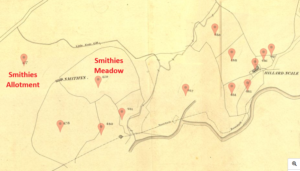
Extract of 1843 Tithe Map showing Smithys and Hillard Scale and surrounding fields
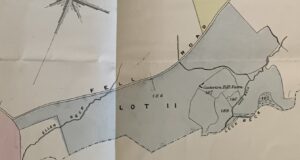
Extract from an 1890 Auction Catalogue referring to Smithy House as Casterton Fell Farm[2]
Eighteenth Century Owners
The earliest mention of Gale Garth according to the place names of Westmorland is on the 1862 Ordnance Survey Map, it is however much older.[3] The word Gale derives from the Old Norse word ‘gil’ meaning ravine. (The words Gill and Ghyll share the same derivation.) Garth on the other hand derives from Old Norse ‘garðr, meaning enclosure.
Gale Garth does not appear in the 1674 Westmorland Hearth Tax returns because the tax returns listed only names of persons paying the tax rather than the name of the property, however, it more than likely existed at this time. The smaller Hillard Scale Farm, also called Hellotscales or Hellatskale can be found in records going back as far as 1638 when Edward Garnett occupied it.[4]
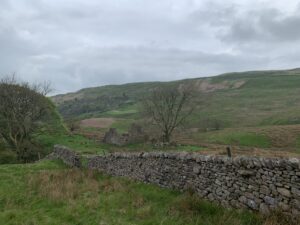
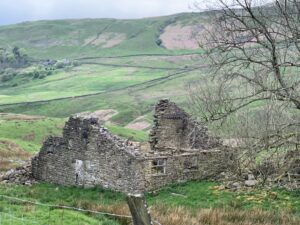
The remains of Hillard Scale Farm in 2024[5]
The earliest document I have located for Gale Garth is one from 7 November 1744. The document records the details of the sale of Gale Garth by Martin Range of Newbiggin, Kirkby Lonsdale. He sold the farm to Giles Redman of Kirkby Lonsdale and Richard Lucas from Burton in Kendal, for the sum of £310. The sale indenture also recorded that Martin had previously bought Gale Garth from Thomas Wilson of Underley.[6] Unfortunately it does not say when this was or which Thomas Wilson of Underley it was.
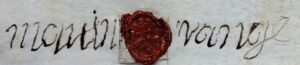
The signature and seal of Martin Range on the 1744 indenture
Five years after he bought a half share in Gale Garth, Richard Lucas died. In his will dated 3 May 1749 he left his share in Gale Garth to siblings William and Elizabeth Batty. They were the children of Richard Lucas’s brother-in-law John Batty from Barbon who was the Executor of the will.[7]
Later that year, Giles Redman relinquished his half share of Gale Garth. He entered into an agreement with William and Elizabeth Batty that he would be allowed to release his rights in ‘the moiety’ i.e. his share, while he was still alive.[8] This allowed John Batty, the father of William and Elizabeth, to purchase Giles’ share of Gale Garth for £165.[9] The document refers to the property as ‘all that customary messuage and tenements in manor of Casterton called Casterton Fell Tenements or Gale Garth of yearly customary rent of 13s. 4d. purchased from Martin Range, deceased.’ The customary rent being what was owed to the Lord of the Manor.
In the records of the 1777 Westmorland Window Tax, one of the 54 assessed properties in Casterton was owned by ‘Jas Batty’, i.e. James. This is most likely Gale Garth. The assessment was for three shillings, which means that it possessed six or fewer windows.[10]
The next change in ownership occurred on 22 April 1784. The Indenture of Conveyance was made between John Batty of Barbon and James Batty his son, of Gale Garth.[11] James paid his father £151 and 18 shillings for his share of the property making him the sole owner of the property. The Indenture again notes that the property was known as ‘Casterton Fell Tenement or Gale Garth.’
On 13 February 1798, another legal document recorded a mortgage arranged between James Batty and Isabel Kitson, a widow from Burton in Kendal. The loan from Kitson was for £180 with agreed payments of annual interest of £9 (5%) from 1799 to 1811. The mortgage was scheduled to be repaid in 1813.
The loan document also noted that James had inherited his sister Elizabeth’s share of the property when she died. We also learn that at this time, the property was in the occupation of two tenants, Joseph Tomlinson, and Thomas Kendal.[12]
The Nineteenth Century
Just before the repayment of the above loan was due, a document in the Kendal Archives dated 21 October 1812 records proposals for selling Gale Garth by auction. The proposal was that the auction would be held at James Batty’s house in Barbon. The property was described as ‘All that improvable customary hold estate called and commonly known by the name of Gale Garth situate between the high and low fell in the Township of Casterton… consisting of a good dwelling house, suitable outbuildings and sixty customary acres or thereabouts … of rich meadow and pasture land. Together with an unlimited right upon Casterton Fells which are now under inclosure; by virtue of which the purchaser in right of the said estate will be intitled to an extensive and valuable allotment thereupon. The property of the said James Batty. The said estate is subject to a mortgage of one hundred and eighty pounds and also subject to the yearly Customary Rent of thirteen shillings and six pence to the Right Honorable William Earl of Lonsdale as Lord of the Manor of Casterton aforesaid, and three times that sum upon change of tenant.’[13] A newspaper advertisement for the auction added the following details ‘There is a good Lime-kiln upon the premises, a good Limestone-quarry; also plenty of good coal within one mile.’[14] The kiln was in the field called Limekiln Pasture noted below on the Tithe Map and in the 1863 loan document below.
The successful bidder was Arthur Robinson. At the time of the auction the following notes were made ‘Be it remembered that at the time and place within mentioned Arthur Robinson of Barbon Fell House in the county of Westmorland is the highest bidder for the within mentioned premises he having bid the sum of Two Thousand two hundred and thirty five Pounds for the same and to abide by proposals to within mentioned which the said James Batty doth hereby agree to accept and take for the said premises and to abide by the said proposals on his part’.[15]
Inflation?
The sale proceeds of £2,235 was substantially more than was paid for half the estate in 1784. Was the sale at this time, between father and son, a true reflection of the worth of the property, i.e. a sale at ‘arms length,’ or did the property increase in value by more than seven times in 28 years? This seems unlikely by reference to the Bank of England inflation calculator, £150 in 1774 was worth £318 in 1812, nowhere near the value the sale of the property achieved.[16]
As noted on an earlier Guest Sketch by Clare Wildsmith titled ‘The Enclosure of Casterton,’[17] and indeed mentioned in the auction details, the Gale Garth Estate was in the process of being enclosed. One of the reasons that the sale of Gale Garth took place was to provide funds to meet the expenses of getting the private 1812 Act of Inclosure through parliament. It was agreed that some land would be auctioned ‘for the best price that could be gotten.’
As we have seen, Gale Garth Farm was bought by Arthur Robinson of Barbon Fell House for £2,235,[18] while at the same time, Joseph Gibson bought 1,325 acres of Casterton Fell for £3,005.[19]
Aside from general inflation, the increase in value was perhaps due to the expected benefits to be derived from the enclosure of the common land. One significant benefit of enclosure was that the land would become a lot more productive. Another advantage, at least for the new landowners, was that it gave them the benefits of grazing on the common land by removing it from the general population who previously had had those rights.
In general, the enclosure of the land deprived many subsistence farmers of their ability to scrape a living and forced them to work as agricultural labourers for the owners of the land that they previously had access to.
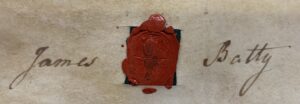
The signature and seal of James Batty on the 1813 Indenture
Gale Garth on Old Maps
Gale Garth appears on both the 1823 Greenwood map of Westmorland and the 1828 Hodgson Map. On the latter map, it is shown lying between Hillard Scale to the South and Bull Pot Farm to the north. Smithy House is not shown on either map. As seen below, all four farms appear on the 1843 Tithe Map and on the first OS Map of the area produced in 1862.
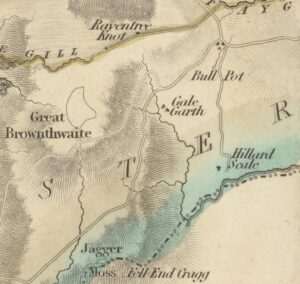
Extract of 1828 Hodgson Map of Westmorland
Passing It On
Arthur Robinson (C1742 – 1828) owned the farm from 1813 until his death on 5 July 1828. In his last will and testament dated 16 May 1828, he bequeathed to his eldest son Thomas Robinson (1796 – 1851) amongst other things ‘all those two estates called Gale Garth and Easegill situate in the township of Casterton in the Parish of Kirkby Lonsdale in the county of Westmorland and now in the possession of Richard Morphet as Tenant thereof’. The reference to the Easegill estate may be referring to Hillard Scale farm. His wife Elisabeth Robinson nee Hutton was the executrix of her husband’s will. In the will she was bequeathed £50 per year for the rest of her life.[20]
The Morphets
A trade directory from 1829 indicates that Richard Morphet was still farming at ‘Galegarth’. There were several Morphets living in Casterton around this time. A possible candidate for the Gale Garth farmer was the Richard Morphet who was born around 1797 in Barbon. He was married to Sarah Gibson who was born in Casterton around 1799. It appears that they were living in Casterton in the mid 1820s. Their son Richard was born there in 1823 while his brother Leonard was born there in 1825.
The Capstick Family
The Morphets certainly weren’t at Gale Garth in 1841. The Census from that year shows that George Capstick aged 65 (born about 1776 in Dent), a Farmer, was in residence. He was living there with his wife, 60-year-old Margaret Capstick nee Ivison. They were married on 21 April 1806.
Living with them were several children. There was Thomas aged 25, Arthur aged 20 and Henry aged 18. Also listed on the Census return was 15-year-old Margaret Mudaleton(?).
The 1843 Tithe Map offers more detail. The records show that the owner of the farm (reference 495) was Elizabeth Robinson and the occupier George Capstick. (It is not clear why the Tithe record states that Elizabeth Robinson was the owner, given that her husband’s will bequeathed it to their son Thomas.)
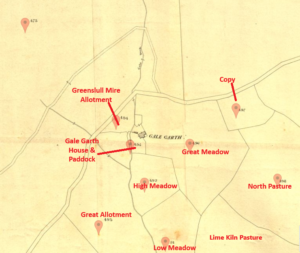
Extract of 1843 Tithe Map showing Gale Garth and surrounding fields
The record and map show that number 495 was ‘Gale Garth House & Paddock’. George Capstick was also the tenant of Hillard Scale (reference 487).
On the Market Again and a New Tenant
A few years later, Thomas Robinson (1796 – 1851) put the farm up for sale, it was to be auctioned at the Royal Hotel in Kirkby Lonsdale on 8 October 1846. It seems that the farms were not actually sold at this time.
The advertisement for the auction described the house as ‘consisting of a commodious and substantially built Dwelling House, Barn, Stables, Shippons, and other convenient Outbuildings, and several Closes and Inclosures of rich Meadow and Pasture Land adjoining thereunto…’[21] The auction catalogue also listed the land that was included in the sale, totalling about 73 acres. The names of the fields were Copy, Low Meadow, High Meadow, North Pasture, Great Allotment, Groeneskill Mire Allotment, Great Meadow and Hoghouse Allotment (not shown on map above).
The three allotments were Freehold while the other land was ‘of customary tenure’ which was held by the Right Honourable William Earl of Lonsdale requiring, as noted above, the annual payment of customary rent of 13 shillings and six pence.
Lot 2 in the 1846 auction was Hillard Scale, described as a ‘compact estate’, totalling 39 acres. The above mentioned Limekiln Pasture was included within the Hillard Farm Estate which also included fields named Lea Dale, Kirk Bank, Long Bank, Dowbergill, and a plot of land near Devil’s Bridge called Water Brow.
George Capstick who was the tenant for both farms was soon to retire. In the 1851 Census he was shown as living with his wife at his son Thomas’s house in Maidenbridge Farm in Tatham. He died there in February 1852.
‘Farmer’s Glory’
George had in fact left the farm before 1848. A newspaper report about that year’s Lunesdale Agricultural Show held in Kirkby Lonsdale, described the show and the awards dinner. The dinner was held at the Green Dragon (now the Snooty Fox) where more than 100 people sat down and enjoyed a fine meal. After various toasts, one of which was by Mr. E. Wilson who proposed ‘The “Farmer’s Glory,” a good wife, a good horse and a good crop.,’ after which various awards were announced. Prize Class IX was for ‘Draining’.[22] It was awarded to the farmer who in the past year, in conjunction with the owner, had ‘drained to the greatest extent on his farm, in the best and most scientific manner, regard being had to the size of the farms of the respective candidates, to localities, and to the expense and labour incurred by the tenant.’ The winner was Mr. G. Whitehead of Gale Garth, Casterton. He won the princely sum of £2.
Whitehead’s Fall From Grace
Despite his success at draining fields, George Whitehead was not at the farm for long. While he was still listed as being at Gale Garth in an 1851 Trade Directory, troublesome events had taken their course – George had spent too much money and was bankrupt. On 9 January 1850 he assigned all his personal estate and effects to Matthew Bell, a Tailor, and Draper in Kirkby Lonsdale. The indenture was filed with a local solicitor. All creditors were asked to lodge their accounts with the solicitor’s and all debtors were asked to pay their bills.[23] That October, a meeting was held at a Kirkby Lonsdale solicitor to pay down a dividend on the estate of George Whitehead, ‘late of Galegarth’.[24] It wasn’t the last time George, or his namesake, would appear in a newspaper connected with Gale Garth.
The Robinson Family
After the unedifying departure of George Whitehead, a not so new family had arrived at the farm. The 1851 Census documents that the Robinson family were living there. The Head of the family was Arthur Robinson (1808 – 1886), aged 42, a Husbandman, born in Barbon. This Arthur was the grandson of the Arthur Robinson who had bought the farm in 1812.
As a reminder, Thomas Robinson (1796 – 1851) was the eldest son of the Arthur Robinson (c1742 – 1828) who bought the farm in 1813. He inherited the farm in 1828 when his father died. He later died in 1851 and, having no children, left Gale Garth to his nephew, also called Thomas (1839 – 1911), the son of Arthur (1808 – 1886) who was Thomas’s (1796 – 1851) brother. In other words, Thomas (1839 – 1911) was renting the farm to his father.[25]
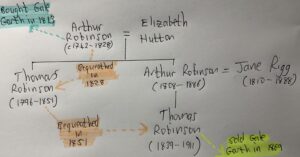
Partial family tree of the Robinson family
Living with Arthur (1808 – 1886) at Gale Garth was his wife Jane (nee Rigg), aged 41, born in Middleton where they were married on 25 Nov 1830. Their children living at home were Thomas, aged 11, born in Melling, Lancs, two daughters born in Barbon, Elizabeth, aged nine and Agnes, aged seven. Another daughter Margaret, who was aged four had been born in Scotland at Meigle near Perth. The next daughter, Ann, aged one, was also born in Barbon. In addition, they had elder children, who were no longer living with their parents. They were Arthur, born in 1832, John Rigg, (1834), William, (1835) and finally Jane (1836).
Prior to moving to Gale Garth, in 1841 Arthur was recorded as living in Box Tree in Barbon, working as an agricultural labourer. He regularly moved house. After being in Casterton for the 1851 Census, by 1861 he was recorded as living at Mill House in Middleton, working as a corn miller. He was still there in 1871, by now farming 15 acres. In 1881 he had returned to his place of birth by which time he was a ‘retired gentleman farmer.’
A gravestone in St Bartholomew Churchyard, Barbon adds more information. It shows that Arthur died there on 15 June 1886 aged 77 and his wife Jane followed him a few years later dying, on 16 October 1888 aged 78.
Fined
An interesting document in the Kendal Archives offers insight into what happened if the Customary Rent was not paid to the Lord of the Manor.[26] On 2 July 1857 Thomas Robinson (1839 – 1911) was brought before the Court Baron and Customary Court of the Right Honorable William Earl of Lonsdale, the Lord of Casterton Manor. The Court was held at the home of farmer James Mallinson. He was living in what had been the original Manor House (going back to Anglo Saxon times) and, despite the Lord of the Manor not having lived there for centuries, it was still where the Manor Court was held.
Thomas had been summonsed by the Lord of the Manor’s Steward, Lawrence Harrison. The document recalled how Thomas the nephew had inherited the property from his uncle and outlined his inherited responsibilities to pay the Customary Rent. Having established the debt, it was noted that Thomas had paid to the Lord of the Manor ‘a piece of silver called a Godspenny and the sum of one pound and three pence as a fine for his admission is accordingly admitted Tenant of the said premises in manner and fore aforesaid.’
A Godspenny, also know as ‘Earnest Money’ is an old English term for money given by a buyer to a seller to bind a contract. In this context it is a token payment by Robinson acknowledging that he was admitting to his guilt.
Interestingly, reference was still being made in this document that the land had formerly been in the possession of Martin Range, some 113 years after he had sold it.
The Newton Family
The 1861 Census, which took place on 7 April of that year, shows that a new family were living at Gale Garth. The Head was Nicholas Newton, aged 32, listed as a Farmer of 120 acres and born at Leck. With him was his wife Sarah nee Kitchen, aged 30, born in Quernmore, Lancashire. Their children were Thomas, aged eight, born in Leck, Nicholas, aged 7, born in Casterton, presumably at Gale Garth, William, aged 5, and Henry, aged 9 months both born in Casterton.
Ten years earlier, Nicholas had been living with his parents and siblings at Leck working as a farm hand. The following year, on 26 May 1852, he married Sarah Kitchen at Leck Chapel, at which point he was a Husbandman. Based on the date of birth of their son Nicholas, the family had moved to Gale Garth before 1854, perhaps after they were married. They left Gale Garth sometime after 7 August 1861 -their son Robert was born there- but before 1864 when their son James was born at the location they were listed as living at in the 1871 Census, Overtown Farm at Burrow with Burrow. In 1871 they were farming 180 acres. Nicholas senior died in Burrow in 1903, leaving an estate valued at £1294. His wife Sarah died in Leck in 1919.
Repairs
The incoming tenant replacing the Newtons was Robert Towers. He signed a lease on the property in 1863. In a file in Kendal Archives is a letter from Kirkby Lonsdale solicitors Pearson and Pearson to Thomas Robinson (1839 – 1911) regarding his tenant Robert Towers. Dated 1 July 1864, it reads ‘Your Tenant Mr Robt Towers called yesterday and said that the barn and one of the outbuildings at Gale Garth required immediate repair. The slates are broken in several places and won’t keep the rain out. Mr Towers wants the repairs to be completed before he puts his hay into the Barn…’[27]
Loans
On 7 November 1863 –Thomas Robinson (1839 – 1911) borrowed money from the Reverend Richard Mallinson from Melling and Robert Burrow from Whittington using the farm as security. The loan was for £1,000 and he was paying annual interest of 4%. The document stated that Robert Towers was the tenant and went on to describe the property. ‘All that estate or farm called Gale Garth consisting of dwelling house, garden, orchard, barn, stable, shippon and other farm buildings and several closes containing 101 acres 1 rood 39 perches called Lime Kiln Pasture (27a. 3r.), Low Meadow (7a. 27p.), High Meadow (4a. 2r. 10p.), Great Allotment Pasture (14a. 3r. 25p.), Green Hill Mire Allotment (1a. 15p.), Gale Garth House and Paddock (3r. 27p.), Great Meadow (13a. 3r. 15p.), Copy (2a. 3r. 26p.), North Pasture (17a. 3r. 13p.), Hog House Allotment (10a. 2r. 1p.) – all in manor of Casterton and held of lord of manor by yearly customary rent of 13s. 6d.’[28] It is clear from this description that the security of the loan included some fields that had previously been part of Hillard Farm Estate. The fields from there not included as security were Lea Dale, Kirk Bank, Long Bank, Dowbergill, and the plot of land near Devil’s Bridge called Water Brow.
More Repairs
In 1867, a contractor named Stephen Atkinson was paid for ‘repairing slate’ at Gale Garth. The lead builder named Thomas, was charged out at two shillings and three pence for a ½ day’s work whereas his labourer was charged at one shilling and six pence. The materials used were one hundred weight of slate costing three shillings and six pence and ‘lime and hair’ for one shilling.
On Sale Again
The property was put up for sale at an auction on 22 July 1869 at the Green Dragon Hotel in Kirkby Lonsdale. The auction poster gave details of the sale. The lot consisted of the farmhouse and garden, a barn, stable, shippons and other ‘suitable outbuildings.’ The total estate was just over 100 acres of ‘good Meadow and Pasture Land.’ One of the selling points was that it ‘is situate within 4 miles of the Kirkby Lonsdale Station, on the Ingleton and Tebay Branch of the North Western Railway’. It noted that Robert Towers was the farmer occupying the farm and that he was available to show prospective purchasers the property.[29]
The property was bought by local landowner Joseph Gibson of Whelprigg for £2,350 from Thomas Robinson (1839 – 1911). As noted above, the property was mortgaged to the Reverend Richard Mallinson in the parish of Melling in County of Lancashire and Robert Burrow of Whittington. The loan for £1,000 was still outstanding, but all interest had been paid. After the sale, Thomas Robinson gave formal notice that he would repay the loan within six months. In addition to the loan of £1,000, Thomas was also in debt to a James Robinson from Bolton le Sands. He also undertook to pay this loan off within six months.[30]
1871 Census
As noted above, Robert Towers moved to Gale Garth when Nicholas Newton and family left there in 1863. The Towers moved from Clapham where they had farmed 38 acres. After having experienced a regular turnover of farming families living at Gale Garth, Robert was there for the long term. He stayed at Gale Garth until he died there in 1896, a stay of 33 years.
In 1871 he was the Head of the household, born around 1818 at Cowan Bridge, aged 52. Robert’s wife was Ann, nee Nowel, aged 54, who was born in Clapham.
They were married on 1 Jan 1838 at Thornton in Lonsdale. On their marriage certificate Robert’s father, also named Robert, was recorded as a Weaver.
From an earlier Census, we know that they had a daughter born in 1840 named Mary and a son named John, born in 1846. Neither were residing at Gale Garth during the 1871 Census but their children Robert, aged 22, and Bridget, aged 21, both born in Clapham were there, along with two eight-year-old Granddaughters named Ann and Margaret, and a one year old Grandson named Roger, who was born in Casterton.
Sheep Worrying
In 1878, a newspaper reported a court case which involved events on Gale Garth’s lands and a protagonist named George Whitehead who was probably the previous tenant of Gale Garth who we have already encountered.[31]
A Richard Sutton from Leck Fell House had accused George Whitehead a farmer at Vipers Mill near Westhouses, Cowan Bridge and Aaron Ewan of Goods near Westhouse, for allowing their dogs to run amok on 13 October, injuring nine of his sheep. He was claiming damages of £18. Richard told the court that he had heard dogs yelping near his home and the Mr [Robert] Towers would be able to say that he saw two dogs passing over Easegill at that time.
The police investigated, visiting George Whitehead at his farm. He and his wife both stated that his dog had not been with them on that day, i.e. it had run away.
Mr Towers told the court that, ‘I saw two dogs in my meadow. It was about 8 o’clock. I should be about 60 yards from them. I gave a description of them to the police. [The] Defendants dogs are the same sort, but I cannot swear that they were the dogs. They were very like them.’ Another witness stated they he had seen the dogs from only 4 or 5 yards away, adding that they were not George Whitehead’s. Several other witnesses having seen the dogs running wild and subsequently seeing George’s dogs could not say for certain that they were his. There was the same uncertainty over identifying Mr Ewan’s dogs. Despite this apparent uncertainty, the plaintiff, Mr Sutton, was awarded £15 and 15 shillings including costs.
Long Term
The 1881 Census confirms that the Towers family were still living at Gale Garth. In residence were Robert and his wife, their son Robert, and their granddaughter Ann. Shortly before the next Census, Robert’s wife Ann died aged 74 at Gale Garth, on 4 November 1890.
The 1891 Census shows Robert as a widower, now aged 72. His son Robert (42) is still with him along with his grandchildren Ann and Roger, and now also a three-year-old grand daughter named Lucy, born at Casterton.
Judgement?
About this time, a curious question was asked in the Yorkshire Herald under the heading Queries. ‘Gale Garth, Barbon Fell [Sic] – Can any readers give an account of a farm-house on Barbon Fell [Sic], called Gale Garth, or sometimes ‘Judgment’ because of a picture, in the kitchen, of the judgement day, in which hundreds of faces look up to the sky, where Christ is represented sitting on a throne and Satan in the back-ground. – H.M.’[32] Sadly, I could find no answer to this query, but it does seem to suggest that The Tower family were God fearing.
New Beginnings
Robert was still listed as Farmer in an 1894 Directory but died at Gale Garth on 8 December 1896. His estate was valued at £754. In the 1901 Census a new family, the Masons, were residing at Gale Garth. The Mason family have been encountered in a previous Sketch as farmers at Bullpot. Before living there, they first farmed at Gale Garth before later moving the few hundred metres to Bullpot.
The Head of the family was Joseph Mason. In 1901 he was 30 years old, born in Dent, his occupation was listed as a Farm Bailiff. He was there with his wife Mary Alice nee Bell, aged 26, from Sedbusk in Wensleydale. They had three children, Mary Elisabeth, aged five, born in Dent, William aged two and James aged 11 months both born in Leck.
In a 1905 Trade Directory, two names were listed as associated with Gale Garth. The aforementioned Joseph Mason, ‘(bailiff) Gale Garth’ and John Harrison ‘Gale Garth, Back o’th’ fell, and Barbon.’ A 1906 and 1910 Directory refers to Joseph as ‘hind to John Harrison’, that is to say a farm hand, working for him.
The 1911 Census provides more information. At this time Joseph had been married for 17 years, i.e. married in 1895, and had had 11 children. There were 10 still living and one had died. In addition to the three children recorded in the 1901 Census, Joseph and Mary had borne another seven children, all born at Gale Garth. There was Alice (9), Joseph (7), Ellen, (5), Annie (4), Maggie (3), Matthew (1) and Richard aged five months. In that Census, their eldest daughter Mary Elisabeth Mason was living at Bullpot, listed as a Servant, age 15.
A Short Move
The 1921 Census shows that they were living at Bullpot. Joseph Mason was aged 52 and 9 months, he was a ‘Hind and Shepherd’, born in Dent and still working for John Harrison. His wife Mary Alice was now aged 46 and 5 months, and was born in Sedbusk, Hawes, Wensleydale. Their eldest son William age 22 and 4 months, born at Leck Fell, Leck, and recorded as a Shepherd, was also working for John Harrison. In addition to those children recorded in the 1911 Census, more had arrived. There was John (9), Rosana (8), Agnes (7), Ada (5) and Bessie (2). Looking at birth certificates, it is possible to identify when the family moved from Gale Garth to Bullpot.
Agnes was born at Bullpot on 26 May 1914. The last child born at Gale Garth was Rosana on 10 May 1913. So sometime after this, but before 26 May 1914 when Agnes was born, they moved up the road.
Potholers
The fields around both farms were increasingly destinations for cave exploders and potholers. This aspect of the history is covered extensively in my Bullpot Sketch (see https://www.castertonparishcouncil.org.uk/a-sketch-about-bullpot-farm/ ) and therefore I have not repeated it here. I have found details about a rescue I had not included in the Bullpot Sketch which is included at the foot of this Sketch.
Abandoned?
It would appear from the 1921 Census that nobody was living at Gale Garth. There is no entry for the farm in the Census record. The house was now apparently abandoned. With the two farms now operating as one, there was no need for them both to be occupied.
The Mason family were still recorded as farmers at both Gale Garth and Bullpot in a 1929 Trade Directory, but Joseph Mason, was now listed as ‘hind to Messrs Croft & Dugdale ’ for both Bullpot and Gale Garth, suggesting that a Mr Croft and a Mr Dugdale had taken on the tenancy. Joseph Mason was still farming the two farms in 1930 but seems to have left before 1934. A Directory from that year states that ‘Dugdale Jn. Creighton, farmer, Galegarth & Bullpot’ was looking after the farms.
Four years later, a 1938 Directory states ‘Croft Fras. Farmer, Galegarth & Bullpot.’ indicating that John Dugdale had left but that Francis Croft was still there.
It would appear from the 1939 ‘Census’ that there was still nobody living at Gale Garth as there is no entry for it in the record. However, the ‘Census’ shows that John Croft was living at Bullpot. He was Francis Croft’s son. He was born 3 Aug 1910. His wife Edith, nee Hayton, was born 9 Feb 1909. The ‘Census’ redacts two other people, I presume their children. One of their children was named Joan, who sadly died in 1967 aged only 33. By 1939, he had moved to High Bank House in Barbon.
The Pearsons
As noted in the Bullpot Sketch, Walter and Catherine Pearson were farming Bullpot and Gale Garth from possibly the late 1940s to the mid 1950s. They were succeeded by Captain J. L. Spencer.
Captain Spencer
1957, a notice was placed in a newspaper stating that both Bullpot and Gale Garth Farms were being offered to new tenants. The notice read ‘This excellent sheep farm carrying a flock of 600 Swaledale ewes, to be let. The tenancy will commence from 5th April, 1958, but arrangements can be made with the outgoing tenant for entry on November the 5th, 1957. There are two modernised houses [i.e. Bullpot and Gale Garth] and good sets of buildings and the land extends to approximately 1,450 acres, of which 30 are meadow.
The holding may be viewed by making an appointment with the tenant, Captain J. L. Spencer, Bullpot Farm, Casterton, Kirkby Lonsdale, Carnforth.’[33] The advertisement suggests that both the farms had been modernised and that the tenant was living at Bullpot rather than Gale Garth.
Previously, Captain Spencer had issued written undated instructions to potholers outlining the rules and regulations that they must follow in order to be given permission to access the potholes on the land that he was farming. A copy can be seen in the Bullpot Sketch.
Within those instructions it stated ‘9. Anyone arriving without the written permit mentioned in (1) above may be refused access: on arrival, all parties should contact the Tenant or his Shepherd (Mr. H. E. Mickle, Galegarth Farm) before going to the Caves.’[34]
It seems therefore that farmhands of the tenant, certainly in Captain Spencer’s tenure and perhaps before, were living at Gale Garth while working at the farm. Spencer’s shepherd was Herbert Ernest Mickle. He was born in 1916 near Barrow in Furness. The 1939 Census shows that he was living in North Westmorland. He married his wife Frances Armistead in 1945, perhaps this was when he moved to Gale Garth.
Writing about the early history of the Red Rose Cave and Pothole Club in the club journal, it was noted that around this time, i.e. 1957/8, ‘There had been a change of tenants [at Gale Garth] and Walter Scarr [Sic – this is actually Norris Scarr – see below] and his wife had taken over – we were made quite welcome until we lit a fire in the old fireplace [at Bullpot]. The chimney was blocked by birds’ nest and the whole farm fogged out with Walter [Sic – Norris] on his hands and knees with a towel over his face “rescuing” people.’[35]
The Scarr Family
Norris and Margaret Scarr moved into Gale Garth in 1958 after Captain Spencer left Bullpot. Their landlord was Colonel Bowring. It is not clear when the Bowrings acquired Gale Garth, but the family still own it. It is possible that they bought Gale Garth at the same time as they bought Bullpot. The UK Land Registry shows that a conveyance dated 25 October 1924 was made between Joseph Gibson who was selling Bullpot and Henry Illingworth Bowring who was the purchaser. As noted above, the Gibson family had acquired Gale Garth in 1869, so it would not be a surprise that they sold Gale Garth to the Bowring family at the same time as Bullpot.
Margaret Scarr is still living locally, in Cowan Bridge a spritely 96 years old. I interviewed her to find out more about her time at Gale Garth, her memories of Casterton and the other Casterton farm she farmed with her husband – Folly Farm. The notes below are taken from this interview.[36]
Margaret Hunter Chapman was born in Muker, Swaledale at Heugh Farm in 1928. She was the fourth child, a farmer’s daughter preceded by three brothers. The name Hunter was the maiden name of one of her grandmothers. In the early 1930s her family moved to Bishop Gale, near Aysgarth, to a dairy and sheep farm.
Margaret remembers the depression of the 1930s and how living on a farm offered certain benefits. The family were allowed to keep a pig for private consumption and were able to make their own cheese and butter with milk from their cows. She remembers walking to school wearing clogs.
She was married from that farm in June 1947 aged 19. Her husband to be Norris was a friend of one of her brothers. After they were married, they moved to Norris’s father’s farm called Moorcock Farm, close to Hawes. It was in a remote location, a mile down a big track off the main road, past a secluded church, through a paddock and across two footbridges to cross the stream. Everything had to be carried over these footbridges by hand, including 10-gallon milk churns, carried on their backs. If the stream was too high, they even had to carry the sheep rather than drive them through the water.
Nearby was a Youth Hostel which meant that lots of people passed by the farm. Margaret recalls that it was a good community where people looked after each other. From Moorcock Farm, Norris and Margaret and their son moved to Gale Garth. The decision to move was brought about by the death of Norris’ father who owned Moorcock Farm. He left the farm to his eldest son. When that son took over, neither Norris or Margaret appreciated being told how to run the farm and so they decided to set up on their own.
Both Margaret and Norris had been brought up to believe that you should only buy something when you had the money. They therefore opted to find a farm that they could rent rather than taking out a mortgage and buying one. In hindsight, Margaret thinks that they should have taken the plunge at this time and bought a farm.
As noted above, Captain Spencer was their predecessor, he had been living in Bullpot. Margaret described him as a ‘gentleman farmer’, that is to say he had staff to do most the work including his hind who lived at Gale Garth. Sadly, the Captain apparently committed suicide at his new home near Long Preston.
Before being offered the tenancy, the Norris’s had to pass an extremely strict interview conducted by the landowner by Colonel Bowring’s agent. This included a visit to see them at Moorcock Farm.
They first moved some sheep from Moorcock to Gale Garth in the autumn of 1957 and moved into the farm on 6 April 1958. Margaret was heavily pregnant with twins just before they moved.
They had the option of either moving into Bullpot Farm or into Gale Garth. Margaret chose Gale Garth. She saw that the roof of Bullpot leaked and when it rained, the cellar filled with water. She felt that Bullpot was in worse condition.
On their arrival at Gale Garth, there was only a small pantry, but there was an outhouse with a sink. They asked their landlord for permission turn the outhouse into a kitchen. They installed a Rayburn, a vast improvement on the fireplace that had been the only place to cook beforehand.
When they arrived, there was no mains running water and it was not unusual to find a frog in the pipes from the local water source, nor was there mains electricity or a telephone line connected to the house.
Margaret’s brother wired the house and connected it to a generator. He installed a button in the house that when pressed turned off the generator. The problem with this of course was that it turned off all the lights in the house. A torch was definitely needed.
As noted above, Norris brought some of sheep from his Swaledale farm and took over the flock that had been living on the land around Gale Garth. These sheep were ‘’heughed’ (pronounced hoofed). This means that they strolled freely over the farmland, knowing their territory, learning it from their parents.
At Gale Garth they farmed a flock 800 – 1,000 sheep. All were hand sheared at the farm by both Norris and Margaret. Norris still returned to Hawes to sell his sheep, it being the best auction house for Swaledale sheep, but occasionally also sold them at Bentham.
The young family kept a cow for personal milk, and Margaret used a ‘separator’ to obtain the cream to make butter. They also used horses on the farm and later bought a small grey Massey Ferguson tractor.
Their twin daughters were born 12 May 1958 and were christened by the Reverend Ewbank at Casterton Church. After the christening, the reception was held at Church Cottage which as well as being a Post Office and local store run by Mr and Mrs Bell, was also a café.
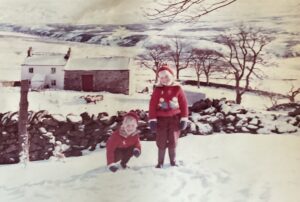
Early 1960s, Norris and Margaret’s twin daughters with Gale Garth farm in the background.[37]
Margaret recalled that on a Sunday night, ‘as a treat,’ if Norris had time to look after the children, she would walk to the top of Brownthwaite to listen to the bells of Casterton Church.
Schooling
As they got older, the children went to village school by taxi using Ribblesdale Taxi Service based in the Market Square at Kirkby Lonsdale, later moving onto New Road, by the old filling station.
When their son passed his 11+ he went to Queen Elizabeth School. This created a scheduling problem because Casterton village school finished at 15:30 whereas QES did not finish until 16:00. This meant that the girls were left outside of the school for 30 minutes while they waited for their brother to arrive. Margaret was understandably concerned about the safety of her daughters but could not be offered a solution to the problem until she took matters into her own hands. She visited the Education Director in Kendal, refusing to leave when she was told he was not there by doing a ‘sit in’ until he deigned to see her. Need less to say, the problem was sorted.
Illness
Norris and Margaret managed the farm without help. However, one day she became terribly ill. She had trouble walking and lost her eyesight and ended up in hospital. It turned out that she was allergic to sheep! It was no longer possible for Margaret to help with the arduous task of hand shearing or suckling them. It was at this point that Norris decided that it would be a good idea to purchase a machine to help with the shearing!
End of an Era
They stayed at the farm for 10 years. Leaving there in 1968. In that year electricity was installed and the year before they had installed a telephone.
When they left the farm, the property was taken over by new tenants. They were not farmers; they rented the house and the land that had for centuries been let with the farm was let separately. As noted in the Bullpot Sketch, Bullpot was also no longer being used as a farm, being let to the Red Rose Cave and Pothole Club from 1967.
It was the end of an era for these old Casterton Farms, becoming as many other farms in the wider area, a house and home but no longer a workplace.
Both Gale Garth and Bullpot have retained the same tenants since 1968 and 1967 respectively.
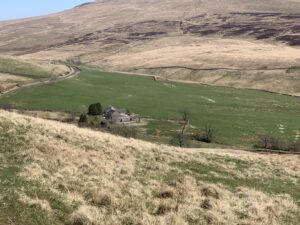
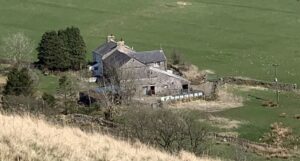
Gale Garth in 2023[38]
A New Challenge
After 1968, Margaret and family moved into the village of Casterton where they acquired Folly Farm, farming there for 35 years, but residing in Kirkby Lonsdale. This chapter of their lives will be covered in a future Sketch when I write about Folly Farm.
Postscript – A Rescue
In my Bullpot Sketch I have written in detail about the history of caving in the area around Bullpot and Gale Garth. While researching this Sketch, I discovered a rescue that was not mentioned in the Bullpot Sketch. Because the newspaper report of this rescue mentions Margaret Scarr, I have included it here.
The rescue happened not long after Margaret and her husband Norris had moved to the farm. The headline read, ‘THREE RESCUED IN POTHOLE – After 21 hours far below the surface.’[39]
Three members of the Kendal Caving Club, all experienced cavers, were lost after entering Lancaster Hole near Bullpot. They were Gerald Williams, aged twenty-six, a teacher at Gilling-gate, Kendal, Ralph Hobson, aged 36 who worked for the Gas Board and lived at Milnthorpe and William Fairbank aged 50 from Morecambe.
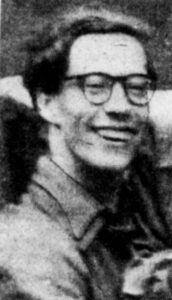
Gerald Williams pictured after his 21-hour ordeal[40]
The cavers became lost because there was a misunderstanding over ladders. Two parties from the Kendal Caving Club had entered the cave, one by way of Lancaster Hole, the other by the Boundary Pot entrance. The plan was to meet up with each other, but this did not happen.
Unfortunately, one of the Cavers had taken away a ladder thinking that the other group had already passed by. Initially, the group left underground decided to wait where the ladder should have been in the hope that the mistake would be noticed. However, after a long wait, they decided to try to make there own way out using a different route. The cavers had the foresight to leave notes indicating the route that they were taking but were hampered by the batteries in their helmet lights running low. Eventually they gave up trying to find their way out and settled down to wait to be rescued. With the help of the notes left by the stranded potholers, the rescue team lead by Mr. Reg Hainsworth from Ingleton (who was the secretary and warden of the Cave Rescue Organisation) found the cavers.
On being rescued Gerald Williams said that ‘We spent a fairly comfortable night talking, eating, and sleeping. There was never any panic for we knew we would be guided out eventually, and in the end we just waited until the rescue team came long. Everybody was most helpful.’ During all the excitement ‘Refreshments were provided for the rescued and rescuers by Mrs. N. Scarr of Gale Garth Farm.’
Simon Drakeford
October 2024
With special thanks to Margaret Scarr
References
[1] Cumbria County Archives (Carlisle), D/LONS/L5/4/15/3
[2] Cumbria County Archives (Kendal), WDB135/1/820
[3] A. H. Smith (ed.), The Place-Names of Westmorland, English Place-Name Society – Part One, vol. XLII, Cambridge, 1967, p 28
[4] William Farrer and John F. Curwen (Ed.), Records Relating to the Barony of Kendale Vol II, CWAAS, 1924, p339
[5] Courtesy of the author.
[6] Cumbria County Archives (Kendal), WDWHELP/8/1
[7] Cumbria County Archives (Kendal), WDWHELP/8/2
[8] Cumbria County Archives (Kendal), WDWHELP/8/3
[9] Cumbria County Archives (Kendal), WDWHELP/8/4
[10] South Westmorland Window Tax – 1777, Cumbria Family History Society, p7
[11] Cumbria County Archives (Kendal), WDWHELP/8/5
[12] Cumbria County Archives (Kendal), WDWHELP/8/6
[13] Cumbria County Archives (Kendal), WDWHELP/8/7
[14] Lancaster Gazette, 3 October 1812, p2
[15] Cumbria County Archives (Kendal), WDWHELP/8/7
[16] See https://www.bankofengland.co.uk/monetary-policy/inflation/inflation-calculator
[17] See https://www.castertonparishcouncil.org.uk/a-guest-sketch-about-the-enclosure-of-casterton/
[18] Cumbria County Archives (Kendal), WD/Whelp/8/7, ‘Proposals for selling by auction, 21 October 1812’
[19] Cumbria County Archives (Kendal), WD/Whelp 11 Box 1
[20] Cumbria County Archives (Kendal), WDWHELP/8/9
[21] Westmorland Gazette, 5 September 1846. Also Auction Poster at Cumbria County Archives (Kendal), WDPP/2/4/98
[22] Lancaster Gazette, 14 October 1848, p2.
[23] Kendal Mercury and Northern Advertiser, 12 January 1850, p 2
[24] Westmorland Gazette, 3 August 1850, p2
[25] Cumbria County Archives (Kendal), WDPP/8/8
[26] Cumbria County Archives (Kendal), WDWHELP/8/11
[27] Cumbria County Archives (Kendal), WDPP/8/8
[28] Cumbria County Archives (Kendal), WDWHELP/8/13
[29] Auction Poster at Cumbria County Archives (Kendal), WDPP/8/8 and Lancaster Gazette, 17 July 1869
[30] Cumbria County Archives (Kendal), WDPP/8/8
[31] Kendal Mercury. 7 December 1878, p6
[32] Yorkshire Herald and the York Herald, 21 May 1892, p12
[33] Morecambe Guardian, 10 May 1957, p10
[34] Taken from the front cover of the RRCPC Newsletter Vol. 22 No.4, March 1986. Used with the permission of the Librarian of the RRCPC
[35] ‘Formation of the Red Rose, & Early odds & Sods’, RRCPC Newsletter, Volume 54 Number 2, October 2017
[36] Interview by the author with Margaret Scarr recorded at Cowan Bridge on 3 May 2024.
[37] Used with the permission of Margaret Scarr
[38] Courtesy of the author.
[39] Lancashire Evening Post, 24 August 1959, p1
[40] Lancashire Evening Post, 24 August 1959, p1