

Introduction
Bullpot Farm is the most isolated farm in Casterton. Located to the far east of the parish, nestled close to the boundary of the parish of Leck. Throughout the centuries, the farm has been referred to in several ways, mostly either Bull Pot or Bullpot. Unless directly quoting, I will refer to it as Bullpot.
Many of the people who lived at the farm were drawn to the closer proximity of Barbon, even though it is in the parish of Casterton. To walk from Bullpot to Casterton Church along the Fell Road is almost 4 miles. To walk to Barbon Church from the Farm across the Fells is only 2.6 miles.
Perhaps because of how remote it is, over the years, many families have farmed at Bullpot. Some were there for decades, others for only a few years. The longest serving tenant is the current one, the Red Rose Cave and Pothole Club (RRCPC) who have been there 57 years and counting. The club was founded in 1946, but only moved to Bullpot Farm in 1967.[1]
This Sketch will focus on the history of the farm itself. To the extent that the history of Bullpot Farm overlaps with caving, I will include such details, but note that this article is not a history of caving in Casterton or the caverns that surround it.
Enclosure Act 1812
Bullpot Farm appears to have been built because of the Enclosure Act of 1812.[2] Preparations to meet the requirements within the Act took several years. The Enclosure Award was finally made in 1816. It was the Reverend Carus Wilson’s father, William Wilson Carus Wilson of Casterton Hall, together with the Lord of the Manor, the Earl of Lonsdale, and local landowners Daniel Wilson, Joseph Gibson of Whelprigg, and James Harrison of Lowfields who decided that enclosing Casterton Fell would solve various problems that they were encountering on the Fells.
One of these problems was the monopolisation of common grazing, known as ‘dogging off’. This was put forward as the principal motive for the enclosure of Casterton by the Reverend William Wilson Carus Wilson, when he gave evidence to the Parliamentary Select Committee on Enclosure in 1844. Wilson claimed that a farmer who lived near the Fell had ‘almost monopolized the herbage, being in the constant habit of dogging off other people’s sheep’, and, in order to gain ‘complete control of the Fell’, he had acquired farms on both sides of the Fell, thus preventing the ‘tenants of the landowners in general getting scarcely any benefit from the pasturage’.[3]
Details from the 1816 Award show that Thomas Gibson acquired 1,325 acres of land which included the land on which Bullpot Farm was built. Within the Cumbria (Kendal) Archives is the payment receipt of the monies paid by Jospeh Gibson to the Commissioners who had been appointed by the Act of Parliament to manage the process of enclosure. The receipt was dated 15 February 1813.[4]
‘Bull Pot Public Lime Stone Quarry’ was identified on the Enclosure Map printed at the time, the quarry was made available inter alia to the public to cut stone for use building the walls which enclosed the fields.
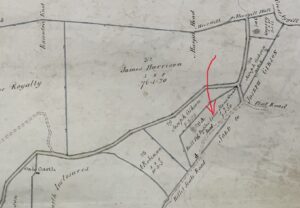
Extract from the 1816 Enclosure Map showing Bull Pot Public Lime Stone Quarry[5]
Old Records and Maps
Craven and Halliwell suggest that Bullpot is marked on Jefferys’ 1770 Map of Westmorland.[6] From my review of the map, I think that the unnamed farmstead on the map is Gale Garth rather than Bullpot.[7] As noted above, Bullpot Farm came into existence as a direct result of the 1816 Enclosure of Casterton and therefore would not appear on that map.
An 1820 Visit
Some time before 1820, an explorer with the pseudonym ‘Valentine’, visited the pothole after which the farm was named, the Bull Pot of the Witches. He wrote about his trip in the Lonsdale Magazine.[8] With a colleague, Valentine walked to Casterton Fell. Arriving first at Easegill on the border of Casterton and Leck, nearby Leck Beck, he wrote ‘To the south was expanded before us the fertile vale of Lune. The meandering river, sometimes hid, sometimes visible, appeared like serpentine ingots of liquid silver, carelessly thrown on a large Brussels carpet…‘.
They spent time exploring the Easegill Witch Hole [called Whittle Hole on the 1770 map]. Having explored it, they tried an experiment. ‘Finding that we had seen all the cave, we were determined to try its echo; and having provided ourselves with a blunderbuss, we almost frightened the rocks themselves with the report. I had imagined that the echo might surprise me, but I never suspected that it would deprive me of hearing any thing else, for nearly half an hour after.‘
They then explored Ease Gill Kirk, which is not, as the name suggests a church but rather, a very atmospheric limestone gorge with a cathedral like atmosphere. Shortly after, they met a local who informed them that there were ‘some astonishing caverns on the same moor close by’. Together they walked across the moor towards the caverns.
The narrator did not mention whether they took Hillard Scale Road (also known as Hillet Scale Road), suggesting perhaps that it had not yet been built, but still ‘quickly found the object of our search. What a field – I should say – what a cavern was here for philosophers to expatiate upon. The place is called the BULLPOTS. But for what reason we could not learn.
The opening is nothing more than an irregular fissure in the rocks, about forty yards long, and of unequal width. The deepest part was ninety six feet deep, perfectly dry and seemingly pretty level in the bottom. On minutely searching, we found a crevice in the rock through which we descended about thirty or forty feet; and would have gone farther if possible. The cavity here expanded to a considerable extent, and we could discern the bottom —a fine limestone flag. Nearly opposite to where we stood, we perceived a large hole in the other wall of the cavern; into this we threw stones, which slowly rattled down a descent, till the sound died away —and by way of rounding the period, I may add —and we heard them no more. What extent of a cave may be here concealed from human eyes, I cannot possibly inform the reader, but our joint imaginations painted, or rather designed it, a remarkably large one.’
Presciently, the local character who Valentine had chanced upon, hypothesised ‘that there might be a cave in Casterton Fell, above a hundred miles long.‘ Valentine dismissed the idea but subsequent investigation has discovered that the caves in the area now form part of what is known as the Three Counties System. The most recent estimate of its length is some 86km. This is expected to increase with the discovery of further connections with other known caves.[9]
Valentine also made no mention of Bullpot Farm which, had it been there he would surely have seen. The building does however feature on the 1823 map of Westmorland prepared by C & J Greenwood and on T. Hodgson’s map of 1828.
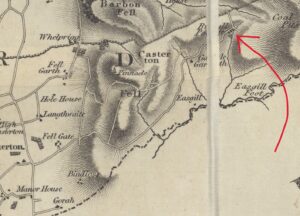
Extract from Greenwood’s 1823 Map of Westmorland
The 1830s and 40s
The 1838 Tithe Map records that the owner of the farm and the surrounding fields was still Thomas Gibson who, as noted above acquired the land in 1813 from the Earl of Lonsdale. The farmer at this time was Thomas Stockdale.
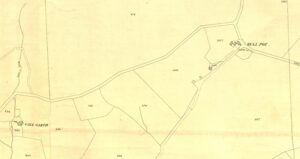
Extract from 1838 Tithe Map
Bullpot next receives a brief mention in the seventh edition of Jonathan Otley’s book A Descriptive Guide to the English Lakes. Included in this edition was a final chapter written by ‘HHD’ about ‘An Excursion Through Lonsdale to the Caves’.[10] Easegill received a detailed mention, Bullpot less so, saying only that ‘These fells abound with chasms of profound depth, and several small caves, which are difficult of access. The most remarkable are Bull-pot, Gavel-pot, and Rumbling Hole.’[11]

Extract from 1862 OS Map
The 1862 OS Map above offers more detail, showing Bullpot Farm and additional outbuildings as well as Bull Pot Quarry. Also identified are several lime kilns. It is likely that these were built after the Enclosure Award, to be used for burning the lime extracted from the quarry.
Lime Kilns
The lime kilns are substantial constructions and there are several located in the parish of Casterton. Lime burning was an early industrial process requiring specialist labour to run effectively. Casterton was fortunate because in the surrounding area were seams of low-grade coal which could be used to ‘fire’ the kilns. Elsewhere, coal would have been imported or otherwise, alternate supplies such as peat, wood or gorse would have been used.
Limestone (Calcium Carbonate) had been recognised as a valuable resource for centuries. A lime kiln is used to calcify limestone by burning it to produce a form of lime called ‘quicklime’. Temperatures of around 900 °C are required for the process to occur. ‘Quicklime’ is used in agriculture to address soil acidity and to supply calcium for plant growth. When ‘quicklime’ is mixed with water it becomes ‘slake lime’, with the chemical name calcium hydroxide. ‘Slake lime’ is commonly used to prepare lime mortar.
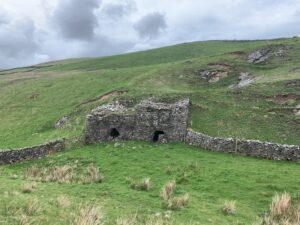
The two limekilns close to Bullpot Farm[12]
The Stockdales
As noted above, Thomas Stockdale was the farmer of the land at Bullpot when the Enclosure Award was made in 1816. In 1829, a Trade Directory notes that it was a Henry Stockdale (born 1758) who was farming land at Bullpot as well as at Bell Yate in Casterton.
On 24 September 1834 a Miss M Stockdale died at Bullpot ‘in the prime of life’.[13]
James Harrison
Seemingly contradicting the information above and below, an advert was placed in a local newspaper in 1840. It stated, ‘To Be Let by Ticket’ the sheep farm of ‘Bulpot’ [Sic]. The advert said that the farm comprised some 1,350 acres as well as a dwelling house, barn, and other suitable buildings. It noted that the tenant was James Harrison, and that further details were available from Joseph Gibson of Whelprigg. Joseph was presumably still the owner.[14] An almost identical advert was placed one year later.[15] Note that the 1816 Enclosure Map shows that a James Harrison owned some of the fields in the vicinity of Bullpot, in particular the large field directly north of the farm.
A Second Thomas Stockdale
The 1841 Census shows that a different Thomas Stockdale was living at Bullpot. He was aged 35 (born 1806), with him were his wife Ellen, who was also aged 35, their sons Henry aged 10 and James aged 6 and daughters Anne aged 8 and Besty aged 3. Thomas married Eleanor (Ellen) Mason on 20 Feb 1830 in Dent.
This Thomas Stockdale was the son of Henry Stockdale, presumably the one recorded in the 1829 Trade Directory. The Thomas mentioned as the farmer in the 1816 Enclosure Award was unlikely to be the same Thomas mentioned in the 1841 Census. He would have only been aged about 13 years old. Presumably, the older Thomas was a relative, perhaps Henry’s brother.
A Legal Opinion
Another document in the Cumbria (Kendal) Archives is titled ‘Manor of Casterton – Copy of Sir F. Pollock’s Opinion.’ The legal opinion is dated 21 May 1841 and concerns a barrister, Fred Pollock, offering his opinion on whether the Lord of the Manor had a right to hunt game on the newly enclosed lands owned by Mr Gibson. It does not specify whether this was William Gibson or Joseph Gibson.
The Lord was trying to exercise his right of ‘Freewarren’, that is to say, the right that Lords of Manors were historically granted by royalty to hunt game etc. Pollock was very definitive that the Lord had no such right to hunt on Mr Gibson’s land. The land in question was that which Gibson had acquired from the Lord of the Manor in 1813 as part of the preparations for enclosing it.
Pollock wrote, ‘The right of the Lord to shoot over the wastes did not arise from any right of Freewarren or any similar right, but because the Lord of the Manor was the owner of the soil and he has now ceased to be owner of the soil, he has therefore ceased to have a right to shoot, and I think this is one of the rights included in the exception as “Rights meant and intended to be barred and extinguished” and I think nothing short of the most clear and direct expressions would have created the anomaly of the right of soil being in one man, and the right to shoot in another without a Freewarren. I am therefore of opinion that the exclusive right to shoot in the new inclosures declared to be freehold is in the freeholders.’
‘Permission to Kill Game’
Another revealing document at Cumbria (Kendal) Archives is titled ‘Authority to kill game upon Bull Pot Farm’.[16] It is an agreement between Thomas Stockdale and William Gibson Esq. The document tells us the William is living at Ellel in Lancashire (next to Galgate). There was a branch of the Gibson family living around there at this time. It stated that Thomas gave William ‘exclusive right to all the game and wild fowl of what nature or kind so ever that now is or at any time hereafter shall or may happen to be up on the lands and premises now in my occupation situate in the Township of Casterton and in the said county of Westmorland.’ Furthermore, he ‘authorise[d] the said William Gibson and his friends gamekeepers and servants accompanying or attending on him to enter upon the said lands and premises or any part thereof for the purpose of pursuing and killing the game and wild fowl thereon.’
Thomas made sure that his own interests were protected. ‘And I do hereby further authorise the said William Gibson to take all such proper and legal measures as may be requisite for preserving the game on the said lands and premises and for punishing any person or persons who may be found trespassing thereon in pursuit of game; he the said William Gibson indemnifying me of and from all costs charges and expenses in any way incurred by the prosecution thereof.’
It seems curious to me that it seems that Thomas had the power to grant such authorities, especially considering the legal opinion above, which made it clear that the owner had the sole right to grant permission, and, as noted below revoke it.
One possible explanation is that in Thomas’s own tenancy agreement with the landowner, he was given the right to pursue game but was sub-letting that right out to William Gibson. The agreement concluded, ‘And I do hereby declare that this authority shall be and remain in full force until I shall by writing under my hand revoke the same. Dated this twenty third day of June one thousand eight hundred and forty one.’
Another point of note is that Thomas appears to have been literate, he was able to sign his name.
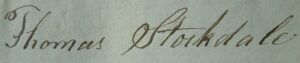
Thomas Stockdale’s signature from 1841[17]
Trespass
A newspaper report from 1850 reporting on the Kirkby Petty Sessions, shows the above agreement in force. John Ashburner, a farmer from Dent, was tried for trespassing on ‘High Casterton Fell’. William Gibson had brought the charges. It was Henry Stockdale, presumably Thomas’ eldest son, who had seen Ashburner in pursuit of moorgame on the Fell. Ashburner was found guilty and immediately paid his very hefty 40 shillings fine, plus costs.[18]
Ten Years Later
The 1851 Census repeats the family details disclosed ten years earlier. It shows that Thomas Stockdale (1803) was aged 48. He was farming 1,350 acres and had been born in Dent. Note that it was not unusual that Census details, particularly ages, varied across the decades. If Thomas were 48 in 1851 it suggests that he was born in 1803, not 1806 as was suggested in the 1841 Census. The 1851 Census shows that Ellen was 44 and was also born in Dent. Their eldest child Henry was born in Dent in 1830, but Ann, was born in Casterton in 1833, presumably at Bullpot Farm. In addition to James (born in Sedbergh), and Betsy (born in Dent) who had appeared in the 1841 Census, there was now also Thomas aged 8, Ellen aged 3 and Jane aged 2 months, all born in Casterton.
In an 1858 Directory, Thomas Stockdale (1803) is still listed as the farmer at Bullpot.
In 1860, the tenancy for the farm was advertised to be let by tender. Thomas must have been the successful bidder because, as noted below, he was still there during the Census of 1861.
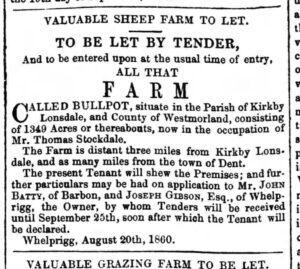
An 1860 advertisement to let Bullpot by tender[19]
In the 1861 Census, Thomas (now aged 59, i.e. born 1802!) has enlarged the farm, now farming 1,400 acres. His wife Ellen is still there and living with them is a grand daughter named Jane Mason aged 2, who had been born in Casterton. Jane was the daughter of Ann Stockdale who had married James Mason in 1858. (Whether or not her husband James was a relative of Ann’s mother whose maiden name was Mason is not known.) Jane had been born at Bullpot on 6 March 1859, one year after her parents’ marriage. The rest of the family were no longer at Bullpot. As described below, they had moved to Fell House in Barbon.
Serendipity
One of the early members of the RRCPC was Tom Sykes (1933 – 2017), becoming a member in 1949. He became President of the club in 1967, the year that the club acquired the tenancy of the farm (described later).[20] After he died, some papers were found by his family in which Tom had recorded his connections with the Stockdale family. These were published in the club’s newsletter soon after his death.[21] Tom’s grand mother had told him about his family history. What he was told agrees with the family information found in the Censuses described above.
There was however one mystery that Tom was uncertain about. I can now provide an answer. He wrote that ‘There was some doubt about Isabella’s mother. Rumour in the family later was that she was the child of eldest daughter Ann. Whatever was the truth no one verified it and Isabella was brought up and treated as one of Thomas and Ellen’s family.
About the time when Isabella was a young woman Barbon Manor was being built. Isabella met and married John Simner and in April 1875 they had a daughter Jane (my Grandmother). By this time they had moved from Kirkby Lonsdale to Lancaster and the family lost touch with Bull Pot and the other brothers and sisters.’
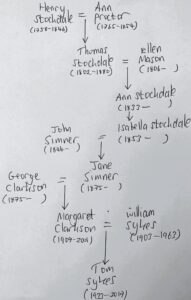
Partial family Tree showing how Thomas Sykes is descended from the Stockdales of Bullpot
Isabella’s birth certificate can be found at the UK Government’s General Records Office. It reveals that she was born on 21 February 1853 at Bullpot. The document confirms the family rumour, she was indeed the daughter of the then unmarried Ann.
Tom then pondered ‘What a pity none of this was recorded. The 1851 census shows only Thomas, Ellen and granddaughter Jane Mason still living at Bull Pot Farm. Another mystery, what happened to Jane’s parents Ann and James?’
The 1861 Census offers a partial answer. Almost the entire family of Thomas and Ellen had moved to Fell House, Barbon. Head of the family living at Barbon was Henry Stockdale, Thomas and Ellen’s eldest son. He was recorded as farming 1,950 acres. Ann was also living there with her first daughter Isabella and husband James. In the Census record, Isabella still had the surname Stockdale rather than that of her stepfather Mason.
As we have seen, Ann and James’s daughter Jane, aged two, was residing at Bullpot on the day of the Census with her grandparents. Living at Barbon was another child, William Mason, aged two months. This was probably the reason why his elder sister Jane was living at her grandparent’s’ house. Also living at Fell House were Henry and Ann’s siblings James, Thomas, and Ellen.
Life at Bullpot in the Mid Nineteenth Century
In the article written by Tom, which was based on his grandmother’s recollections, he offers some fascinating insights into how life was for the Stockdale family in the mid nineteenth century.
‘Ann Stockdale married James Mason (not the film star!!) in Barbon Church in December 1858 and their daughter Jane was born in 1859. Another wedding and connection with the Masons, James Stockdale married Betsy Mason in Barbon Church in 1862.
The family were almost entirely self sufficient. Water was from the beck outside the back door, light was from oil lamps and candles. They made their own candles. Heating and cooking was from the open fire using wood, peat and coal from the open cast mines on the slopes of Crag Hill. I dread to think what toilet facilities existed but probably the old thunder box some way away from the house. They shepherded around 40 sheep (the children knew most of them by name) and after shearing, the wool was spun and made into cloth – the tailor used to stay at the farm for two weeks making clothing for the family. One pig was reared and slaughtered each year to provide ham and bacon joints which were cured and hung from hooks in the kitchen. Nothing was wasted from the trotters to the snout and, of course, the blood which made black puddings. They had chickens, ducks and a large vegetable and herb garden at the back of the farm.
My Grandmother who passed most of this information down never mentioned a cow or a horse but I assume they must have had a horse because visits were made infrequently to Kirkby Lonsdale and Barbon. The children were for the most part bare foot. They had to wear clogs to walk to Church in Barbon but whenever possible they were hidden behind the wall on the Green Lane and collected on the way back!!’
Changing Tenants
A document dated 24 September 1878 offers insight into the considerations that landlords had to contemplate during the transition from one tenant to another.[22]
In this case, John, and James Maudsley of Newton, in the parish of Whittington who were farmers, had taken on the tenancy of Bullpot in 1869 for nine years. Their landlord was Joseph Gibson of Whelprigg. It appears that after nine years the Maudsleys had identified a new tenant for the farm, a Mr Wrathall. Filed with this document was a letter from Pearson & Pearson, local solicitors, who recommended to Gibson that he should formally serve the notice documents on the Maudsleys just in case the proposed changeover fell through.
The formal notice activated various provisions within the 1869 lease agreement. These provisions were designed to ensure that the new tenant was able to move into a functioning farm that they could take over. For example, the old tenants were required to ‘provide room in the cow house stable … for one cow and one horse belonging to the incoming tenant… and accommodation for the shepherd of the said incoming tenant’ The Maudsleys were asked to give up the possession of the farm and lands and ‘wintereatage’ (i.e. winter food) to Joseph Gibson and allow him the use of a barn. They were also to leave ‘all manure arising from the Hay and the Vestures[23] produced thereon and to leave… not less than 150 yards of hay for the use of the landlord or the next incoming tenant.’ In addition, the old tenants were asked to leave ‘a useful good stock of sheep which have been for some time previously depastured… consisting of the numbers and descriptions following viz 170 lambs 170 one shear 170 two shears[24] and 240 aged sheep.’
In the formal notice, Gibson informed his old tenants that he had appointed Richard Fulton of Fell House in Leck in the parish of Tunstall to be his ‘Referee’ to calculate the value of ‘wintereatage’, 150 yards of hay and of the lambs and sheep. He asked that the Maudsleys advise him of their ‘Referee’. The process was that the two ‘Referees’ would be able to agree a valuation of what was being handed over at the end of the tenancy. If they could not reach agreement, there was provision to appoint an ‘Umpire’, i.e. an arbitrator, to make a valuation.
The Stockdale’s Connections with Other Farms
In 1871, the family of Thomas Stockdale (1803) were still at Fell House, Barbon, farming 800 acres. He died in Sedbergh in 1880. The probate of Thomas (1803) shows that by this time, his son Thomas (1843) was farming at Bell Gate in Casterton which was confirmed by the 1881 Census which adds that he was farming 143 acres, with his wife Isabella and five children.
The Kitchen Family
The 1871 Census shows that a new family were in residence at Bullpot. It was not the Maudsleys but rather the Kitchen family. It is clear from the documents referred to above that the Maudsleys had been tenants of Bullpot and later handed the tenancy onto the Wrathall family. The 1878 document referred to above refers to the Maudsleys as being ‘of Newton, in the parish of Whittington’, I assume therefore that the Kitchen family noted in the 1871 Census were sub tenants of the Maudsleys.
Head of the new family was James Kitchen, age 33, his occupation was recorded as ‘Hind’ or farm hand, and he had been born in Longsleddale, Westmorland. Many years later, this village was the inspiration for the fictional village of Greendale in the BBC children’s television series Postman Pat.
With James were his wife Sarah, also 33, his mother Hannah aged 70, who hailed from Cartmel, and six children; Mary, aged 8, who had been born in Pendle, Cumberland, Hannah (6), William (5), John (3) and James (2) who were all born in Longsleddale. David however, aged 1 month, was born in Casterton. This indicates that they had probably moved to Casterton after 1869 which ties in with when the Maudsley’s took on the tenancy with the Landlord.
The Kitchen family did not stay at Bullpot for long. In an 1873 Directory, nobody is listed at Bullpot Farm. The 1881 Census shows the Kitchen family were by then living somewhere else in Casterton, with James’ occupation recorded as a Gardener. In the years after the 1871 Census, they had had at least another five children, all recorded as born in Casterton. The houses’ position within the 1881 Census comes after Bee Nest and Ivy Cottage, but their residence is not named. It was possibly Folly Lane [farm]; they were recorded there in the 1891 Census when James was noted as being a shepherd. In that Census there were four separate residences listed at Folly Lane. By 1901 they were living in Barbon.
The Wrathall Family
In 1881 there was another new family living at Bullpot, the Wrathalls. As shown above, they took over Bullpot sometime in 1879. Head of the family was Anthony Wrathall, aged 54 who had been born in Thornton in Lonsdale. His wife was Jane, nee Downham, aged 41 from Slaidburn, Yorkshire (but now in Lancashire). They were married in Chapel le Dale, near Ingleton in November 1859. They had 6 children living with them, all born at Chapel Le Dale. They were John (19), Lucy Ellen (18), Thomas (15), Anthony (13), James (11) and Mary Jane (8).
Before they moved to Casterton, Anthony had been a Parochial Constable at Ingleton, serving alongside Richard Downham who may have been his wife’s father or her brother who were both named Richard.[25] In 1865, Anthony was re-elected as a Church Warden for Ingleton Fell.[26] He was an Overseer of the Poor there in 1877.[27]
In the summer of 1877, the property where Anthony farmed as an annual tenant, some 500 acres at Southerscales, near Ingleton, was advertised for sale.[28] Perhaps this was why, despite being a valuable and apparently respected member of the community he was forced to move.
In 1880, by which time he was residing at Bullpot, Anthony offered for sale 460 sheep comprising ‘KEEPING SHEEP, HALF BRED-LAMBS, SCOTCH WETHER LAMBS, AND OTHER SHEEP.’ The sheep had been moved to the farm of John Wrathall, Over Kellet, for the convenience of the sale.[29] John was probably Anthony’s son.
In an 1885 Directory, Anthony Wrathall is listed as living in Casterton ‘Back o’th’ fell.
Visiting Potholes
In 1888, two visitors to Bull Pot of the Witches, R. R. and M. Balderston, noted that it had a vast entrance with an 18-metre waterfall adding, that it was a ‘dreadful hole, foetid with the dead carcases of sheep and lambs, and whitened skeletons’.[30]
A few years later in 1892, Harry Speight appears to have been the first visitor to measure the dimensions of the cave. He too observed the rotting animals. ‘A tremendous chasm, 80 yards in circumference, lies a little to the south of the house. It is generally filled with dead, putrifying [Sic] remains, – not of bulls, although these may at some time have been the engulfed victims, but of sheep and smaller animals. The rocky, western face attains an elevation of near 100ft, while the opposite extremity is about 60 feet.’[31]
A New Tenant?
An 1890 advertisement suggests that by then, there was a new tenant. It records that W Hollins’ Esq. of Bull Pots Farm [Sic] had instructed an auctioneer to sell sheep at the Red Lion, Whoop Hall, near Kirkby Lonsdale Station.[32] Craven identified that this was William Hollins jr., of Pleaseley Vale, Mansfield and that he was the owner of the land on which Bullpot stood.[33]
The Foster Family
The 1891 Census shows that Leonard Foster, age 48, a Shepherd, and born in Casterton, was living at Bullpot. He was with his wife Jane, nee Brennan, age 50 and their five children, all born in Casterton. There was May (17), James (17), Leonard (15), John (14), and Jane (10).
They were a local family. In 1871, after their marriage in 1868 in Kirkby Lonsdale, Leonard and Jane were living at Jane’s father’s house at Whelprigg Lodge.[34] Jane’s father James, was a Gardener. At this time Leonard was a ‘Farm Servant’. He and Jane had already had a child named Christopher. Ten years later, Leonard was the head of the household at Whelprigg Lodge with his wife and expanding family. His occupation was now ‘Cow Man’.
In an 1894 Directory, no one was listed as occupying Bullpot, certainly by 1901, the Fosters were no longer there. They had moved to Mireside Farm, Mansergh.
More Explorers
In May 1900, three members of the Yorkshire Ramblers Club claimed the first descent into Bull Pot of the Witches, going down about 65 metres, although they did not leave any record of the exploration.[35]
The Martindale Family
A new family were at Bullpot in the 1901 Census. Edward Martindale, age 31, was a Farm Bailiff, born at Strickland Kettle. His wife Hannah, nee Graves, age 26, was born in Langdale. With them was their daughter Mabel, aged 3, also born at Langdale.
A 1905 Directory indicates that as well as Edward being at the farm, there was also a H E Hollins at Back o’ th’ fell’. Possibly a relative of W Hollins mentioned above.
The Martindales were still at Bullpot in 1911. In addition to Edward and Hannah and their daughter Mabel, there was also another daughter named Nina, age 3 born in Casterton. The Census shows that they had had three children, but that one had died.
Also living there was Mary Elisabeth Mason, a Servant, age 15. She appears to be the daughter of Joseph and Mary Mason who were farming at Gale Garth in the 1911 Census noted below. The proximity of Gale Garth to Bullpot can be seen in the extract from the 1862 OS Map above, a little over ½ a mile away.
Two More Visitors to the Witches
Between 1905 and 1910 when Dr Theodore Ridley Burnett was the headmaster of Kirkby Lonsdale’s Queen Elizabeth School, he took pupils into the cave. There is only one formal record from 11 April 1909. The record itself was inscribed on the wall of the cave as graffiti. His visits were sufficiently penetrative to have two features of the cave named after him, ‘Burnett’s Great Cavern’ and ‘Burnett’s Passage’.
A more formal survey of Bull Pot of the Witches was conducted in 1919 by Cuthbert Hastings and Guy Louis Hudson from the Yorkshire Ramblers Club. The original survey was lost but at some point, had been copied by a pioneer of British Caving, Eli Simpson.[36] It was published for the first time in 2005.[37]
Craven and Halliwell document many more examples of visitors to Bull Pot of the Witches from 1920 to 2003, detailing the story of its ongoing exploration by different Cave and Potholing groups.[38]
From Bullpot to Fell Garth
By 1921 the Martindale family had moved to Fell Garth Farm in Casterton. Born in 1911 but after the Census, was Eric Martindale, he was recorded as farming at Fell Garth in the 1939 War ‘Census’ with his wife Frances and three children. He had been born at Fell Garth in 1911 and died there in 1961, leaving an estate valued at £14,746. His brother Hugh Martindale was born 1917, also at Fell Garth. Their father Edward died in 1939 at 2 Brook Side, Barbon, leaving an estate valued at £3,852.
The Mason Family
In 1901, the Mason family were living and farming at Gale Garth, Mary Elisabeth noted above, was also living there. With the exception of Mary Elisabeth, the Mason family were still farming at Gale Garth in the 1911 Census.
A 1914 Directory shows that Joseph Mason, ‘hind [farm hand] to John Harrison esq.’ was farming at both Bullpot and Gale Garth. I presume that James Harrison was the tenant of these two farms with Mason as sub tenant. The entry in the 1914 Directory implies that the Martindales had left Bullpot by that year. The same details appeared in a 1921 Directory.
The 1921 Census offers a lot more detail about the Mason family. Joseph Mason was aged 52 and 9 months, he was a ‘Hind and Shepherd’, born in Dent and working for John Harrison. His wife Mary Alice was aged 46 and 5 months, and was born in Sedbusk, Hawes, Wensleydale. Their eldest son was William age 22 and 4 months, born at Leck Fell, Leck, and recorded as a Shepherd, also working for John Harrison. All the other children, of which there were many, were born in Casterton. They were Joseph (18), Ellen (16), Annie (14), Maggie (13), Mathew (12), Richard (10), John (9), Rosana (8), Agnes (7), Ada (5) and Bessie (2).
The UK Land Registry shows details about the sale of Bullpot. The conveyance was dated 25 October 1924 and was made between Joseph Gibson who was selling Bullpot, a Charles Ernest Hollins and Denis Machell Hollins who were given some rights by a covenant and Henry Illingworth Bowring who was the purchaser. The conveyance gave various people the right to pass with or without livestock and carts and carriages over some land nearby Bullpot.
The Mason family were still at the two farms in 1929, recorded in a Trade Directory, but Joseph Mason, was now ‘hind to Messrs Croft & Dugdale ’ for both Bullpot and Gale Garth, suggesting that a company had taken on the tenancy. Joseph Mason was still farming the two farms in 1930.
John Dugdale
Joseph Mason seems to have left before 1934. A Directory from that year states that ‘Dugdale Jn. Creighton, farmer, Galegarth & Bullpot’ was looking after the farms.
Memories from 1934
In a 1988 newsletter of the RRCPC, a person -R A Bindloss- who lived at Bullpot in the 1930s shared with the club his memories. I quote below, slightly out of order to improve the flow.[39]
‘Bullpot where I lived in 1934, of course there was no electric light, only paraffin lamps and candles. No hot water, only what was in the boiler by the side of the old black range. I still have what we called a ladling can, with a handle, with which we used to get the hot water out. No bathroom or toilet, but there was a little WC in a building alongside the back door.
I remember cutting old clothes up to make hearth rugs and little door mats, we still have two door mats, I just can’t throw them away, sentimental. There were no fitted carpets, bedroom floors were covered in oilcloth, with our homemade mats jotted around. We made butter, I still have mothers butter bowl and the acorn print she used to stamp on the blocks of butter. The big kitchen in the house was used when the shooting parties came and had their meals.
The postman came three days a week; just fancy walking all the way up and down that long road to Kirby [Sic] Lonsdale. I picture the journey he had every time we ride up to Bull Pot. There was no tarred road in those days. We always had to walk down the fell onto the Barbondale road, we had a hut at the bottom of the fell for our bicycles, then we rode on to Barbon. I had an auntie who lived at High Bank and we always called there, perhaps to change our wet clothes.
There was no machinery in those days, all the work was done by hand rakes, one horse did all the mowing of the grass, when I look back I just don’t know how we got through.
A lot of potholers came around in our day from Leeds, they had wash themselves in that little beck.
Bull Pot seems to be going into decay now with no farmer to keep things up. The walls are falling down, there used to be a good wall around the cave. The old barn has tumbled in. The field across from the house was a hay field called Moss Meadow, it is all rushes now. I would like to see the rooms again and picture what used to be.
I left Bull Pot when I married. Well now, this is just a little peep into bysgone [Sic] days.
- A. Bindloss.’
The Croft Family
Four years later, a 1938 Directory states ‘Croft Fras. Farmer, Galegarth & Bullpot’. The 1939 War ‘Census’ shows that John Croft was living there, born 3 Aug 1910, Farmer, his wife Edith, nee Hayton, born 9 Feb 1909, plus 2 other people, I presume their children, but the information is redacted. One of their children was named Joan, who sadly died in 1967 aged only 33. Francis Croft was John’s father. By 1939, he had moved to High Bank House in Barbon.
It is not clear when the Croft family left Bullpot.
Cave Club Visitors in the 1930s
In the 1930s, the site was visited by several caving clubs including the Craven Pothole Club, the Leeds Cave Club and the Northern Cavern and Fell Club. Between them they were there on eight occasions, often staying overnight. They would have required the permission of the landowner or more likely the tenant to access the various ‘pots’ around the farm.[40]
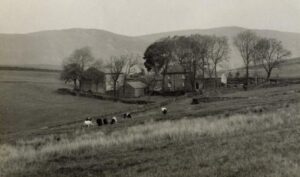
View of the farm from Bull Pot of the Witches taken Whitsun (early June), 1933[41]
The Pearsons
The penultimate farming tenants of Bullpot were the Pearsons. In the early days of the RRCPC before they moved to Bullpot Farm, various reminiscences show that they had a more ad-hoc relationship with the farmers and the tenants at Bullpot.
Writing in the club’s newsletter, member Harry Bewes recalled that ‘We became associated with Bullpot Farm In a rather funny way. Going up to do some hole in Easegill we travelled to Kirkby Lonsdale on the Saturday afternoon and walked up (after a few drinks) to Gale Garth which at that time was used only as a fodder store for the sheep. We decided to kip down for the night in the warm hay. We were woken Sunday morning by a giant with a pitchfork, Walter Pearson from Bullpot. Someone must have been a very persuasive talker as he became a good friend of the club. Eventually he allowed us to use the back room at Bullpot and picking us up in the Land Rover from Kirkby Lonsdale.’[44]
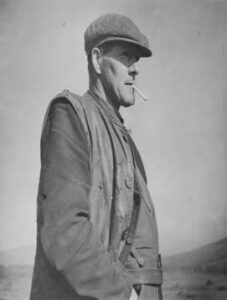
Walter Pearson, farming tenant of Bullpot Farm[45]
Tom Sykes recalled that Walter and his wife Cathleen were still at the Farm when the Red Rose occupied a room at the back in the 1950’s. ‘We were great friends of the Pearson’s until one of our members Peter Kitchen had a pie in the sky idea to install an electric turbine in Bull Pot to provide unlimited free electricity to the farm.
Walter was really excited by this but it did not materialise. Peter stayed away for some time but when he reappeared Walter chased him down the lane in his land-rover (Peter on an old motorbike) armed with a pair of gelding pliers and a blue marker dye that he used to identify impregnated ewes. The lane was un-surfaced in those days so Peter was lucky to escape in one piece. Ron tells me he [Walter] took a farm in Malham after he left Bull Pot and his wife died a few years later.’[46]
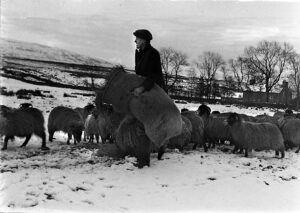
Walter Pearson feeding sheep with Bullpot Farm in the background C1950s[47]
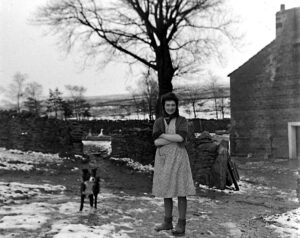
Cathleen Pearson stood with dog in front of Bullpot C1950s[48]
Captain Spencer
In 1957, Bullpot was advertised ‘for let’ along with Gale Garth. It stated ‘this excellent sheep farm carrying a flock of 600 Swaledale ewes’ will be let from 5 April 1958. There was about 1,450 acres across 30 meadows. The tenant at the time was Captain J. L. Spencer at Bullpot Farm.[42]
While he was the tenant, he had issued Fell Permits to Cavers with strict details about the rules and regulations they were required to follow.
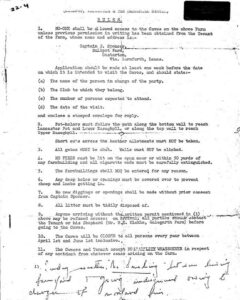
Casterton Fell Permit issued by tenant farmer Capt. J. Spencer – date unknown. Point 12 reads ‘In dry weather. No Smoking between leaving farmyard & going underground owing to chance of moorland fires’.[43]
Before the Red Rose Cave and Pothole Club – the late 1940s and 1950s
It seems that even before Captain Spencer left Bullpot, the farm had started to fall into disrepair. For the farmers, having a handy large hole near the farm proved useful. The closest pot to the farm, now called ‘Casterton Pot’ was first called ‘Tip Pot’ because it had been a convenient rubbish tip for Bullpot Farmhouse until the 1950’s. It was discovered in 1959 by Earby Pothole Club, who described it as about 100ft deep.
Another early pioneer of the RRCPC was Jim Eyre. He left some of his papers at the club which were later edited and published in the club newsletter by Mel and Sandra Wilkinson.[50] Jim was the club’s first President (1956-1968). His notes recall his early visits to Casterton Fell in the late 1940s and early 1950s. One of the club’s first meeting points was at a club hut behind the Marton Arms in Ingleton. Later there was a move was to Hellot Scales Barn on Casterton Fell, where they would sleep under a cart until one night it rained and ‘nearly squashed Taylor’s ribs’. Thoughts then turned to the ‘Bullpot back room’. Jim recalled ‘The route to Bull Pot Farm in those days was just a rutted track – quite a challenge for our ancient motor bikes and Hellot Scales lost its popularity when Roland Johnson parked his bike at the top of the road and vaulted the wall in the fog. The steep drop soon parted Johnson from his senses and we eventually returned a much battered caver to his well strewn belongings.’
Another memory, ‘Bill [Leyland] was quite useful as he used to pinch some of his mother’s gin and his father’s cigars and bring them up to Bullpot, when by this time we had got use of the back room.’
Around this time ‘There had been a change of tenants [at Gale Garth] and Walter Scarr [Sic – this is actually Norris Scarr] and his wife had taken over – we were made quite welcome until we lit a fire in the old fireplace. The chimney was blocked by birds nest and the whole farm fogged out with Walter [Sic – Norris] on his hands and knees with a towel over his face “rescuing” people.’
Norris Scarr was originally from around Hawes where he married his fiance Margaret Hunter Chapman in 1947. They farmed the land around Ease Gill, Gale Garth, and Bull Pot of the Witches between 1958 and 1968. They lived at Gale Garth and in an interview years later, she recalled that in the early 1960s, Bullpot ‘was dropping to bits then.’[51] Margaret still lives in the area.
Accident and Rescues
In 1953, three potholers from Keighley were rescued after ‘having been hopelessly lost in the five miles of subterranean passages of Lancaster Pot, England’s most famous cavern, 1,500ft. up on the Casterton Fells.’[52] The men had arrived in a party of seven at Bullpot Farm. Four of the party exited as planned and went to the farm to wash and change but became concerned when their friends had not returned. They returned to Lancaster Pot where they waited for ninety minutes before raising the alarm. When rescued the lost cavers had been underground for 15 hours, and lost for 9 of them. The rescue required 60 people representing all the Yorkshire potholing clubs as well as the R.A.F. Mountain Rescue Squad from Topcliffe.
The following year, there was more drama when ‘A Burnley woman pot-holer falls 40ft. to rocky slope.’[53] The newspaper reported that ‘Rescuers worked for four hours 60 feet below the ground in Bull Pot, Casterton Fell… to bring to the surface a young woman pot-holer who had fallen 40 feet down a rope ladder.’ She was 23-year old Mrs. Patricia M. Carroll from Burnley. Dr Mathews from Kirkby Lonsdale descended into the abyss to treat her and give her morphia for the pain. ‘A special stretcher of the Neil Robertson type was lowered down the pitch Mrs. Carrol was strapped into it and then drawn to the surface.’ She was taken to Kendal Hospital with a broken wrist, back injuries and suffering shock. Her husband Peter, who saw her fall, also stayed in hospital suffering from exposure and shock.
In 1955 there was a less serious accident when 19 year old Sandhurst Cadet Officer Robin Robinson Edgar slipped and fell 16 feet while exploring Easegill Cave, breaking his knee cap. He was rescued by nine members of the Royal Mountain Exploration Club from Sandhurst and taken to Bullpot Farm and thence to Kirkby Lonsdale surgery for treatment.[54]
Good Times
There were of course many more successful and safe visits to the pot holes around Bullpot Farm than there were accidents. For example, the Craven Pothole Club’s reports in their journals from 1949 to 1959 offer a flavour of such trips and the team work and friendships that they engendered.[55]
For example a 1948 visit to ‘Bull Pot o’ The Witches’ noted that ‘VJ Wood forced the well-known up-stream siphon, clad only in nailed boots and a helmet, all other clothing having to be divested at the very tight start.’[56]
In 1950, a Whitsuntide trip was made. ‘The party assembled on the Saturday afternoon and spent the evening in photography at Cow Pot. The club bus arrived on the following day and Bull Pot o’ the Witches was investigated. Other clubs were also there and a new extension was explored, ending in a sump, which was duly swum in.’[57]
Two years later ‘tents were pitched on the grass track near Bullpot farm, above Easegill. On the first day, many of the people descended Bull Pot of the Witches and hammer and chisel were used to such satisfactory effect on “Crunden’s Crevice” that Brian Varley was able to squeeze through into an hitherto unexplored portion of the pothole, a “dry” system with good formations.’[58]
In 1957, thoughts turned to exactly how extensive the caverns that led from Bull Pot of the Witches were. On member wrote ‘I always feel that this pot is somewhat neglected and might well lead to a large system.’[59]
In 1959, ‘Arthur Hardy led at Bull Pot of the Witches. A good number attended and most of the system was visited. The upstream syphon was passable and those who were prepared to get wet stated that it was the finest part of the cave.’[60]
Before the Red Rose Cave and Pothole Club – the early 1960s
For a time, the Fylde Mountaineering Club had sought and received permission to use Bullpot as a base for their activities on the Fell. Unaware of this arrangement, three young members of the club set out to do some exploring on Casterton Fell. One of those young men, Graham Stevens, shared his story in the RRCP’s newsletter.[61]
‘On 7th June 1960 three of us set out from Blackpool for Casterton Fell. Barry and I, aged 16, had motorbikes with L plates and arrived before Keith on his pushbike. We met no-one and thought Bullpot Farm was deserted despite hay in the barn and equipment in the outbuildings!…
Meanwhile Keith had arrived and called at Gale Garth where he met Margaret Scarr the farmer’s wife who gave him permission for access but warned that her husband Norris did not like trespassers!…
After he reported Margaret’s comments, it was with some trepidation that we returned to Bullpot Farm and met Norris. We apologised for our ill-mannered behaviour and asked permission to retrieve the tackle from County Pot. He recognised our naivety in rural matters and asked where we were from. When we said Blackpool, he said he had recently made an arrangement with some members of the Fylde Mountaineering Club [FMC] to use Bullpot Farm in return for occasional help on the farm and upkeep of the farmhouse interior. As it happened, we were already members of FMC but didn’t know it had a potholing section!…
Between July 1960 and September 1961 we stayed at the farm as often as possible doing 29 trips in the area. The FMC members helped Norris with haymaking and dry stone walling, whilst in the farmhouse they provided heating at weekends and did decorating. Several of them were carpet fitters by trade and they put lino tiles on the stairs and bathroom floor and carpeted the ladies’ and men’s ‘dormitories’… The hot water came from a water-jacketed stove in the fireplace in the kitchen which nearly blew my head off when I tried to re-kindle it with ‘meths’. I remember it well!’
Permission Withdrawn
Graham Stevens also recalled a dramatic rescue and its consequences.
‘…on Sun 11th Feb 1962 a pivotal event in British Caving took place when Leeds University cavers Alan Fincham and Barry Greenwood were trapped by rising water in Pegleg Pot in Lower Easegill. A major rescue event ensued and without seeking permission, Bullpot Farm was taken over as rescue headquarters. The rescue involved blasting to divert Upper Easegill into the sinks and dam building at the entrance to the pot. Unfortunately walls were knocked down and lambing ewes affected by the blasting. The press arrived and the single track lane up to the farm was blocked with vehicles. Norris was unable to get back to his farm to tend his animals. Not surprisingly there was a backlash. The landowners declared ‘war on potholers’ and closed the fell.’[62]
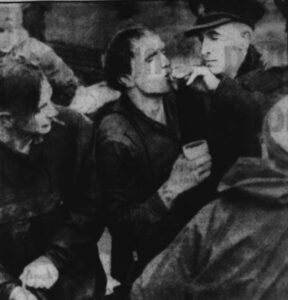
The Daily Herald’s tagline ‘Brandy for Barry [Greenwood] as rescuers help him to safety’[63]
The events were widely reported at the time and included the above photograph of the rescue. Referring to the 24-hour ordeal of Barry Greenwood, age 23 and Alan Finchman age 28, who had founded Leeds University’s cave exploration society, the Daily Herald explained how the pair had been trapped by rapidly rising water. They retreated to a higher ledge in the cave and scooped up some mud to offer a further barrier. Barry said that ‘We knew we were safe from the water. It was just a question of time before it went down. But how long would it take?’ He explained that ‘It seemed we had been there for days when quite suddenly I noticed the water going down. It was a wonderful sight.’[64]
The reason that the water fell so rapidly was, as noted above, explosives had been used to break the dam that was causing the water to rise. Years later, in an interview with Margaret Scarr, she reflected on this event.[65] In that interview she explained that the Leeds cavers were reckless. She had refused them access to the caves because of the weather conditions but they went via Leck Fell instead. The consequence was that FMC were banned from Bullpot Farm, although Norris Scarr did allow occasional visits by personal friends.
Negotiations
The situation was a big blow for more responsible cavers. It was not long before talks were being held to try to secure access again. Stevens wrote that ‘In Dec 1962 the landowners told me they were dealing with Tom Sykes and the RRCPC and renewed access was under review following progress towards the formation of an Association of Caving Clubs capable of controlling visits by its members.
This became the CNCC [Council of Northern Caving Clubs now called the Council for the Northern Caving Community] who regained provisional access later in 1963.’[66]
This history is explained in more detail on the CNCC website, ‘Prior to 1962, access to caves and potholes was based on private agreements between cavers and the landowners. In 1962, the grouse moors of Leck and Casterton Fells were closed completely to cavers following the rescue of cavers from Pegleg Pot, which they had visited without permission. The landowners refused to negotiate with individual clubs but indicated that an access agreement would be considered if responsible clubs got together to help administer access.’ With Tom Sykes as Secretary, the CNCC was formed in 1963, with ‘11 established clubs as a joint negotiating body. Access to Leck and Casterton Fells was restored following the signing of an access agreement although, initially, only one club per fell was permitted on one day.’[67]
Craven Pot Hole Club took advantage of this in 1966. ‘There was a good attendance of Bull Pot of the Witches on the 26th September, fourteen having camped on the green lane and the club bus brought many others. Some members took advantage of the good weather and stayed on top to enjoy the sunshine, but the majority supported their leader R Taylor below ground. All tackle was out by 4 p.m. which left time enough for a swim in Barbon Beck.’[68]
Red Rose Cave and Pothole Club
As noted above, the RRCPC moved to Bullpot Farm in 1967 where it remains to this day. An early article, written by Mel Wilkinson in their newsletter, documented the occasion.
‘At last! At last! The club has now taken a lease on Bull Pot Farm and from May 18th we will have moved into our new deluxe Club Headquarters; a palace compared with our last one at the “Shoes”.[69] It has three bedrooms and a bathroom upstairs, and four rooms and a garage downstairs. And our own football pitch which is supposed to be a garden.
Since we first started to prepare for moving in we have successfully installed electricity [and] an electric stove whilst also repairing the plumbing system, installing a coke boiler and repairing the upstairs toilet. Our main efforts however, have been concentrated on one room downstairs and one room upstairs, but it is hoped to do the whole house eventually. Hot water is expected to be made available soon, Ian Carruthers was elected Chief Warden and together with six other wardens will help in its running at weekends. Wardens have been issued with keys and members wishing to stay in midweek should apply either to Chief Warden or Hon. Sec.
Much work is still to be done and it’s hoped that all members will willingly give their help and support to make this a great success. The following donations would be willingly accepted:- Plastic Lavatory seat, Sink plugs, carpets, kitchen utensils, bedframes, fuel.’[70]
In the early days, one member, D. Creedy, had a curious experience while staying at the Farm which he shared in the newsletter.
‘The call of the hills was ringing in my ears. The fact that a storm was raging and it was nearly midnight did not deter me. I paused only to grab a tube of toothpaste (forgetting the brush) before taking to the road. My bike roared into action at the twitch of a foot. Five minutes later I was coasting the hill towards Bull Pot Farm with the brake chute aiding the rapid deceleration.
A light glowed eerily through the bathroom window. The doors were locked. I produced a key and entered. I switched on the kitchen light but no illumination was forthcoming. The meter was obviously empty. I hurtled upstairs to find the bathroom light still burning. I scratched my head furiously searching for an explanation to no avail. Not being superstitious I switched off the light and settled down for the night – under the bed.
A floorboard squeaked. Regular inmates know full well that to hear strange noises in the farm is not a rare occurrence however, this squeak was different from any other squeak ever heard. It could only be caused by some disembodied soul tortured by the past (or a rat). Courage mustered, I assumed an air of nonchalance and wandered downstairs. A band of light shone beneath the kitchen door, I flung open the door. “Would you like a cup of tea”, came a voice from the gentleman sitting at the table, I accepted gracefully. He continued talking and my nerves calmed from a fearful jangle to a quite rattle. A rope ladder lay on the table beside him, his headgear was unconventional in that few people today wear a bowler with a carbide lamp wedged in the hat band for caving. His suit was splattered with mud. The eccentricity of his apparel did not worry me unduly but when he began to talk of Martel’s descent of Gaping Gill as if an eye witness, I felt a trifle disturbed. After a surge of mental turmoil I experienced what can only be described as horror. I felt a pair of motionless eyes piercing deep into my thoughts. My fear racked brain could take no more.
It was daylight when I awoke to feel the hard cold, stone floor beneath me. The terror of the night seemed diminished, by the comforting light of the day. A search of the farm revealed nothing unusual, nothing that is except a pile of fresh earth bordering the stone flag nearest the door in the changing room, as if the slab had been recently moved. Would any member of the Red Rose (or any other club) practiced in the art of exorcism please perform the appropriate rites before my next visit to Bull Pot Farm.’[71]
Two Tragedies
Potholing and diving under water in caves can be very perilous. In 1980, there were two tragedies at Bull Pot of the Witches, one involving a very experienced caver, the other a novice.
On 16 March 1980, it was reported that the Editor of the Craven Herald in Skipton, 31 year old Ian Plant was ‘missing, believed to be trapped in the part flooded Bull Pot’.[72] Sadly, any hope was quickly dispelled. The following day’s newspapers reported the tragedy.
Under the headline ‘Potholer dies in flooded tomb’, the tragic story was told. Ian who lived in Settle, was described as an obsessive caver, had been one of Britain’s most experienced potholers and a veteran of many cave rescues as part of the Upper Wharfedale Fell Rescue Association and the Cave Rescue Organisation. Ironically, in January Ian had reported that ‘Sunday nights were peak periods for big rescues.’, it was a Sunday when rescuers from Settle and Upper Wharfedale set off in search of him.
His body was found submerged near the bottom of the Bull Pot cave system. He had apparently descended into a flooded pothole to test underwater radio equipment.[73] Another newspaper reported that ‘Mr Plant was among a team trying to chart an unexplored passage, believed to be about 500 yards long… he was well equipped with a double wet suit, four hours’ supply of oxygen and lights to guide him along the murky water-filled passages.’ It added that the group ‘had planned to plot the link passage between Bull Pot and Aygill Cavern, its dye tests showed they were connected.’[74]
Several months later, the Coroner’s Inquest held at Kirkby Lonsdale, heard that Ian had ‘died after going ahead with a dive 200-feet below ground, even though he knew he did not have a full supply of air.’ The verdict was death by misadventure.[75]

Caver Ian Plant
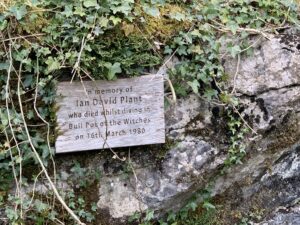
Memorial to Ian Plant at entrance to Bull Pot of the Witches (Courtesy of the author)
Only seven months later in October 1980, student Tracy Gibson, from Burgess Hill, West Sussex, was one of eight students from Salford University on a weekend potholing trip. She is believed to have fallen about 60ft and suffered significant head injuries. She was already dead when the Settle Cave Rescue team found her. A police spokesman at the time told reporters that the accident happened only minutes after the student party entered the system.[76]
Alfred Wainwright
In the late 1960s, none other than Alfred Wainwright visited Casterton Fell and Bull Pot of the Witches. His visit was part of a research trip for his book ‘Walks in Limestone Country’ which included in it a walk on Casterton Fell and at Easegill Kirk. The book included his characteristic pen and ink drawings of Casterton Church, the Cairn on top of Brownthwaite Fell, Bullpot Farm, the entrance to Bull Pot of the Witches and the entrance to Lancaster Hole.[77] As part of the walk’s description he observed that ‘The farmhouse at Bullpot is now tenanted by the Red Rose Cave and Pothole Club. A notice says “Visitors Welcome” which is jolly nice of them – but they lock the doors!’[78]
At the Cumbria (Kendal) Archives are two items of interest connected with the farm. One item consists of two photographs.[79] The first features Wainwright and his second wife Betty, in the vicinity of the farm. The second shows Wainwright walking towards the farm. They were taken on what looks like a cold day, but the reverse of the photographs indicates that it was 23 August 1989.
There is a side story here. When Alfred visited the area in the 1970s he was with his ‘assistant’ Betty. Alfred had divorced his first wife Ruth in 1968, their marriage had been unhappy for decades. Betty’s divorce also happened in 1968 but she had legally separated from her husband in 1952. Betty and Alfred had met in 1965 and a discrete relationship began.[80]
Betty drove Alfred on his walking trips including the ones that resulted in his book Limestone Country. Wainwright’s biographer observed that ‘Betty proved to be much more than just a chauffeur. She organised his domestic life which had been in chaos during the three years or so he had lived alone, and helped with the research on the new walks he was now starting. She was his constant companion on every trip, keeping quiet when she knew she had to.’[81]
The book was dedicated; ‘To Betty – a charming companion on these walks’.[82] They were married 10 March 1970 at Kendal County Hall. They went on to have 21 years of a very happy marriage until Alfred died in 1991.
There is another connection with Casterton, Betty had attended Casterton Girls School and according to one obituary it was ‘a school for which she retained a life-long affection.’[83]
The second item of interest at the archives is what looks like a page from a Wainwright book, but I am unsure if it is. It is specifically about Casterton. I will leave it to Wainwright himself to explain about the importance of the area around Bullpot Farm in his own inimitable way.
‘Casterton’s Limestone Underground
The more obvious potholes on Casterton Fell were known to farmers and shepherds long before modern adventurers came to explore them, but the most significant of all, Lancaster Hole, was discovered as recently as 1946 and found to be the key to an extensive underground system of caves containing rare and beautiful limestone formations, where continuing exploration has already accounted for six miles of passages, with alternative entrances from the stream bed in Ease Gill. The discovery of Lancaster Hole was a ‘chance’ find – a potholer resting nearby noticed a single clump of grass quivering as if agitated by a breeze although the day was calm, and, curiosity leading to investigation, he encountered a strong draught issuing from a tiny hole in the ground; this was subsequently enlarged a little to permit entrance to a vertical shaft 110 feet in depth, at the bottom of which access was gained to a vast series of wonderful caverns – a fantastic underworld of fairy grottoes with delicate calcite traceries, of lofty halls with columns of massive stalagmites, of ceilings formed of myriads of fine opalescent stalactites, of floors and shelves littered with cave pearls and crystals, the whole a store of supreme beauty that has been slowly developing through the countless ages and only now is revealed to man. The evidences below ground, in the size and nature of the formations and the superimposed layers of old stalagmitic deposits, suggests that this is the oldest cave system in the country. Certainly it is Westmorland’s greatest natural treasure. And the most secret. Few have seen it. Few will ever see it.’[84]
Today
In the intervening years the RRCPC has remained at Bullpot Farm, continually improving the premises to something unrecognisable to the farmers who lived there before, or the pioneering cavers who first tentatively trod over the threshold. Bullpot Farm and the pot holes that surround it continue to be very popular with visitors from around the UK and beyond.
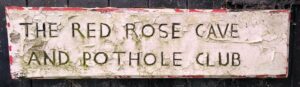
With around 200 members and numerous visitors from other clubs, the future of the farm as part of Casterton’s history remains assured. Details about how to join can be found here https://rrcpc.org.uk/join/ .
Simon Drakeford
April 2024
With special thanks for the support of Sandra Wilkinson, the Librarian of the RRCPC for supplying material and granting permission to use images from the Ron Bliss Collection.
Also to Ric Halliwell for providing information about the Craven Pot Hole Club’s visits.
References
[1] See https://rrcpc.org.uk/about/ . Accessed 21 March 2024
[2] Note that Enclosure was also written as Inclosure. They have the same meaning.
[3] Report From the House of Lords Select Committee on Commons Inclosure Vol XX, 1845, p124, para 1543
[4] Cumbria County Archives (Kendal), WD/Whelp 11 Box 1
[5] Courtesy of Cumbria County Archives (Kendal), WQ/RI/14 Inclosure Award: Casterton Inclosure Award. Act: 1812 1816
[6] Steve A Craven and R A Halliwell, , ‘Bull Pot of the Witches – A frustrating and incomplete historical exercise,’, Craven Pothole Club Record, Vol 80, pp 5 – 11, October 2005
[7] Thomas Jefferys’ Historic Map of Westmorland 1770
[8] Valentine (Pseud.), ‘The Witch Holes’, The Lonsdale Magazine, Vol 1, 1820, pp338 – 341
[9] A detailed explanation of the system can be found here https://www.ukcaves.co.uk/cave-threecounties Accessed 4 April 2024
[10] According to Craven and Halliwell this was Henry Harrison Davis of Kirkby Lonsdale see Craven and Halliwell, ‘Bull Pot of the Witches’, p 5
[11] Jonathan Otley, A Descriptive Guide to the English Lakes, and adjacent Mountains’ seventh edition, 1843, p199
[12] Courtesy of the author
[13] Kendal Mercury, 4 October 1834, p3
[14] Westmorland Gazette, 21 September 1839, p2
[15] Westmorland Gazette, 8 August 1840, p2
[16] Cumbria County Archives (Kendal), contained within WDWHELP/11 Box 1
[17] Taken from Cumbria County Archives (Kendal), contained within WDWHELP/11 Box 1, ‘Authority to kill game upon Bull Pot Farm’
[18] Westmorland Gazette, 30 November 1850, p2
[19] Lancaster Gazette, 1 September 1860, p4
[20] Mel Wilkinson, ‘Memories of Tom Sykes, 1933 – 2017’, RRCPC Newsletter, Vol 54, No.2
[21] Tom Sykes, ‘The Stockdales of Bull Pot’, RRCPC Newsletter, Vol 55, No.1, pp10 – 12, January 2018
[22] Taken from Cumbria County Archives (Kendal), contained within WDWHELP/11 Box 1, ‘1869 Indenture ’
[23] The term ‘Vestures’ means, everything that grows on the land except trees such as grass, wheat, etc.
[24] The reference one or two ‘shear’ literally means how many times the sheep has been shorn and therefore how old it is.
[25] Lancaster Gazette, 26 February 1859, p8
[26] Lancaster Gazette, 29 April 1865, p10
[27] Lancaster Guardian, 31 March 1877, p5
[28] Field, 30 June 1877, p7
[29] Lancaster Gazette, 4 September 1880, p4
[30] Robert R. & Margaret Balderston, Ingleton: Byegone and Present, 1888, p74
[31] Harry Speight, The Craven and North-West Yorkshire Highlands, 1892, p273
[32] Westmorland Gazette, 6 September 1890, p4
[33] Craven and Halliwell, ‘Bull Pot of the Witches’ p 5
[34] Whelprigg Lodge is in Casterton whereas Whelprigg House is in Barbon.
[35] Craven and Halliwell, ‘Bull Pot of the Witches’, p6
[36] Eli Simpson (1884–1962), was the founder of the British Speleological Association, now the British Cave Research Association (BCRA)
[37] Craven and Halliwell, ‘Bull Pot of the Witches’, p7
[38] Craven and Halliwell, ‘Bull Pot of the Witches’, pp6 – 9
[39] R A Bindloss, ‘Bull Pot 1934’, RRCPC Newsletter, Vol 25, 3, September 1988
[40] Craven and Halliwell, ‘Bull Pot of the Witches’, p7
[41] From the Harold Wadsworth Haywood – Leeds Cave Club Photograph Collection – https://earthwise.bgs.ac.uk/index.php/Harold_Wadsworth_Haywood_-_Leeds_Cave_Club_photograph_albums . Accessed 2 April 2024
[42] Morecambe Guardian, 10 May 1957, p10
[43] Taken from the front cover of the RRCPC Newsletter Vol. 22 No.4, March 1986. Used with the permission of the Librarian of the RRCPC
[44] Harry Bewes, ‘Voices from the past’, RRCPC Newsletter, Vol 30, No.2, 1993
[45] The “Ron Bliss Archive” of the RRCPC Library by permission of the Librarian
[46] Tom Sykes, ‘The Stockdales of Bull Pot, RRCPC Newsletter, Vol 55, No.1, January 2013
[47] The “Ron Bliss Archive” of The RRCPC Library by permission of the Librarian
[48] The “Ron Bliss Archive” of The RRCPC Library by permission of the Librarian
[49] Andy Hall, ‘Casterton Pot – Recent Developments’, RRCPC Newsletter, Vol 59, No.3, Autumn 2022, p18
[50] ‘Formation of the Red Rose, & Early odds & Sods’, RRCPC Newsletter, Volume 54 Number 2, October 2017
[51] See https://caving-library.org.uk/audio/playback-248.html
[52] Bradford Observer, 2 March 1952, p5
[53] Lancaster Evening Post, 25 October 1952, p8
[54] Lancaster Guardian, 3 June 1955, p9
[55] I am indebted to Ric Halliwell from the Craven Pot Hole Club for scouring his old records to provide me with this information.
[56] Journal of the Craven Pothole Club, Vol.1 No.1, 1949, p39
[57] Journal of the Craven Pothole Club, Vol.1 No.2, 1950, p86
[58] Journal of the Craven Pothole Club, Vol.1 No.4, 1952, pp188-189
[59] Journal of the Craven Pothole Club, Vol.2 No.3, 1957, p178
[60] Journal of the Craven Pothole Club, Vol.2, No.5, 1959, p289
[61] Graham Stevens, ‘Bullpot Farm – Before the Red Rose’, RRCPC Newsletter, Vol 56, No.1, January 2019
[62] Stevens, ‘Bullpot Farm – Before the Red Rose’, Vol 56, No.1, January 2019
[63] Daily Herald, 13 February 1962, p7
[64] Daily Herald, 13 February 1962, p7
[65] ‘Farming at Ease Gill’ audio interview with Martin Baines in Nov 2012 on the British Caving Audio Library website. See http://caving-library.org.uk/audio/playback-248.html Accessed 2 April 2024
[66] Stevens, ‘Bullpot Farm – Before the Red Rose’, Vol 56, No.1, January 2019
[67] See https://cncc.org.uk/resources/history/ Accessed 3 April 2024
[68] Journal of the Craven Pothole Club, Vol.3 No.6, 1966, p298
[69] This was a barn at the rear of the Flying Horse Shoes in Clapham
[70] ‘Bull Pot Farm’ RRCPC Newsletter Vol 5 No.2, Summer 1967
[71] ‘The Bull Pot Farm Ghost’, RRCPC Newsletter, Vol 6 No.3, July 1969
[72] Leicester Daily Mercury, 17 March 1980, p1
[73] Liverpool Daily Post, 18 March 1980, p5
[74] Daily Telegraph, 18 March 1980, p19
[75] Liverpool Daily Post, 25 April 1980, p5
[76] Newcastle Journal, 28 October 1980, p1
[77] Alfred Wainwright, Walks in Limestone Country, 1970, Westmorland Gazette, Walk 1
[78] Alfred Wainwright, Walks in Limestone Country, 1970, Westmorland Gazette, Walk 1 (2)
[79] Cumbria County Archives (Kendal), WDAW/4/3/2/108
[80] Hunter Davies, Wainwright The Biography, Penguin Books, 1998, chapter 21
[81] Davies, Wainwright, p251
[82] Wainwright, Limestone Country
[83] Westmorland Gazette, 28 August 2008
[84] Cumbria County Archives (Kendal), WDAW – 1- 10 – 1 – 71 ‘Wainright page re Casterton’. Note, a large part of this text was used in Wainwright, Limestone Country, Lancaster Hole Walk 1 (4)
Very good Simon. It’s interesting that in the quotation from ‘An Excursion Through Lonsdale to the Caves’ Gavel Pot and Rumbling Hole are mentioned as being on ‘Easegill’ since both caves are on Leck Fell, far up on the eastern side of the valley.
Very interesting and detailed account. The RRCPC are still only tenants. The farm is part of the Whelprigg estate. The club went to court some time ago to establish a business tenancy. This makes the club in a more secure position for the future.