

Introduction
Our ‘local’ under four different names, has been serving the village and villagers for centuries. During these years it has been at the heart of the village community, serving as a meeting point to greet old friends and offering a venue for families to celebrate milestones such as weddings, funerals and christenings, significant birthdays etc. Since 1832, parents of the Clergy Daughters School have stayed there while visiting their children. Several of the pub’s Landlords and their family are buried in the local churchyard, a stone’s throw from the bar behind which they served.
This Sketch explores the history of the Pheasant and its Landlords from the earliest known records up to the turn of the 20th Century. A later Sketch will continue this history to modern times.
The Red Lyon – Batch 1
The Kendal Archives contains two batches of documents which make reference to the Red Lyon Inn in Casterton. The earliest document is dated 14 February 1780. Several names are mentioned in the document. There is John Colthard of Shiel in the parish of Heskitt, County of Cumberland and George Turner from Barbon.
It seems that George Turner lent John Colthard the sum of £30 using the Red Lyon and associated assets as security. The description of the security was ‘All that messuage or Mansion House known by the name of the Red Lyon Inn with the Barn, Garden, Orchard, and one parcel or inclosure of Ground called known by the name of the Croft containing by estimation three roods be the same more or less. All which said premises are situate standing lying being within Casterton in the parish of Kirkby Lonsdale and now in the Occupation possession of William Meason as farmer thereof…’[1]
The reference to Rood is an old measure of length or area. In area, 1 rood is ¼ of an acre. I cannot see a field named ‘Croft’ in the 1843 Tithe Map which is the earliest document available which details names of fields.
George Turner hailed from Barbon. Transcripts of the Kirkby Lonsdale Parish Registers offer more information.[2] George was baptised on 8 August 1725, the son of Richard Turner and his wife Elling Tatham, both from Casterton, who were married on 16 April 1724.
Elsewhere within the batch of documents we learn that George was married to Agnes. They had numerous children in the years 1760 to 1777. George died aged 57 and was buried on 28 January 1782.
The Landlord
William Meason is named as the occupant of the Red Lyon Inn, in other words, he was the Landlord. He can first be seen as a resident of Casterton in the 1777 South Westmorland window tax records, also available from the Cumbria Family History Society. I have assumed that he was at the Red Lyon in this year. The house which he occupied was assessed as having six or fewer windows and he was taxed three shillings.



The earliest written evidence of the Red Lyon Inn in 1780, also identifying its Landlord William Meason[3]
William Meason, married Agnes Braithwaite in Middleton in Lonsdale on 7 January 1750. William ‘from Casterton’ was buried in Middleton on 15 April 1786. His wife Agnes lived until the age of 87, and was also buried in Middleton, on 1 September 1800.
A separate document in batch 1 also refers to Sir James Lowther who, as Lord of the Manor of Casterton, was owed the yearly ‘customary rent’ of ‘four pence halfpenny’ as well as the provision of ‘other services usual and accustomed.’ Customary rent was paid in addition to the rent on the property by the owner and went to the original owner of the land, the Lord of the Manor.
The Red Lyon – Batch 2
A second collection of documents in the file WDCW/2/1/3/17 includes a document dated 13 February 1786. It refers to Agnes, the wife of the deceased George Turner. It appears that John Colthard still owed the £30 paid to him by George and that Agnes lent him an additional £10, on the security of the Red Lyon.
Another document, this one dated 28 January 1788, indicated that Agnes again entered into a contract with the aforementioned John Colthard and with John Wilkinson. The document said that because John Colthard had not paid the £30 debt, the Red Lyon at this point belonged to Agnes Turner.
The 1788 contract involved three parties because it was agreed that Wilkinson would pay Colthard the sum of £42 and that he would then pay this to Agnes being settlement of the £40 owed plus interest. Furthermore, Colthard would receive an additional £23 from Wilkinson. Wilkinson therefore became the new owner of the Red Lyon. The same document indicated that the Landlord was Agnes Meason, the wife of William, who as noted above, died in 1786.
Another document, a contract dated 13 February 1793, concerns the conveyance of the Red Lyon etc from John Wilkinson to William Carus Wilson, the father of the Reverend William Wilson Caris Wilson. The selling price was £105.
The descriptive details of what was sold remained the same as in the 1780 document, referring to ‘All that messuage tenement or inn commonly called known by the name or by the sign of the Red Lyon with one barn one garden and orchard and one close or parcel of land thereunto belonging called and known by the name of the Croft containing by estimation three roods be it more or less. All of which said premises are situate standing lying and being in the village of Casterton in the parish of Kirkby Lonsdale in the County of Westmorland are now in the possession of George Metcalfe as Farmer thereof one parcel of the Manor of Casterton in the said County of Westmorland of the Richmond fee and are held of the Earl of Lonsdale as Lord of that Manor by a payment of the yearly Customary Rent of four pence half penny…’[4]
A New Landlord
Of note in the 1793 document is that there is a new Landlord – George Metcalfe.
George Metcalfe with his wife Bella were certainly living in Casterton in 1790 when the birth of their child was recorded in the Kirkby Lonsdale Parish Registers. In a later parish record from 1805, he is recorded as being an ‘Innkeeper at Casterton’.
Twenty-four years later, he is recorded as the victualler of the George and Dragon in an 1829 Trade Directory. These documents suggest that at some point between 1793 and 1829, George changed the name of the Inn from the Red Lyon to the George and Dragon, perhaps as a nod to his own name. (It is possible that there could have been two different Inns in the village. However, as there is no evidence that two Inns existed at the same time, I think this highly unlikely.)
A Gruesome Discovery
Around 1980, a disturbing discovery was made when The Pheasant was being renovated. The discovery was likely connected with the early years of this Sketch or before. In 2020, Jean Hamlett corresponded with David Hesmondhalgh, Landlord of The Pheasant from 1978 to 1992. He told Jean that ‘During our stay we did many alterations. During renovation of the small lounge of the bar when taking out an old gas fire the flue crumbled and down came a skeleton. Later, during building the new kitchens, we found a slave’s collar and we understand the body up the kitchen flue belonged to him. In the old days slaves in transit to and from Glasson dock were watered at the Inn. Presumably he must have escaped and hid up the old kitchen chimney… we had several customers complaining that they had strange happenings [hauntings] and at least one couple left unexpectedly. We always prompted people on their arrival to be careful of the stairs: several felt they had been tripped… The old kitchen is what we called the Fox room and was to the left of the bar. This was the chimney in question.’[5]
The discovery was reported some ten years later in the Westmorland Gazette in March 1990. The report noted that at the time, the incident went unreported. Speaking to David Hesmondhalgh in 1990, he told the Gazette that he couldn’t remember the exact date of the renovation or the builders that he used. Nor could he be more precise about what happened to the remains, he thought that perhaps they had gone to Lancaster but the museum there had no such record.[6]
Cumbria’s Connections with the Slave Trade
The question arising is what was a slave doing up the chimney of the Red Lyon? Cumbria has many connections with the slave trade which was finally abolished in the UK in 1807. The Ports of Glasson Dock and Whitehaven were known to have been part of the slave trade while many local landowners including the Lowther family were owners of plantations in the Caribbean.
Heywood proposed a theory that Emily Bronte’s Wuthering Heights was influenced by the impact felt in the wider area around Cowan Bridge area after the 1807 Act of Parliament Abolition of the Slave Trade was passed through the efforts of William Wilberforce. The Act made slave trading in the British Dominions illegal.[7] The Act of 1807 was a major victory for the abolitionists, however, it was not the end of slavery. The legal trade of enslaved people was ended, but it did not abolish the continued enslavement of those already brought to the colonies. As part of Heywood’s study he analysed Kim Lyon’s book which examined the slave trade around Dentdale and compared oral stories and written sources with the book. In her book she quoted a Liverpool newspaper from 1758 which shows that there were black slaves in Dent at that time. The newspaper read ‘Run away [Sic] from Dent in Yorkshire, on Monday the 28th August last Thomas Anson, a negro man, about 5’ 6’’ high, aged 20 years and upwards and broad set. Whoever will bring the said man back to Dent, or give any information that he may be had again, shall receive a handsome reward from Mr. Edmund Sill of Dent, or Mr. David Kenyon, in Liverpool.’[8]
Kim studied the parallels between the Wuthering Heights and the tale of the slave owning Sill family from West House, Dent and their adoption of a white orphan boy called Richard Sutton, described as a ‘foundling’ when he was brought to Dentdale by Edmund Sill. Rather than bringing up Richard with his own children, Richard was kept with the family’s own slaves. The subsequent life of Sutton bore a marked similarity with the fictional Heathcliffe. Is it too fanciful to think that the slave found in The Pheasant was an escapee from West House (now known as Whernside Manor), in Dent?
Local Slave Owners
The Centre for the Study of the Legacies of British Slavery has been established at University College London, tracing the impact of slave-ownership on the formation of modern Britain. After the 1807 Act, the abolitionists continued to campaign for the complete and total abolition of all slavery in the British Empire. In 1833 the Slavery Abolition Act was passed by Parliament. It dictated that all slaves in British dominions, excluding the East India Company territories, would be freed on 1 August 1834. The Act stated that all slaves should be freed by their enslaver and that compensation should be made available to people who had been entitled to the services of such slaves, for example plantation owners.
The Centre has researched in detail about people who applied for this compensation. Two locations in Kirkby Lonsdale are connected with people who applied for compensation. One of them was occupied by a Richard Briggs who died around 1838. He had bought Aberly plantation estate in St Ann, Jamaica, from James Wilson c. 1823 and Richardsfield, also in St Ann, from Thomas Willis some time before 1825. In his will written in 1835 he described himself as a gentleman of Kirkby Lonsdale. When he died, he left these estates to his brothers John and Jonathan. Closer to home, his will stated that ‘I give & devise my copyhold or customary closes of Land called Cow Close and Sour Flat situated in the Manor of Casterton to my brother John Briggs subject to the payment of all fines etc.’[9] This shows that people closely associated with the slave trade were very close to home.
Introducing Mr Fitzwilliam
In May 1846, Henry Fitzwilliam travelled from Leeds to Casterton, the place of his birth. He was an old man on a nostalgic trip, recording his visit in letters to a cousin in Leeds. Four of his letters were published in the Westmorland Gazette. Henry does not name his cousin, referring to her as ‘Miss F. C———-h’, from Fulneck near Leeds. Fulneck is a small village to the west of Leeds, south of Pudsey.[10]
The First Letter[11]
A Return
The letter starts ‘My dear Cousin – I arrived at this place from Leeds last evening, after a pleasant journey on a delightful day. How my heart swells as I drew near the place of my nativity, you, who have so often heard me describe it, may well imagine. My minds eye retained each beauty like a treasured gem… But time has been busy here as elsewhere. Many “old, familiar faces” have disappeared- some, forever- others, to live again in the features of child and grandchild.’
Here Henry sees in the faces of the people he meets in the lanes of Casterton, shadows of faces that he knew as a boy perhaps their children or grandchildren. This would make Henry at least 50 years of age, more likely 60 years old, perhaps older.
First Observations
Henry continues, ‘Changes are obvious in the scenery and in many places they have sprung up decided improvements. For instance, the inn, under whose roof I am now sojourning, is the “George and Dragon”, for so many years kept by old Bella Metcalfe. But it is no longer Bella’s “George and Dragon”. True, the old Sycamore yet flourishes at the front door, flinging it’s grateful shade upon the threshold, and inciting to drowsyhood, with the ceaseless humming of the insect inhabitants; but the house has been altered, and in many places rebuilt. Instead of the low, dingy kitchen, with its Hearthstone fire, we have an airy light apartment, furnished with a modern fire range. Sanded parlours have given place to carpeted drawing rooms; and instead of the ancient lady in her old arm chair by the hearth, issuing her orders to the “lass” in a voice like a hurricane, we are waited on by a polite, chatty, tidy hostess, whose attentions are divided between her guests and her beautiful children.
Truly, this same inn is a right pleasant place, and the attractions of the neighbourhood render it excellent headquarters.’
The Metcalfe Family
This sentimental section reveals so much. The old sycamore at the entrance of the inn to which Henry refers could still be seen in a photograph some sixty years later.
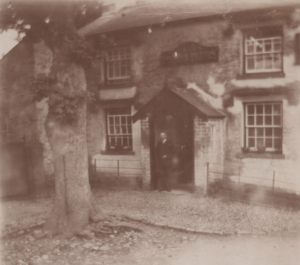
The front door of the George and Dragon C1905 with the tree
There is mention of ‘old Bella Metcalfe’ who Henry recalls kept the pub for ‘so many years’. Bella is also referred to as ‘an ancient lady in her old arm chair by the hearth, issuing her orders to the “lass” in a voice like a hurricane.’ As noted above, Bella and George are recorded in the Kirkby Lonsdale Parish registers and George is noted as Innkeeper at Casterton.
Hypothesis
A George Metcalfe married Isabella Thackstone in Hawes in Yorkshire in late March 1788. This was less than two years before their first child Alice was born, perhaps they are our couple, moving the 23 miles from Hawes shortly after they were married.
Further Documents Recording George Metcalfe
In 1798, land tax records were compiled to collect the land tax. Unfortunately, the records do not specifically identify the property, showing only the owner, the tenant, the assessed tax and the date of the rental contract. George Metcalfe appears three times in the 1798 list confirming that he was living in Casterton at the turn of the nineteenth century.
One of the properties he was listed as occupier of was owned by John Taylor’s heirs, another property, owned by William Wilson Carus Wilson, was also occupied by David Crayton. It is possible that he worked in one of the buildings he occupied, and David Crayton lived there, perhaps as the resident Joiner and George, Bella and their children lived in the other property.
George was also listed as occupier of a third property, also belonging to the Reverend’s father. This building had multiple occupiers and had a tax assessment of more than £6. The total tax assessment of all properties in Casterton was a little more than £22 suggesting that the building was perhaps a community building or land.
The 1829 Trade Directory noted above also gives details of George’s activity as a carrier. The listing read ‘Metcalf George, carrier to Lancaster, Fri., dep. 7 mng,; arr. Sat. 6 evg, – To Sedbergh, Wed., dep. 7 mng.; arr. 8 evg.’
The Inn appeared on Hodgson’s 1828 Map of Westmorland which had been surveyed between 1823 and 1825.
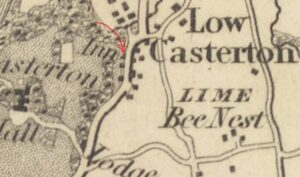
Extract of 1828 Hodgsons Map of Westmorland
A newspaper reported that George, an Innkeeper, died at Casterton in December 1831 aged 73. He was therefore born about 1758.[12] Bella would have taken over as Landlord of the Inn on the death of her husband. Henry Fitzwilliam’s comments in his letter above suggests that she was actively involved in running the Inn prior to her husband’s death.
An Accident
In 1832, there was an unfortunate accident outside the pub. The Lord Exmouth coach, which was on its way from Newcastle to Kirkby Lonsdale had stopped outside the Inn. The coachman and guard had gone inside leaving a boy at the head of the horses. The boy could not keep hold of the horses, the coachman, named William Robinson, ran out to get hold of the reins but was thrown to the ground and the wheels of the carriage ran him over. Sadly the unfortunate coachman died of his injuries the next day.[13]
Further References to Bella Metcalfe
A newspaper cutting from October 1837, giving notice of a meeting ‘at the House ISABELLA METCALFE, in Casterton’ shows that she was Landlady. The meeting was for the local large landowners or their agents ‘for the purpose of making an AGREEMENT for the COMMUTATION of GREAT TITHES’ in Casterton.[14]
Coroner’s Inquests
In 1838, Bella Metcalfe was running the Inn. In February of that year, a body, later identified as Kirkby Lonsdale solicitor Mr Robert Bradley, aged nearly 70, had been found by Thomas Batty on the side of the road between Barbon and Kirkby Lonsdale near Crow Trees. Thomas had gone into the house of William Hardacre,[15] the local shoemaker and told him of his discovery. They then retraced Thomas’ steps. On the way they met two men, William Robinson and John Johnson, with a horse and cart carrying the body headed towards Casterton. The corpse was taken to the George and Dragon, ‘the house of Bella Medcalfe’ and laid on a table. The local doctor, William Batty, was called to examine the body ‘upon which no marks of violence appeared likely to cause death. There was a bruise upon the nose, and the lips were dusty as if he had fallen upon his face against the ground.’ The doctor formed the opinion that Mr Bradley had died of a fit of apoplexy. The Coroner’s verdict, held in Kirkby Lonsdale, was that he had ‘died by the visitation of God, of a fit of apoplexy.’[16]
A year later, an inquest was held at the Inn, regarding the death of Casterton resident 37 year old Agnes Gibson whose body had been found in the Lune near Tunstall. Her husband had told the inquest that she had ‘been in a state of mental derangement for ten weeks past, or upwards; a fit of melancholy had seized her since the death of her mother, she despaired of ever being able to do her work again, and her husband found it necessary to keep a watch upon her.’ Unfortunately she escaped the house at night and was not missed until the following morning when a search party was organised. The Coroner concluded that she had drowned herself while in a fit of temporary insanity.[17]
The following year, another inquest was held, this time on the body of a still-born female child which had been found buried under the root of a tree in a hedge bottom in a field at Casterton. Once again, Mr Batty, the local doctor examined the body. He stated that the baby ‘appeared not to have been a full grown one. And whatever care had been used could not have lived.’ The inquiry heard that Elizabeth Parkinson of Casterton, a domestic servant, was the mother of the child and had borne it six weeks earlier, ‘she was taken with labour in the field and the child being dead, left it as above described – she had told her parents before, of being pregnant.’[18]
The Final Years
In the 1841 Census, there was a 78 year old Isabella Metcalf –of independent means- still living in Low Casterton, but not at the George and Dragon.[19] She was therefore born about 1763. The Census shows that she was not born in Westmorland, as posited above, she was possibly from Hawes, Yorkshire.
Isabella Metcalfe’s death certificate shows that she died in Caton on 11 February 1844 aged 81 years of ‘natural decay’. Her profession was recorded as ‘Widow of George Metcalf – innkeeper.’
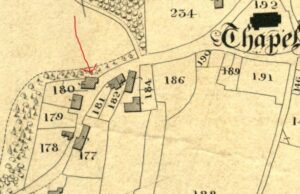
Extract from the 1843 Tithe Map. Number 180 is the George and Dragon. The owner is recorded as Willima Wilson Carus Wilson and the occupier as Richard Nelson
The Nelson Family – 1
In his letters Henry Fitzwilliam noted that when he visited the pub in 1846 he was ‘waited on by a polite, chatty, tidy hostess, whose attentions are divided between her guests and her beautiful children’.
The 1841 Census, which was taken on 6 June, records that the publican was 30 year old Richard Nelson (1811). Also living there with a lady called Jane Nelson aged 20, his younger sister. Also at the house was Richard’s (1811) one year old son, also named Richard (1840), who was born at Melling, Lancs on 24 April 1840. Richard’s (1840) mother was Elisabeth Nelson, nee Bownass.
Richard (1811) and Elizabeth were married in Middleton in 15 June 1839. For an unknown reason, Elisabeth was not on the Casterton census, nor can I identify her elsewhere. Tragically, in July, a newspaper reported that Elizabeth had died aged 30.[20] Her death certificate confirms that Elisabeth Nelson died on 19 July 1841 but says that she was aged 33. The cause of death was consumption, i.e. tuberculosis. Her husband Richard (1811) was with her in Casterton on her deathbed.
Life Goes On
A local landowners meeting was held ’at the House of RICHARD NELSON, the George and Dragon Inn’. It was held ‘for the purpose of making an agreement for the general Commutation of Tithes.’, the process by which a payment in kind was substituted for a cash payment, as outlined in the 1836 Tithe Commutation Act of Parliament.[21]
In December, an auction of wood was held at the Inn. Various auction lots from around the area were being offered. For example, Lot 2 included trees from the Casterton, Kirfit Hall and Hole House Estates, being ’31 Oaks; 108 Ashes; 42 Plain Trees; 20 Elms; 8 Chestnuts; 5 Alders.’, whereas Lot 3 included wood from the Riddings Wood Casterton Estate ‘suitable for Cloggers and Bobbin Turners, or for Colliery purposes.’[22]
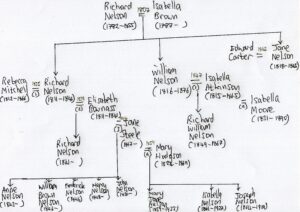
Selective family tree of the Nelson family
A New Wife
On 31 July 1844, the widower Richard Nelson (1811), aged 32 recorded as a Joiner living at Casterton, whose father was Richard (1782), also a Joiner, married Jane Steele aged 28, a spinster. They were married at Preston. Jane’s father was Henry Steele, a Mason. A newspaper notice of the wedding stated that Jane came from Sedbergh. Jane was therefore the ‘polite, chatty, tidy hostess, whose attentions are divided between her guests and her beautiful children’ that Henry Fitzwilliam mentioned in 1846.
More Meetings
Another Tithe meeting was held at the Inn in December 1848.[23]
In 1849, a Coroner’s inquest was held at the Inn. The deceased was Isabella Airey who had lived with her daughter in law in rooms above the National School in Casterton. The room had been given to them rent free by Mr Wilson. On the Saturday evening before she died, Isabella had intended to visit Mr. Rowley ‘the teacher of the school’ who lived on the same floor. The inquiry heard that ‘The poor old lady, who was 86 years of age, in stepping out missed her way to Mr. Rowley’s door, and fell headlong down the long and steep flight of stairs close by, and was killed on the spot. She was taken up at the bottom of the stair, the lower steps of which are of stone, with her head dreadfully cut and the brain laid bare.’[24]
In 1850 there was another auction which, rather than selling wood as noted before, had three lots belonging to James Carter. The first lot was Holly Bush Farm next to the church, together with farmland. The second lot was for two parcels of waste ground, one near Kirkby Lonsdale Bridge (Devil’s Bridge) and the other on Casterton Fell. The final lot was for the Malt Kiln, the remains of which can be seen in a field off Wandales Lane.[25]
The Nelson Family – 2
The Nelsons were still at the pub in 1851 listed in the Census as Innkeeper and Joiner, by then with six children, Richard (10), who was the son of Elisabeth, Anne (8) who, if the age recorded in the Census was correct, was born in 1843, after Elisabeth died but before Richard married Jane. The other children were all born in Casterton, William (5), Frederick (4), Henry (3) and John (1). The ‘beautiful children’ that Henry Fitzwilliam referred to were therefore Richard, Anne and William.
On 20 July 1855, Richard Nelson (1782), Joiner aged 73 died at Low Lodge, Casterton.[26] He was probably the father of Richard (1811). His death certificate shows that he died from ‘general debility dropsy’. With him at his death was William Nelson, presumably his son who, as noted below, later became the Landlord of the George and Dragon.
A Tragic Accident
Another sad inquest was held at the George and Dragon in 1860. It concerned an unfortunate two year old child named Frances Windle. The girl’s father, William Windle, was out at work on the Lune Valley Railway near Barbon. Her mother had left the house to go and do some washing about half a mile away. Francis was left in the house with Hannah, her sister, a girl of six and her brother John, a boy of four all under the care of Francis’ eleven year old elder sister. Ellen had boiled some potatoes for their dinner. After dinner she left the house with Hannah to go into the fields and watch the railway wagons. While she was out, Francis’ clothes had caught fire. When Ellen returned about 20 minutes later she found the toddler lying in the floor burnt almost all over her body and barely alive. Sadly the young girl died before medical aid could be found. The verdict was accidental death.[27]
Another Nelson as Landlord
The 1861 Census shows that Richard Nelson (1811) had decided to move on. He was by this time living in Yorkshire, at Steeton with Eastburn with his children Richard (20), by now a Joiner. Ann (18), William (15) also a Joiner, Frederick (14), Henry (13) and John (11). It would appear that Richard’s second wife had died. Richard’s new wife was Mary nee Hodgson. They were married in 1859 and they had two more children, Mary aged 1 and Isabella aged 1 month, both born in Steeton. Richard (1811) died in Steeton in December 1866.
The 1861 Census showed that William Nelson, aged 45, who was Richard’s (1811) brother was now Casterton’s Innkeeper and Joiner. William was born in Middleton. He was there with his wife Isabella, also 45, born in Lancaster. Their son Richard William was there a 12 year old scholar, he too had been born in Middleton.
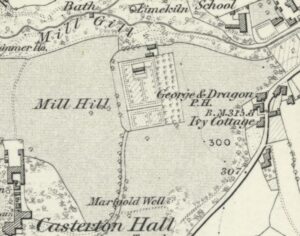
Extract of the 1862 OS Map showing the George and Dragon Public House
In 1863, in an advert inviting builders to tender for the new “FOUNDER’S WING” at the Clergy Daughters School, tenderers were informed that drawings and specifications could be seen at ‘Mr. W. Nelson’s Inn at Casterton.’[28]
Young Deaths
William’s first wife Isabella, died 23 September 1865 aged 50, with her husband William at her side. The cause of death was debility.
In 1867 the death of Richard William Nelson, the ‘only child of Mr. Nelson, George and Dragon Inn, aged 18 years’, was announced.[29] He died on 11 January from Consumption.
Other Activities
In 1869, William attended a special dinner ‘for the workmen employed in making the alterations requisite to accommodate the large number of scholars attending the schools were kindly invited to a dinner.’ They included William Nelson, Joiner.[30]
In his capacity as a farmer, William was one of many farmers who were listed in the newspaper with stock, in his case ‘1 milch cow’ suffering from Foot and Mouth Disease. The report observed that ‘This disease has spread very considerably during the last two or three weeks… sufficient care cannot have been exercised for its prevention, or a slow infection like the foot and mouth disease would never have spread so rapidly.’[31]
In the 1871 Census, William Nelson was still listed as an Innkeeper, Carpenter and Farmer. His wife was listed as Isabella, but this was not his first wife. The new Isabella was aged 40 and had been born at Cowan Bridge.
In 1873 another inquest was held at the Inn to consider the death at Whelprigg of 13 year old William Spedding. Some plants had been placed in the open air to harden off, and William was carrying some of them back inside. While doing so he stepped backwards and fell down a trap door which had been left half open to allow a better draught for the stoves which heated the greenhouses. Despite being aware of the open door, he fell down about 9 feet breaking his neck. A verdict of accidental death was returned.[32]
William Nelson died in 1876, aged 60 and was buried in the Holy Trinity graveyard. His second wife Isabella died at Barbon on 9 July 1890, aged 60 years.

The gravestone reads:
IN MEMORY OF
WILLIAM NELSON
OF CASTERTON
WHO DIED AUGUST 14TH 1876
AGED 60 YEARS
ALSO OF
RICHARD WILSON
SON OF THE ABOVE
WHO DIED JANUARY 11TH 1867
AGED 18 YEARS
ALSO OF
ISABELLA
WIDOW OF THE ABOVE
WILLIAM NELSON
WHO DIED AT BARBON JULY 9TH 1890
AGED 60 YEARS[33]
The Knowles Family
In 1881, a new family were in residence, possibly arriving after the death of William Nelson. They had moved back into the area from nearby Warrington. James Knowles, Joiner and Innkeeper, was recorded in the Census. He was aged 46 and born in Clapham. He was living in Casterton with his wife Anne, nee Blezzard (48) from Bentham and four adult children. There was Isaac (27), also a Joiner, Elizabeth (23) a school teacher both born in Bentham, Agnes (20) and Margaret (18) who were both born in Earlestown, Lancashire. James and Anne were married in 1857 in Skerton, St Luke, Lancashire. Given that Isaac was 27 i.e. born in 1854, it seems that he was born out of wedlock.
Also residing at the George and Dragon on the night of the Census was a visitor, presumably a hotel guest named William Dodds who was a shipbroker hailing from Durham.
Isaac, James’ eldest son died on 4 November 1889 in Overtown, Tunstall.
A Fine Hostess
In 1899 a trip by the Centenary Congregational Institute was reported by the local newspaper. The venue for their annual Whit-Monday picnic was the ‘Quaint quiet Kirkby Lonsdale and the lovely leafy Casterton Woods.’[34] On arriving in Casterton in a horse and carriage, ‘the friends alighted and indulged with much amusement in what looked like carpet beating in the shape of shaking and brushing off clothes. This was good preparation for and made most welcome the splendid luncheon prepared by Mrs. Knowles of the George and Dragon. It was provided out of doors on elevated ground, with lovely mountain scenery in view and a large clump of trees that did service in warding off the north-east wind. The site of the cold collation as it was placed on the long table in first class style was pleasing, but the realisation was better, for everything pertaining to it was excellent in character and heartily enjoyed’.
After their hearty lunch, the party ‘Through the kindness of Lord Bective went through Casterton Woods. The woods are this year in their richest and fullest beauty of foliage, and the narrow romantic sylvan walks up and down, with peeps here and there of Underley Hall and Park and the mountain ranges in the distance, gave enthusiastic delight to all, especially to those who for the first time saw the beauties of this district.’
James and his family were still at the George and Dragon in 1891, actively involved in the community. Elizabeth had become a School Mistress, Agnes was a Bar Maid and Margaret a Kitchen Maid. Anne died 14 March 1900 and was buried in the churchyard.
Billy Makinson, who was born in Casterton in 1921 at Old Manor Farm, recalled in his reminiscences a story that he had been told years after the Knowles left the Inn.
‘Now a bit about Casterton Hotel. Casterton Hotel of course was the George and Dragon, and Mr. Knowles who kept the hotel was a farmer, a joiner, a wheelwright and an undertaker. He had three daughters: the Miss Knowleses. One of the Miss Knowleses became headmistress at Casterton village school. There’s rather an amusing story about three men in the pub talking about their daughters. They were quite sure that their daughters would all get married very well, and Mr. Knowles the landlord said “Well, I’ve got three daughters, and they’re all spoken for”, but unfortunately none of the Miss Knowleses ever got married, which rather amused me.’[35]
The 1901 census showed that Elizabeth was still a School Mistress while Agnes and Margaret were still working in the pub. All three daughters were still unmarried. Their more than 20 year residence at the Inn was soon to end.
James died on 20 October 1909 and was buried alongside his wife in the church yard. a stone’s throw from the Inn. His estate was valued at £131 which he left to his three daughters.
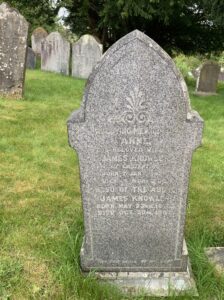
The gravestone reads;
IN LOVING MEMORY OF
ANNE
THE BELOVED WIFE OF
JAMES KNOWLES
OF CASTERTON
BORN 7 JANY 1829
DIED 14 MCH 1900
ALSO OF THE ABOVE
JAMES KNOWLES
BORN MAY 22ND 1836
DIED OCT 20TH 1909
“THY GOD SHALL BE MY GOD”[36]
Resident in Casterton
The spinster daughters remained in the village. In 1911, the three sisters’ were all living in Caton House. Elizabeth was still a School Mistress, while her younger sisters were both living on ‘private means’. They were still at Caton House in the 1921 Census.
The Census records of the sisters births, deaths and their gravestone are contradictory. Reference to the General Register Office’s records helps clear up the discrepancies. The official records show the following:
Elisabeth’s birth record at the General Register Office (GRO) shows that she was born in the second quarter of 1858. Her probate record shows that she died at Caton House on 19 February 1938. She was therefore 79 when she died, although her death certificate recorded that she was 76.
Agnes’ GRO birth records shows that she was born in the third quarter of 1860. Her probate record shows that she too died at Caton House, on 25 March 1949. She was therefore aged 88 when she died. Her death certificate recorded that she was 84.
Margaret’s GRO record shows that she was born in the first quarter of 1863. Her death certificate shows that she died at Caton House 11 September 1937. She was therefore 74 when she died. Her death certificate said that she was 72.
They were all recorded on a gravestone in the churchyard, although as shown above, the ages on the gravestone were as incorrect as those variously recorded on the Censuses over the years.
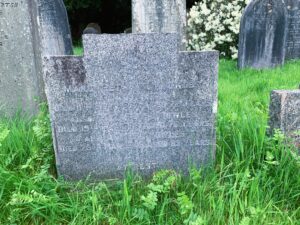
IN
LOVING MEMORY
OF
MARGARET JANE KNOWLES
OF CASTERTON
DIED 11TH SEPT 1937, AGED 72 YEARS
ALSO ELIZABETH KNOWLES.
DIED 19TH FEB 1938, AGED 76 YEARS.
AND AGNES KNOWLES
DIED 25TH MAR 1949, AGED 83 YEARS.
AT REST[37]
A Change of Landlord
In 1905, the Westmorland Gazette announced movements of local Landlords. Frederick Hutton of the Sun Inn in Kirkby Lonsdale was leaving there and moving to the George and Dragon, taking over from James Knowles.[38]
The story of the Pheasant and its future Landlords will be featured in a later sketch.
Appendix
Landlords of Casterton’s Inn 1777 – 1905
Red Lyon from before 1777 to after 1793 but before 1816
Before 1777 – 1786 William Meason
1786 – after 1788 but before 1793 Agnes Meason
Before 1793 – George Metcalfe
George and Dragon after 1793 but before 1816 to XXX
Before 1793 to 1831 George Metcalfe
1831 to after 1838 but before 1841 Bella Metcalfe
After 1838 but before 1841 to after 1851 but before 1861 Richard Nelson
After 1851 but before 1861 to 1876 William Nelson
1876 (assumed) – 1905 James Knowles
Simon Drakeford
May 2024
References
[1] Cumbria County Archives (Kendal), WDCW/2/1/3/16
[2] The transcripts can be bought from the Cumbria Family History Society at https://cumbriafhs.com/?page=shop
[3] Sourced from Cumbria County Archives (Kendal), WDCW/2/1/3/16
[4] Cumbria County Archives (Kendal), WDCW/2/1/3/17
[5] Courtesy of Jean Hamlett.
[6] Westmorland Gazette 13 March 1990
[7] Yorkshire Slavery in, Christopher Heywood, The Review of English Studies, Vol.38, No.150 (May, 1987), pp.184-198 Wuthering Heights
[8] Kim Lyon, The Dentdale Brontë Trail, 1985, pp6-7
[9] See https://www.ucl.ac.uk/lbs/maps/britain/#zoom=17&lng=-2.597483&lat=54.202698&lbs/person_id=2146639637&address_id=558182652 Accessed 23 May 2024
[10] This material has already been published in the Sketch about an 1846 visit to Casterton which includes a lot more detail from the letters. See https://www.castertonparishcouncil.org.uk/a-sketch-of-an-1846-visit-to-casterton/
[11] Westmorland Gazette, 22 August 1846, p4.
[12] Westmorland Gazette, 24 December 1831, p3.
[13] Lancaster Gazette, 10 March 1832, p3
[14] Westmorland Gazette, 14 October 1837, p1.
[15] This house was most likely what is now called Ghyll Cottage.
[16] Westmorland Gazette, 24 February 1838, p3
[17] Kendal Mercury, 27 July 1839, p2
[18] Kendal Mercury, 28 March 1840, p3
[19] Casterton was divided into High and Low Casterton. High Casterton is still referred to as that but Low Casterton is simply called Casterton, it is the area around the church.
[20] Kendal Mercury, 17 July 1840, p3
[21] Westmorland Gazette, 11 September 1841, p2
[22] Lancaster Gazette, 27 November 1841, p1
[23] Kendal Mercury, 19 February 1848, p2
[24] Westmorland Gazette, 8 December 1849, p2
[25] Lancaster Gazette, 2 February 1850, p4
[26] Westmorland Gazette, 28 July 1855, p7
[27] Westmorland Gazette, 31 March 1860, p5
[28] Lancaster Gazette, 16 May 1863, p4
[29] Lancaster Gazette, 19 January 1867, p5
[30] Lancaster Gazette, 7 August 1869, p8
[31] Carlisle Journal, 2 August 1870, p2 A ‘Milch Cow’ is one kept for milk.
[32] Lancaster Gazette, 24 May 1873, p8
[33] Photograph courtesy of the author
[34] Lancaster Guardian, 15 June 1899, p5
[35] See Billy Makinson’s reminiscences page 8 which can be found here https://www.castertonparishcouncil.org.uk/wp-content/uploads/2021/10/Billy_Makinson_reminiscences.pdf
[36] Photograph courtesy of the author
[37] Note that the transcription recorded in the Cumbria Family History Society is incorrect. Photograph courtesy of the author
[38] Westmorland Gazette, 25 February 1905, p5