

Introduction
In November 2023, I was handed a rather battered small suitcase which was filled with documents relating to the history of the Casterton Village Hall. It had been passed on from Secretary to Secretary until being deposited in the cellar of the Hall. This Sketch uses some of these documents to tell the story of the Hall’s history from 1910 to 1969.
I thank the Casterton Village Hall Committee for lending me these documents. Details about the current Hall activities can be found here https://www.castertonparishcouncil.org.uk/casterton-village-hall/ .
Notes on References to the Hall and Abbreviations Used
Throughout the narrative I will refer to the building as either ‘the Hall’, ‘the Room’, ‘the Village Hall’ or ‘the Church Room’. They are the same thing and were used interchangeably in this way during the period that this Sketch covers.
There are a number of organisations referred to below. The first mention the organisation will be referred to with its full title followed by the abbreviation used in the text thereafter. If the organisation is included within a quote, it will be referred to as it was in the original text. The Appendix records these for quick reference.
Before the Hall was Built
In 1912, the Village was given a new space where it could meet and, with some restrictions, socialise. It is not clear where meetings and social events took place prior to the Village Hall being opened.
A search for meetings in Casterton before 1912 bears little fruit. In 1905, a Casterton Bible Society met in the church during Sunday Service and on the Monday met at the National Schoolroom i.e. the Village School, for a lecture titled ‘From the Cape to Cairo with the Bible’, with illustrations using lantern slides.[1]
In 1905, Mr Stewart-Smith, a Liberal politician, held a political meeting at the Schoolroom.[2] A few months later, another political rally was also held at the Village School. In attendance were Captain Jocelyn Bagot, Kendal’s Conservative MP, and Lord Henry Bentinck, husband of Lady Olivia Caroline Amelia Bentinck who is referred to below.[3]
Going further back in time, the George and Dragon, now the Pheasant, was a regular meeting point for events such as coroner’s inquests, land related matters and other such things.
A Plaque
A simple plaque erected inside the Hall shows when the Church Room was built. In last month’s Sketch I wrote in detail about the information that was written on it and therefore will only briefly mention it here. The previous Sketch also highlights an intriguing story about what was left off the plaque. I will not reveal the mystery here, to find out, you will need to read the previous Sketch. See https://www.castertonparishcouncil.org.uk/a-sketch-of-a-plaque-in-casterton-village-hall/ .
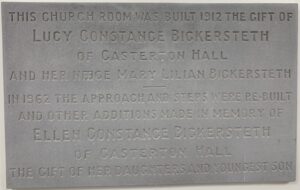
Photograph of the Plaque inside the Village Hall with the corrected spelling mistake[4]
The Bickersteth Family
The Bickersteth family who lived at Casterton Hall, were wealthy benefactors to worthy causes in the village including the Village Hall. The family were first associated with Casterton soon after the Reverend William Carus Wilson died in London in 1859.
A newspaper report in 1863 confirms that Mrs Katherine Bickersteth, formerly of Kirkby Lonsdale had been resident at Casterton Hall ‘for the last half-dozen years.’[5] Katherine was the daughter of John Pares and had married Robert Bickersteth (1787 – 1857) in 1825. Robert, like his father, was a Surgeon who practised in Liverpool. Robert’s father was Henry (1750 – 1821), he was born in Kirkby Lonsdale, but at some point, moved to Liverpool to practise as a Surgeon.
The 1881 Census includes two unmarried Bickersteth daughters living at Casterton Hall. There was Emma Katherine aged 48, and Lucy Constance aged 37. Lucy is the lady mentioned on the Plaque. Emma and Lucy were financially independent living off income from inherited wealth. The Bickersteth spinster sisters remained at the Hall for many years. The elder sister Emma died in 1907, leaving her estate to her sister Lucy. In 1911, the only Bickersteth in residence was Lucy, she was also living there in 1921 with 5 servants and a nurse. She died in 1930.
Also mentioned on the plaque is Mary Lilian Bickersteth (1862 – 1942) referred to as Lucy’s niece on the Plaque. Mary Lilian, born in Mumbai (Bombay), India, was the daughter of John Pares Bickersteth (1826 – 1909), who was Lucy Constance’s elder brother.
By 1939, Mrs Ellen Constance Bickersteth nee Wilson (1873 – 1959) had moved into the Hall with her daughter Ailsa Patricia (1902 – 1989). Ellen’s husband was Robert Alexander Bickersteth (1862 – 1924), Lucy’s nephew. Robert was the son of Edward Robert Bickersteth (1828 – 1908).
Ailsa was one of the daughters who, as described on the Plaque, along with the younger son, dedicated the rebuild of the approach and steps of the Village Hall to their recently deceased mother. The story of how this came about is told below. The other daughter was Elizabeth Gaynor Bickersteth (1906 – 2001). The youngest son was Arthur Wilson Bickersteth (1910 – 1996). There were two other sons not included in the inscription. More detail about these men can be found in the Sketch referred to above.
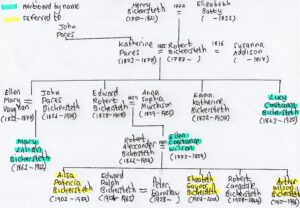
A selected family tree of the Bickersteth family to illustrate how those mentioned and not mentioned on the plaque are related.
The Plot of Land
The Church Room is clearly marked, highlighted in green, on the 1914 OS Map below. Note that the plot of land in which the Church Room rests is within a larger boundary, highlighted in pink. Note also that to the east of the church room Croft House has been built. Croft House does not appear in the 1862 OS Map, nor on the Lunesdale Estate Sale map of 1899. This implies that the Croft House is either late Victorian or Edwardian.

Annotated extract of 1914 OS Map showing the Church Room
This boundary is clear to see on the 1862 OS Map below, but the subdivision of the land has not yet happened.

Annotated extract of the 1862 OS Map
The same plot of land is also identifiable on the 1843 Tithe Map.
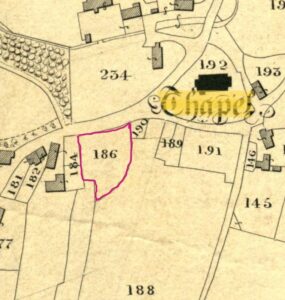
Annotated extract of the 1843 Tithe Map
The owner of plot 186 on the Tithe Map is listed as the Earl of Lonsdale. The occupier was Joshua Hutchinson who was a farmer and also ran the Carpenters Arms, a beer house, which was the front part of Fern Cottage (plot 184 on map), near the road. The Tithe records show that the land’s use was as a ‘Housestead’ and was 1 Rood and 5 Perches in area. Strangely, there is no indication of a building on any of the maps until the Church Room appears.
From these maps, it is possible to tell that at sometime before 1914, the parcel of the land on which the Village Hall sits had been extracted from a large and older plot of land. The Deed of Conveyance below shows how this was done.
The Owners of the Land
In the Kendal branch of the Cumbria Archives lies a draft conveyance of a plot of land in the parish of Casterton dated 26 September 1910. The transfer of land is from Lady O. C. A. Bentinck to The Carlisle Diocesan Trust & Finance Association (CDTFA).[6]
It would appear that at some point after 1843, the plot of land had been acquired from the owner listed in the Tithe Map -Lord Lonsdale- by the Earl of Bective, the owner of Underley Hall.
The owner of the land in 1910 was Lady Olivia Caroline Amelia Bentinck (1869 – 1939). She was the daughter of Thomas Taylour, Earl of Bective (1844 – 1893). Her father’s family, the Bectives, had owned Underley Hall since 1842 when Lady Olivia’s grandmother Amelia Thompson ( – 1864) married into the Bective family. Lady Olivia was the only surviving child of her parents and the only heir.[7]
When Olivia married Lord Henry Cavendish Bentinck in 1892, she became Lady Bentinck. A year later her father died, and she inherited the estate from him. Lady Bentinck died in November 1939, aged 70. Her probate in 1940 showed that her estate was worth £747, 882.
Conveyance of the Land
The conveyancing document gives more details about how Lady Bentick held the land and the terms under which it was sold. The deed notes that the land under question was subject to an Indenture of Settlement from 1892 when she had married Lord Henry Bentick. As I understand it, this protected her rights to the property. This was to ensure that her new husband could not dispose of it without her permission or his creditors, were he to have any, seize it for his debts.
Thus, Lady Olivia was the owner of the land and agreed with the CDTFA that they could purchase the land for the sum of £25. She therefore granted and conveyed to the CDTFA ‘All that piece or parcel of land situate in the Parish of Casterton in the said County of Westmorland, containing 507 sq: yards or thereabouts and are more particularly delineated and described on the map or plan endorsed on these presents and thereon coloured Pink To Hold the same unto and to the use of the association their successors and assigns Upon Trust to permit the same and all or any buildings which are or may be hereafter erected on the said Premises or any part thereof at all and any times to be used by the Vicar for the time being of the parish of Casterton in the County of Westmorland or by his nominee or during his absence or disability or the avoidance of the benefice by the officiating Minister for the time being of the Parish of Casterton aforesaid or by his nominee for all or any of the purposes of following that is to say:-
- For the celebration of Divine Service in accordance with the principle’ rites and Ceremonies of the religious body known as the Church of England or for a Sunday School in connection with the same Church
- As a Class Room Meeting Room or Lecture Room for Confirmation or Communicants Classes or for other religious instruction
- As a place of meeting for Clerical Meetings for social gatherings of Clergy or Laity for Committees of any Societies for the promotion of any religious philanthropic charitable or benevolent purposes or for meetings in aid of or for the benefit of any such societies
- For any other meetings or for any other objects ends or purposes of a spiritual intellectual moral or social character.’
A condition of the purchase was that the CDTFA ‘hereby covenant with the Vendor that they will within one month from the date hereof erect substantial fences on the Southern and Western boundaries of the land hereby convened to the satisfaction of the Agent of the Vendor and will forever after maintain the same.’

Plan of the proposed Village Hall from the 1910 Draft Conveyance Deeds[8]
Building the Hall
After the land had been purchased by the CDTFA, building commenced. A copy of a page from a 1910-11 accounts book in the suitcase shows the extent to which the Bickersteth family contributed. In July 1910, L C Bickersteth and what looks like L M Bickersteth contributed £700 for the building costs. Later that year, large payments were made to W Mashiter and W Carr, contractors who were building the Hall.
In early 1911, further Bickersteth contributions were paid, £31 for a piano and later, £20 for ‘Library’. What looks like final bills for the construction were paid in May 1911. Mashiter received £27, Carr £48 and a new name, Hadwin, was paid £36.
By 1912 the nature of the receipts and payments had changed. There was a receipt for ‘Billiards’ for winter 1911 – 12, a receipt from the Men’s Club and what looks like a room hire. On the expenses side of the ledger, rates and taxes were paid and books and coal were purchased.
A Second Hall
Billy Makinson recalled in his reminiscences that there was a wooden Public Hall built by public subscription after the First World War. This was necessary because, as noted above, the Church Room had restrictions on how it could be used. He recalled that events such as Whist Drives, or Dances or any sort of entertainment were not allowed in the Church Room. He mentions that Canon Burton who was the Vicar of Holy Trinity from 1889 to 1922, was very strict about this. He states that the Public Hall was built next to the Village School in the little field just below Folly Barn. I’m not too clear whether the wooden hut was on the Village School side of the road (A683) or on the side of the road where Folly Barn is.
Billy thought that the hall was in existence for about 30 years, i.e. until soon after World War Two. The old wooden hall was bought and removed by Carr & Bleasdale’s, the joiners at Barbon and was used for a workshop there.[9]
The Women’s Institute
One of the notable things to have happened at the Hall in its first years was the founding of the Casterton Women’s Institute.[10] It was on 12 March 1919, that the first President was elected. She was Miss Mabel Williams who was also Headmistress of the Clergy Daughters School. The first Secretary was Mrs Hardacre, and the first Treasurer was Martha Roper who lived at Old Hall. Monthly meetings were held at the Church Room on the first Wednesday of every month. There were 56 members.
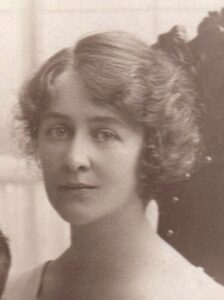
Martha Roper C 1920
The 1920s
The records in the suitcase go back to 1956. A review of newspapers prior to this shows only a few references to the Village Hall. In 1924 several events were noted. There was the Casterton Women’s Institute (WI) monthly meeting presided over by Mrs Whateley. The speaker at that meeting was Doctor Henderson from Kendal, who spoke about ‘Health in the Home’.
Also reported in the newspapers was a Whist Drive and Dance attended by about 60 people held in the ‘Public Hall’. I assume that this was not the Church Room, but rather the Public Hall referred to above. The event was truly a village affair. Prizes were presented by Mrs William Robinson, while the Misses Martindale and Mattinson played the music for the dancing, and the Messrs R Gawith and James Greenbank were the Masters of Ceremony. The catering was looked after by Mrs Teasdale, Mrs Hardacre, Mrs W Thompson and Miss M Greenbank.[11]
As far as the Women’s Institute meetings were concerned, a typical meeting took the form of a demonstration of some kind and an instructive talk These were followed by a cup of tea and some form of community entertainment such as a sketch or community singing.[12]
In 1929 the Church Room was used as the venue for the wedding reception of Miss Dorothy Parker of Tollbar Cottage and Mr Laurence James Richardson from Lancaster. Around 50 people attended the celebration after which the newly wed couple left by car to Liverpool for their honeymoon.[13]
The 1930s
In 1937, an inquest was held in the Village Hall about the death of Horace Mason who was the gardener at Casterton Grange. At about 19:00 he had left home to go to Whoop Hall for the football results. At about 22:15 two men, Edward Troughton and Edward Bayliffe, were walking home to Kirkby Lonsdale. They observed an electric light on the grass verge near the intersection of Chapel House Lane and Hull Brow. On the opposite side of the road, they discovered a man lying on his back unconscious. The local Doctor, R G Mathews was called, and took the unfortunate fellow back to his house where he sadly died. The local policeman was informed and inspected the scene of the accident the next morning. The conclusion was that Horace had been on the wrong side of the road, ridden straight into a kerbstone, travelled along the grass verge and fallen off. There was no evidence of being hit by another vehicle. The Coroner concluded that the death was accidental.[14]
One of the last meetings to be held at the Hall in the 1930s was the first meeting after the declaration of the Second World War. At the WI meeting on 6 September 1939, it was reported that the attendance was ‘quite good, considering it was only three days since the outbreak of war, and there were several evacuees in the village.’[15]
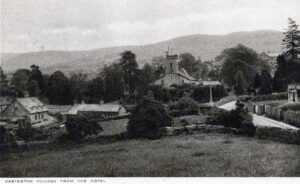
Postcard C1930s showing on the far right, the Village Hall.[16]
The 1940s
I have not been able to find any newspaper references to the Village Hall in the 1940s. Of course, events were still happening there. Claire Wildsmith’s history of the Casterton Women’s Institute gives some idea about how that organisation was using the Hall during the 1940s.[17] Wartime meetings were held in the afternoon because of wartime lighting restrictions. There were now talks on war related matters such as fire fighting, air raid restrictions, home nursing and first aid. Members volunteered to make blackout curtains for the Hall.
Whist Drives were held to raise funds for war time charities such as Wings for Victory. Poignantly, in January 1944, a Whist Drive was held at the Hall which raised £24 to purchase parcels of gifts to be sent to the 16 sons and daughters of residents of Casterton who were serving in the Forces. Two of the recipients, Edward Bickersteth and Thomas Parker, were killed in action later that year. Post War rationing dictated much of the WI meeting agendas in the last half of the 1940s.[18]
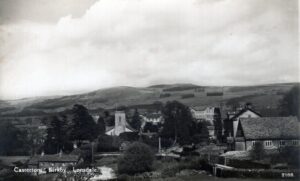
Postcard C1940s showing on the right the Village Hall.[19]
1956 – A New Committee
In the suitcase is a Casterton Village Hall minute book from 1956 to 1959. At the front of the book, it reads ‘Casterton Church Room Management Committee inaugurated June 14, 1956.’
It is not clear from the records what preceded this new Committee.
At the inaugural meeting, the Vicar, the Reverend Walter Frederick Ewbank,[20] briefly explained the circumstances under which the Room had originally been built and the nature of the Trust under which it had and would still be administered. It seems that circumstances demanded that a new body was required to manage what appears to be a previously poorly managed Hall. The original Trustees seem to have encountered financial issues and the building’s maintenance had been poor.

The Reverend Ewbank
The Reverend suggested that a new committee needed to be created. It was named the Casterton Church Room Management Committee (CRMC or ‘the Committee’). Members were to be elected annually and would report to an Annual General Meeting (AGM). The Committee would take over the responsibility for the management of the room ‘IN ACCORDANCE WITH THE TERMS OF THE TRUST’ [capitalised by author for emphasis].
What might not have been clear to the new Committee was that under the terms of the still extant Trust Deed, it was only the Vicar who had decision making authority. If he so wished, even if the Committee had voted in a different way, the Vicar could veto it. This situation would cause difficulties in later years.
The CRMC was duly formed with the Reverend Ewbank as Chairman with other members being Mr Bowring, Miss Capstick, Mr Tom Lowthian, Mrs Martha Roper, Mr Thompson, Mrs Crossley and Mr George Thurstan. It was agreed that the main focus of the committee should be to raise funds to clear the deficit and to start to address the long list of necessary repairs. The size of the deficit is not recorded, the earliest set of accounts in the suitcase is for the year ended 1956 which showed a deficit of £25.
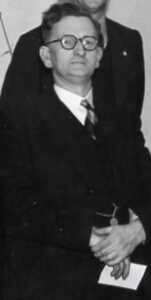

Tom Lothian (top) and George Thurstan
At the next meeting on 5 July 1956 Miss Bickersteth was co-opted onto the Committee. A decision was made to write to the County Council Canteen Committee asking for a grant towards the £200 required for renovations to the Hall. Specifically, to pay for the new heating furnace and remove the old gas brackets from the roof at a cost of about £50. The Canteen Committee were approached because the Hall was used by the local Village School to serve school meals.
The next meeting was held only four days later. It was resolved that estimates should be obtained for repairing the ceiling by clearing loose materials, repairing plaster and applying two coats of emulsion to the ceiling. A fund-raising event was agreed to be held in October at the Hall in Kirkby Lonsdale. It was to be a Harvest Whist Drive to include a raffle.
At the next meeting, on 23 July, a quote had been received from Carr and Bleasdale for £46 to paint the Hall’s interior. Funds were clearly tight, the decision to go ahead was deferred. At this early stage of the new Committee, it is clear that they still had not got a full idea of the financial situation. Until liabilities became clearer, it was resolved that Mr Bowring’s proposal of the Rents to be charged to users of the Hall be held in abeyance but that he was to try to renegotiate the arrangement with the Education Authority for using the canteen in the Hall.
At the next meeting on 17 September, plans were well developed for the Whist Drive in Kirkby Lonsdale. There was an anticipation of 140 attendees. Plans were also discussed for a ‘sale’ on 24 November with an entrance fee of 6 pence.
It was agreed that the main door lock should be replaced because when it got stuck, the only way to get in was through a window!
In October it was reported that the Whist Drive had raised more than £21 and a Children’s concert had resulted in more than £4 for the coffers. There was more good news, the Canteen Committee representatives had agreed to offer a grant of £50, and to increase the annual rent that they paid from £60 to £70. The funds were needed, Armistead’s Plumbers had presented a bill for repairing the boiler for £60. It was agreed to write to every farmer in the parish for their support in the forthcoming ‘sale’ and that dead or live stock would be welcome.
The November meeting reported that the farmers’ response had been ‘moderate’. It was also agreed that the sale of the dead and live stock should be held at the Kirkby Lonsdale Auction Mart rather than on the day of the sale itself at the Hall.
The December meeting was informed that the ‘sale’ had raised £50 and the sale of live and dead stock another £24. The issue of having a Caretaker for the Hall was discussed and it was agreed to approach Mr Wright to prepare a quote for performing caretaking duties including cleaning.

A 1951 Social in the Church Room[21]
1957 – Steadying the Ship
The first meeting of the year was in February. Mr Wright had requested a fee of £52 per annum for his caretaking duties, which was agreed to, the accounts show that he was first paid in February.
The Rents to be charged to users of the Hall were also agreed, vis; £70 to the Canteen Committee, £22 for the Men’s Club, £9 for the WI, £10 for the Anglican Young Peoples’ Association (AYPA) and £3 for the Football Club. Rent charges were also agreed for ‘casual users’ of the Hall, for example £1 for a Coffee Morning and 1 pound and 10 shillings for a Coffee Evening. During the year, in addition to the regular users, bookings of the Hall were made by the Parish Council (PC), the Conservative Association and a wedding reception.
The first AGM was held in May. The only change to the Committee was that Mrs Roper stood down and Mr I E Herd was appointed. Mr Bowring suggested that the PC be approached about ‘the possibility of a levy of 1d rate in the Parish for Church Room Funds.’
There was a small controversy at the next meeting in June. The Men’s Club had felt that it was unfair that the Football Club should have meetings in the kitchen on Men’s Club nights and yet pay £3 to the CRMC. It was agreed that instead, the Football Committee should pay £2 to the Men’s Club and £1 to the CRMC. Concern was expressed about the central beam in the room. It was agreed that a builder should come and examine it.
The meeting in July was told that the centre beam was safe. Another interesting development was the news that the PC had approached the Committee about acquiring a small plot of land within the boundary of the Hall in order to provide a bus shelter.
In September it was approved that the WI would be charged £12 for the classes that they were to hold there for two hours every Thursday, for 24 sessions. At the beginning of the month the Hall’s deficit stood at £9.
In the accounts in December was a receipt from the CDTFA for 11 pounds, 5 shillings and 6 pence. This was a payment of returns made on a Trust deposit thought to be £325, made by Miss Bickersteth in February 1915. The same amount was paid annually as a contribution to the cost of running the Hall.
1958 – Deficit Delight
The first meeting of the year was in early March. It was agreed that an application be made to the Carnegie Trust to help with providing and replacing the Hall’s furnishings and fittings.[22] It was agreed that there should be a Domino Drive in April.
Occasional users of the hall in this year were a funeral tea, a Village School party, a wedding reception, and the Conservative Association.
At the second AGM in May, it was reported that the funds were now to the good by £8. The Committee remained the same except that Mr Pattison took over from Mr Bowring as Treasurer, and new members, Mr Edward Askew and Mr Martindale joined the Committee. One of the new groups using the Room was the Rifle Club.
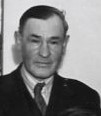
Edward Askew
In June it was revealed that a Kindergarten School had asked how much it would be to hire the room for two hours, 11 times per term, three terms per year. The charge was agreed at £18. It was agreed that the CRMC would meet the PC to discuss the bus shelter. This topic would take a while to reach its conclusion.
At the next meeting in July, a rough sketch of the bus shelter was shown, and it was explained that it was not possible to erect a conventional shelter because of the narrowness of the pavement. The PC said that they would be responsible for keeping the shelter clean and tidy. The roof would be concrete slabs which would be earthed over. The Reverend Ewbank suggested an alternative design to that shown in the rough sketch. This was dismissed by the PC. It was suggested that if the land were granted, it would be by way of an easement. At the end of the meeting the CRMC assured the PC they would reach a decision soon.
Two days later the CRMC stated that the following conditions were required to be agreed to as a condition of granting the land.
- The PC be responsible for maintenance of the bus shelter
- The PC be responsible for keeping it clean
- The final design and type of shelter be approved by the CRMC
- All legal costs connected with the easement be borne by the PC
- If the shelter is no longer needed ‘the Parish Council shall restore the property to Status Quo, namely a retaining wall with earth behind, or shall not put the shelter to any other use save with the consent of the Church Room Management Committee.’
Finally, the CRMC was told that there were two ways of granting the land to the PC, either by absolute gift or by granting an easement. The second option was chosen by 4 votes to 3.
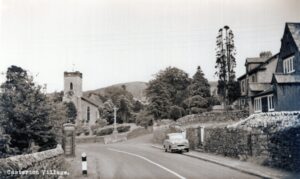
Postcard pre 1962 showing on the right the Village Hall before the bus shelter was built.[23]
In October the prospective Kindergarten advised that they would require the Hall for 3 hours each session rather than 2. The revised fee was agreed at £21. The Village School had also asked how much it would be to use the Hall for PE classes for 3-4 periods per week for ½ hour sessions. The charge was agreed at £21.
A revised plan was submitted for the bus shelter, slight modifications were suggested, and the design was agreed, subject to those amendments, i.e. the retaining wall should be 2 feet thick at the base and that any step should be flush with the door opening.
A proposal for refurbishing the Hall had been prepared by the Chairman. He had calculated that an expenditure of £250 was required. It was agreed to apply for the grant to the Carnegie Trust.
Finally, it was agreed to sell the old crockery and purchase new items including a large tea pot!
In November the meeting included a guest, the Secretary of the Cumberland Council of Social Services. He was Mr Hobman and he was there to explain an issue that had arisen with the grant application to the Carnegie Trust. The issue was that the Trust Deed under which the CRMC was run stated that the Vicar would always have the final say on any matter rather than by a majority vote of the CRMC. Mr Hobman told the meeting that such an arrangement was not acceptable to the Carnegie Trust or the Charity Commission. He suggested that the Trust Deed be revised and that in his opinion ‘in a small community it is a good thing if the Village Hall belonged to the Village rather than the Church.’ After the Secretary left the meeting, having answered questions raised by the Committee, the Chairman said that he was surprised at the attitude of the Carnegie Trust and stated that he was not in favour of altering the Trust Deed for the sake of obtaining probably [indecipherable]. Mr Paterson added that that he thought that the funds could be raised locally.
It was resolved that, despite the warnings from Mr Hobman that the Carnegie Trust might not approve the grant, it should be applied for anyway – with the addition of a gas cooker.
At the same meeting it was revealed that the AYPA owed £10, half of which was from the previous year. Mr Martindale, who was also the AYPA rep, said that he considered the charges were too high and asked that they be reduced.
1959 – A Busy Year
At the first meeting of the year in March a letter was read from Mr Hobman, the contents were not included in the minutes, only a rather terse ‘No Comment’. Another letter was read which the Committee did comment on, the Director of Education (DofE) had accepted the quoted fees for using the Hall for children’s dancing classes, but required clarifying who was responsible in the case of an accident. There had been no letter from the AYPA regarding their overdue debt.
In February the CDTFA paid the investment return amounting to £11 5 shillings and 6 pence. Occasional Renters of the Hall included the Liberal Association.
It was reported that one of the ‘players’ in last year’s pantomime had fallen down the cellar steps. Fortunately, they had not been injured. The Secretary offered to erect a suitable fence around the area to make it safe as long as the CRMC provided the materials. To help with fund raising, another Domino and Whist drive was proposed together with a raffle.
In May, matters discussed included what would happen if the Hall was damaged while doing the PE lessons, the appointment of an auditor to sign the accounts for the forthcoming AGM, the non-payment of the AYPA debt and more bus shelter debate.
A new draft of the clause about the reinstatement of the bus shelter should it no be longer required was reviewed, ‘If the shelter is no longer needed as a bus shelter the Parish Council shall not put the shelter to any other use save with the consent of Church Room Management Committee.’
The idea of a Christmas Whist Drive was mooted.
At the AGM a week later, aside from the regular reading and approval general reports and accounts, it was agreed to approach the PC and ask them to explore the possibility of having a car park in the village.
The election of officials confirmed the Reverend Ewbank as Chairman, Tom Lowthian as Secretary and Mr Paterson as Treasurer. Other Committee members were Mr Edward Askew, Mrs Crossley, Mr Martindale, George Thurstan, Miss Wright, Mr Major, Mr Wilson Goad and Miss Makinson.
With the new Committee in place, the weighty subject of how much the AYPA should pay was raised. Mr Martindale said that the charge of £10 was a ‘very heavy drain on their present strength of 12 or so members.’ It was agreed that the fee would be reduced to 7 pounds and 10 shillings. The Committee approved the purchase of a pair of ‘steps’ [ladders] for use in the room, it was noted that nothing had been heard from the Carnegie Trust.
In September, after the new Committee members were welcomed, it was reported that the DofE had ‘cleared the question’ of liability of using the room for the school’s PE classes and that henceforth, children would be using the Hall at a fee of £21 per year. The Kindergarten plans however fell through. It was agreed to run a Christmas Whist Drive with a raffle.
The Bickersteth’s had informed the Chairman that they wished to provide something for the Church Room in memorial of their late Mother, Ellen Constance, who had died earlier in the year. Suggestions arising were a new piano, a stage and stage curtains and a brass plaque stating that the room was given by Miss Lucy Bickersteth.
In November, the meeting was told that the soft furnishings class had lapsed. Quotes had been received for the 8ft step ladders. It was approved that they should be bought for 3 pounds, 19 shillings and 6 pence from A Eglestone(?). A donation of crockery and cutlery was accepted from the Football Club for a nominal sum.
The Christmas Whist Drive was then discussed, with prizes such as a plum pudding and a purchased turkey while Mr Thurstan offered a goose. It was agreed to purchase a box of fruit for the raffle. For the refreshments that were included in the 2 shillings and 6 pence entrance fee, nearly 3lb of biscuits, ½ lb tea and 6 pints of milk were authorised to be acquired. The playing cards were to be hired from the Men’s Club.
1960 – Constitutional Conundrums
The first meeting of the decade was held towards the end of February. Miss Bickersteth had spoken with the Chairman who reported that none of the earlier suggestions for a memorial to her mother were agreeable. It was agreed to ask her if a Trust Fund for the Hall could be established.
A charge of more than £3 for rodding the sewer was felt to be excessive and Mr Paterson agreed to speak to Mr Thomas about it. Local groups had again been tardy in paying their 1959 subscriptions. The WI, the AYPA and Men’s Club were all in debt. The Whist Drive had been successful. Another one was approved as well as a Bring and Buy sale in April.
The thorny issue of the Constitution of the Committee and its connection with the Trust Deed was raised by the Chairman. He said that he would like to see the Committee put on a stronger footing and was seeking possible solutions to alter the Trust Deed so as to provide that powers to control the room be vested in the ‘Parochial Church Council’ i.e. the PC, with the CRMC being its sub-committee.
At the May meeting, the AYPA were again asking for a favour. They had written to the CRMC to explain that they now only required the room once a month in winter and not at all in summer. It was agreed to reduce the already reduced charge from £7 to £5, but they were told that the prior year’s charge must be paid.
Mr Paterson, who was Chairman of the local Conservative Association, explained that when they used the room on 29 February it had been in a dirty state and felt that the matter should be brought to the attention of the Committee. It was agreed to half the amount charged. On the back of this, it was also agreed that when the room was hired by ad-hoc users, a 5-shilling booking fee would be levied in addition to the charge for the room. If the room was subsequently returned in a tidy state, the booking fee would be reimbursed. A notice would be affixed to the notice board to define what was meant by ‘tidy state’.
The Chairman again raised the issue of a change in the control over the Room by vesting control with the PC. It was agreed that the current solution was the more desirable one.
The AGM was held in June. The Committee remained the same, but the Secretary was asked to write to the Village School managers to appoint a representative to sit on the Committee.
A long discussion was held about using the Hall for weddings and parties etc. It was agreed that a social party would be charged £4 and a wedding party also £4 plus 10 shillings for night [indecipherable].
The AYPA’s fees for 1960 were agreed at £5 to allow for nine meetings. The fees charged to the Village School for their Christmas party and their school sale were reduced.
In September a draft agreement prepared by the Diocesan Board’s solicitors for submission to the PC was read was read and after discussion approved. A copy of the draft was placed in the Church Room Papers, but the contents were not noted in the minutes. I assume that it was about the bus shelter.
A letter from the Carnegie Trust informing the CRMC that their grant application had failed was read out. The date for the Christmas Whist Drive was set as 2nd December 1960.
October’s meeting agreed that the rental for the bus shelter site should be a nominal 1 shilling each year. (I wonder whether this was a typo, by reference to subsequent payments, the final fee agreed was 10 shillings.) The dangerous state of the steps leading to the road was noted and it was agreed that Mr Needham should be asked to come and take a look. Plans were made for the Whist Drive.
In November, it was reported ‘that the Parish Council were still experiencing considerable difficulty with the Diocesan Board of Finance on the point of nominal rent of the Bus Shelter.’ The Chairman undertook to write to the CDTFA on the matter.
1961 – An Appeal for Funds
The first meeting of the year was held in March. The front steps were again noted as being in a dangerous state. The Christmas Whist Drive had raised a profit of 12 pounds, 4 shillings and 6 pence. It was agreed to hold a Coffee Morning on May 6th.
Mr Paterson brought to the attention of the Committee that the Barbon Village Hall had successfully applied for a grant from the Carnegie Trust for new chairs, noting that it was unfortunate that the Church Room could not participate in such grants. He asked if there was any chance of a grant from the F.W.O. [I am not clear what the F.W.O. is, it appears to be related to the Invested money.]
The Chairman replied ‘that whilst this was a proper point to raise, the funds from the F.W.O. are all at the disposal of the P.C.C.’ He agreed to write and ask how the money was invested and about the terms of the Trust and if any of the capital could be ‘realigned’ to provide for renovation of the room. The Committee generally felt that Diocesan Board of Finance should increase their contribution to the running costs of the Room.
The Chairman had again approached the Misses Bickersteth about the memorial to their mother. They ‘had agreed to consult with her (Sic) Brother about providing some chairs for that purpose.’
While the general funds of the CRMC had increased and were in fact in a healthy state, the Committee were clearly still troubled by the responsibility of the ongoing maintenance of the building. They agreed that all parishioners would be written to, inviting subscriptions towards the upkeep.
The bus shelter saga reached its conclusion. The Chairman had received the Agreement and Counterpart for the letting of the site to the PC. After due consideration it was approved and signed.
Based on the minutes, the April meeting was short affair. The main subject was the forthcoming Coffee Morning and Bring and Buy Sale.
At the June AGM, the Chairman reported that ‘The Room had been in constant use during the past year and said that it was hoped to decorate the interior in the near future.’ The Secretary appealed for more support in aid of special efforts for maintenance of the room.
The Officers of the Committee remained the same with the addition of Miss Smith who would represent the Village School.
In the absence of the Reverend Ewbank, the July meeting was chaired by the Secretary. There had been an anonymous £10 donation to the Church Room. Two other donations were also received, one, a gas boiler for use in the room by Mr Robert Wright, the other, a mahogany upright piano by the Secretary and his wife.

Robert (Bob) Wright
Quotes were examined for redecorating the interior of the room. They ranged from £60 to £115 from Lunesdale Decorators who offered two quotes, the second for £175, which was presumably for additional work. Mr Gibson’s quote of £60 was accepted.
September was another short meeting. The date of the Christmas Whist Drive was set, and Mr Thurstan offered to show some Christmas slides one evening to raise funds.
The October meeting reported that the decorations had been completed and that ‘all agreed that a very great improvement had been carried out.’ The PC were warmly thanked for allocating the proceeds of the Harvest Sale and Whist Drive of almost £17 to the CRMC special account.
November’s meeting dealt with matters arising and more mundane matters. Mr Thurstan’s offer of a Christmas Slide show was accepted, the title being ‘In and around Lakeland’.
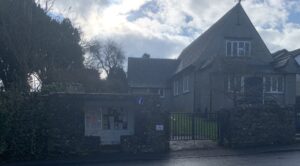
The bus shelter with Village Hall in background
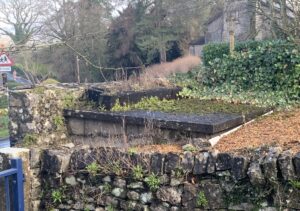
The reverse and top of the bus shelter showing how it encroaches into the Village Hall boundary
1962 – Committee Changes
At the February meeting a stocktake of the crockery in the cupboard had revealed the existence of 108 good cups, 8 chipped cups, 106 white plates, 30 old plates of various designs, 104 saucers, 8 bread plates, 3 new jugs, 3 old jugs and 1 enamel jug. It was agreed that no further purchases were necessary.
There was no mention of Mr Thurstan’s Christmas slide show, but his offer of another show was accepted. It was also concluded that there would be a Coffee Evening with a Bring and Buy Sale followed by a Domino Drive.
The significant item on the agenda was on the subject of the late Mrs Bickersteth’s memorial. After discussion with the family, they had agreed to rebuild the front steps leading to the main door, provide a wall on each side and also install a stone plaque with a suitable inscription on the panel between the 2 bottom windows on the west side of the Room. It was decided to accept the offer.
More big news was that the Vicar was leaving. He asked if the Committee would continue to look after the affairs of the Room until a new vicar arrived in the Parish. Mr Paterson, who seemed to have a bee in his bonnet about this, stated that ‘in his opinion this was not practicable as legally the present Committee has no legal standing. The Vicar explained that the affairs of the Parish generally are to be in the hands of Sequestrators during the Interregnum and he would obtain the signature of the 3 Sequestrators to a document giving power to the Committee to act as suggested.’[24]
Because both the Chairman and the Secretary were leaving the Parish, it was agreed to close the 1961-62 year accounts on 31 March 1962 so that the AGM could be held early. The AGM was fixed for 6 April 1962.
Before that, there was a meeting in March. The soon to leave Chairman explained the position regarding the Sequestrators. Mr Paterson again raised an objection about the arrangements. He was concerned that the bank account was now in overdraft and that several sources of income had stopped. He felt that it would be difficult for the Room to pay its way until after September. The Committee agreed to carry on as requested.
At the AGM on 6 April, the Acting Chairman was agreed as Mr Thurstan. He was to interview candidates for the position of Secretary, notably, Mr Martindale, Mr R M Dixon and Mrs Aynscough. Paterson was re-elected as Treasurer and the Committee re-elected en-bloc with the power to co-opt if necessary.
The meeting was stopped at 8:00pm to allow the Acting Chairman to interview for the position of Secretary. The meeting was resumed on 13 April. Mr Martindale had indicated that he did not wish to stand as Secretary and so it was that Mr Dixon agreed to take on the role. He was duly elected.
The September meeting saw the attendance of the new Vicar, the Reverend John Price Evans.[25] As well as welcoming a new Vicar, the new steps had been completed and the new plaque installed. The Chairman agreed to write to Miss Bickersteth thanking the family and at the same time pointing out that there was a spelling mistake! (Can you spot where it was corrected?)
The new Vicar was invited to become the new Chairman of the Committee. The date of the Christmas Fair and Whist Drive was agreed as was the date of the next Committee meeting. That meeting was not held due to insufficient members being able to attend.
Thus, the next meeting was in November. At that meeting it was agreed that the Whist Drive would be replaced by a Coffee Morning with a Bring and Buy Sale and a Raffle.
1963 – Change of Chairs
At the February meeting thoughts turned to getting the outside of the building painted, with a separate quote for the gable end because Miss Bickersteth had indicated that she would cover the cost of that work. J G Gibson of 5 Beck Head in Kirkby Lonsdale was approached. It was also resolved to find out how much it would cost to repair the front gates. Mr Geoffrey Hadwin Huggonson of Cowan Bridge was suggested as a possible contractor.
There was a possibility of a Youth Club starting, if it did, it would be charged 5 shillings a night. Discussion on how much to charge the Women’s Fellowship and other Church functions was deferred.
In the accounts a new income of 10 shillings was recorded, it was Ground Rent from the PC. I assume that this was for the land on which the bus shelter was built.
In the March meeting, a Coffee Morning was agreed to be held with a Bring & Buy stall. A sub committee was formed to oversee the purchase of new tables and chairs. The Women’s Fellowship would be charged 10 shillings for each use of the Church Room.
A bell was given to the Church Room by William Robinson. Casterton School offered as a gift a Piano. A crockery stock count was agreed to be held before the next AGM.
May’s meeting reported a profit of more than £13 from the Coffee Evening. The fabric fund was boosted by 5 pounds and 11 shillings from the sale of pencils by Miss Wright, while the Men’s Club donated £6 towards the proposed purchase of chairs. Meanwhile Miss Bickersteth and her brother had agreed to pay for 50 chairs complete with a ‘nest’, the Committee resolved to pay for another 20.
At the AGM held in May it was resolved to donate the Hall’s old piano to Bela Prison in Milnthorpe. This is the prison that had housed German and Italian Prisoners of War in the Second World War, some of whom laboured on local farms during and after the War.
The new Committee retained the same Chairman and Treasurer, but Miss M Wright was appointed Secretary. All other members were re-elected, and it was agreed to ask Mr Robin Breay to join the Committee.
September’s meeting saw a letter of thanks from the Governor of H.M. Prison Milnthorpe for the piano. The 70 new chairs had arrived, and the sub-committee were asked to identify 30 of the old ones to keep and to try to sell the remainder. It was agreed to purchase 10 whist tables. A Coffee Morning was proposed for 7th December.
The Headmaster of Casterton School requested to use the Room for one hour on a Sunday afternoon for Bible Classes. The Chairman was tasked with finding out how much extra the heating would be.
The WI’s rug making classes from 7 to 9 PM were agreed to charge 15 shillings per evening.
November’s meeting reported that the Whist tables had been delivered by Messrs Carr & Bleasdale but as they were not in accordance with the sample, they were returned. Mr Gibson’s quote of 34 pounds and 15 shillings for the outside painting and cleaning the gutters was accepted.
The Fabric fund increased due to donations from WI Whist Drive of £10, and the PC Harvest Whist Drive contributed £14.
1964 – ‘the picture’
The first meeting of the year in February was told that Mr Gibson would start work on the exterior as soon as the weather was favourable, and that Mr Huggonson had said the front double gate was beyond repair. He had quoted £12 for a new wooden one, £20 for a wooden one of the same specification as the current one or £12 for an iron gate.
Carr & Bleasdale were unable to supply Whist Tables for the same specification as the sample, after examining the ones that had previously been delivered it was decided to purchase them at 32 shillings and 6 pence each, subject to some necessary adjustment.
The treasurer reported that the Fabric Fund had been boosted by another £18 from December’s Coffee Morning. Flushed with that success, another one was arranged for 8 April.
The March meeting was told that there had been no interest in the old chairs and that they would be advertised in the Diocesan Magazine. April’s Coffee evening would be followed by 18 hands of Whist and a raffle.
Mr Paterson commented on the state of ‘the picture’, and the Vicar was asked to speak with Mr Harris of Barbon about repairing it. This picture was a very large Victorian painting, it would remain a regular entry in the Minutes for the next 14 years!

A detail from the 1951 photo above showing what I believe to be ‘the picture’ It appears to show a Bishop with children
At the AGM held in June the Committee members were unchanged but a Mr Mellor was requested to join. Concern was expressed about the high cost of fuel and the possibility of electrical heating was discussed. Mr Parker offered to pay for the cost of repairing the picture frame. The poor state of the Hall’s back entrance was noted. The Men’s Club indicated that they would enlist the help of Junior Members to tidy it up. There was still no interest in the old chairs.
1965 – Life Goes On
There were no other meetings in 1964. The February minutes made no reference as to why there had not been a meeting since the last regular meeting in March or the June AGM. On the positive side 4 old chairs and 4 old whist tables had been sold but nobody had been found to repair the picture frame.
A money raising Coffee Morning was proposed for 8th May. The Secretary reported that she had found the kitchen dirty after a meeting. It was decided to put up a notice in the kitchen asking users to leave it clean.
At the April meeting, the proposed Coffee Morning was postponed. The current account was overdrawn by £33, partly because there was £22 rent outstanding from various parties. At the end of the meeting the members inspected the boundary wall.
The May AGM reported that the exterior painting had been completed in the summer of 1964, further discussion was held about how to best to heat the Room. The picture frame remained unrepaired.
The new Committee was re-elected en bloc with the addition of Mr Kendrick. The Coffee Morning’s new date was set for 19th June.
1966 – Heating Horrors
Once again, there were no more meetings after the AGM. Any sense of momentum gained in the first half of the year seems to be dissipated after the summer. The February 1966 meeting reported that the boundary wall had been repaired. The finances had improved largely because the Caretaker’s wages had not been paid since August, the Vicar had been acting as Caretaker, a search for a new one at this time had proved fruitless. The cost of heating remained on the agenda, the Secretary was asked to get estimates for electric, oil and gas heating.
June’s meeting was also the AGM. The repair of the picture frame was still outstanding. The finances continued to improve by virtue of having no Caretaker, but the Committee had been advised that the DofE would no longer require the Room for the Village School.
There had been some vandalism at the Hall, it was presumed that some children had accessed the Cellar and damaged a magic lantern that belonged to the Men’s Club.
Quotes had been received from the Electric and Gas Board’s and led to a lengthy discussion, more information was required and so the Chairman was asked to contact the Gas Board to get an idea of running costs. Because the main users of the Hall were the Village School, it was decided to approach the Education Authority to see if they could provide a grant towards the cost of improvements.
With the exception of Mr Thurstan who wished to resign, the Committee was re-elected en bloc. The Secretary was asked to approach Mr and Mrs Blaylock, Mr Castle, Mrs Luxton. Mr Parker and Mr Spencer to see if they might want to join it.
A second meeting was held at the end of June. There was some possible good news, the DofE had asked for more information about the proposed changes to the heating and indicated that a grant might be possible. The DofE also let them know that the room was often untidy after evening lettings.
The Gas Board had provided more information. The cost of running was expected to be about 1 shilling and 6 pence an hour, the system would be guaranteed for the first year after which an annual maintenance contract would cost 1 pound and 5 shillings. It was agreed to accept the quote of £80.
To help raise funds, it was decided to hold ‘an enlarged Coffee Evening’. This would consist of a Coffee Evening, Bring & Buy Sale, Rummage Sale, Bottle and Cake Stalls, a Raffle and Sideshows, the target date was Friday 23rd September.
July’s meeting focused entirely on planning for the forthcoming ‘enlarged Coffee Evening’.
In September the meeting was informed that the new gas heating had been installed but not yet tested. The left-over Coke [Coal] weighing 3 – 400 pounds, was donated to the Vicarage.
1967 – Cleaning Conundrum
The next meeting was not until May 1967. The ‘enlarged Coffee Evening’ had proved a success, raising in excess of £33. There was some concern expressed about the running costs of the new heating. It was decided to contact the Gas Board to check for leaks. The Treasurer reported that the DofE had promised £50 towards the cost of installing the gas heating but that the payment had not yet been made.
The picture was still in a state of disrepair. Miss Smith and the Secretary undertook to take on the task.
At the AGM in June, the Committee were again elected en bloc. The boundary wall was noted as requiring repairs. It was felt the Hall needed a ‘Spring Clean’ and a budget of £5 was approved.
At September’s meeting except for a group of youngsters, nobody had offered to ‘Spring Clean’ the room. It was thought the youngsters would require supervision and that a better solution would be for members of the Committee to do the job themselves during the October half term.
1968 – Water Worries
The next meeting was the AGM held in June. The Coffee Evening in October 1967 had raised £21. It appears that the Committee had not performed the ‘Spring Clean’ in the Autumn half term. It was proposed that a cleaning company be contacted to do the job during the summer holidays. The Treasurer reported that after the installation of a water meter, the annual cost had increased from £2 to £6.
The Chairman reported that the stage had been stored in the open for several years which was most unsatisfactory. Discussion turned to covering it with plastic sheets, but a decision was deferred until the next meeting.
1969 – Financial Fears
The next meeting did not happen until May 1969! It was reported that the Coffee Evening held in October 1968 ‘was successful’. There was bad news from the DofE. They had written giving one month’s notice that they no longer need to use the Hall as a canteen. This had surprised the Committee who had assumed that because the DofE paid on a quarterly basis, a quarterly notice would be required. Inquiries were to be made…
The Treasurer indicated that with the loss of the revenue from hiring the room to the Village School as a canteen, the future of the room was in doubt. Adding to the despondency, there was discussion about the excessive gas bill. One reason for the high bill was thought to be that the two previous bills had been estimates, another possible reason suggested was that the clock that controlled the heating had been damaged by a flood in the cellar and had stopped working, and finally, it was observed that the winter had been severe.
The AGM was held in June. The Chairman reported that the CDTFA had reinvested the stock. (I presume this to mean the funds held in Trust generating the annual income.) The stage had been sold. It was proposed that another firm should be approached about cleaning the hall. The Treasurer again warned that with the loss of the income from the County Council, the future of the Room was in doubt.
The Committee was re-elected en bloc with the addition of Miss Willson, Mr Airy and Mr Hodge. A substantial fund-raising event was suggested for the Autumn, the planning was to be done at the next meeting. There was no next meeting that year. The next one did not happen until an AGM was held in September 1970.
In May it was necessary to transfer £50 from the Deposit Account to the Current Account, a further £20 was transferred in September. Cash flow was becoming a problem.
A Conclusion Before an Interlude
Some 57 years after the Hall had opened it was still going – but not strongly. There was an existential threat from the loss of income and the lack of formal committee meetings to plan how to overcome the threats to the Hall. The first meeting in 1970 reported that more funds were transferred from the Savings Account to the Current Account.
The years after 1970 turned out to be turbulent. In 1975, when the Church no longer had a dedicated Vicar, the issue about how the Hall was managed under the Trust Deed came to a head. This together with the concerning lack of income, led to a ‘Holding Committee’ to be elected. The question of how to transfer ownership from the CDTFA to the new Village Hall Committee began a long tortuous path until a transfer finally happened in 1978. The fate of ‘the picture’ was also resolved in that year. All this and more will appear in part two of ‘A Sketch of Casterton Village Hall’ later this year.
Appendix 1
A list of documents used in this Sketch contained in the suitcase
Photocopy of 2 pages from the 1912 Accounts for the Church Room showing income and expenditure from July 1910 to April 1912.
Casterton Village Hall – Minutes of Committee Meetings & AGMs 1956 – 1959. A Blue notebook with black spine. 20 cm x 16cm.
Casterton Village Hall Minutes of Committee Meetings & AGMs 1960 – 1975.A Dark Green notebook with red spine. 20cm x 16cm
Casterton Parochial Church Council Church Room Accounts 1957 – 2002. A Black notebook with red spine. 32cm x 20cm.
Appendix 2
Abbreviations
AGM = Annual General Meeting
AYPA = Anglican Young Peoples’ Association
CRMC or ‘the Committee’ = Church Room Management Committee
CDTFA = Carlisle Diocesan Trust & Finance Association
DofE = Director of Education
PC = Parish Council
WI = Women’s Institute
Simon Drakeford
With Thanks to the Village Hall Committee
February 2024
References
[1] Westmorland Gazette, 25 February 1905, p5
[2] Westmorland Gazette, 30 September 1905, p2
[3] Westmorland Gazette, 11 November 1905, p8
[4] Photograph taken by author, April 2023.
[5] Westmorland Gazette, 19 December 1863, p5
[6] Cumbria County Archives (Kendal), WDU/69/5
[7] John D. Battle (Ed.), Underley Hall, Kirkby Lonsdale, Westmorland – A History of House and Occupants, 1969, pp27-29
[8] With permission of Cumbria County Archives (Kendal), WDU/69/5
[9] Billy Makinson’s reminiscences can be found here https://www.castertonparishcouncil.org.uk/wp-content/uploads/2021/10/Billy_Makinson_reminiscences.pdf
[10] Claire Wildsmith, Casterton Women’s Institute – The First 50 years, 1919 – 1969, Privately printed, 2009, p1
[11] Lancaster Guardian, 16 Feb 1924, p2
[12] Wildsmith, Casterton Women’s Institute, p7
[13] Morecambe Guardian, 10 August 1929, p9
[14] Lancaster Guardian, 29 January 1937, p18
[15] Wildsmith, Casterton Women’s Institute, p9
[16] Courtesy of the author
[17] Wildsmith, Casterton Women’s Institute
[18] Wildsmith, Casterton Women’s Institute, pp8-10
[19] Courtesy of the author
[20] Vicar of Casterton Church from 1952 to 1962
[21] Courtesy of Stephanie Vickers
[22] The Trust is still active, today named ‘Carnegie UK’, it is a charitable foundation established with an endowment from Andrew Carnegie in 1913.
[23] Courtesy of the author
[24] Sequestrators are legally responsible for the parish during a vacancy.
[25] The Reverend Evans was the last Vicar of Casterton Church before it became part of the Rainbow Parish in 1975.