

Introduction
When you visit Casterton Village Hall, on the right-hand wall there is a simple plaque which offers some basic details about when the Hall was built and who were the main benefactors. There is however an omission from the plaque which through my research reveals a fascinating story about a member of the Bickersteth family. A love story with a tragic end that until now has not been told.

Photograph of the Plaque inside the Village Hall[1]
The First Bickersteth at Casterton Hall
The Bickersteth family who lived at Casterton Hall were wealthy benefactors to many worthy causes in the village including the Church, the School, local community groups and the Village Hall. The family was first associated with Casterton before the death of the Reverend William Carus Wilson who died in London in 1859.
A newspaper report in 1863 confirms that Mrs Katherine Bickersteth, formerly of Kirkby Lonsdale, had been resident at Casterton Hall ‘for the last half-dozen years.’, i.e. from about 1857.[2] Katherine was the daughter of John Pares. She had married Robert Bickersteth (1787 – 1857) in 1825. Like his father Henry (1750 – 1821), Robert was a Surgeon who practised in Liverpool. Henry was born in Kirkby Lonsdale, but at some point, moved to Liverpool to pursue his profession. It appears that on the death of her husband Robert in 1857, Katherine moved to Casterton Hall.
While there, she regularly hosted local events. For example, in October 1864, Mrs Bickersteth hosted a group of local young people from the area to whom she had been ‘imparting instruction’ [Bible classes] on Sunday during her summer residence at Casterton Hall. ‘About 30 youths availed themselves of the invitation by indulging in cricket, football, and a variety of other games, until about 6 o’clock, when they sat down to an excellent repast [meal], which had been liberally provided for them. The beaming countenances of the partakers were a sufficient guarantee that they truly appreciated the kindness of the donor of the feast.’[3] This became an annual event for the next few years.
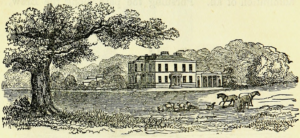
Casterton Hall in 1849[4]
Casterton Hall does not feature in the 1871 Census although we know that Mrs Bickersteth was still visiting there, but most likely, only during the summer months. She died in August 1878 at the Hall. As part of her will, after leaving various legacies to family members, she left the balance of her possessions to those of her daughters who were unmarried at the time of her death. Her estate did not include the Hall itself which was still owned by the son of the Reverend Carus Wilson, Mrs Bickersteth was a tenant.
The Second Generation
The 1881 Census records Katherine’s two unmarried daughters living at the Hall. There was Emma Katherine aged 48 and Lucy Constance aged 37. This was the Lucy mentioned on the plaque. Emma and Lucy were financially independent living off income from dividends. The Bickersteth spinster sisters remained at the Hall for many years. They were still in residence in 1891, with seven Servants, a Cook, a Maid, a Housemaid, an Under Housemaid, a Kitchen Maid, a Butler, and a Coachman. They were still there in 1901, being waited on by their seven servants.
The elder sister Emma died in 1907. Most of her estate was left to her sister but she also gave substantial sums to her servants and to local causes. Her Maid received £250, her Nurse £200, a past Cook £75, her Butler £50, and she gave £30 to four other servants. She also gave six months wages to her staff who had served her for more than a year and twelve months’ salary to those that had served her for more than three years. The Clergy Daughters School were also given £1,000.[5]
In 1911, the sole Bickersteth in residence, Lucy, still required six servants, this remained the same in 1921. Lucy died in 1930.
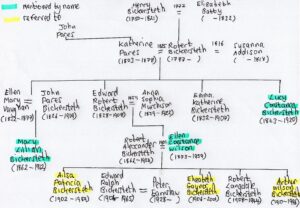
A partial family tree of the Bickersteth family to illustrate how those mentioned and not mentioned on the plaque are related.
The Third Generation
Also mentioned on the plaque is Mary Lillian Bickersteth (1862 – 1942) who was referred to as Lucy’s niece. Mary was the daughter of John Pares Bickersteth (1826 – 1909) who was Lucy Constance’s elder brother. Mary Lillian was born in Mumbai (Bombay), India.
By 1939, Mrs Ellen Constance Bickersteth nee Wilson (1873 – 1959) had moved into the Hall with her daughter Ailsa Patricia (1902 – 1989). Ellen’s husband had been Robert Alexander Bickersteth (1862 – 1924) Lucy’s nephew. Robert was the son of Edward Robert Bickersteth (1828 – 1908).
The Fourth Generation
Ailsa was one of the daughters who, as described on the plaque, along with the younger son, dedicated the rebuilding of the approach and steps of the Village Hall to their mother. The other daughter was Elizabeth Gaynor Bickersteth (1906 – 2001). The younger son was Arthur Wilson Bickersteth (1910 – 1996).
The Middle Son
There were two other sons not mentioned by the inscription on the plaque. The middle son was Robert Langdale Bickersteth (1908 – 1944). He was not included in the inscription because he had died 18 years earlier. Four years younger than his elder brother, he had gone to War. Prior to this it appears that he spent some time at Casterton Hall. A newspaper report in 1941 refers to him living at Casterton Hall.[6] The details of his probate also referred to his home as Casterton Hall. He is therefore commemorated on Casterton’s War Memorial.

Major Robert Langdale Bickersteth[7]
An obituary for Robert Langdale was written by Chris Sparrow, a teacher at Summer Fields School, Oxford to commemorate the school’s pupils who died during the invasion of Normandy. He wrote ‘Robert Bickersteth was born in 1908 the son of Robert Alexander Bickersteth and Ellen Constance Bickersteth. He came to the school in 1917 and went on to Eton in 1922. A keen sportsman, he did football, rugby and athletics. He then went to Trinity College, Cambridge in 1927 and gained an M.A. Bickersteth then became a schoolmaster and, in 1935, a partner in Winton House School. At the outbreak of war he signed up and was commissioned into the 7th Battalion, Seaforth Highlanders. He died in Normandy on 26th June 1944 and is buried at St. Manvieu War Cemetery, Cheux. He was 36 and left a wife, Penelope Bickersteth (née Waterfield), of Kirkby Lonsdale, Westmorland.’[8]
He was engaged to his fiancé Penelope in October 1943, and they were married the same month. Robert had only been in Normandy for 10 days prior to his death.
The Eldest Son
Edward Ralph Bickersteth was born on 8 August 1904 and was baptised in St Saviours Church in Liverpool on 5 September of that year. He was the first-born son. His life story is not only fascinating, but also offers a captivating social history lesson.
A Strange Omission?
The fact that Edward’s name was not included on the plaque, nor as noted below on the family headstone, suggests that he was in modern parlance ‘cancelled.’ The omissions are even more surprising because not only was he the first-born son, two years younger than Ailsa, in 1962 he was still alive.
Early Life
A short biography of Edward published in a pamphlet from the parish of Whitehaven offers a glimpse into Edward’s early life.[9]
‘EDWARD RALPH BICKERSTETH 1931 to 1933 [N.B. years served at Whitehaven]
He graduated from Magdalen College, Cambridge in 1927, gained his MA in 1931, and trained at Wells Theological College. He was deaconed in 1928 and priested in 1929. His first curacy was at Christ Church, Waterloo, Liverpool from 1928 to 1931. At Whitehaven his primary responsibility was Kells St. Peter Mission. By 1941 he was retired and living at Casterton Hall, Kirkby Lonsdale having held no other position since. He died in Leeds in the March quarter of 1945, at the age of 55.’
The obituary does not include the circumstances of why Edward had to leave his role as Curate in Whitehaven, seemingly a deliberate omission because the story behind his sudden departure was published in national newspapers at the time.
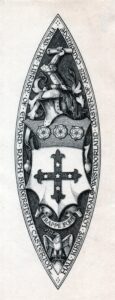
Book plate once belonging to Edward Ralph Bickersteth. Courtesy of the author.
A Different E. R. Bickersteth
The obituary above incorrectly refers to Edward as dying in 1945, perhaps an innocent mistake or perhaps a deliberate ‘red herring’. The person who died in the first quarter of March 1945 in Leeds was in fact Edward ROBERT Bickersteth who was indeed aged 55 when he died on 4 January. He was therefore born in 1890. This unrelated (as far as I know) Bickersteth was recorded on his death certificate as a Company Director and married to a lady named Evelyn.
A Second Omission
As referred to above, it is not only the plaque that omitted to mention the eldest son. The family gravestone at Kirkby Lonsdale graveyard reads,
In memory of
Robert Alexr Bickersteth
died Feb 29 1924 aged 61
and of his wife
Ellen Constance
died April 11 1959 aged 86
of Casterton Hall
also their son
Robert Langdale Bickersteth
Seaforth Highlanders killed in action in
Normandy June 26 1944
and their daughter
Ailsa Patricia Bickersteth
J.P.T.D.
died Nov 13 1989 aged 87
and their son
Arthur Wilson Bickersteth
died July 9 1996 aged 85
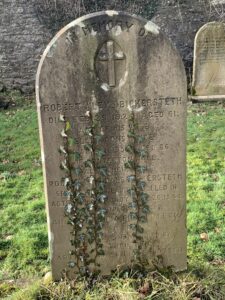
The family gravestone of the Bickersteth family in St Mary’s Graveyard, Kirkby Lonsdale[10]
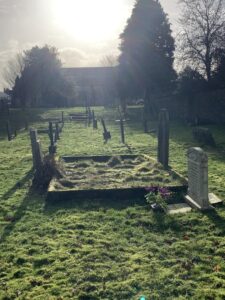
The Family Gravestone with St Marys Church behind[11]
The Scandal
A newspaper report from 1933 had the startling headline, ‘CURATE ADMITS IMMORAL CONDUCT – To be deprived of His Whitehaven living.’[12] The report went on to say that Edward had ‘admitted that he had been guilty of one of a number of charges of immoral conduct’ and was ‘sentenced to be deprived of his curacy and declared incapable of holding preferment.’
Through his Counsel, Edward had asked the Bishop of Carlisle to pronounce the sentence in respect of one charge admitted without further proceedings. The bishop agreed to do so. He also agreed to strike out the other charges without offering any evidence. At the trial, the Chancellor of the Diocese said that ‘he was pleased that this was a case, the details of which would not have to be discussed in Court.’ and expressed his gratitude to Counsel ‘for having assisted in avoiding what would have been a painful case.’
The exact nature of the immoral conduct therefore was not disclosed, leaving the circumstances open to speculation and gossip from Edward’s parishioners and the wider public. Perhaps wishing to keep a low profile, very soon after the trial, Edward headed to France with his youngest brother Arthur Wilson Bickersteth. Arthur was the youngest son mentioned on the plaque.
They did not stay away too long. On 11 August 1933 they boarded the White Star Line Ship Olympic at Cherbourg headed to Southampton. Their proposed future address was Casterton Hall, Edward’s occupation recorded incorrectly as a ‘Clerk in Holy Orders.’
London Life
Edward next appears in the records in a 1937 London Electoral Register living by himself at 4 Moscow Place, Paddington London. He is noted as still living there in the 1939 ‘War Census’, shown as the Rev. E. R. Bickersteth, unmarried and whose occupation was a retired Clerk in Holy Orders. Retired at the age of 35. His reserved occupation was with the Police. Edward would have been eligible to be conscripted to serve with the Armed Forces. At the outbreak of war, 3 September 1939, parliament immediately passed a law that all males aged between 18 and 41 had to register for service. It appears that, unlike his younger brother, Robert, he did not serve in the War.
During World War 2, and until 1999, there was an official ban on lesbians and gays serving in the armed forces. However, many did serve by either lying or being vague about their sexuality. A blind eye was often turned because the country was in desperate need of able-bodied men and women. I have not been able to find out why Edward did not serve. If it was because he declared that he was gay, the death of his serving brother would likely have harmed relations with his wider family.
Eight years after the 1939 ‘War Census’, a newspaper report about the funeral of Herbert Lewis Wilson in 1947 offers more information. Herbert was the brother of Ellen Constance. The report shows that Herbert’s nephew Edward and his niece Ailsa attended the funeral.[13] Edward therefore was not completely estranged. Ailsa was Edward’s older sister, and she was one of the sisters mentioned on the plaque.
Two years later, a 1949 London Electoral Register shows that Edward is living by himself at 41 Broadwalk Court, in Kensington. He remains at the same address until 1957. However, in 1953 living in the same flat is a gentleman named Peter Earnshaw.
‘The Love That Dare Not Speak Its Name’
Peter Earnshaw was born in 1928 in Huddersfield. If Peter and Edward had met in 1952, Edward would have been 48 and Peter 24. The quote above is taken from a poem by Lord Alfred Douglas, an alleged younger lover of Oscar Wilde. During one of Oscar’s trials in 1895, he was asked to explain what the “Love that dare not speak its name” was. His explanation may well have applied to the relationship between Edward and Peter.
Wilde said that ‘I think the writer’s meaning is quite unambiguous. The love he alluded to was that between an elder and younger man, as between David and Jonathan; such love as Plato made the basis of his philosophy; such as was sung in the sonnets of Shakespeare and Michael Angelo [Sic]; that deep spiritual affection that was as pure as it was perfect. It pervaded great works of art like those of Michael Angelo and Shakespeare. Such as ‘passeth the love of woman.’ It was beautiful, it was pure, it was noble, it was intellectual—this love of an elder man with his experience of life, and the younger with all the joy and hope of life before him.’[14]
The Ballet Dancer
As a curious aside, Peter was a twin. His brother was named Brian. Brian’s professional name was Brian Shaw. He was a renowned Ballet Dancer, performing with the Sadler’s Wells Ballet (later the Royal Ballet) from June 1944 aged only 15. As a leading dancer with the Royal Ballet during the 1950s and 1960s, he was widely regarded as ‘one of the finest classical male dancers of his generation…’[15]An article in a ballet magazine featured Brian saying that ‘There is a joyousness in Shaw’s dancing; there are speed and ballon, ease, lightness and fluency… Above all there is his musicality, which provides both the strong base on which his performances are built and the light irradiating them all from within.’[16]
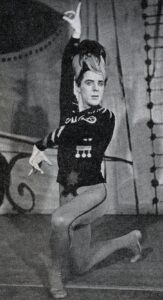
Photo of Brian Shaw[17]
A Change of Name
In 1952, Peter and Edward are also recorded as living at 44 The Mall in Ealing and remained on the register there until 1959. They were recorded as being on the Electoral Register in both Kensington and Ealing, perhaps these were the houses that they had owned or rented prior to meeting each other.
In 1958, there is a new address, 142 Latymer Court, Baron’s Court. In 1961 they are both recorded as living at 28 Fairfax Road, Chiswick. In 1962, Peter Earnshaw is listed as Peter Bickersteth. In a 1963 Electoral Register their surnames are both listed as Bickersteth-Earnshaw. They seemed to have officially changed their names to a shared surname.
The information above suggests that Peter and Edward were either openly living as a gay couple or as father and son. Bear in mind that it wasn’t until 1967 that the Sexual Offences Act was passed which decriminalised private homosexual acts between men aged over 21. Edward would not live to see this milestone change in the rights of gay men.
A Terrible Tragedy
About September 1964, Edward and Peter moved away from London to live at Durrington Manor in Durrington near Salisbury. Joining them there were Peter’s parents Frank Shaw Earnshaw, who had recently retired, and Annice Beatrice Earnshaw nee Brooke.
Six months later, on 1 March 1965, Peter was driving the family car, a green Volkswagen, with his parents and Edward as passengers. The car collided with a lorry at Folly Bottom, Amesbury not far from their home. Peter’s mother and Edward were both killed in the crash. Edward’s death certificate indicates that he was dead by the time he reached Salisbury General Infirmary suffering from multiple rib fractures from a crush injury to the chest.
Peter’s father who had head injuries and a broken thigh survived the crash. He was taken to the same hospital in a coma, unaware that his wife had died. Peter too was badly injured but was later reported as making a good recovery from his head injuries and broken arm.
A newspaper report of the crash referred to Peter and Edward by their shared surname of Bickersteth-Earnshaw. The report obliquely mentions Edward’s relationship with Peter stating, ‘Also killed in the accident was sixty-year-old Mr. Edward Ralph Bickersteth-Earnshaw, a friend of the family, who lived with them at Durrington Manor.’[18]
A report of the inquest gave more heart breaking details. A witness explained that the roads were running with water from a recent snowstorm. The driver of the lorry said that he had put his foot on the brake to change down to a lower gear and that his lorry just seemed to slide. There was a loud bang, after which he had no further memory. Peter also spoke at the inquest. He said that ‘I have a hazy recollection of a vehicle coming towards me on my side of the road, but I can’t remember anything after that.’[19]
Sadly, Peter’s dad Frank died 10 months later, on 31 July 1966, perhaps not fully recovering from the injuries sustained in the accident.
It appears that Peter went on to have a long life and is perhaps still living. A Mr Peter Bickersteth-Earnshaw was listed in Electoral Records dated 2003-2009 living at 51, Aveling Park Road in Walthamstow, London.
Conclusion
It is not certain whether Edward was estranged from his Casterton family although the evidence suggests that he was. He had publicly been sacked as a priest for immoral conduct and later formed a relationship with a younger man at a time when homosexuality was illegal. He had also crossed the class barrier and formed a relationship with a man whose parents were working class, going on to leave his inherited wealth to his partner. The fact that he probably did not join the armed services during the war whereas his brother did and made the ultimate sacrifice, may have been a source of tension. Such circumstances may explain why Edward’s name was left off the plaque and the family gravestone.
Years later such facts lose their significance. What remains important is the story that was left behind. How a gay man born in the Edwardian era, struggled to find his place in the world but ultimately met his life partner, with whom he shared his life until his untimely death.
Final thoughts
At the end of E. M. Forster’s novel Maurice, he wrote a postscript he titled “Terminal Note”. In the novel the leading protagonists were two gay couples, firstly Maurice and Clive and later the same Maurice and Alec. Forster wrote the novel in 1913 – 14 but was reluctant to publish it because of the consequences it might have for him. It was posthumously published in 1971, a year after his death. About Maurice he wrote ‘A happy ending was imperative. I shouldn’t have bothered to write otherwise. I was determined that in fiction anyway two men should fall in love and remain in it for the ever and ever that fiction allows, and in this sense Maurice and Alec still roam the greenwood.’[20]
Forster understandably believed that because homosexuality was illegal in the UK, he could never publish a book about a homosexual romance with a happy ending. Fortunately, in real life, even in the 1950s and early 1960s it was possible for some gay couples to find happiness together and wander in the greenwood. I wonder whether Edward and Peter ever journeyed in Casterton Wood together.
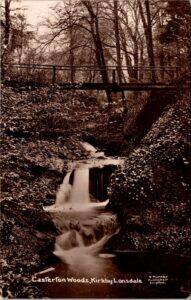
Casterton Woods C 1914
Simon Drakeford
January 2024
References
[1] Photograph taken by author, April 2023.
[2] Westmorland Gazette, 19 December 1863, p5
[3] Westmorland Gazette, 15 October 1864, p8
[4] Jonathan Otley, Otley’s Concise Description of the English Lakes (8th edition), 1849, p188
[5] Guardian, 15 July 1930, p8
[6] Lancaster Guardian, 18 July 1941, p4
[7] Sourced from https://www.cwgc.org/stories/stories/major-robert-langdale-bickersteth/
[8] Sourced from https://www.britishnormandymemorial.org/normandy-story/summer-fields-school-old-boys/ Accessed 5 January 2024.
[9] Christ Church Curates Biographies, Parish of Whitehaven Publication HS14, p4. The former Christ Church in Whitehaven burned down, in November 2003. At the time it was a fitness gym and had not been used as a place of worship since 1977.
[10] Taken by the author January 2023
[11] Taken by the author January 2023
[12] Sunday Sun, 2 July 1933, p3
[13] Chester Chronicle, and Cheshire and North Wales General Advertiser, 9 August 1947, p6
[14] Joseph Bristow (Ed,) Oscar Wilde and Modern Culture: The Making of a Legend, Ohio University Press, 2009, p243
[15] Debra Craine and Judith Mackrell, The Oxford Dictionary of Dance, 2000, p431
[16] John Percival, , ‘Accent on the Male: 7 Brian Shaw’, Dance and Dancers, Vol 9 No.12, December 1958, p21
[17] Percival, ‘Accent on the Male: 7 Brian Shaw’, p20-21
[18] Huddersfield Daily Examiner, 8 March 1965, p4
[19] Huddersfield Daily Examiner, 25 May 1965, p4
[20] E. M. Forster, Maurice, Penguin Books, 1972 p218
Dear Mr. Drakeford
We have further information concerning Peter Bickersteth Earnshaw.
Yours sincerely
John Cass, Gavin Maughling, Gillian Whitbread
Hello John, Gavin and Gillian, I will email you directly.
How interesting … it looks as if some related ‘grants of arms’ and a ‘pedigree’ are for sale on eBay. See: https://www.ebay.co.uk/itm/366061609846?mkevt=1&mkpid=0&emsid=e11021.m164380.l178264&mkcid=7&ch=osgood&euid=3173f405784a403c8e440996bbd639b7&bu=43128189926&ut=RU&osub=-1~1&crd=20251216065458&segname=11021&recoId=366061609846&recoPos=1
Interesting! Thank you for bringing it to my attention.
Regards
Simon