

The Start of Family Life
Norwood House, which was originally called Norwood Cottage, is a fine example of Georgian architecture built for a gentleman of independent means. The earliest definitive evidence of the existence of the house is in 1841, that year’s Census showed that 25 year old Dorothy Winster, James Eccles aged 20 and John King aged 14 were living there. Ten years later, Dorothy was living elsewhere in Westmorland, her role was a house servant. This suggests that James and John were also servants living at the house and that their employer was not in residence on the day of the census. If the house is Georgian, as it’s style suggests, then it is from the period 1714 to 1830. Examining the 1828 Hodgson Map (surveyed 1823 – 25), there is a building that could well be Norwood Cottage although it’s footprint looks smaller than the current plot. [1]
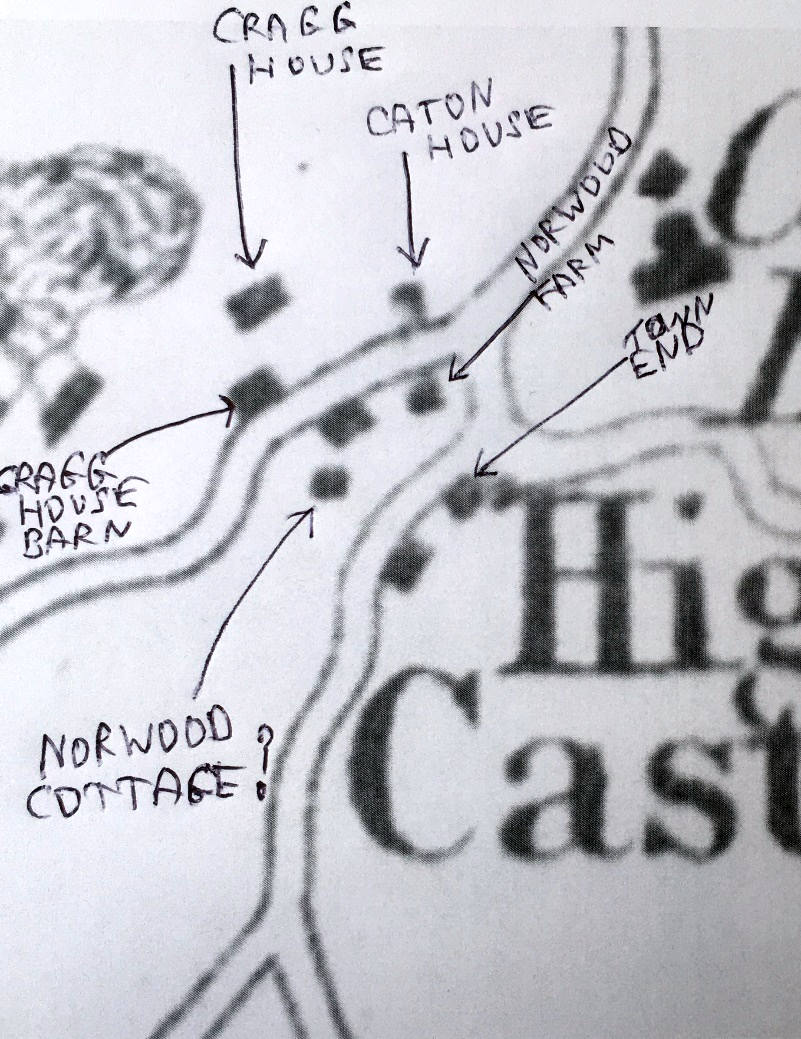
Extract of Hodgson’s 1828 map of Westmorland
The 1843 Tithe record shows that Thomas Clarke was the occupier of Norwood Cottage whereas the property was owned by Alexander Pearson. In the 1841 Census, Thomas was recorded as living in Casterton at ‘Town End’. It is unclear if this was the area ‘Town End’ or Town End Farm itself. On the Census there are four residences called ‘Town End’ listed consecutively, one of which was Town End Farm where the Bayleys were living. They are followed in the census record by Norwood Cottage, suggesting all premises are close by. Living at one of the ‘Town Ends’ was Miss Lucy Wilson, and two of her brothers, Joseph and Edward.

Comparison of 1843 Tithe Map (left) [2] with 1862 Ordnance Survey Map (right) [3] showing how properties changed. Note that Town End Farm buildings reduced whereas Norwood Farm increased.
Thomas Clarke and Lucy Wilson were married on 1 September 1841 in Holy Trinity Church at Casterton, only eight years after it was first consecrated.
The following year their first child was born, James Thomas Clarke. He sadly died in December 1843 of scarlet fever and was buried at Holy Trinity Church.
From the 1851 Census, we learn that Thomas Clarke was born in London in 1811 and described himself as ‘Gentleman’. Thomas’s father was James Clarke who for 48 years was the Recorder of Liverpool. The role was an ancient legal office in the City of Liverpool. For 23 years he was also the Attorney-General of the Isle of Man [4]. Thomas was living with his wife Lucy and their surviving children who were all born in Casterton, presumably in Norwood Cottage. They were Henry William (7), Joseph Addison (6), (Addison being the maiden name of Thomas’ mother Jane), Thomas Edward (4) and James Francis (2). Also in the household was a governess, three servants and a nurse.

Circa 1850 Century print of Norwood Cottage [5]
To Open or not to Open – That is the Question
With his career and family well established, Thomas was also active in local affairs. One such example was his involvement in a debate about whether the Kirkby Lonsdale News Room should be opened on a Sunday. The newsroom was a venue where both local papers such as the Lancaster Guardian, Kendal Mercury and Westmorland Gazette and national publications such as the Times, Punch Magazine, Manchester Guardian and the Illustrated London News were kept and could be read by subscribers [6]. Reading rooms were a feature in many villages, towns and cities in Victorian times, for example, one house in Barbon is still called the Reading Room. The cost of a newspaper was prohibitively expensive for many people and so the opening of such an establishment would have allowed many more people to be informed on current events and was seen by the middle class as a more wholesome recreational meeting place than the public houses.
At the meeting, 46 subscribers met to discuss the controversial subject of whether the reading room should be opened on the Sabbath. Thomas Clarke took the chair and explained that at a prior meeting, the Reverend Thomas Croft had proposed that the ‘room be closed the whole of every Sabbath day.’ Clarke was of the opinion that the decision to be made could be easily settled if a person would, ‘seriously examine his own conscience for a minute, and act according to its impartial judgement.’ Clarke’s own firm judgement was that the room should indeed be closed every Sunday. He stated that he believed that having such a public room open for reading newspapers was even worse than if a private individual read them in his own house, explaining that, ‘not that there was any difference in the sight of God, but the responsibility of the one rests with him alone who does it, while the other is openly setting the public a bad example, and is the means of leading others into temptation and sin.’
After hearing from the Reverend and his exhortation to, ‘Remember the Sabbath day to keep it holy.’, and Mr Clarke’s closing remarks that, ‘Every one’s conscience must tell him that the thing is wrong, and that he ought to be better employed on God’s holy day.’, perhaps in fear of eternal damnation for reading a newspaper on a Sunday, the meeting unanimously agreed to support the motion that the room be closed on that day [7].
Not everybody agreed with the decision, the debate elicited a heated correspondence in the Kendal Mercury. One person who signed himself as ‘Anti-Pharisee’ observed that the words and actions of the Reverend Croft and Thomas Clarke, ‘…are not actuated by the spirit that is in Christ, and I do not think that I am far wrong in my deduction that they are on the high road to that Pharisaic self-righteousness, which lacks nothing but time and opportunity to expand itself into a thraldom the most galling and withering that ever cursed mankind.’ [8]
Sadness and Joy
Sadly, only five months later, Thomas’ wife Lucy died, on 10 March 1856, aged only 38. Just over one year later, on 24 March 1857, Thomas married again, this time at St Mary, St Denys and St George in Manchester (now known as Manchester Cathedral). His new wife was Margaret Wilson, the younger sister of his first wife. In the marriage certificate, Thomas’ profession was recorded as ‘Gentleman’.
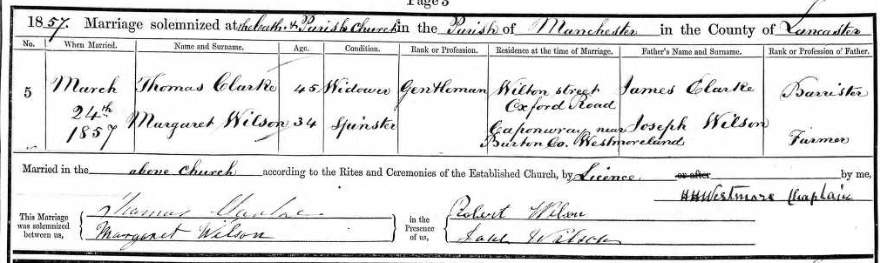
1857 Marriage Certificate of Thomas Clarke and Margaret Wilson [9]

Late 19th Century view of Norwood Cottage with Mr & the second Mrs Clarke. [10]
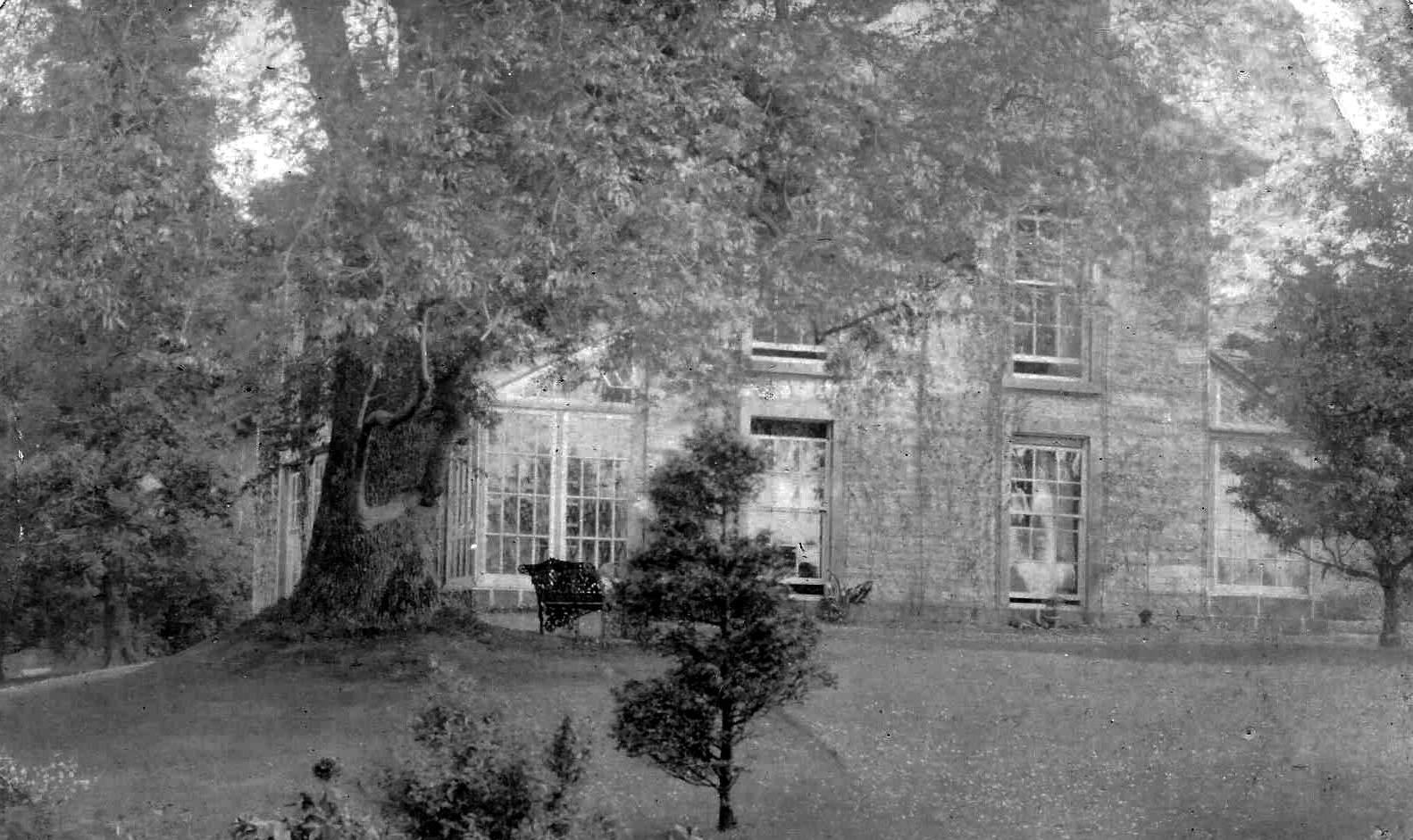
Alternate view of Norwood Cottage, early 20th Century. [11]
Let the Poor Men Fish
Moving on from matters of the Sabbath, in 1859 Thomas became concerned with, ‘protecting poor men in their rights of angling in the river Lune.’ [12] He chaired a meeting, noted as being, ‘very crowded and respectable’, at the Green Dragon Hotel (now called the Snooty Fox) in Kirkby Lonsdale on 11 March. Clarke stated that, ‘it was known the Lune had been a free angling river from time immemorial, [and] that this freedom had descended from father to son without interruption until the formation of an association called the Angling Association.’ (This would have been the Lunesdale Angling Association which had been formed in June 1858.) [13]
Clarke et al were concerned that two local men, John Bowie and John Brayshaw, had been charged with illegally fishing the Lune and were due to go to court. The meeting was told that some landowners who owned land alongside the Lune had not joined the Angling Association. The meeting also stated that they found it hard to believe that the Reverend William Carus Wilson (who owned land alongside the Lune) was aware that these men were due to attend the Magistrates and proposed to write to him on the subject. This implies that the men had been caught fishing on Wilson’s land. In the meantime, within two days of the meeting, more than £100 had been subscribed for the purpose of defending poor men in their exercising of their rights, ‘when pursuing the innocent amusement of angling.’ It was also reported that soon after the meeting, the summonses on the two men were withdrawn.
It appears that an accommodation had been arrived at whereby the Lunesdale Angling Association had agreed to withdraw the summonses. In doing so they left unchallenged the assertion that all men had a free right to fish the Lune, in return it was agreed that in the future, ‘all others who wish to fish will raise a subscription equal to not less than 3s. a head, and will otherwise support the association in every possible way.’ [14]
The Family Grows
In the 1861 Census, Thomas, now described as a Landed Proprietor, was still living at the house with his second wife, Margaret aged 39, 11 years younger than her husband. Four of Lucy’s sons were still at home, living with their father and step mother/Aunt, joined by two new half siblings, Lucy aged 2, named after Thomas’ first wife and Margaret’s sister, and Robert aged 1. In addition there was what appears to be a live in tutor, Thomas’s niece and three servants comprising a groom, a cook and a housemaid.
Farewell to Old Friends
In 1865, Thomas presided over a meeting held at the George and Dragon Hotel (now the Pheasant) in Casterton to present a testimonial to a Mr. Brian Dodgson on the occasion of him leaving the village in recognition of his ‘many onerous services he had rendered the township during the past nine years…’. [15] Dodgson was given a valuable mahogany bookcase with a large family Bible bearing suitable inscriptions.
In 1871, the Clarke family were still in residence, Thomas -now listed as a Landowner- and Margaret were there with their two younger children now aged 12 and 11 and another child, John aged 8. There were also three servants in residence aged from 14 to 18 and a tutor.
Entertaining Sunday School Children
In 1874, the Lancaster Gazette reported that Mr J. Clarke had invited the staff and pupils of the Independent Congregational Sunday School, about 60 persons, for tea at Norwood Cottage… ‘They reached Mr Clarke’s about two o’clock, and shortly afterwards sat down to an excellent tea, after which they amused themselves with various games until about eight o’clock, when they left for home, all thoroughly delighted with their day’s entertainment.’ [16] This appears to have become an annual visit, it was reported each year, in 1879 for example, the report mentioned that, ‘Much pleasure was expressed in the improvement in Mr Clarke’s health, and the earnest desire that his life might long be spared.’ [17] A wish that was to be fulfilled. In 1880 the newspaper noted that, ‘There was a large attendance. The day was highly favourable for outdoor games, and, creature comforts not being forgotten, a pleasant afternoon and evening was spent. Before leaving, hearty cheers were given for Mr and Mrs. Clarke by the scholars.’ [18]
Collecting Rain
In 1879, Thomas spent some of his time recording the rainfall in Casterton, even on a Sunday, and shared it with the local newspaper. Total rainfall for the year was 43 inches and rain fell on 178 days. The wettest month was July with about 7.5 inches and the driest, April with only 1.1 inches. According to www.worldweatheronline.com, the current average rainfall in Casterton is 64 inches, with April being the driest month (2.6 inches) and December the wettest (7 inches). The average for July is 1.7 inches. Make of that what you will!
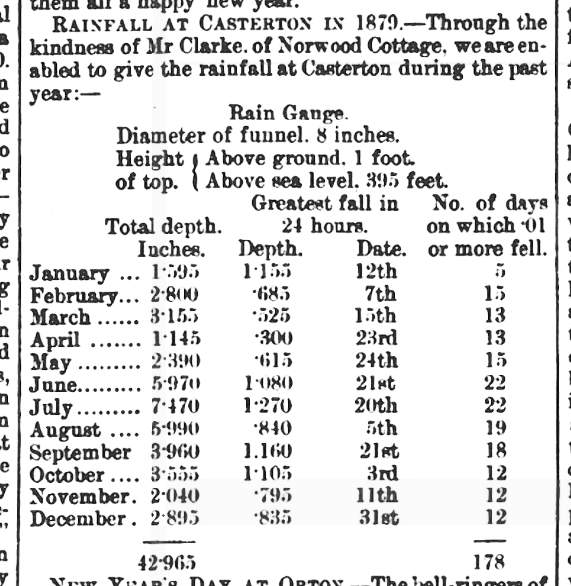
Extract from 1880 Kendal Mercury showing rainfall in Casterton in 1879 [19]
Time Moves on
In 1881, now aged 70, Thomas was still at the house with his wife and their children Lucy and Robert. Thomas’s sister in law Elizabeth Wilson was there with his great niece and his 37 year old son Henry. They were supported by three servants – a house maid, a cook and a gardener.
Thomas died 1 July 1886 and was buried in Casterton Churchyard where five years earlier his eldest son Henry William was buried. Thomas’s estate was valued at £21,495 (more than £3 million in today’s money).
In 1891, Margaret was still at the house accompanied by her son Robert who was now a solicitor, a 3 year old granddaughter and a 19 year old niece named Francis Hawkins whose job was an amanuensis, defined as ‘a literary or artistic assistant, in particular one who takes dictation or copies manuscripts’. Once again there were three servants, a cook, a housemaid and a groom.
Tenants Move in
The following year on May 21, Thomas’s second wife Margaret died and she was laid to rest with her husband and step son. After her death, her son Robert Alfred Clarke decided to put the house onto the rental market. The house was described thus, ‘Norwood Cottage, Casterton, Kirkby Lonsdale; pleasure grounds; with or without four acres of land; gas, all conveniences; good stabling, kitchen garden. – Apply Robert A. Clarke, solicitor, Bank-street Bradford.’ [20]
In the 1894 Kelly’s Directory a Joseph Applegarth is shown as living in the house. In the 1901 Census, the new residents were a retired farmer named Robert Rawlinson and his wife Ann.
The Family Return
In 1911, Robert Clarke, now aged 51, the son of Margaret and Thomas, was living at the house with his wife Mary Agnes nee Wolfenden, and two children, Freda Mary (17) and Charles Edward (10).
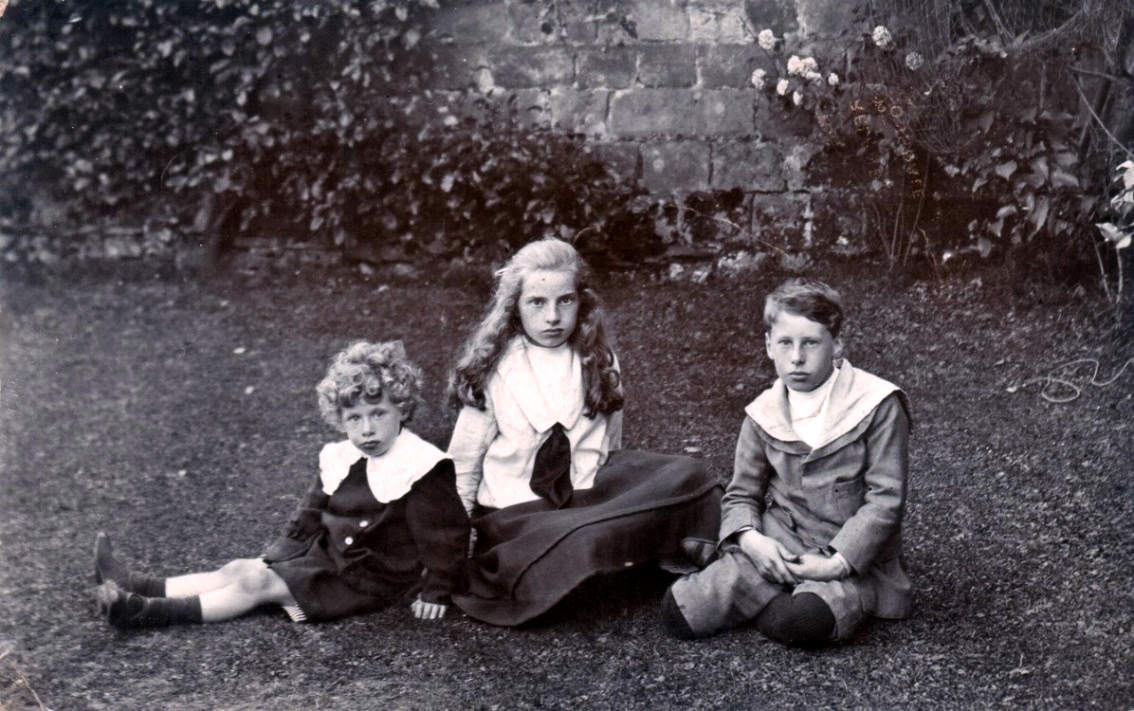
Charlie, Freda and Henry (Harry) Clarke grand children of Thomas Clarke and his second wife Margaret. [21]

Undated watercolour of Norwood Cottage by Annie Wolfenden (1862 – 1953). Annie was the sister of Mary Agnes Wolfenden, wife of Robert Alfred Clarke. [22]
Fallen Hero
Not included in the Casterton census was their eldest son Henry Cecil Clarke born on 16 June 1895. In the 1911 Census he is listed as being at school in Wetherby, but he was also educated at Queen Elizabeth Grammar School [QES], Kirkby Lonsdale, and was keen on sport, particularly football.
In August 1911, when he was 16 years old, Henry went to work for Manchester & Liverpool District Banking Co as a junior at its Lytham branch. He transferred to Barrow branch in 1912 and Sedbergh branch in 1913, and in 1916 was promoted to a clerkship.
In April 1916 Henry left the bank to go on military service in the Duke of Wellington’s (West Riding Regiment). He was sent to France in July 1916. He was soon transferred to the Northumberland Fusiliers, 23rd (Tyneside Scottish) Battalion, and by January 1917 had been promoted to Lance Corporal. He died on 11 February 1917, following a night trench raid against the German forces south east of Armentières aged only 21. [23] His body was not found and so he is commemorated on the memorial at Ploegsteert, Hainaut, Belgium.
See Addendum below for an update about Henry’s grave.
Surviving Hero
Henry’s younger brother Charles, known as Charlie, also attended QES and afterwards went to work at Marconi. Aged only 17, perhaps mindful of his brother’s fate, he joined the Merchant Navy as a senior wireless operator. On 23 July 1918 he embarked on the SS Australplain in Liverpool en route from Liverpool to Australia via South Africa. The ship was a steel single screw cargo steamship built by Henderson, Meadowside as the Ardanmhor for Ardan S. S. Co Ltd, Glasgow. In 1916 it was sold to the Australian Commonwealth Line and renamed Australplain. [17]
Charlie arrived in Fremantle in Western Australia on 5 November 1918 in time for the signing of the Armistice on the 11th.[25] Around him was great excitement which must have been tempered by not only the death of his brother on the Western Front, but also that of his father who died shortly after Henry, on 14 July 1917 aged only 57.
After the Sea
Charles stayed at sea until the late 1920s or early 1930s whereupon, in spring 1930, he married Elizabeth Reynolds. They had one daughter, Avril Veronica (1932 – 2017). Charles tried several jobs before finally settling down. He first tried his hand working at a family printers printing guidebooks in Ingleton before he lost his job in the Great Depression, struggling to survive with his is young family. The family next lived with his wife’s mother in Wales for a while, before moving to Windsor, with Charles taking on various jobs including as a car salesman, a role in which his honesty ensured that it did was not a long career. Eventually, a Merchant Navy friend suggested he try Imperial Airways (later BOAC) as an aircraft radio operator, where he finally succeeded. He died in London on 13 January 1958, fifty-one years after his brother. [26]
Several New Residents
In 1921, the remaining Clarkes had departed. In their place was Mr James Christopher Bland, a 50 year old farmer born in Kirkby Lonsdale, with his 53 year old wife.
The 1929 Kelly’s Directory records that Cyril Breay was staying at the house, his occupation a poultry farmer. In 1928, he was a participant in Newton Rigg egg laying trials. His Rhode Island Reds, a heavy breed of chicken were good layers. From 23 June to 20 July his chickens lay 99 eggs, the best of the trialists that month. Across the previous 10 months, they had laid a total of 6,263 eggs. [27] The following month, his five hens lay 108 eggs, again he was the best performer. [28] At this time his parents were living virtually next door in Laitha Cottage, perhaps the first people to live in the house. Cyril’s father, the Reverend Wilfrid Henry Breay died there in 1928 and Cyril’s mother in 1936.
Cyril had moved on by 1939, he was living with his brother Wilfrid listed as a clerk in holy orders at a vicarage somewhere in South Westmorland. In 1940, Cyril was divorced from his wife Marjorie nee Coutts. They had married in Windermere in 1918 and had three children. The Divorce was granted to Marjorie on the grounds of her husband’s adultery. [29]
A 1938 newspaper report about a summer fete at the Rectory in Low Bentham makes reference to a Mrs Townsend who lived at Norwood Cottage. She had opened the fete and was awarded a bouquet of flowers for her efforts. [30]
In the 1939 Register, a widow, Sophie Isabel Ware, aged 76 was in residence, living with a student, Jacqueline Mary Magdalene Sandford (aged 18), a children’s nurse and a housemaid.
The large house, now named Norwood House, together with the smaller Norwood Cottage, was put up for sale by auction at the Royal Hotel in Kirkby Lonsdale on 17 April 1958. It was described as an attractive Georgian type residence, being in a secluded and charming situation, containing entrance hall, dining room, drawing room, kitchen pantry, larder, cloakroom, five bedrooms, dressing room, two bathrooms, with mains water, electricity and septic tank drainage. Together with the detached Norwood Cottage, the property also had ample garage accommodation, a greenhouse and a ‘delightful easily maintained garden.’ [31]
Pennys roll in
In later years, the Penny family moved into Norwood House. Tom Penny was the headmaster at Casterton School from 1973 until his death 10 years later. In the book about the history of Casterton School his wife Dorothy was described as, ‘…playing an active part in the aspects of school life which call for the feminine touch, hospitable, decorative, deeply involved – and bassoonist, forsooth, in the orchestra!.’, adding that, ‘Few girl’s schools can at any time have enjoyed such a combination of drive and humane efficiency and gracious and effective femininity as the Pennys supply.’ [32]
While serving as Headmaster, Tom and Dorothy lived at the Old Vicarage. After Tom’s premature death in 1983 aged only 54, Dorothy purchased Norwood House in 1984, moving there with her youngest daughter. She stayed there until 2017 when sold Norwood House and moved down the road to a smaller property at the Chapel House farm complex.
Addendum
A fascinating development regarding the location of Harry’s grave was published in the online Westmorland Gazette.[1]
The discovery was made by David Tattersfield, from The Western Front Association, during a visit to Rue-Petillon Military Cemetery between Neuve-Chapelle and Armentières. As he was leaving the Cemetery he noticed a group of headstones which bore the same inscription – ‘A Soldier of the Great War, 11th February 1917’. He knew that it was unusual for attacks resulting in a large number of casualties to happen during the height of winter. Through diligent research, he was able to identify what happened that day and who was involved.[2]
Asa a result, family members of the men who had been identified attended a rededication ceremony at Rue-Petillon on 19 March 2024. Henry’s Commonwealth War Grave citation can be found on their website.[3]
Addendum References
[1] Source https://www.thewestmorlandgazette.co.uk/news/24204557.cumbria-fallen-ww1-soldier-rediscovered-107-years/ Accessed 25 March 2024
[2] More detail of the research can be found here https://www.westernfrontassociation.com/world-war-i-articles/the-lost-raiders-found-the-tyneside-scottish-at-armenti%C3%A8res/ Accessed 25 March 2024
[3] See here for CWGC details. https://www.cwgc.org/find-records/find-war-dead/casualty-details/1641711/henry-cecil-clarke/ Accessed 25 March 2024
Simon Drakeford
Sketch 2
September 2022
References
[1] 1828, Thomas Hodgson Plan of the County of Westmorland from www.nls.co.uk
[2] 1843 Tithe Map from www.thegenealogist.co.uk
[3] 1862 Ordnance Survey Map from www.nls.co.uk
[4] Penrith Observer, 20 July 1886, p6
[5] Author’s copy: The partnership of Pulleyn & Hunt, Lithographers in Leeds, was dissolved in April 1854 and so the print pre dates this date.
[6] Lancaster Guardian, 20 October 1855, p5
[7] Lancaster Guardian, 20 October 1855, p5
[8] Kendal Mercury, 10 November 1855, p6
[9] Source: www.ancestry.co.uk
[10] From the family archives of Edward J. C. Chapman, great great grandson of Thomas Clarke.
[11] From the family archives of Edward J. C. Chapman, great great grandson of Thomas Clarke.
[12] Lancaster Gazette, 19 March 1859, p6
[13] Lancaster Gazette, 25 February 1860, p5
[14] Kendal Mercury, 2 April 1859, p4
[15] Kendal Mercury, 21 October 1865, p4
[16] Lancaster Gazette, 29 August 1874, p5
[17] Lancaster Gazette, 30 August 1879, p5
[18] Lancaster Gazette, 11 September 1880, p5
[19] Source: www.britishnewspaperarchive.co.uk
[20] Manchester Courier, 20 July 1892, p1
[21] From the family archives of Edward J. C. Chapman.
[22] From the family archives of Edward J. C. Chapman.
[23] Source: https://www.natwestgroupremembers.com/our-fallen/our-fallen-ww1/c/henry-clarke.html . Accessed 18 August 2022
[24] Sourced from https://www.flotilla-australia.com/acl.htm#australplain-acl . Accessed 5 September 2022
[25] From Jean Hamlett’s research on the men of Casterton who served World War One and survived the conflict. Copy available in Holy Trinity Church, Casterton.
[26] Email correspondence with E J C Chapman, relative of Charles Clarke. 9 September 2022
[27] Penrith Observer, 31 July 1928, p2
[28] Penrith Observer, 28 August 1928, p2
[29] Penrith Observer, 23 January 1940, p6
[30] Lancaster Guardian, 16 September 1938, p6
[31] Morecambe Guardian, 3 April 1958, p3
[32]The History of Casterton School, Geoffrey Sale, Casterton School, 1983, p130.