

Introduction
For this month’s Sketch, we have something different, a ‘Guest Sketch’. That is to say a Sketch written about Casterton by somebody other than myself. I very much welcome anybody to contribute their own writings about the history of Casterton as future Guest Sketches.
This first Guest Sketch has been written by Jean Hamlett. Jean and her husband Duncan bought their barn in 1973 and permanently moved into it in 1976 after its conversion. Since that time, as well as having been very active in many local activities, Jean has extensively researched the history of Casterton.[1]
Jean has been a tremendous help in my own research, providing information, contacts and good advice. I welcome the opportunity to thank her for her valued support.
As you will see, Jean has a mystery to tell – as yet unsolved. My own ‘digging’ around on the subject has also reached a dead end. Perhaps you may have more luck finding some answers – if so, please let us know!
Simon Drakeford
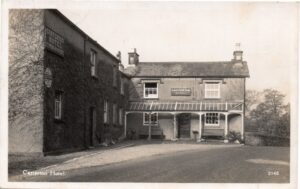
The Casterton Hotel, mid-1930s[2]
Jean’s Guest Sketch
An Intriguing Story
Many years ago before Billy Makinson died he told me the following:
‘It was the early part of the war, and it was very mysterious for the people of Casterton because suddenly the Pheasant (which was the Casterton Hotel then) was closed down – no more business, you see.
Edgar Hutton was the landlord then – before he was married. Suddenly the hotel was closed down, and while it was closed if you wanted a drink you had to go down to Kirkby [Lonsdale]. The next thing we knew there was this family moved in and we didn’t really know what it was all about for quite a while. There was the Prince and his wife, and two small children. There was a nursemaid and two other maids, and two security guards.
Occasionally Billy Bownass, who had the taxis, had to take some of them to Carnforth Station. They were going to London or somewhere, and he said “Do you know – they all carried revolvers!” and suddenly we found out that they were part of the Yugoslav Royal family.
They would be here – I’m not quite sure but certainly the best part of a year – until America came into the war [December 1941] and then they went to America – they were probably safer there. In fact the only person we really saw was the nursemaid with two small children. I’m not sure whether it was Prince Peter or Prince Michael, but it was one of them.
You can understand what a difference it made to Casterton. When all these men carried revolvers, you know…! You see Yugoslavia was in a very peculiar situation – they didn’t quite know whether they would be invaded by the Germans or the Russians, because they were in between, you see, so the Royal family got out. It’s quite a bit of history. Very hush-hush it was, you know.’
Recalled by Billy Makinson c. 2005
‘I can’t remember the exact words, but I remember Billy saying that the bodyguards – in dark suits and trilbys, and with guns in their holsters – would jump on to the running boards of the big black car and speed down towards Kirkby.’
Recalled by Duncan Hamlett c. 2005
Overview
I have worked on this story on and off for some years, and there is always some other line to follow up, but for me I think it is time to pass on what I have. You may draw your own conclusions. I imagine that Billy also told a few other people this story, and I should be interested to hear from them.
There are still questions to be answered, e.g. if it was either of the princes listed below, whose were the wife, the children and the nursemaid? Prince Peter did not marry until 1944 and his first child was born in 1945. Prince Michael married Genevieve Prigent in 1941 and their only child was born in 1944.
First Hand Account?
Mrs. Norah Hutton, who married Edgar Hutton, the landlord of the Casterton Hotel, in December 1942, certainly thought it was Prince Michael. The book ‘Kirkby Lonsdale and District in Times Past‘, edited by Norah Hutton and others has a photo of The Casterton Hotel and the following caption: “…The hotel had many distinguished guests, especially during the war, including Prince Michael of Yugoslavia…”[3]
The Princes
Prince Peter (b. 1923, Belgrade), who became King Peter II of Yugoslavia, was living at Claridge’s in London during the war. He married Princess Alexandra of Greece and Denmark in March 1944 and they had a son, Alexander, at Claridge’s on 17 July 1945 – a most interesting story involving Winston Churchill.[4]
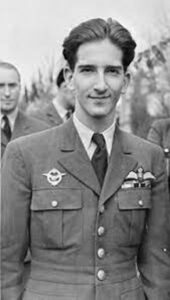
Prince / King Peter II of Yugoslavia
“Prince Michael of Yugoslavia”. I could not find a “Prince Michael of Yugoslavia” who was alive during the war. I checked with the Serb Embassy in London and the Yugoslav Archives in Belgrade (among others) and they both said there was no Prince Michael of Yugoslavia during WW2. (There have been two Prince Michaels of Yugoslavia since the war.) This appeared to be a bit of a ‘brick wall’ – and at one point I was beginning to think it was in fact King (Prince) Peter who might have been using the Casterton Hotel as a bolthole to get away from London every now and again.
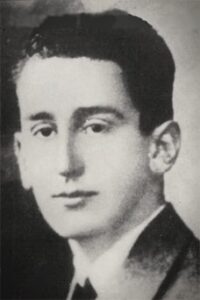
Prince Michael of Montenegro
More recently I had another dabble and found a Prince Michael of Montenegro, which was part of Yugoslavia during WW2. He was evidently a member of the Crown Council of King Peter II of Yugoslavia. Was he the “Prince Michael of Yugoslavia” known by Mrs. Hutton? He and his wife, Genevieve Prigent, were themselves held prisoner by the Nazis on two occasions during the war. Could it be that the time he was free coincided with the period when “the royals” were living at the Casterton Hotel?
Prince Michael and his wife had one son, Nicholas, on 7 July 1944.
Local Accounts
When exactly was the royal family living at the Casterton Hotel?
“the early part of the war” [Billy Makinson]
“Yes, A royal family in exile definitely stayed at my father’s hotel round about 1942/3.“ [David Hutton, son of Edgar and Norah Hutton]
“I think they must have been in the hotel in 1943 because I have a memory of my mother mentioning their extreme politeness to her; all the men standing up whenever she went into their sitting room, and my parents were married in December 1942…“ [David Hutton]
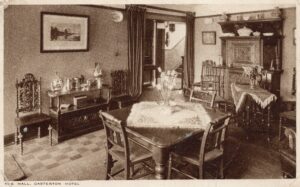
The Hall, Casterton Hotel, mid-1930s[5]
Fact Checking1 – Who Drove the Taxi?
Two people have queried Billy Makinsons’ story that it was Billy Bownass who had the taxi: one said it was Henry Bownass and the other said it was Anthony Hird. The 1939 Register shows that Henry Bownass (Dairy Farmer & Stockman) was living at Holly Bush, and William (Billy) Bownass (“Co-partnership Assisting Father on Farm”) lived just up the lane at Fell View, so it may well be that he drove the taxi.
Re Anthony Hird, going by the W.I. Scrapbook for 1965, Anthony Hird had served the village for 21 years, which would mean from 1944, i.e. after the royal family had left.[6]
Fact Checking 2 – Was Oxenholme on the southern route to London at that time?
I rang and spoke to John Adams, Carnforth Heritage Centre Manager, and asked about this, and in fact did they have any record of the comings and goings of an important personage accompanied by bodyguards during the war. When he rang back he said they had no record of this, and he had also checked with the four volunteers on duty that day. He said both Carnforth and Oxenholme were in use during the war.
The End?
I should be interested to know if anyone knows anything more about this story or has any other theories. It may have to remain a mystery!
Jean Hamlett
with introduction by Simon Drakeford
October 2023
References
[1] As part of the 100 year anniversary of the end of World War One, Jean researched the stories of Casterton men who served during the war and survived. A copy of her research can be found in a ring binder at the back of Holy Trinity Church.
[2] Courtesy of Jean Hamlett
[3] Elizabeth Breay, Audrey Cox, Norah Hutton, Dennis Dixon, Kirkby Lonsdale and District in Times Past, 1985, p9
[4] The story has been repeated many times. However, the BBC has cast doubt on the story’s veracity – see https://www.bbc.co.uk/news/magazine-36569675
[5] Courtesy Jean Hamlett
[6] Cumbria County Archives (Kendal), WDX 139/29 [Scrapbook]