

A Sketch of Gorah later Gowrey
A Name
Gowrey, or Gorah as it was called in its original location, is one of the oldest houses in Casterton. Robert Inglesfield, a grandson of the farmers who lived there after World War One, established that the original Gowrey was named ‘Gorah’ as early as in Greenwoods’ Map of 1823.[1] He added that it lay across the fields to the east of the modern day Gowrey and as far as he knew, nothing remained of the old farm when his mother, Winnie Ewan, was a girl there in the 1920s. Screenshots from Google maps (below) show that there are still the remains of what looks like outbuildings from the original site.
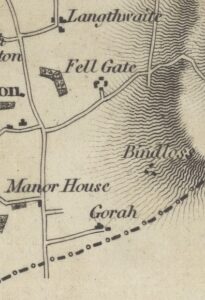
Extract of C & J Greenwoods’ 1823 Map of Westmorland
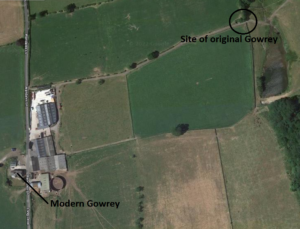

Arial views from Google Maps.
The small wood nearby was known as Gowrey Orchard. Robert’s grandfather, Ted Ewan thought that the name Gowrey meant ‘cuckoo wood’, Robert believes that he was right about the cuckoo from the Norse word ‘gaukr’, but thinks that the second element may be the Norse word ‘vrá’, meaning a nook or corner, i.e. Cuckoo Corner.[2] As noted below, the name Gorah goes substantially further back than 1823.
Hearth Tax 1674
Gorah is identifiable in the 1674 Hearth Tax return.[3] The location on the return is actually recorded as being in the constablewick of Fell Gate rather than that of Casterton, a constablewick being the area of land under the territorial jurisdiction of a constable. In both Casterton and Fell Gate, the constable is named as Bryan Smith. The Fell Gate return lists 10 houses as opposed to the 42 houses listed in constablewick of Casterton. There appear to be two properties named Gorah, one with one hearth, the other with two. The only other named property in Fell Gate was ‘Elme Tree’.
Francis Slyth is listed as living at Gorah in the 1674 Hearth Tax listing. Christopher Jackson is the other name attached to Gorah. Francis is also listed on the earlier 1669-71 Hearth Tax Returns.
Various Wills
Francis is likely to be one of the several Francis Slyths whose Wills are held at the Lancaster Archives.[4] For example, there is a Francis Slyth, a Yeoman, with a will dated 30 December 1611. In the same archives, various Francis Slyths have wills dated 13 March 1627, 19 December 1683 and 19 November 1687. In addition, a Thomas Slythe from Casterton has a Will dated 28 Feb 1711. Gowrey is not mentioned in the 1611 Will, but it certainly suggests that the Slyths were resident in Casterton if not Gorah in the 1500s!
Will
The 1687 Will[5], begins, ‘In the name of God amen the sixth day of June in the thirtieth year of the reign of our Sovereign Lord King Charles the second and in the year of our Lord god one thousand six hundred seventy and eight of Francis Slyth of Gawrish within the [?] of Casterton in the parish of Kirkby Lonsdale and County of Westmorland Yeoman, being of sound mind, and in good and perfect [?] praise be to almighty god…’
Within in the Will Francis requested that he be buried in the churchyard of Kirkby Lonsdale in ‘the Christian manner’. He granted and bequeathed all of his estate of freehold land to his loving wife [Jouell?] for a period of two years after his death. After two years, his estate went to his second son, also named Francis. The land was in both Westmorland and Lancashire, not surprising given the proximity of the farm to the county borders.
We learn that his youngest children were named Johan, William and Eleanor. In the Will, William appears to have been given some land, whereas Jonah received £80. There is a mention of a daughter named Elizabeth who also received £80. Thomas, another son, was given items from the house and farm. He made some undecipherable provision for the poor of Kirkby Lonsdale, Casterton and Barbon with the balance of his estate going to his wife and daughter Elianor.
Attached to the will is an inventory list of the property of Francis, with valuations. The inventory list is dated 3 November 1680. It was prepared by Thomas Willan, Christopher Jackson and Henry Johnson, all of whom appear in the 1674 Window Tax return and John Smith, perhaps a relative of Bryan Smith, the local Constable. The total inventory, which does not include land, is valued at more than £211. One item of note is ‘money in his purse’ at £9. According to the National Archives, this would have been about 128 days wages of a skilled tradesman or enough to buy a horse.[6]
Also in the inventory were; bedding, ‘woolling’ yarn, sacks of cloth, pots and pans, a plough and plough gear, spades and scythes, wheel wood, 4 oxen, horses, sheep valued at nearly £12, barley and bales, hemp and hay.
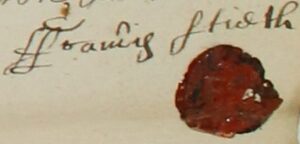
Francis Slyth’s signature and seal from his 1670 Will
More Maps
The 1770 Thomas Jeffery’s map of Westmorland shows Gorah, lying just south of Bindclose or as it is called today Bindloss, not far from Fell Gate and Langthwaite farms.

Extract from 1770 Jeffrey’s Map of Westmorland
New Occupants
One century after Francis Slyth’s Will, there is no Slyth listed on the 1777 Window Tax return but there is a Jn. Sarginson with 8 hearths. Some years later, in 1811, T Serginson a Carpenter from Casterton married Margaret Holme from Leck, it was he that moved into Gowrey. In these times, the spelling of family names and also houses was, to say the least variable. I will use the spelling as it appears in the document, where it is clear from the context and the spelling that the same family is being referred to.
The Gawrey Estate was advertised as being for let from Spring 1822 by the owner D. Wilson of Dallam Tower. The details noted that part of the farm was in the parish of Kirkby Lonsdale and part in the Parish of Tunstall. The Casterton Parish was not yet created hence it was still in Kirkby Lonsdale. The property consisted of, ‘a Dwelling-House and suitable Outbuildings, with One Hundred and Seventy Three acres of Land… now in the occupation of Mr. Thomas Serjeantson, as farmer thereof.’[7] The advert went on to say that the present tenants would show the estate to prospective renters. We know therefore that Thomas had been at the farm for several years before 1822, perhaps since his marriage eleven years earlier.
Thomas Seargeson is listed in a 1829 Trade Directory living at Gorey, we therefore know that he renewed the tenancy in 1822. The 1828 Hodgson Map confirms that this building was still the original Gorah, there was only a barn, called Wandle Barn, stood on the location of what would become the new Gowrey.

Extract from 1828 Hodgson Map showing original Gorah and Wandle barn in the vicinity of modern Gowrey
Last Will and Testament
A probate document dated 17 May 1830 held at Lancaster County Council archives contains a will of John Sergeantson, a husbandman from Gowrey.[8] John wrote the will on 6 November 1815. It was witnessed by a Robert Moore and Robert Bradley. John died on 21 December 1815. From the will, we can learn that Thomas took on the tenancy of Gowrey in 1815.
In his will, John appointed his brother Thomas as executor. He bequeathed to his brother all his household goods and other goods, chattels, stock, crop, farming utensils, personal estates and effects upon trust. The fact that he left his estate to his siblings suggests that he had no living wife or children. In addition, Thomas was requested to sell the assets held in trust to provide ‘ready money’. The cash was to be used to pay, Thomas the sum of £10 for his trouble and loss of time in the execution of the will. He was asked to invest £120 in order that the interest be used to pay for the education and maintenance of his nephew Robert Serjeantson until he reached the age of twenty one. On attaining that age, Robert was to receive the capital sum. Thomas was also requested to invest £60 in order that the interest on the amount be paid to his housekeeper Elizabeth Richardson until her death. Upon his housekeeper’s death, the capital sum of £60 was to be paid equally to Thomas, his brother William and sisters Elizabeth and Margaret. After 12 months had passed since John’s death, Thomas was requested to divide the residue of the estate equally between Thomas and his siblings William, Elizabeth and Margaret.
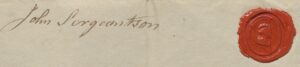
The signature of John Sergeantson on his 1815 Will
The New Tenant
The 1843 Tithe Map adds a little more information. It lists the owner of Gorah as George Wilson Esq with his tenant as Thomas Sarginson. Gorah farm still straddled two parishes, one being Casterton -by now it had become a parish with the opening of the Holy Trinity Church in 1833- the other Burrow with Burrow. In Burrow’s Tithe Map, the fields tenanted by Thomas are noted with his surname recorded as Serjeantson.

Extract from the Casterton Tithe Map of 1843, annotated by author with field names
Triplets?
The 1841 Census helps tie the above records together. It lists Thomas Sarginson, a Farmer aged 57 at Goray, with his wife Margaret (50), William (25), John (15), Elizabeth (15), Alice (15), Robert (13), Joshua (10). The list of names suggests that there are three children aged 15. Could they be triplets?
As noted in the 1851 Census, the ages recorded on Censuses can be variable. Of the three children, the 1851 Census only includes Elizabeth who is then aged 27, not 25 as would be expected. Alice married Christopher Dowbiggin in 1848. In the 1851 Census she is living with her husband aged 24. There is no mention of John. The answers can be found on a gravestone in Leck Church which reads,
To The Memory
of
ISABELLA Eldest Daughter of
THOMAS & MARGARET SERGENCSON
of Gowrey.
Who departed this life Dec 13, 1839
aged 22 years.
Also of
JOHN, third Son of the above
Who departed this life April 27th, 1851 aged 29 years.
Also of ALICE, wife of CHRISTOPHER DOWBIGGIN,
And Youngest Daughter of the above who died March 28th, 1852
aged 25 years.
According to the gravestone, John would have been 19 in 1841 not 15. Alice would have been 14 or 15, as suggested also by the 1851 Census. The gravestone also introduces a different spelling of the family name, ‘Sergencson’, Is this the correct spelling? If so, it has a hint of Scandinavian origin.
Country Pursuits
In 1844, a newspaper report tells us that William Sarginson of Gorah was an umpire at the third annual meeting of the Kirkby Lonsdale Wrestling Association. A fellow umpire was Robert Hodgson from Casterton and the referee was Isaac Mason. The action took place in a field belonging to John Wearing of the Fleece Inn (now The Orange Tree). The weather was not kind but once it had cleared up, in front of a ‘numerous concourse of spectators’, events started with a steeplechase for men. The course consisted of running two times around the field across four fences. Only two men entered! As might be expected, the wrestling drew a larger field. There were 29 competitors in the heavy weight category and 20 in the light weight.
In the heavy category, two men worked their way through to the fifth and final round. The newspaper reported that, ‘The last wrestle was a beautiful display of science on the part of both antagonists; and in the first fall, we never remember to have seen so clean a throw as [John] Hewitson received at the hands of [Luke] Lupton.’ Hewitson from Troutbeck was beaten by local lad Lupton, from Kirkby Lonsdale. Lupton also won the light weight tournament. He was born in Kirkby Lonsdale around 1824, and in 1851 was living at 68 Main Street with his wife Mary and children, working as a Tailor.
The report concluded that, ‘We must say that great praise is due to all parties concerned in the management of these sports, for the fairness, and absence of blacklegging which has characterised them; and we are certain that the general satisfaction which they have given, will induce lovers of an old manly sport to come forward and support the Kirkby Lonsdale ring on every future occasion.’[9] The reference to blacklegging recalls a time when bookkeepers on such events were not averse to fixing the results.
At the 1849 the 11th Annual Lunesdale Agricultural Show, T Sergeantson of Gowrey was awarded the first prize for the ‘Best two years old filly [Sic] for husbandry purposes.’[10]
Wedding Bells and Pigeons
In May 1845, Thomas’ eldest daughter Margaret was wed at Casterton Chapel to John Thornhill from Kensington, Rock Ferry, Cheshire. Margaret was noted as living at ‘Towery’. Officiating was the Rev. J. Millie of Cumblesford.[11]
In 1848, J. Sarginson of Gowrey did not excel at pigeon shooting. In a competition against John Bradley of Whittington who hit both his birds, Sarginson failed to hit either.[12]
As noted above, a few weeks later, Thomas’ youngest daughter Alice of ‘Gawray’ was married. Her husband was farmer Christopher Dowbiggin from Tatham. Officiating at Casterton Chapel was the Reverend William Carus Wilson.[13]
How Old?
An 1851 Trade Directory records Thomas Sarginson still farming at ‘Gorey’. This is confirmed by the 1851 Census which shows that Thomas Sergentson was still the farmer, now aged 64 and born in Casterton. Note that he was only 7 years older than he was in 1841. His wife Margaret on the other hand was 63, 13 years older than a decade before! Still living at the house were their children Elizabeth (27) and Joshua (20) both born in Casterton. Also there were James Simpson a 57 year old servant from Dent and John Holf? aged 27 from Barbon.
Patriotism
A listing of donors to the Patriotic Fund in 1855 showed that Thomas Sergentson of Gowrey donated 5 shillings. Other Castertonians donating on this occasion were Thomas Clarke of Norwood House (7 Shillings), Mr Mattinson of Old Hall (5 Shillings) and Thomas Wilson of Norwood Farm (5 Shillings). Not to be outdone, each of the three schools in the village also made a contribution, the Clergy Daughters School donated £1 and 6 shillings, the Preparatory School 7 shillings and one pence and the Training School £1 and 10 shillings.[14]
The Royal Patriotic Fund was established in 1854. Queen Victoria was concerned for the well-being of the widows and orphans of British servicemen who had died or were wounded in the Crimean War. At this time the State did not take any responsibility for the dependants of its soldiers and sailors lost in conflict and so the Queen made an appeal for public donations. The Fund was administered by a Royal Commission, with Albert, the Prince Consort, as its first President. The appeal was very successful, not only were the Commissioners able to make grants for hardship cases and to place orphans in existing schools, they were also able to found and administer two new schools of their own, one each for boys and girls.
Gaming
As well as donating to charity, in the same year, Joshua Sergeantson of Gorah of Casterton was included in a long list of people who had paid for a General Game Certificate costing £4 and 10d.[15]
The years 1784 and 1785 saw the introduction of the Game Acts which made it compulsory for individuals who wished to kill game to purchase a Game Certificate. After July 1785, anyone caught killing game without a licence or even simply refusing to show their certificate could be fined. In 1855, the penalty was £20, a cost that would have been beyond the capacity of most poachers to pay.
Ploughing a Furrow
In 1855 Joseph Sargison of Gowrey, ploughman to his father, was awarded a first prize of £2 in a ploughing competition organised by the Lunesdale Agricultural Society. The newspaper reported that the weather was very unfavourable, and the ‘rained poured down in torrents the whole of the day.’[16]
A few years later in 1857, he was awarded a second prize of £3 at the third annual meeting of the Arkholme and Whittington Ploughing Society. It was reported that, at the end of the day ‘The ploughmen sat down to an ample dinner at the house of Mr Thomas Ullock, Bay Horse Inn, Arkholme. Ample justice having been done to the good old English cheer, the company separated, highly gratified with the day’s entertainment.’[17]
In 1859, we learn that J Serginson was using a plough at the Lunesdale Agricultural Association’s plough meet. The plough, which was manufactured by Messrs Stainton and Son of Milton near Kendal, ‘bore an unmistakeable finish that was wanting in the others for show implements.’ Despite his well presented plough, Serginson did not win on this occasion.[18] At the same show, Thomas Sarginson was awarded a first prize of £1 for best foal for husbandry purposes. His near neighbour at Old Manor Farm, James Mattinson came second.[19]
In 1856, in modern terminology, Thomas was an ‘influencer’. He appeared in an advert for manure, assuring all readers that Robert Rumney’s Manure was the best![20]
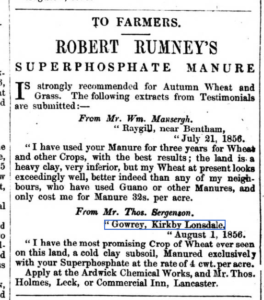
Extract from Lancaster Gazette 30 August 1856
Agricultural Awards
In 1857, Joshua Sergenson attended the ninth annual North Ribblesdale Agricultural Association meeting in Settle. He entered his ducks into the poultry section of the meet. He was awarded 5 shillings for the ‘Best couple of ducks, male and female.’[21]
The 22nd Lunesdale Agricultural Association Show in 1860 was held in a field on the outskirts of Kirkby Lonsdale. Thomas Sergentson was awarded the best short-horned bull calf under one year old. The show itself was considered a great success, which was not how the dinner was viewed. The event was held at the Kirkby Lonsdale Town Hall with food supplied by the Green Dragon (currently The Snooty Fox). The report noted that ‘The viands, including a haunch of venison from Burrow Hall, were abundant, but some of them were quite cold by the time the guests sat down. There was also a great want of waiters.’ Also observing that ‘There was a large attendance of farmers present, but a melancholy paucity of country gentleman, who formerly used to attend this dinner in large numbers.’[22]
At the following year’s show, J Sargentson of Gowrey was awarded second prize of 10 shillings for the best two-year-old filly for saddle or harness. The dinner held at the Royal Hotel also passed muster, ‘The catering reflected the highest credit upon the host and hostess, Mr. and Mrs. Dawson.’[23]
A Change in Circumstances
In 1858, Miss [Elizabeth] Sergeantson of Gowrey was married at Casterton Chapel to Richard Willan of Uphall by the Reverend Mr Shepheard.[24]
In the 1861 Census there are two properties called Gowrey. In Gowrey 1, Thomas Sergenson now aged 74, was listed as a joint farmer of 175 acres living with his wife Margaret (73), and a 15 year old grandson named John Sargenson Dowbiggen, Alice’s son, who had been born in Tatham.
In Gowrey 2, Thomas’ son Joshua (30) was the other joint farmer of 175 acres. He was living with his wife Sarah (24) who was from Mansergh, and their two year old son Thomas Nelson Serginson son, (born in Burton in Lonsdale), one year old Jacob, (born in Caton), along with Ellen Black, (House Servant), John Thompson (Servant Carter) and Robert Batty (Cow Man).
A New Gowrey
The 1862 OS Map, which was surveyed in 1857, does not show the new Gowrey, it only shows the barn. This suggests that the new Gowrey started to be built after 1857 when the land was surveyed. There were people living there according to the 1861 Census. There is a datestone above the door of the farm recording 1866. Presumably this is when the new building was completed.

Extract from the 1862 OS Map showing old Gowrey
Awards For and Against
Joshua attended the annual Lunesdale Agricultural Show in September 1863 held in Kirkby Lonsdale. The newspaper report observed that in attendance were ‘…many of the leading families of the neighbourhood… and an unusual attendance of the fair sex added very considerably to the attractions of the show ground.’[25] Joshua received a special mention. ‘The entries for cattle were very numerous, and the quality of the stock was much above the average. The old bulls shown were very fine specimens, that gaining the first prize, and belonging to Mr. Joshua Sergentson, Gowrey, Casterton, was greatly admired, being a truly noble animal.’
In 1865, one of the Sergensons at Gorah was a defendant at the Kirkby Lonsdale County Court. The plaintiff was a labourer named Moore from Cowan Bridge. He was asking for wages of £3, 1 shilling and 2 pence. Sergenson had paid £2, 9 shillings and 9 pence in to the court before the hearing. The Judge adjudicated that Moore should be paid the balance.[26]
Joshua Serginson exhibited at the Kendal Agricultural show in 1867. The show had missed a year because of a cattle plague and therefore attracted a large audience. He won a first prize of £1 for his two-year-old heifer.[27]
A Prince Visits
In 1869, The Lunesdale Agricultural Show was held in poor weather, ‘the rain coming down in occasional showers of a violence very seldom experienced.’ Richard Willan, the husband of Elizabeth Serginson, was now living at Gowrey. He won first prize for his goose and gander exhibit. At the dinner held at the Music Hall in Kirkby Lonsdale, a toast was raised for the Prince of Wales, later to become Edward VII, who had recently visited Underley Hall.[28]
Despite the King’s visit being private, it had been announced in the Court Circular and so a large crowd gathered to see the future King at Ingleton Station along with Lord Kenlis who was in his carriage to accompany the King to Underley Hall. Unfortunately the King had missed the train, or so it was thought. It turned out that somebody, perhaps Lord Kenlis or the Station Master, had asked for the train to be stopped at Kirkby Lonsdale to avoid the crowds.[29]
Having arrived in his Royal saloon carriage at Kirkby Lonsdale, there was a large crowd of onlookers lining the road to Underley Hall and the bells of St Mary’s Church were rung in honour of his visit. The next day he went hunting on the shooting grounds at Killington Common, ‘making a capital bag’. Presumably he didn’t require a game certificate. He left for Scotland the following day.[30]
Living With the In-laws
It was all change in the 1871 Casterton Census. Gowrey is not included in the Casterton Census but was now listed in the parish of Burrow. It seems that the new Gowrey was considered to be in Burrow and that by now, nobody was living at the old Gowrey.
The records show that the new head of the Gowrey household was Richard Willan, aged 67, born in Burrow. He was farming 190 acres. He had been there as early as 1869, perhaps earlier. With him was his wife Elizabeth Willan nee Sergentson, aged 46, born in Casterton, the daughter of Thomas, Gowrey’s previous head, who was still living with his daughter and son-in-law. Thomas’ wife had died in 1863 and Thomas was to die later that year and was buried in Leck. Also in the house were Elizabeth and Richard’s children Margaret (9) and Ellen (7), both born in Burrow. After they were married in 1858, they lived in High House, Burrow where both Ellen and Margaret born. The 1861 Census shows that Richard was farming 120 acres. Some time after 1863 they moved to Gowrey.
Changing
Richard Willan did not stay long at Gowrey. He died in December 1877 at Bindloss Farm, the next door farm to Gowrey. His probate details state that he was formerly of ‘Gorey’. We learn of the new tenant from a newspaper report from a few months before Richard died. In 1877, Mr R Garnett from Gowrey was highly commended for his entry of six lambs not fed for the butcher and to be kept by the exhibitor nine months after the show day. A report about the day commented that, ‘The show was favoured by splendid weather, although people who are never satisfied found cause for grumbling even in that.’[31]
The 1881 Census, confirms that as suggested in the 1877 newspaper report, there was the new head of the house. It is another Richard, this one with the surname of Garnett, aged 45, who had been born in Tatham in 1836. He was farming 188 acres. With him were his wife who coincidentally was also named Elizabeth, nee Pooley (41) and their children Eleanor (18), William (16), Annice (14), John Bindloss (12), Annie (9,) Sarah (6) and Frances (2).
Several Garnett Families
An 1885 Trade Directory shows that not only is there a Richard Garnett farming Gowrey, but, in a separate entry a Richard Garnett also at Langthwaite and Brownthwaite Farms. There were indeed two Richard Garnetts. Richard (1836 – 1895) was at Gowrey and Richard (1814 – 1893) was farming at Langthwaite and Brownthwaite Farms. A review of family trees on ancestry.co.uk suggests that these two Garnetts are from different family lines, perhaps distantly related.
The Langthwaite Garnett family had been connected with Casterton for many years. There were two Garnetts listed in the 1674 Casterton Hearth Tax return. A Robert Garnett had two hearths whereas a William Garnett had three, one of which could well have been Langthwaite Farm. A James Garnett was recorded on the 1777 Casterton Window Tax return with 7 windows, almost certainly Langthwaite Farm. The Garnetts at Langthwaite had a long tenure. Richard Garnett (1814 – 1893) lived at Langthwaite farm as early as 1841 and was also living there in the 1851, 1861, 1871, 1881 and 1891 censuses. He was most likely related to the earlier Garnetts. More details about the Langthwaite Garnetts will be included in a future Sketch of that farm.
In the mid nineteenth century, there were also Garnetts farming at Hole House and Kirfitt Hall, both in Casterton. As shown below, they were related to the Garnett family who were living at Gowrey.
Richard Garnett at Gowrey was the son of John Bindloss Garnett (1798 – 1874) and Elizabeth Lawson. John Bindloss Garnett’s brother was William Garnett (1788 – 1864) who farmed at Kirfit Hall. He was therefore Richard’s uncle. This William married Jane Armistead and they too had a son named William (1824 – 1874) who was a farmer at Hole House. He was therefore Richard’s cousin. John Bindloss and his brother William’s parents were another William Garnett (1751 – 1828), and his wife Eleanor Bindloss (1758 – 1827) from whom the Bindloss name derived.

Selected family tree of Garnett family showing farming relationships
Farming Success
At the 1886 Lunesdale Agricultural Show, R Garnett of Gowrey was a busy man. In the Tenants Farmers; class he won the ‘Heifer above two and not exceeding three years old in milk, or to produce a calf within eight months of the day of the exhibition.’, class. He was awarded a special prize as, ‘exhibitor and breeder of the best cow and not less than two of her produce exhibited in the foregoing classes.’, he earned second place for his colt foal for husbandry purposes and a special prize presented by Mr Thomas Harrison for the best colt or filly foal sired by his horses “British Lion” or “Tenant Farmer”.[32]
In the 1891 Burrow Census, Richard Garnett (1836 – 1895) was still at Gowrey, now aged 56, with his wife Elizabeth (51), and six children, Alice Fisher (24), John Bindloss (22), Annie (18), Sarah (16), Richard (14), Frances (12). There were several grandchildren as well. William Richardson (5), William Fisher (1) and Sarah E Fisher aged 2 months.
An 1894 Trade Directory lists Richard Garnett at Gowery, but he died the following year. His wife was listed as the farmer two years later in another Trade Directory and the 1901 Census records Elizabeth Garnett as head of the household, living with her son John Bindloss (1868 – 1951), her married daughter Annie Huck (28), son Richard (24) and daughter Frances Lucas (21). Frances had married John Lucas, a farm labourer at ‘Gowry’ in December 1900. The timing of their first child’s birth suggests that the wedding was hastily arranged, their daughter Helena was born in April 1901.
A 1906 Directory indicates that a John Garnett is now farming Gowrey. The 1911 Census confirms that it is John Bindloss Garnett (42) who was still at Gowrey with his wife Jane nee Postlethwaite (39) and their children Richard (5) and several servants. His mother Elizabeth had died in 1903. John was still farming at Gowrey in 1914.
The Ewans Arrive
By the time of the 1921 Census, John Garnett had left the farm and was living at Lime Craggs in Casterton. He died in 1951 at Hollins Hall Park in Lancaster leaving an estate in excess of £6,000.
A 1921 Trade Directory lists Ewan Edwin as a farmer at ‘Sowrey’. The 1921 census confirms the head of the household as Edwin Ewan (37) known as and herein after referred to as Ted, with his wife Dora Winifred Ewan (29), known as Winnie and herein after referred to as, Edwin’s mother Jane Ewan, nee Robinson (67), and children Heather M Ewan (5), Winifred M Ewan (1). Also there was Edwin’s brother Aaron Ewan (28) who was a cowman (28) and William Robinson, who was the farm’s horseman. He was the 36 year old second cousin of both Ted and Winnie who were themselves second cousins. Also on the Census were visitors Sarah Jane Ewan (17), a clerk with Phillips Wholesale company in Oldham St, Manchester, and Lillian Gertrude Ewan. Trade directories from 1925, 1929 and 1934 record Ewan Edwin as the farmer at Gowrey.
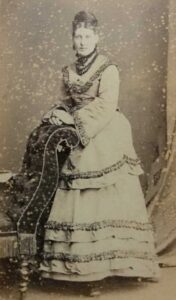
Photograph of Jane Ewan, nee Robinson[33]
Memories of Gorah – ‘This is indeed a farm loved and remembered by so many members of my family’
Robert Inglesfield, the grandson of Ted and Winnie Ewan shared his memories and what he had learned about Gowrey with me. He wrote so eloquently, I have kept it largely untouched.
Who’s Who
Gowrey was part of the Leck Hall estate. At Christmas Miss Welch of Leck Hall gave books to the children of her tenants, and I have at hand a copy of A Tale of Two Cities inscribed ‘Winifred Ewan, from Miss Welch. Christmas 1933.’
My grandparents moved to Gowrey in about 1919. Married in 1914, they had spent the first few years of their marriage at Hall Bank, New Hutton, where my grandfather’s Robinson grandparents had farmed. My great grandmother, Jane Ewan, who had lived at Hall Bank for many years, came with them to Gowrey, where she died in 1929. My maternal grandmother was the daughter of Thomas and Annie Maria Martindale, who farmed at Low Bendrigg, Old Hutton. Thomas Martindale, who was a well-known Westmorland Liberal and Methodist local preacher – invariably riding on horseback to his preaching places – died in 1921, and his widow, my great grandmother, moved to Lime Craggs in Casterton (later a guesthouse for Casterton School); Miles, one of her sons, ran a small garage in the village.[34]
My mother, Winifred Mary (Whin) was born at Gowrey in February 1920; her elder sister Heather Martindale Ewan had been born at Hall Bank in 1915, and two further sisters, Ida Jane and Nina Annie, were born at Gowrey. Aaron Ewan, my grandfather’s younger brother, who had been wounded in France in the First World War, lived with the family for two years, recuperating and working on the farm: later he farmed at Natland Abbey. A cousin of my grandmother’s, William Robinson, lived at Gowrey until he married, when he moved to Casterton village.
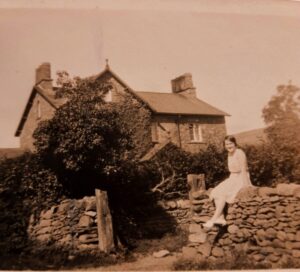
Photograph of Heather Ewan sat outside Gowrey C. 1930s[35]

Selective family tree of the Ewan family
Domesticity
From the start my grandmother had living-in domestic help. When the younger sisters appeared on the scene, Martha Holliday, originally from Ashstead in Whinfell, was recruited to help look after the older children: my mother always regarded her as a second mother, and she remained a close family friend. As a little girl my mother sometimes stayed at Ashstead during the holidays, and she remembered lying in bed with Martha on one side and her similarly large sister on the other. Special friends were Maisie and Billy Middleton, who farmed at Smithy House on the Casterton Fell road.
I have a photograph of a small summer party at Smithy House, with the company laughing as they perform a conga in the garden in the sunshine.
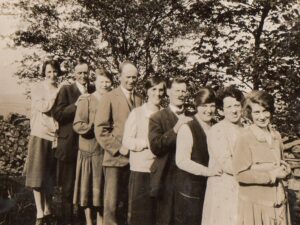
Doing the Conga at a Summer party at Smithy House: from l. to r.: Annie Robinson, Billy Middleton, Jean Robinson, unknown, Winnie Ewan, Ted Ewan, Maisie Middleton, Martha Holliday, unknown.[36]
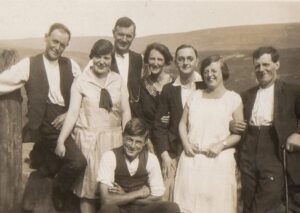
With Brownthwaite Fell in the background, a happy group at the same summer party at Smithy House. From l. to r.: Billy Middleton, Maisie Middleton, Willie Robinson, Annie Robinson, Billy Wright, Nina Wright, Ted Ewan; seated: unknown.[37]
My mother, carrying a small child’s suitcase and accompanied by Martha, would walk up to Smithy House (taking the short cut over the boggy pasture) to spend the night: from her bedroom window in the darkness she could see the lights (oil lamps, of course) of remote Leck Fell House.
Both my grandparents were fine singers, (my grandmother played the piano, and my grandfather had a concertina or ‘squeezebox’), and frequently Maisie and Billy would come to Gowrey for supper and a sing-song, before presumably returning up the rough fell road in the dark. Always they would sing a Victorian ballad about the ‘loved ones far away’, as so many members of my grandparents’ families had emigrated. My mother and her sisters were fond of one particularly sentimental ballad, and after going off to bed would shout downstairs with their request: ‘Life’s dream is o’er!’.[38]
The maudlin lyrics include,
My heart ever shall be thine, love.
Ah! why canst thou not be mine own!
Oh! love, stay one moment,
A moment of ecstasy,
Thy heart throbbing on my breast.
Life’s long dream is o’er, life’s dream is o’er, farewell! farewell!`
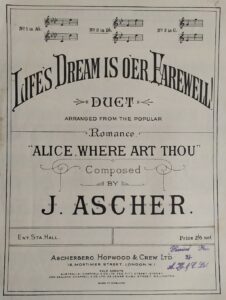
Sheet Music for Life’s Dream is O’er
Farm Life
My grandparents, needless to say, had to work very hard. My grandmother had to bake something in excess of twenty loaves of bread each week to feed her extended household. Clothes washing, presumably using a clothes dolly and zinc dolly tub (as my mother did when I was little), must have been interminable. My great grandmother’s task was peeling potatoes. Lambing time and hay time were especially busy times. At hay time, of course, the local farmers and their families helped each other: the refreshments provided for the haymakers by my grandmother included large quantities of homemade lemonade. I have a small photograph of my mother, aged about twelve, mounted on one of four huge horses hauling some unidentified piece of farm machinery.
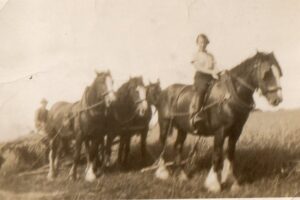
Winifred Ewan aged about twelve circa 1932, with four farm horses
An Angelic Vision
My grandparents were Methodists, and on Sunday mornings the family went by trap to Cowan Bridge Methodist Chapel, (where on one occasion my mother saw an angel). Visiting preachers were not always inspiring: my mother recalled one regular preacher, a Mr Burton, who would stab his open Bible with his forefinger while exclaiming ‘And it sez ’ere…!’ School holidays were enlivened by the presence of cousin Frank, a remote cousin whose father was a Methodist missionary in India, and who attended a Methodist public school in the south. No doubt encouraged by the four Ewan girls, Frank’s mischievous side (perhaps surprising in the son of a missionary) came to the fore: on one occasion he attempted to play my grandparents’ much prized wind-up gramophone backwards, wrecking it in the process.
Social Life
In 1937 and 1938 Heather and my mother attended the Boxing Day Hunt Ball in Barbon village hall, cycling through the darkness and cold in their long dresses, along unsurfaced lanes by the light of acetylene lamps. The Ball was rather a grand affair, the highlight being the Posthorn Gallop, in which a real posthorn was played by some accomplished local musician. Sadly there was no Hunt Ball in 1939 as the country was at war.
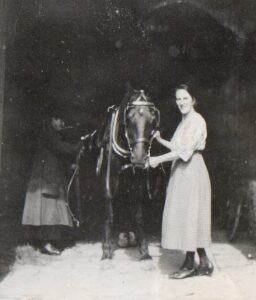
Winnie Ewan, with her horse Anzac at Gowrey. The horse was named Anzac after Roger Martindale, Winnie’s elder brother who fought with the Anzacs at Gallipoli, where he was seriously wounded.[39]
Farewell! farewell!`
My energetic great grandmother Martindale heard about New Zealand from her brother John, who, as a young man sailed round the world as a passenger in a sailing ship for the good of his health, and came back with tales of these lush green islands in the southern hemisphere: one of my cousins still has cowrie shells that John brought back from some Pacific island.
In 1926, at the age of 66, she fulfilled her dream by emigrating to New Zealand with her sons Thomas and Miles and daughter May. It was from Gowrey that the family left for Oxenholme station and Southampton. My mother remembered large boxes and crates containing belongings and items of furniture, including a piano, temporarily stored in the attic and barns. My grandmother was very close to her mother, and knew that she would never see her again.
Those Magnificent Men…
Around 1930, an air circus, probably employing former RAF pilots from the war, but run by a Dutchman called Piet, descended on Gowrey. The field which they used is still called the Aeroplane Field. My mother remembered her father’s shock and horror as the open-topped plane carrying my grandmother and her two younger daughters suddenly began to loop the loop: ‘But they’re not strapped in!’ The Ewan sisters were delighted when two girls from Kirkby Lonsdale whom they regarded as stuck up were given what was apparently a very rough ride and, upon landing, were both sick beside the hedge. Of such things are family legends built. The parachutes used by the daredevil performers were hung in the Gowrey attics to dry.
Moving On
My grandparents left Gowrey in 1939, their animals and equipment sold in a farm sale. The dairy herd had been badly affected by infectious spontaneous abortion (‘calf-dropping’), and to make matters worse the Liverpool dairy to which the milk was sent by railway made no payments for months before finally going out of business. Leaving Gowrey must have been devastating for both of them. My grandfather never farmed again, although he remained closely involved with the farming community. With the outbreak of war he worked for the War Agricultural Committee. He also worked for Bibby’s, the farm animal feed company, and carried out farm insurance valuations.
Wartime
Gowrey passed into the hands of my great uncle William Robinson (another of that name) and my dear great aunt Annie, my grandmother’s sister, who had formerly farmed at Elm Tree, Preston Patrick. The war was on: my aunt recalled looking out of the window one night and seeing the sky to the south reddened with the fires caused by the German bombing of Manchester, Liverpool and Preston; meanwhile a cat was playing unconcerned on the lawn in the darkness.
In a birthday postcard which I have, Aunty Annie wishes my mother ‘roses, roses all the way’ before returning to unglamorous present reality: she is busy redecorating the Gowrey bathroom, her ‘girl’ is in bed with appendicitis, and Uncle Willie has disappeared to some far-flung corner of the farm.
I don’t think my aunt had evacuees at Gowrey – those she had had at Elm Tree had practically driven her to despair – but she certainly took in visitors. My aunt was a well-known local figure, still remembered by older members of the farming community. She was a keen horsewoman, and spent much time riding around the farms collecting money for Methodist missions abroad; at Christmas time, with Uncle Willie and a few friends, she would go carol-singing on horseback, riding from farm to farm into the early hours. Her riding took her up the surrounding fells – to the County Stone and beyond.
A Final Departure
Uncle Willie died suddenly in 1949, and Aunty Annie had no choice but to give up the farm. (William Robinson died 15 May 1949, probate was settled on 28 September 1949, after the sale of Gowrey.) In the months after her husband’s death she received invaluable help from Frank Benson[40] of neighbouring Fell Gate. With characteristic spirit she marked her impending departure by throwing a family party, to which my parents, my elder brother John and myself – we lived at Natland, where my father was headmaster of the village school – as well as my grandparents and assorted aunts, uncles and young cousins were invited. We have photographs of the occasion taken by my Uncle Eric, the adult company sitting on deckchairs in the sunshine, the children playing on the lawn, and Aunty Nina perched on a hammock slung from the trees. I maintain that though I was only about fifteen months old I can still remember this party, though I admit that the memory now lies at several removes, a photocopy of a photocopy of a photocopy. It was, in any case, a happy occasion, despite the fact that for Aunty Annie it marked a final leaving of Gowrey.
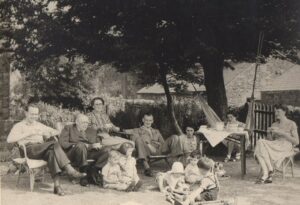
1949 – Aunty Annie’s farewell party at Gowrey Farm. From l. to r.: Wally Holloway, Jack Postlethwaite, Annie Robinson, Sam Inglesfield, Ida Jane Rowe, Nina Holloway, Whin Inglesfield. On lawn: John Inglesfield, Mary Holloway, Robert Inglesfield, David Rowe, Martin Holloway.[41]
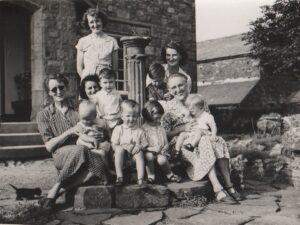
1949 – Aunty Annie’s farewell party. The stepped sun dial was brought to Gowrey from Elm Tree by Aunty Annie; later it stood in the Inglesfield’s garden in Natland, and is now in his brother John’s garden, also in Natland. The grown-ups are, from l. to r., Annie Robinson (Aunty Annie), Whin Inglesfield (standing, Robert’s mother); Ida Jane Rowe, Nina Holloway and Winnie Ewan (Robert’s grandmother); the children are, from l. to r., Robert Inglesfield, David Rowe, John Inglesfield, Mary Holloway, Martin Holloway and Michael Rowe.[42]
And so concludes a wonderful memoire of life at Gowrey farm.
The War Census
The 1939 Census which was taken on 29 September 1939 was used to produce identity cards and, once rationing was introduced in January 1940, to issue ration books. For Gowrey, it records a number of people living at Gowrey. Thomas G Earl was the ‘foreman horseman’ on the farm, James R Barnes, born 1922, a Cowman and Bull Mucker, William Robinson, who was distantly related to the Ewan’s Robinson family members. He married Anne Maria Martindale, Winnie’s sister. He therefore, is not the same William as the second cousin who appeared above in the 1921 census. Also at the farm were John J. Armistead a Bank accountant and his wife Hannah I. Armistead an assistant cashier. Finally, Ida J. Ewan, the daughter of Ted and Winnie, was a ‘clerk to agricultural officer’. Ida married Eric W Rowe in 1945, died in Alcester Warwickshire 2006.
By this time, Ted and Winnie had moved away from Gowrey. Robert recalls that they were certainly living at Old Town on 3 September 1939, the day that war was declared, as on that day his father, Samuel Inglesfield, who was then teaching at the Central School, Kendal, cycled across to meet his future parents-in-law for the first time.
A New Town
A 1945 Yorkshire voter list shows Ted and his wife Winnie living with their daughters Ida Jane Ewan and Nina Annie Ewan in Sedbergh in a house named Gowrie on Cautley Road, named after their beloved farm Gowrey. The difference in spelling was to avoid any unnecessary confusion. They lived there until shortly before Winnie’s death in June 1965.
New Owners
After the unexpected death of William Robinson, the farm was put on the open market. It was sold at a public auction on 24 August 1949. It was bought by Stephen and Amelia (Amy) Woodhouse who together with their two sons, Maurice and Ronald moved to Gowrey in the first week of November 1949.
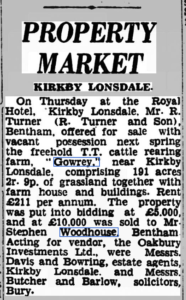
Clipping from the Lancaster Guardian 2 September 1949, p4
The Woodhouse family are still farming there today, Maurice taking over from his father. The business was diversified in 1986 when one of Maurice’s sons started a welding and fabrication business at the farm, making and selling canal narrowboats. The business later expanded and now includes a holiday park, and a unit making and selling self contained holiday pods.[43]
Simon Drakeford with contributions from Robert Inglesfield
Sketch 5
December 2022
Revised January 2023
References
[1] A. H. Smith (ed.), The Place-Names of Westmorland, English Place-Name Society – Part One, vol. XLII, Cambridge, 1967, p 29
[2] Email from Robert Inglesfield, Grandson of Edwin and Winifred Ewan, to Author, 12 November 2022
[3] The Westmorland Hearth Tax – 1674, Cumbria Family History Society. For more details about the Window Tax see the October 2022 Sketch about Old Hall.
[4] Lancashire, England, Index of Wills and Probates Proved at Richmond and Chester, 1600-1858, WRW/L/R598D/27
[5] Note that 1687 was the date of probate, the will was written in 1678, the inventory attached to the will taken in 1680, the year Francis died.
[6] See https://www.nationalarchives.gov.uk/currency-converter/
[7] Westmorland Gazette, 18 August 1821, p1
[8] Probate record WRW/L/R639/13 , Lancaster County Council Archives
[9] Kendal Mercury, 16 November 1844, p3
[10] Preston Chronicle, 13 October 1849, p7
[11] Lancaster Gazette, 10 May 1845, p3
[12] Kendal Mercury, 5 February 1848, p2
[13] Lancaster Gazette, 18 March 1848, p3
[14] Kendal Mercury, 13 January 1855, p4
[15] Kendal Mercury, 6 October 1855, p3
[16] Westmorland Gazette, 24 March 1855, p5
[17] Kendal Mercury, 14 March 1857, p8
[18] Kendal Mercury, 24 September 1859, p4
[19] Kendal Mercury, 24 September 1859, p5
[20] Lancaster Gazette, 30 August 1856, p1
[21] Lancaster Guardian, 26 September 1857, p8
[22] Lancaster Guardian, 29 September 1860, p
[23] Westmorland Gazette, 1 October 1861,
[24] Westmorland Gazette, 13 March 1858, p5
[25] Lancaster Guardian, 26 September 1863, p6
[26] Westmorland Gazette, 13 May 1865, p5
[27] Westmorland Gazette, 5 October 1867, p8
[28] Lancaster Gazette, 18 August 1869, p10
[29] Lancaster Gazette, 28 August 1869, p8
[30] Cheltenham Looker-On, 28 August 1869, p3
[31] Westmorland Gazette, 22 September 1877, p6
[32] Lancaster Gazette, 18 September 1886, p6
[33] Photograph courtesy of Heather Ulewicz, grand daughter of Ted and Winnie Ewan
[34] Noted in the 1925 Kelly’s Westmorland Directory as ‘Martindale Myles , motor garage’. As noted below, he emigrated to New Zealand in 1926.
[35] Photograph courtesy of Heather Ulewicz, grand daughter of Ted and Winnie Ewan
[36] Photograph courtesy of Robert Inglesfield
[37] Photograph courtesy of Robert Inglesfield
[38] The song was written as a duet by Joseph Ascher (1829 – 1869), you can hear it here, https://www.youtube.com/watch?v=Id4ZbkSsjkU
[39] Photograph courtesy of Robert Inglesfield
[40] Frank Benson was Chris Benson’s uncle. Chris is the current chairman of the Casterton Parish Council, following in his father Ottie Benson’s footsteps.
[41] Photograph courtesy of Robert Inglesfield wearing the cute white hat.
[42] Photograph courtesy of Robert Inglesfield
[43] Email from Ronald Woodhouse, son of Stephen and Amelia Woodhouse, to Author, 10 January 2023
A fascinating read!
I was researching Martha Holliday & it brought me to this page! Plus I’ve took a look now at other articles on this site & find it very interesting! I’m wondering if I could find any more information on Martha Holliday & her job looking after the children at the Gowery? Or any information to her time in casterton. I believe she married Henry Robinson later in life and wondered if he is a relative to the Robinsons in the photo? Plus who the photos belong to & if they have anymore, which would be amazing!
A fascinating read!
I was researching Martha Holliday & it brought me to this page! Plus I’ve took a look now at other articles on this site & find it very interesting! I’m wondering if I could find any more information on Martha Holliday & her job looking after the children at the Gowery? Or any information to her time in casterton. I believe she married Henry Robinson later in life and wondered if he is a relative to the Robinsons in the photo? Plus who the photos belong to & if they have anymore, which would be amazing!
Dear Angela,
Thank you for your kind words. It is always nice to see that people find there way to the site and explore further.
Regarding Martha, that narrative section was provided directly to me by someone who lived at Gowrey. I have their contact details and would be happy to pass them your message and email contact if you would like?
Regards
Simon