

Preliminary Notes
This house has a long history, previously researched by a local historian, David Smail, who sadly died in 2021. He was commissioned by the Bayley family to write a short family history in partnership with Fleur Bayley in Australia. A copy of their work now resides at Town End Farm.[1] Fleur Bayley has also written an essay about the property from which I have liberally quoted – with permission- as a source for this essay. These quotes are in red text. [2]
A word of caution, there was also a Town End Farm situated in [Low] Casterton. In the 1939 Census this was positioned between Ivy Cottage and The Terrace, suggesting that it was the building now known as Town End Garage. To the best of my knowledge I have not included anything about Low Casterton’s Town End Farm below.
Note that the spelling of the family name Bayley varies across the years and documents, for the sake of consistency, I will use the form ‘Bayley’ unless using a direct quote.
The Bayleys in Casterton Before moving to Town End
Manor Court records[3] show that on 28 June 1560, Henry the Earl of Cumberland, farmer to the Queen [Elizabeth I], held court trying numerous misdemeanours. Gyles and Leonard Baylye [sic], free tenants of the Manor of Casterton, were in attendance.[4]
Gyles Bayliff [sic] appears again in the Casterton Manor Roll of 1574 as a Customary Tenant paying a rent of 6 shillings and 5 ½ pence on his 7 ¼ acres of land to the Queen.[5] After this date, there is a break of nearly 60 years in the records.
A 1631 document held at the Lancashire County Archives refers to the Bayley family in Casterton. Written in Latin, the document’s archive description offers a tantalising glimpse into 17th Century Casterton life. The ancient document is an article of libel in a defamation case between Edward Bayley of Casterton and Alice, the wife of Giles Bayley of Casterton. Alice had accused Edward of “hudlinge one Jane [Wrymer?] in a Chamber and that he had a queane… in every towne‘.[6] It is likely that this Giles Bayley is a direct descendant of Gyles or Leonard or both referred to above.
On 15 September 1635 Giles Bayley, a yeoman of Casterton died. At the time of his death he farmed ‘Casterton Fell Yate’, i.e. Fell Gate. His son Edward, then aged 23 years and 7 months took on the farm (he was therefore born in 1612).[7] An intriguing question arises, are these the same Giles and his son Edward who were in dispute four years earlier?
The Hyndes, Owners of Town End to Early 1644
Fleur Bayley’s account of this period provides details about the Hyne, Hind, Hine or Hynde family, written in different ways across historical documents. For clarity I will use the form Hynde unless directly quoted from a source document.
‘Nicholas Hyne (probably the grandson of Robert Hind) was born in 1597, the son of Robert Hynde.[8] Nicholas owned a grocery business at Town End, perhaps operating from part of the buildings at the rear of the house itself.
We think Nicholas and his wife (Abigail) had six children, at least one of whom did not survive infancy.
Nicholas was sufficiently prosperous to provide his eldest son, Robert, with a good education at Queen Elizabeth School in Kirkby Lonsdale. From here, he went to Christ’s College, Cambridge, possibly the beneficiary of one of the scholarships to Cambridge offered by the school to three scholars each year. However, as Robert died in 1636 at 17, he did not complete his education.
Nicholas Hynde died in August 1644 at the age of about 47. His wife Abigail died just four months later. Only two children survived them.’
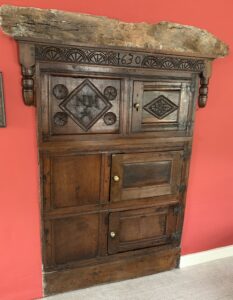
The 1630 cupboard in Town End, author’s photograph
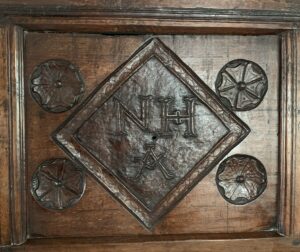
Detail of the 1630 cupboard in Town End, author’s photograph

Detail of the 1630 cupboard in Town End, author’s photograph
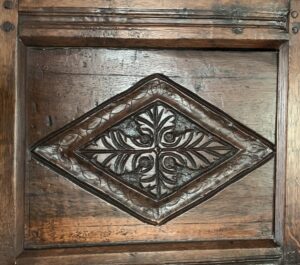
Detail of the 1630 cupboard in Town End, author’s photograph
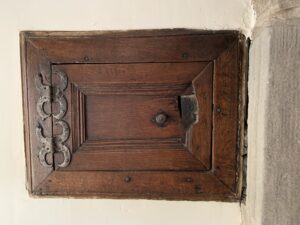 Salt cupboard in the same room as the cupboard, kept adjacent to the fire to keep the salt dry, author’s photograph
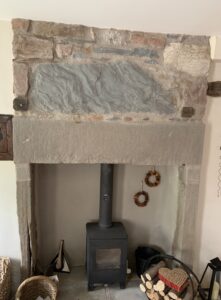
Fireplace with more recent large mantle under the huge older, almost certainly original one, author’s photograph
The cupboard in what was the front room of the house has the date 1630 carved into it. Also inscribed are the letters NH and A, representing Nicholas Hynde and his wife Abigail.
Fleur Continues, ‘An interesting item in the inventory attached to Nicholas Hynde’s will was a large sum of money and a listing of “powder”. This might have referred to gunpowder, suggesting Nicholas may have been involved in the First English Civil War (1642-1646). Westmorland was on the royalist side, and the area was heavily involved in the production of gunpowder at this time, thanks to the large areas of woodland and the skills of the local charcoal burners.
It seems Nicholas’ unmarried daughters, Jane and Abigail, worked in the grocery business, and he left the family business and Town End Farm to them. As well as taking care of the business, they cared for a younger relative, perhaps a cousin, named William who was just eight. At the time of their father’s death, Jane was 18, and Abigail was 16.’[9]
William Hynde is listed as a property owner in Casterton in the 1699-71 Hearth Tax Roll, with two hearths, and a Thomas Hynde, perhaps his son, is listed separately in Casterton with one hearth.’[10]
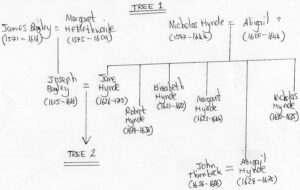
Family Tree 1
A Bayley Marries in to Town End
Town End Farm came into the Bayley family when Joseph Bayley (1615 – 1666) married Jane Hynde (1626 – 1710) in 1647. It is not clear whether the Bayleys mentioned above in the court records and residing at Fell Gate, are related to Joseph Bayley, but as they lived in the same small village, it seems likely that they were. Two of Jane and Joseph’s children were named Giles (1664 – 1712) and Edward (1656 – 1703) which suggests a family connection. As noted above, Jane Hynde along with her sister Abigail inherited the property when their father Nicholas Hynde (1572 – 1644) died, in the early years of the English Civil War. Jane’s husband Joseph Bayley died in 1666, the year of the Great Fire of London.
Fleur Bayley notes that ‘Joseph Baylie (born 1615) joined the Hynde family workforce, possibly after the death of Nicholas Hynde, working in the grocery business. He was the son of James Bayley (1571 – 1616) and Margaret Hebblethwaite (1575 – 1609). Margaret was the eldest daughter of Robert Hebblethwaite ( – 1617) and Agnes Stainbancke ( – 1616) from Killington. As the youngest son, Joseph would have had little chance to inherit any family property, so he had to look for work.’
Fleur adds that ‘While at 31, Joseph was ten years her senior, he was probably left with no doubt that the business still belonged to Jane and her sister. It seems Jane was very conscious of her responsibility for carrying on her father’s business.
At this time, when a woman married, her property automatically transferred to her husband. However, Jane and Joseph and Jane’s sister Abigail and her husband John Thirnbeck jointly held their shares of the property. Jane and Joseph were listed as joint owners, with Abigail in the manor records in 1657 as Freehold Tenants.[11]
Then, in 1664, Jane and Joseph signed an “Indenture of Partition” to “buy out” Abigail’s half-share of the properties. There’s nothing to say what the consideration was, whether money changed hands or there was something else exchanged.
When Joseph died in 1666 aged 51, Jane needed to reorganise her life. She had eight children, aged 16 to just one year. She must have been concerned for their welfare if something should happen to her.
The year after her husband’s death, Jane developed a cunning plan. In 1667, she entered into a contract to sell Town End, not to the highest bidder but to her brother-in-law John Thirnbeck (Abigail’s husband) and his cousin, both of Middleton. Under this deal, the Thirnbecks would sell the property if Jane died and divide the money equally amongst her children.[12] Under more typical arrangements, her eldest son, Samuel, would have inherited the property, leaving nothing for his siblings. It seems Jane aimed to prevent only one of her sons from inheriting while the other children received little or nothing.‘
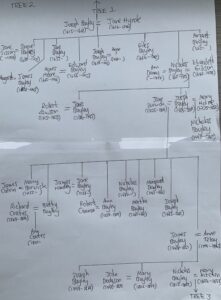
Family Tree 2
‘When Town End Farm was sold, Jane moved her family to Middleton, near her sister Abigail and some of her husband’s family. Her children grew up in Middleton, and most continued to live there…
…However, Jane’s sister Abigail, and the Thirnbecks, who were parties to the 1667 contract, pre-deceased Jane. When Abigail died a widow in 1675, she left all her property (a significant value at more than £55) to her sister Jane and her six surviving children.[13] On the death of her husband in 1668, Abigail had inherited his property (jointly with her mother-in-law), but only for her lifetime, so it’s likely none of the Town End properties went to Jane as part of Abigail’s will.
Jane Baylie died in 1710 aged 84… She appears to have been a feisty and competent woman who, when widowed at 40, was committed to ensuring all her children would inherit in the event of her early death.
Town End may have been on-sold by the Thirnbecks during Jane’s lifetime, but we don’t know who owned the property from 1671 – 1700.’[14]
The Hearth Tax return of 1669 – 71 for Casterton noted above, lists Widow Bayliffe with two hearths.[15] The 1674 Hearth Tax return however shows no Bayley present indicating that for a while at least, Jane was not living at Town End.[16] There is a Widow Bayley listed in Middleton, possibly Jane. Jane’s younger relative William Hynde is shown in the 1674 Hearth Tax Return as a property owner in Casterton with four hearths, a substantial house. Perhaps this is an expanded Town End Farm.
Field Names
The contract above notes that ‘all that messuage and mansion house wherein the said Jane Baylie now dwelleth, the one half barn, that is to say the east end thereof, one cowhouse, one orchard, one garden, one close called the Croft one other close called Aykey, one other close called Wandales and one other close called Birkett Wood …. with their turbary and appurtenances.’[17] [18]
The field names mentioned in the document are of note. Jumping ahead 176 years, the orchard, garden, one close called Croft, Aykey,[19] Wandales and Birkett Wood are recorded in the 1843 Tithe Map. This shows that James Bayley (1768 – 1851), the great great grandson of Jane and Joseph, still owned the land around Town End Farm as well as the farm itself. His land included the same field names as mentioned in the 1667 document, as illustrated below.
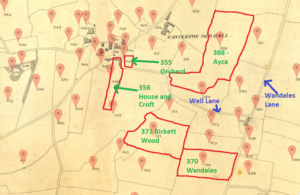
A section of 1843 Tithe Map annotated to show lands held by James Bayley that had been owned by Jane Bayley in 1667
Reconsolidation – The Return of Town End to the Bayley Family
Fleur’s essay explains how the Bayleys returned to Town End. ‘From 1694 to 1703, Jane’s second son James (1656 – 1703), bought land and other property in Casterton and surrounding areas (including Middleton), perhaps using some of the inheritance from his aunt, Abigail.
James is relatively prosperous by this time, and he buys several pieces of property, including a cattle gate in Casterton, land in Middleton and Casterton, and a half share in a lime kiln. The cattle gate in Casterton Fell Close (rent of 10 1/2 pence per year) entitled him to graze one cow in this gated pasture, as long as he maintained the section of the hedge he was allocated.‘
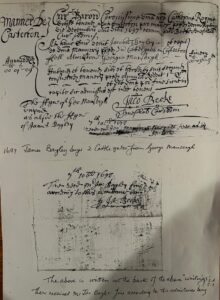
Copy of document detailing cattle gate transaction supplied by David Smail. Source unknown
‘James bought much of his property from George Mansergh. The Manserghs were a large property-owning family in the Casterton area until part of the family moved and established themselves in Ireland in the mid-17th century, part of the move by English families to Ireland following the Act of Settlement after the Civil War.
James Baylie and his wife Margaret (surname unknown) lived in Middleton, where all his (at least four) children were christened. James died in 1703, the same year his youngest child was born.
The manor records for Casterton for this period are not readily available, so we don’t know how purchases of land at the end of the 17th century by James Bayley come into the hands of his younger brother Nicholas Bayley (1661 – 1725). Their elder brother, Samuel, did not die until 1733 so the property transfer may not have been an inheritance, at least not in the traditional sense.’
Consolidation
Fleur continues the story ‘Born in 1661, it seems Nicholas took over the Town End properties after the death of his brother James, possibly around 1718. He had married Ann Denny in 1709 when he was 48 (was this his first marriage?), but Ann died eight years later, apparently without having any children.
Nicholas was 57 when he married Elizabeth Gibson in 1719. She was 33, so it’s possible she had also married previously. Nicholas was a responsible member of the community. From church records, we see he was a warden of St Mary’s Church in Kirkby Lonsdale.
Nicholas and Elizabeth had a daughter, Jane, born 12 months after marriage. Then, on 7 May 1725, Elizabeth gave birth to a son, Joseph. Nicholas may have been very ill when Elizabeth was expecting her baby. He had a daughter but probably hoped for a son, wondering if he’d survive to see his second child born. On the day the baby boy was born, he was whisked off to Kirkby Lonsdale Church to be baptised. Perhaps the new baby was also sickly.
A scribe was summoned, and Nicholas’ will was drawn up and signed the day his son was born. Unfortunately, Nicholas died within days of Joseph’s birth. He was 63.’
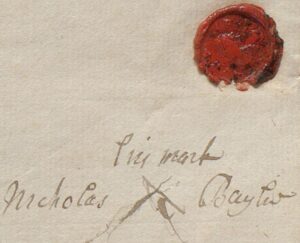
Nicholas could not write, or perhaps he was too ill, he signed his will under a seal with a barely legible X[20]
Passing On
In his will, Nicholas is recorded as living at Town End, Casterton. He gave his messuages, tenement, lands and hereditaments to his son Joseph Baylie (1725 – 1807) and his heirs as long as he [Joseph] reached the age of 21.[21] If he had not have reached this age, the properties would have gone to Jane (1720 – 1795), also on the condition that she reached 21. Nicholas’ wife Elizabeth Gibson (1682 – 1758) lived for another 33 years, and his son Joseph went on to live to the age of 83, and so he gained his inheritance in 1746.
The Trustees of Nicholas’ will were James Harrison of Barbon and Roger Thirnbeck of Middleton, presumably related to the earlier Thirnbecks.
There is an inventory of Nicholas Bayley’s belongings dated 22 May 1725 with a total value of £60 2s 6d. Nicholas’ belongings included, brass and pewter £3, bedding, beds and bed furniture £5, tables and chairs £5, a clock and watch £2, a silver Cup and ‘other things’ £1 10 shillings, plows [sic] and plow [sic] gear £0 17 shillings, a promissory note £2, eight head of cattle £20, a grey gelding £3 and seven sheep £1.
Joseph’s sister Jane also went on to live a long life. She married Robert Lawson, a husbandman of Thurland Castle, Tunstall in 1742, and died there in 1795.
Tenants of the Lord of the Manor
Joseph makes an appearance in a document dated 1745. ‘In the 18th century, people living in Casterton Manor held their property as tenants of the Lord of the Manor. At least half of the tenants in this part of the world were Customary Tenants meaning when they took on the property, they had to attend the Manor Court where they were sworn in as tenants, swearing fealty to the Lord, and swearing to attend the regular courts that were usually held annually.
As Customary Tenants, they also swore they would “Upon one hour’s notice serve upon the borders of England against Scotland with their own arms and at their own costs.”[22] This goes back to the time when England and Scotland were separate kingdoms. After James VI of Scotland became James I of England in 1566, the kingdoms were united, and this border service ceased. However, the Lords of the Manor still held the power to summon their tenants.’[23]
This right was exercised for the last time in 1745 during the Second Jacobite Rebellion. At its head was the son of the Old Pretender, the charismatic Charles Edward Stuart or Bonnie Prince Charlie as he was better known. In response to the rebellion heading towards Lancaster, the Lords summoned their tenants to turn out with horses and carriages to transport soldiers.

Document listing men of Casterton who did not respond to call to arms, which includes Joseph Bayley – source unknown
Fleur continues ‘This included the men of Casterton who were summoned to furnish horses and carriages to carry the advancing soldiers from Lancaster to Penrith. The document lists the names of men who did not fulfil their duty, and Joseph Bayley is one of those who did not go to Lancaster. However, there is no record of what his punishment might have been.’
Family Matters
Three years after the thwarted rebellion and shortly after Joseph inherited the farm, on 14 July 1748, he married Mary Holme (1725 – 1752) from Wrayton in Melling. Their marriage bond was signed by Joseph’s brother-in-law Robert Lawson. The records indicate that Mary and Joseph had a son named Nicholas baptised in February 1748, several months before their marriage. Sadly, Nicholas died in 1749 and his mother Mary died in 1752 and was buried at Kirkby Lonsdale in February of that year.
In the same year that Mary died, Joseph was named in a Bastardy Order. He acknowledged that he was the father, ‘in respect of a bastard female child’, called Mary, born to Jane Borwick (1725 – 1809) and baptised in August 1752 at Kirkby Lonsdale, the church register recording her as illegitimate.
Joseph agreed to support the child by paying forty pounds to the Overseers of the Poor.[24] In 1754, Joseph married Jane Borwick and they went on to have another eight children, some of whom died as infants.
Joseph lived to a good age. When he died in 1807 at the age of 83, he left Town End Farm to his youngest son James (1768 – 1851) who was 46 at the time. In his will he was recorded as living at Town End in ‘South Casterton’, an unusual reference to High Casterton.[25] He also left an annuity of £10 to his wife Jane for the rest of her life and ‘One Good Feather Bed Bedstead Bed Linen and Bed Cloathes’ [sic]. He bequeathed the sum of £60 to each of his four daughters being, Mary (1752 – ) the wife of James Calvin, Betty (1754 – 1847) the wife of Richard Coates, Jane (1756 – ) the wife of James Handley and Ann (1757 – 1809) the wife of Robert Cannon. He also gave £10 to his eldest surviving son Nicholas (1760 – ). There is no mention in the will either why James, the younger son, was left the estate rather than Nicholas, or why Nicholas was bequeathed only £10 whereas his sisters received £60.
Before his inheritance, James had married Anne Tebay (1771 – 1842) in 1792 and they had three children, Joseph (1799 – 1869), Mary (1802 – 1875) and Nicholas (1812 – 1855). James continued to run the farm with his sons until his death in 1851.
Inclosure Awards
In the 1815 Casterton Inclosure Map, only one of James’ fields is documented to be inclosed.[26] It is marked number 16 on the inclosure map with an area of 11 Acres. The area around Town End Farm and Chapel Houses, where his other fields were located was not part of the 1815 Inclosure award, presumably already having been inclosed. On the 1843 Tithe map (see below) what was field 16 in the Inclosure map was numbered 445, and named Fell Allotment, still 11 acres in area. I believe that this was the same Casterton Fell Close noted above, that the family owned in 1635.
Tragedy and Survival
In about 1836, James’ son Nicholas was elected to the Board of Guardians, who were entrusted to run the local Poor Laws. In recognition of his services, Nicholas was awarded a Grandfather clock inscribed: ‘Presented to Mr Nicholas Bayley by the ratepayers of Casterton and his friends as a token of respect for his valuable services as a public officer for 16 years in that township. October 1851’. It was built by Thomas Winder, a clockmaker in Kirkby Lonsdale, and has passed down through the Bayley family, with the eldest son inheriting it. The clock now resides in Australia. The clockmaker Thomas Winder was listed in an 1851 Trade Directory for Westmorland as working from Main Street in Kirkby Lonsdale and was also an Ironmonger.
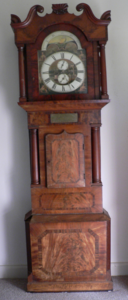
The Bayley family clock, courtesy of Fleur Bayley
Nicholas married Mary Kitchen (1824 – 1858) and they had three children. Ann (1851 – 1859), James (1853 – 1902) and Nicholas (1856 – 1859). Sadly, Nicholas died suffering from tuberculosis in 1855. Unfortunately, his son James experienced great loss, not only did his father die when he was two, by the time he was six he had also lost his mother, brother and sister. Orphaned, he was left in the care of his uncle Joseph.
Overseers of the Poor
The charity known as the Poor Lands was set up in 1682 and administered by five Overseers or Guardians, their heirs and assigns for the use of the poor of the township. It owned three small pieces of land in the township – 2 ½ acres on Casterton Fell, 8 acres comprising two fields called High Carr and Low Carr, collectively known as Poor Carrs, nearer to the Roman Road [Wandales Lane], and a small patch called Hospital Garden. These are presumably the same lands as mentioned in an 1851 history of Westmorland which includes an abstract of Parliamentary Reports which mentions, 1646 Poor’s Land, Casterton Township, Rent Value £.11 9s 3d.[27] Hospital Garden was the small field next to the Orchard which was part of Town End.
The 1841 Census
The 1841 Census suggests that Town End comprised several different residences. In one section lived, Elizabeth (Betty) Coates (85), her husband Richard had died in 1824, and Ann Coates (40) both of independent means. They were the daughter and granddaughter of Joseph and Jane.
Another entry recorded Mary Taylor (70) of independent means. Betty Huck (65) was recorded as living in a separate dwelling, also of independent means. Then there was Thomas Clark (30), Lucy Wilson (25), Joseph Wilson (20) and Edward Wilson. Thomas and Lucy were soon to be married and to move across the lane to Norwood Cottage – more details can be found in that sketch.[28]
Finally, James Bayley (1768 – 1851) aged 70, was living at his ancestral home, listed as a farmer, with his wife Ann (65) and their sons Joseph (41) and Nicholas (25).[29]
Tithe Map
The 1843 Tithe Map, a detailed listing of who owned and occupied property and land in a parish, shows that James Bayley owned and occupied 16 pieces of property or land in Casterton with an area of a little more than 41 acres. This included Town End Cottage and the long Croft behind it, as well as the small field opposite the cottage known then as now as the Orchard.
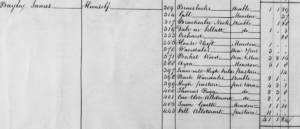
Extract from the 1843 Tithe Map showing the properties owned and farmed by James Bayley
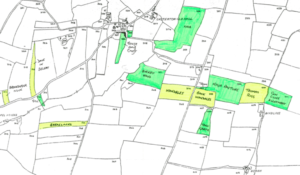
Extract from the 1838 Tithe Map showing the location of some of the properties owned and farmed by James Bayley. Courtesy David Smail
1851 – A Year of Transition
In James’ will, he appointed his sons Joseph and Nicholas as Executors.[30] In it, he left an annuity of £10 to his wife Anne, an annuity of £5 to his daughter Mary Dodgson and to her children -to be shared equally- the sum of £100. To his younger son Nicholas he left a legacy of £400. To his elder son Joseph Bayley he gave all his household goods and furniture, books, plate, linen, china, money securities and ‘all that my Freehold and Customary Estate situate at Casterton Town End… and now in the occupation of the said Joseph Bayley’.
This time of transition was captured in the 1851 Census. The Bayleys had moved from their ancestral home but were still present in the village. In that year, Town End Farm was let to a farming family, Sedbergh born James Taylor, his wife Agnes and five children. It would appear that a second family were also living in another part of the farm, Robert Walker (30) with his wife Elizabeth (21) with their children Richard (2) and five month old Mary.
James’ brother Nicholas (38) was living in Casterton but not at Town End Cottage, the name of his property is not recorded but from its position within the Census it appears to be in [Low] Casterton rather than High Casterton. He was living there with his wife Mary (27) and step daughter Alice Moore (7).
In the Census, Joseph (1799 – 1869) was recorded as living with his father James (1768 – 1851), also in Casterton, in part of, or in a building close to Kirfitt Hall. James died later that year, and his son Nicholas was to die within four years from consumption, leaving a three year old son, another James (1853 – 1902).
Charity
In 1854, Joseph was recorded in a list of Casterton donors as donating 10 shillings to the Royal Patriotic Fund.[31] Other Castertonians donating on this occasion were Thomas Clarke of Norwood House (7 Shillings), Mr Mattinson of Old Hall (5 Shillings) and Thomas Wilson of Norwood Farm (5 Shillings). Not to be outdone, each of the three schools in the village also made a contribution, the Clergy Daughters School donated 1 pound and 6 shillings, the Preparatory School 7 shillings and one pence and the Training School [‘Servants School’] 1 pound and 10 shillings.
The Royal Patriotic Fund was established in 1854. Queen Victoria was concerned for the well-being of the widows and orphans of British servicemen who had died or were wounded in the Crimean War. At this time the State did not take any responsibility for the dependants of its soldiers and sailors lost in conflict and so the Queen made an appeal for public donations. The Fund was administered by a Royal Commission, with Albert, the Prince Consort, as its first President. The appeal was very successful, not only were the Commissioners able to make grants for hardship cases and to place orphans in existing schools, they were also able to found and administer two new schools of their own, one each for boys and girls.
Letting the Farm
In 1855, Town End Farm was advertised in a local newspaper to be let.[32] The Bayley family speculate that this decision may have been influenced by the knowledge that Nicholas was terminally ill, but as shown above, the 1851 Census shows that tenant farmers were already living there with the Bayleys living elsewhere in Casterton.
In the letting advertisement, the farm was described as situated about one mile from Kirkby Lonsdale consisting of 41 acres, 1 rood and 25 perches, exactly the same size as was listed in the 1843 Tithe Map. It had, ‘excellent Arable, Meadow, and Pasture Land, in a high state of cultivation, being late in the occupation of the Owner.’ The advertisement added that ‘Early in the ensuing Spring, extensive alterations will be made in the Farm House and Buildings, rendering them suitable for a family of respectability.’
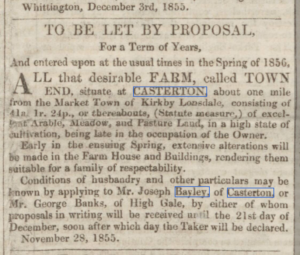
An 1855 Newspaper advertisement letting the farm
An 1858 Trade Directory lists Robert Leeming and John Taylor as the tenant farmers at Town End.
Settling Down
In 1861, the Census records that Joseph Bayley (1799 – 1869) was living in Casterton in a house close to Elm Tree Cottage, with his widowed sister Mary Dodgson, and orphaned nephew James (1853 – 1902), Nicholas’ son. James’ mother Mary had died in 1858. Tragedy was to follow James, his sister Ann died in 1859 and his brother Nicholas the same year, leaving him an orphan with no siblings.

James Bayley (1853 – 1902), the last Bayley to have lived at Town End Farm. Courtesy of Fleur Bayley
Town End Farm itself, still owned by Joseph, remained occupied by several families. James Taylor and his family were still there, farming 66 acres. Also living at Town End, presumably in a different building, was James Hay and his family. Hay’s occupation was recorded as a Railway Contractor’s Agent. He was working on the railway that had only recently opened, running no more than 200 metres from where he was living.
The opening of the railway changed the demographic of the village. The 1861 Census records about eight railway workers living in Casterton, some like James Hay with their family, others as single men. The workers came from locations as far apart as Lincolnshire and Wiltshire but mostly from Scotland.
The 1861 Census also shows that a William, not Robert, Leeming and his family were living at Town End, farming 41 acres. William’s father was a Thomas Leeming, Robert was presumably a relative of William but I cannot find out how they were related.
As noted above, in the 1843 Tithe Map, James Bayley’s fields had an area of 41 acres, it would appear therefore that the Leeming family were farming the fields historically linked to Town End Farm whereas the Taylor family’s 66 acres were different fields.

Family Tree 3
James’ Guardian Dies
When James’ uncle Joseph died in 1869, he was still only five years old. There is no record of Joseph being married or having children. In a small obituary, Joseph was described as ‘a noted breeder of short-horns, and was well known in the district as a “walking herd book,” he was able to tell from memory the pedigree of almost every animal brought before his notice.’[33]
James received an annuity of 14 pounds ‘towards his maintenance education and advancement’. When he attained the age of 25, he inherited the farm from his uncle Joseph and also the estate from his father Nicholas.
Staying Put
In the 1871 census, James Bailey was listed as a visitor in Selside in Westmorland. Living at Town End were two families who had been there 10 years before. There was John Taylor by now 82, listed as a farmer of 66 Acres. With him were his wife Agnes (76), two unmarried sons, George (41) and Thomas (27) with Mary Jane Bland (14) who was a servant. The other family was William Leeming, now 38 years old. He was listed as farming 136 Acres, substantially more than he had been farming 10 years earlier. With him were four children, all born in Casterton, Agnes (13), John (8), Margaret Ann (6) and Jane (3). William was listed as still living at the farm in an 1873 Directory.
Moving Further Away
In 1873, James appeared in the Westmorland Land Registry as a landowner in Casterton, owning just over 39 acres of land with a gross rental value of 56 pounds.[34] This property likely formed part of the original family holdings. It is not clear if this return included Town End Farm.
In 1878 he married Margaret Willan who was born in Leck in 1854, but whose family lived in Casterton before settling in Ribby-with-Wrea, Lancashire. The Bayley family think that James had waited until he was 25 and gained his inheritance before he married. They add, ‘It seems that they met through family connections. Margaret’s aunt, Ann Willan married George Banks, a very close friend of James’ father (Nicholas) and grandfather (James). He was even James’ guardian when his father died. It seems very likely Margaret and James knew each other as children, and may well have kept in contact through Ann and George Banks.’[35] George Banks was listed alongside Joseph as the contact person for the 1855 advertisement above for the letting of the family farm.
In the 1881 census James was living with his wife Margaret. They were no longer near their respective birthplaces, living about 30 miles south in Barton in Preston, with their one year old son Nicholas Frederick, and 10 month old Joseph Roger. A third son, James Norman, followed in 1885, and a fourth, Wilfred Ernest in 1887. Their fifth son, Harry Willan (1889) and Frank (1890) were born after they moved to Ormskirk, Lancashire.
All Change
The 1881 Census showed that two new families were living at Town End Farm, once again in two houses. There was the Croft family, the head of which, Matthew was a Farmer and a Blacksmith. He was there at least as early as 1877 when he came first in the Tenant Farmer category for his 1 to 2 year old heifer at the Lunesdale Agricultural Show.[36] The other family was the Fletcher family. William, the head of the family, was farming 39 acres. He was there at least until 1885 when he was recorded a farming at Town End in a Trade Directory.
End of an Era
In 1888, James sold Town End Farm, ending the Bayleys’ centuries long ownership of the farm. It seems probable that James Bailey sold it to Alfred Harris. Harris certainly owned the Orchard in 1890. A plan in the auction catalogue for the sale of the Old Manor Estate indicates that Harris was the owner of this plot of land.[37] Harris, originally from Stoke Newington, was a wealthy banker from Bradford. He bought the original Lunefield in Kirkby Lonsdale in 1870 and later rebuilt it into a much grander property.[38] He also acquired huge swathes of Casterton in the following years. The Bayley family do not know what happened to the sale proceeds. There is a family story that, on the advice of a family member James lost the family fortune on poor investments.
Tragedy
In the 1891 Census, James is recorded as a Farm Bailiff near Ormskirk. More family tragedy was to follow. Two sons died young, Harry in 1892 aged two and Joseph in 1897 aged 17. James died in December 1902 of polio. His wife Margaret and her three remaining sons struggled on. In 1911 Margaret and her three sons James Norman, Frank and Wilfred Ernest decided that the best thing to do would be to emigrate to Australia which they did in 1911, taking the clock with them.
The Bayley boys were frequent visitors to their mother’s family farm in Lancashire and hankered for land of their own. It was this desire that prompted their move to Australia, and by 1912 they had bought their first block of land in a new farming area in Denmark, in southwest Australia.
New Residents
In the 1891 Census, there was just one family living at Town End, a husband and wife James and Elizabeth Mitchell who were farmers. On 10 May 1893 James Mitchell of Casterton died aged 77.[39]
On Sale Again
Alfred Harris moved to Wharfenden in Frimley Green, Hampshire in 1899, and decided to sell his Westmorland property at auction, including much of Casterton. And so, in 1899 Town End Farm was offered for sale as part of the auction of Harris’ Lunefield Estate.
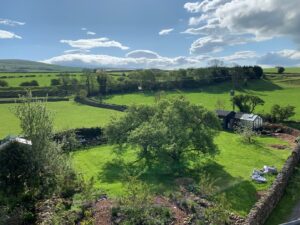
A view of the Orchard front of picture taken in 2023 by author
In the auction catalogue, Lot 21 was described as ‘A very valuable SMALL ACCOMMODATION HOLDING known as “TOWN END FARM,” situate in the Village and Township of CASTERTON, in the County of WESTMORELAND [sic]. It comprises A STONE AND SLATED DWELLING-HOUSE, fronting the High Road, and containing:- On the upper floor, Three Bed Rooms, and on the Ground Floor, Kitchen, Sitting Room, Scullery, etc, and having at the rear a very useful SET OF STONE AND SLATED FARM BUILDINGS, consisting of an Eight-Stall Cow-byre with Feeding Gangway: Stable, Poultry House, a Loose Box for Cattle, and a Hay Barn. On the opposite side of the road is a small Garden, and at the side a capital Pasture Paddock. In all it occupies an Area of 1a. 0r, 37p.’[40] The listing added that the Farm was let to a Mr Whittaker on a yearly May-day tenancy, at the rental of £15 per annum.
Also sold as part of the lot were three fields, numbers 107, 108 and 109 coloured pink on the plan, amounting to more than 13 acres rented to a Mr Cowin for £20 per annum. These three fields can be seen in the illustration above of the Tithe Map.
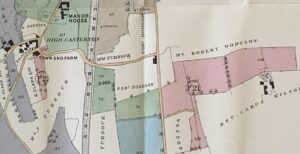
Extract of the 1899 auction catalogue plan showing Town End Farm (112), the paddock (114) the Orchard (113) and fields, 107, 108 and 109 in pink[41]
And Again
Just four years later, the farm and three fields were offered for sale again using an almost identical sales description.[42] They were offered for sale by ‘By order of the trustees of the late Alfred Harris’, which suggests that the properties weren’t sold in 1899. Alfred Harris had died in 1901. His estate was valued at a little over £105, 281.
Twentieth Century
By 1901, John Drake, a stone mason, and his wife Mary were living at Town End.
In a 1905 Trade Directory William Fisher was noted as a ‘cowkeeper’ at Town End.
In the 1911 Census, William Fisher was still living there with his wife Alice and two children. They were still there in 1921, he was working on the farm but it did not belong to him. It was owned by J. Wilman. It was perhaps he who bought it in 1899.
William Fisher had been a long time resident of Casterton. In 1861, he was living at Kirfitt Hall, working as a ‘Cow Boy’ for William Garnett. In 1930 his son, also named William Fisher, was working at Chapel House Farm.
In the 1939 War Census, William Willan, a horseman, was working on the farm with his wife Elsie.
Since the War the house has passed through several owners with a series of renovations enhancing the more than 400 year old Farm House which still retains many original features and some of its original land.
In 2011, Jeff Bayley, the grandson of James Bayley (1853 – 1902), the last Bayley to own and live at the farm, visited the farm with his daughter Fleur.
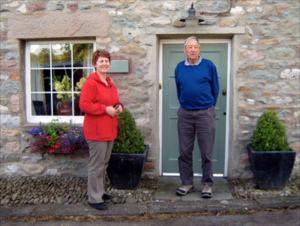
Town End in 2011, Jeff Bayley with his daughter Fleur.
Simon Drakeford
May 2023
With thanks to David Smail and Fleur Bayley
References
[1] David Smail and Fleur Bayley, How did we get to here? – A brief history of the Bayley family, early settlers in Denmark district of Western Australia, 2012, copy held by author
[2] Fleur Bayley, Town End Farm, the 1500s to the present day, 2015 (revised 2023), copy held by author
[3] The court was probably held at the Manor House in Casterton
[4] William Farrer and John F. Curwen (Ed.), Records Relating to the Barony of Kendale Vol II, CWAAS, 1924, p333
[5] Farrer and Curwen (Ed.), Barony of Kendale Vol II, p336
[6] Lancashire County Archives, ARR/2/4/4/149 . If anybody can read Latin, I have a copy of the document…
[7] Farrer and Curwen (Ed.), Barony of Kendale Vol II, 338, surname written as Bayliffe
[8] Nicholas’ father was probably Robert (b Kirkby Lonsdale in 1572) and his mother Ann Cowper (b 1575) who were perhaps married in Kendal in 1595.
[9] Fleur Bayley, Town End Farm, the 1500s to the present day, 2015 (revised 2023), pp 2-3
[10] Farrer and Curwen (Ed.), Barony of Kendale Vol II, p340
[11] Casterton Manor Court Roll – 1657, David Smail did not give a reference for this document and I have been unable to identify it.
[12] Bayley, Town End Farm, 2015 (revised 2023), pp 2-3
[13] Note: The document listed the children as Samuel, Jane, James, Joseph, Nicholas and Margaret. It is not clear why Giles and Edward were not included, as far as can be seen they were both still alive at the time of the document.
[14] Bayley, Town End Farm, 2015 (revised 2023), pp 2-3
[15] Farrer and Curwen (Ed.), Barony of Kendale Vol II, p340
[16] The Westmorland Hearth Tax for the year 1674, Cumbria Family History Society, 1998, pp17-18
[17] Sourced from www.ancestry.co.uk. Bayley Family Tree, prepared by fbayley123 .
[18] Note: ‘Appurtenance’ means a possession or piece of property that is considered to be a typical feature of a particular way of living, in this case items such as driveways, drainage ditches and fences, may have been included. ‘Turbary’ is a legal right to cut turf or peat for fuel on common ground or on another person’s ground.
[19] The field name Ayca possibly means Oak Hill, see A. H. Smith (ed.), The Place-Names of Westmorland, English Place-Name Society – Part One, vol. XLII, Cambridge, 1967, p 29
[20] Detail from Lancashire County Archives, WRW/L/R551A/74, Will of Nicholas Baylie of Town End
[21] Lancashire County Archives, WRW/L/R551A/74
[22] Quote not referenced by Smail.
[23] Bayley, Town End Farm, 2015 (revised 2023), pp 5-6
[24] Cumbria Archive Centre (Kendal), WPR 19/7/4/1/12, Alternative ref. WPR 19/8/5, Bastardy Order regarding Jane Borwick and daughter Mary
[25] Cumbria Archive Centre (Kendal), WRW/L/R629/39, Last Will and Testament of Joseph Bailey, 1808
[26] Cumbria Archive Centre (Kendal), WPR 19/14/1/1, Inclosure Award: Casterton 1816
[27] History, Topography, And Directory of Westmorland, Mannex & Co, 1841, p341
[28] For the Sketch about Norwood Cottage see here https://www.castertonparishcouncil.org.uk/norwood-cottage-later-norwood-house/
[29] Note that it was not unusual in the Census returns for the ages of people to vary by a few years from other sources of information such as parish registers.
[30] Lancashire County Archives, WRW/L/R648/17, will of James Bayley 1852
[31] 13 January 1855, Westmorland Gazette, p4
[32] 8 December 1855, Westmorland Gazette, p1
[33] Lancaster Gazette, 30 October 1869, p7
[34] Known as the Modern Domesday Book, in 1873 the first complete picture of the distribution of land ownership in Great Britain was prepared.
[35] David Smail and Fleur Bayley, How did we get to here? – A brief history of the Bayley family, early settlers in Denmark district of Western Australia, 2012, p5
[36] Westmorland Gazette, 22 September 1877, p6
[37] Cumbria Archive Centre (Kendal), WDB 135/1/820, Sale of Casterton Old Hall Estate 1890, Plan 2
[38] 5 November 1901, Liverpool Daily Post, p6
[39] 12 May 1893, Lancaster Standard and County Advertiser, p5
[40] Cumbria Archive Centre (Kendal), WDB 22/2/2/12, Sale of the Lunefield, Holme House and Casterton Estates, 1899, p24. This is 1 acre, 0 roods and 37 perch.
[41] Image courtesy of Cumbria Archive Centre (Kendal), WDB 22/2/2/12
[42] Cumbria Archive Centre (Kendal), WDB 22/2/2/18, Sale of the Lunefield, Holme House and Casterton Estates, 1899