

Introduction
There are several printed biographies of one of Casterton’s most famous sons. This Sketch references these and tries to present a narrative that is easier to read than the often very verbose and flowery Victorian chronicles quoted below. The most contemporaneous biography, albeit by an unnamed author, and one which later biographies relied on, was published four years after Garnett’s death in his posthumous publication Zoonomia.[1]
Thomas’s Parents
Thomas Garnett was born in Casterton on 21 April 1766. His father was John Garnett (1737 – 1812) who was born close by in Middleton although some of his ancestors also came from Casterton with some associated with Fell Garth Farm.[2]
According to his entry in the Dictionary of National Biography, Thomas’s father John owned a small landed property in Casterton.[3] John was buried in St Mary’s Church graveyard Kirkby Lonsdale, his gravestone stating that he was from Bank House in Barbon. There was a Low, Middle and High Bank House in Barbon. The residence inscribed on his grave was probably what is now called High Bank House.
An archived document records a different Thomas Garnett, a Yeoman from Higher Bank House, Barbon, who is recorded as living there in 1738, presumably, he was a relative of Thomas.[4] The Scientist’s mother was Elizabeth Skyring (1733 – 1807). She was born in Dent and was also buried in St Mary’s Church graveyard alongside her husband.
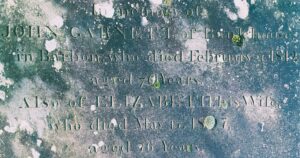
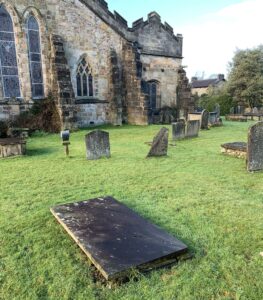 Grave of Thomas’s parents at St Mary’s, Kirkby Lonsdale with detail.[5]
Garnetts in Casterton
The wider Garnett family’s connection to Casterton goes back centuries. For example the Cumbria County Archives holds a document dated April 1590 about a bargain and sale of two messuages and tenement in Casterton between Edmund Garnett and his wife Helen of Casterton and George Stockdale of Casterton.[6] In December 1619 there was a conveyance of lands called Thirrigg in Casterton between the parties William Riggs, George Stockdale, Robert Townson, John Ewan and Thomas Garnett for a consideration of £149 8s.[7] In February 1719 there was a ‘settlement certificate for Izabell Garnett, a spinster from Casterton, parish of Kyrby [Sic] Lonsdale, Westmorland‘.[8]
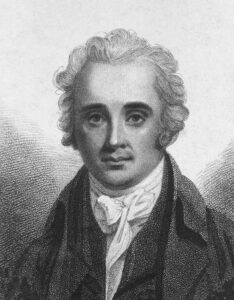
Thomas Garnett (1766 – 1802)
Thomas’s Early Life
According to Atkinson, Thomas moved with his parents to Barbon while still a baby and was educated there.[9] His first biographer told us that he was taught ‘the rudiments of the English Grammar, a small portion of Latin, and a little French, together with the general principles of Arithmetic.’[10]
Atkinson noted that whilst at school he ‘gave decided proof of a precocious, active, and, ingenious turn of mind…’. At the age of 11, he was said to have copied a quadrant which he had seen and tried to measure the height of a mountain behind his father’s house.
John Dawson (1734 – 1820)
At the age of 15, at his own request, Thomas was apprenticed to a celebrated mathematician in Sedbergh named John Dawson.[11] Dawson was not only a talented mathematician, he was also a surgeon, an apothecary and an immensely successful teacher.
According to Dawson’s entry in the Dictionary of National Biography, students ‘… flocked to him from all over England. His charge for instruction was only five shillings per week, for which sum he would teach for as many hours as his pupils would work.’[12] Over the four years under the tutelage of Dawson, Thomas was given a sound education in ‘mechanics, hydrostatics, optics and astronomy.’[13]
Other pupils who benefitted from Dawson’s education included Adam Sedgwick, one of the founders of modern geology and George Birkbeck, the founder of Birkbeck College in London. Garnett was an excellent student. ‘In every respect his conduct was highly commendable; he was assiduous; he was virtuous.’[14]
University Days
After benefitting from Dawson’s expert tuition, in 1785 Thomas went to Edinburgh University. While there he was particularly attracted to the lectures of Dr. Black and Dr. John Brown and became an ardent disciple of Brunonian theory. This was a doctrine which regards and treats diseases as due either to defective or excessive excitation. Around 1787, Thomas wrote an essay titled Lecture on Health which was based on his mentor’s Brunonian theory, and, as noted below, was eventually published in 1797.
Thomas was a diligent, perhaps too diligent a student; ‘he avoided almost all society, and it is said he never allowed himself at this period more than four hours sleep per day.’[15] Perhaps he had learned such behaviour from his mentor Dawson who he still visited in the summer months during his holidays from Edinburgh.
In 1788 Garnett published his dissertation De Visu which translates to ‘with ones own eyes’, which earned him his doctorate, becoming a Doctor of Medicine.
Early Academic Studies and Interests
After his graduation, Thomas went to London to complete his medical studies, after which he returned to his parents’ house in Barbon where he wrote the treatise on optics for the Encyclopaedia Britannica.[16] If I understand this correctly, his treatise was a revision of the one that had appeared in the second edition. Garnett’s update appeared in the third edition of Encyclopaedia Britannica printed in 1797 in Volume 13 pages 231 to 364.
In 1790, Thomas moved to Bradford to where he gave private lectures to local worthies about Chemistry and Philosophy. It was here that he wrote a published paper about the Spa Waters of Horley Green Spa near Halifax.[17] The frontispiece says that he was the past President of the Royal Physical Society [of Edinburgh] which was founded in 1771, and of the Natural History Society [of Edinburgh]. The latter was established as a student natural history society in 1782. It was officially named “Societas Naturae Studiosorum [Edinburgena]”, or the Natural History Society of Edinburgh.[18] He was also a member of the Royal Medical Society of Edinburgh which had been founded in 1737.
Horley Green Spa
The Spa had been recently discovered and its owner a Mr J Drake. He was in the process of building a house to accommodate ‘the invalids’ who came to drink the waters. Garnett observed that ‘The Horley Green water is quite pellucid—sparkles when poured out of one glass into another—and has a sharp, aluminous, styptic taste, not unlike ink. The taste is not unpleasant when the water is taken from the springhead and drank [Sic] immediately; but if it be taken up a few yards only from the source, its taste is more disagreeable, and it is not so clear;…’[19]
Garnett performed a series of 19 experiments on the water. In his section about how to make use of the water he wrote ‘As this water is a very powerful remedy, great caution is necessary to prevent its being drank [Sic] either in too great quantity, or in improper cases. I think I have seen bad effects arising from inattention to these two circumstances, and particularly the former. It would therefore be prudent, never to enter upon a course of it with-out having first consulted some medical practitioner. When taken in too great quantity, it lies heavy on the stomach, and produces violent sickness and pain in that viscus, together with diarrhoea. In general, an ounce and half, by measure, or wine-glass full, will be sufficient at first, and the dose may, perhaps, be increased, very gradually, to twice that quantity, provided it does not disagree with the patient.’[20]
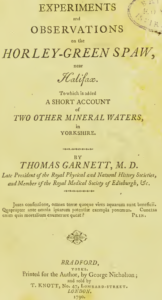
Page from Thomas Garnett’s first named published work
Knaresborough and Harrogate
Garnett did not enjoy his time at Bradford. A year after arriving there he moved to Knaresborough with the intention of staying there in the winter while residing in Harrogate in the summer. He followed this routine until 1794 and while there, having cut his teeth analysing the waters of Horley Green he did the same for the waters at Harrogate, publishing a paper in 1791.[21] In the frontispiece we learn that in addition to the societies mentioned above he was also a member of the Literary and Philosophical Society of Manchester which was established in 1771. Garnett dedicated his book to Thomas Percival (1740 – 1804) who was an English physician, health reformer, ethicist and author who wrote an early code of medical ethics.
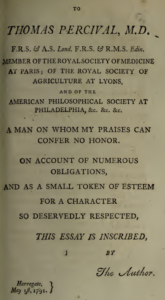
Garnett’s dedication to Percival in his 1791 Treatise on the Spa at Harrogate
Garnett observed that the spring at Harrogate had been discovered in 1783 by the landowner who was digging for fresh water in a field. Rather than finding fresh water, he found water that ‘resembled that at the sulphur wells both in taste and smell.’[22] Garnett performed a series of twenty-one experiments in 1790. In the same way that he had provided written testimony about how people had benefitted from the waters at Horley Spa, Garnett also printed witness accounts in his treatise on the waters of Harrogate.
He recorded ‘A married lady between fifty and sixty years of age, of a nervous habit, came to Harrogate in July, 1790. Her complaints were pain of the stomach, nausea, and other symptoms of indigestion; several of her family had been afflicted with the gout, but she never had the least symptom of it. She was advised to drink a glass of the Crescent water first thing in the morning, another about an hour after, the same dose at eleven o’clock A. M. and again at four o’clock P. M. Before she had continued its use in this manner for a week, the pain of the stomach and symptoms of indigestion left her, and she was attacked with a pain and swelling of her hand, which continued while she remained at Harrogate, which was about a month; her general health being much better.’[23]
Benevolent Pursuits
While in Knaresborough securing his reputation of an eminent scientist and talented lecturer, Garnett also looked out for the welfare of his fellow citizens. Aware of the benefits of education for all, he helped establish a public subscription library there. He also helped create the pleasure grounds at Fort Montague which through employment, supported local less well-off families.
Blind Jack of Knaresborough
While staying at Knaresborough, Thomas also sought to help a man named John Metcalf who was better known as Blind Jack of Knaresborough. Garnett helped Metcalf write his biography, an amazing story, which was published in 1795.[24] In the introduction, presumably written by Garnett, it was noted it was hoped that the sales of the book would help Metcalf in his declining years. Atkinson stated that the book did indeed raise a considerable sum for Metcalf.[25] An abbreviated account of Metcalf’s life below is included at the end of this essay in Appendix 1.
A Chance Meeting
While in Harrogate in 1794, Garnett obtained the patronage and protection of the Earl of Rossyln, who at the time was Lord Loughborough. The Earl built him a house. Notwithstanding this, dissatisfied with the opportunities Harrogate was offering him, Thomas decided that he would like to go to America.
Fate however was to take a hand. A friend from London encouraged Garnett to take in lodgers who visited Harrogate for the water. He met Miss Catherine Grace Cleveland and her friend Miss Worboys who planned to stay there for several months. Grace was the daughter of Mr. Cleveland of Salisbury Square, Fleet Street. Thomas’s enthusiasm to share his knowledge and Grace’s keen intellect led to a close attachment. In December 1794, Thomas shared his thoughts on going to America. Grace was at first hesitant but prior to leaving for London at the end of December, she had agreed to accompany him there as his wife.
For the next three months they were apart with Garnett making plans for their time in America. On 16 March 1795 they were married from Grace’s mother’s house in Hare Hatch, Berkshire. A few weeks later the newly wed husband returned to Harrogate to make arrangements to permanently leave there, thereafter going to London to purchase equipment for his lectures that he would need in America. He then headed to Liverpool via his parents in Barbon to make plans to travel to America.
A Change of Plans
While in Liverpool Thomas was strongly persuaded by local medical men to deliver a series of Chemistry lectures. These lectures were very successful and so he next presented some lectures about Experimental Philosophy. Atkinson noted that ‘His first lecture created what in opera language is called a furore: he was at once pronounced to be a star of the first magnitude.’
News of his lectures spread, and he was invited to lecture in Manchester where, in late January 1796, he successfully delivered his lectures. Garnett later said that this was the most profitable and happiest time of his life, accentuated by the birth of his first child in February. His daughter Louisa Cleveland Garnett was born in Manchester on 24 February 1796.
Shortly after, Thomas then proceeded to successfully deliver the same lectures in Warrington and Lancaster. In his paper titled ‘Thomas Garnett, the Lodge of Lights and the Radical Enlightenment’, David Harrison suggests that Garnett was a Freemason. In the minute books of Lodge of Lights № 148 of Warrington in Lancashire, Harrison records that Garnett gave a lecture there about Astronomy in October 1796. The minutes read ‘In consequence of a request made to Bro[ther] Thomas Garnett Professor of Physic & Philosophy of the University of Glasgow, that he would give the members of Warrington Lodge a lecture on Astronomy which he accordingly complied with …’.[26]
Thomas then travelled to Birmingham and Dublin, responding to invitations from organisations that had procured many subscribers eager to see and hear him lecture.
A Full Time Appointment
On the back of this success. Garnett decided not to go to America after all and instead accepted a position as the first Professor of Natural Philosophy at Anderson’s Institution in Glasgow. This decision was made simpler by the institution offering a very generous salary and was embraced by his wife who had been having second thoughts about travelling to America with their new daughter.
‘The ‘Andersonian’ was originally a technical school, founded in 1796 with money bequeathed by John Anderson for the creation of an institution to be denominated Anderson’s University. Anderson had been Professor of Oriental Languages and of Natural Philosophy at the University of Glasgow, who sought to create a “university” for the teaching of practical scientific and industrial subjects.’[27] It later became the University of Strathclyde.
Thomas started at Glasgow in November 1796. After his first year there, he fulfilled a promise to friends in Liverpool to deliver more lectures, leaving his wife and child in Barbon. He joined them there after his lectures and spent the summer pursuing his botanical interests, returning to Glasgow in the Autumn. His time in Glasgow ensured that he became a significant participant in the Scottish Enlightenment. This movement included other luminaries such as Robert Burns, Sir Walter Scott, Erasmus Darwin and James Watt.
Academic Papers
In 1797 he published his book ‘A Lecture on the Preservation of Health’, which explained the principles of Brunonian theory of Medicine. He dedicated this book to Erasmus Darwin, the grandfather of Charles Darwin. In a very busy year, he also bowed to pressure from his peers and printed his lectures on Chemistry in a book titled ‘Outlines of a Course of Lectures on Chemistry.’[28]
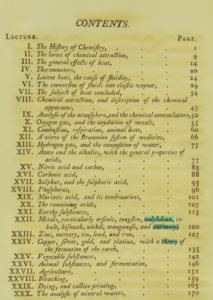
Contents page from Garnett’s Book Lectures on Chemistry, 1797
Tragedy
His wife became pregnant again in 1798. Riding on the wave of this success in Glasgow, Garnett however suffered a significant blow when his wife died in childbirth on Christmas Day 1798, while giving birth to their second daughter Catherine Grace Garnett.
The first words of his Lecture on Health became especially poignant: ‘The greatest blessing we enjoy is health, without it, wealth, honors, and every other consideration, would be insipid, and even irksome; the preservation of this state therefore, naturally concerns us all.’[29] Under her married name, Catherine also became a well known personality, more of which later.
In November 1796, Thomas started presenting a series of lectures which were punctuated by the loss of his wife. These were later printed in 1800 in two volumes ‘Observations on a Tour Through the Highlands and Part of the Western Isles of Scotland ’.[30] In his preface he described the purpose of his mammoth 600+ page works. ‘These volumes contain a description of the country, manners, and customs of the inhabitants, natural curiosities, antiquities, mineralogy, botany, natural advantages, proposed improvements, and an account of the state of manufactures, agriculture, fisheries, and political economy, with local history and biography.’[31] Cementing his reputation as a true polymath.
Desolation
Garnett was devastated by loss of his wife. On 1 January 1799 he wrote to a Mr. Ort in Bury Lancashire. ‘Oh my dear Cousin, little did I expect that I should begin the new year with telling you that I am now deprived of all earthly comforts; yes, the dear companion of my studies, the friend of my heart, the partner of my bosom, is now a piece of cold clay. The senseless earth is closed on that form which was so lately animated by every virtue; and whose only wish was to make me happy… My poor, dear love had been as well as usual during the last two or three months, and even on the dreadful evening (christmas eve) she spoke with pleasure of the approaching event. My spirits were elevated to so uncommon pitch, by the birth of a lovely daughter, that they were by no means prepared for the succeeding scene; and they have become so overwhelmed, that I sometimes hope that it may be a dream, out of which I wish to awake.’[32]
Moving On
Later that year, still deep in mourning, Thomas decided it was time to move on. In October 1799 he told his colleagues that he was leaving to take up a professorship of Philosophy, Chemistry, and Mechanics in the Royal Institution of Great Britain. This institution had only recently been founded, and he was chosen as its first Professor. In November 1799 he went to London to start his new Professorship, leaving behind his two children with the faithful Miss Worboys in Barbon.[33]
Sadly, for Garnett, things did not work out in London. In melodramatic fashion Atkinson described his troubles. ‘He at once began his course of lectures, but his health gave way still more in the course of the session, especially after a visit, in the summer of 1800, to his children at Kirkby-Lonsdale [Barbon]; scenes which too vividly had reminded him of moments passed with her who had left him these pledges of her affection, his children.’[34] Garnett’s health, both mental and physical was in severe decline.
Deep Depression
On his return to London, Thomas returned to his position at the Royal Institute but had already resolved to leave. In order to allow the still new institute time to find his replacement, and being a man of his word, he continued lecturing through the winter into 1801.
His biographer observed that ‘The transactions of the last winter almost completely served to undermine the small strength of constitution he had left; he was constantly harassed by complaints in the organs of digestion; head ache deprived him of the power of application; his countenance assumed a sallow complexion; the eye which had beamed with animation, retired within its socket, deprived of lustre; melancholy conceptions filled his imagination more habitually; and were excited by slighter causes… at this time, a gloomy day, or the smallest disappointment, gave him inconceivable distress. ’[35]
A New Chance
Having finally left the Royal Institute, Garnett set himself up as a physician on Great Marlborough Street in London. He was able to bring his children to live with him, setting up his practice perhaps in a more optimistic state of mind.
He commenced lectures on Chemistry, Mineralogy, Botany, and Experimental Philosophy, sometimes in his own house, in a lecture room built for the purpose in the summer of 1801, sometimes at Brompton, and sometimes in a room in Tom’s Coffee House, for the convenience of medical students and others in the city. It was in Tom’s Coffee House that he delivered his popular lectures on Zoonomia.
Garnett had attempted to overcome his grief by throwing himself into his work, fortified initially by his new job and the presence of his daughters and Miss Worboys his health improved. However, it was not to last. He was delivering an unsustainable number of lectures and his health suffered.
In the spring of 1802, the position of physician arose at St. Mary le Bonne Dispensary. Thomas applied successfully for the role and started it in May. The new role was as equally draining as the numerous courses of lectures he had prepared and delivered the previous year.
Death
In his weakened state, both mental and physical, Thomas was in no position to fight the typhus virus he caught from a patient at the Dispensary. He suffered for several weeks and died on 28 June 1802 aged 35.[36] He was buried in what at the time was the new burial ground of the Parish of St. James in Westminster.
Looking After the Children
After his death, his friends rallied around and readied his Zoonomia lectures for publication. The hope was that the proceeds from it would help provide for the welfare of his two orphan children. The very long list of subscribers at the back of the book is testament to Garnett’s academic reputation, the affection many felt for him and concern for the welfare of his young daughters.
Self Diagnosis
There is a final irony. The posthumous book of lectures prepared by Garnett during his final years of illness included a section on Nervous Complaints in which he used his own experiences and Brunonian theory to explain to his students his own mental health problems.
He wrote in detail about his own state; ‘… if I can for a few years ward off the fatal effects of some acute sthenic diseases, this tendency to sthenic diathesis will gradually wear off, and I may probably enjoy a state of good health…’[37] Sadly this was not to be.
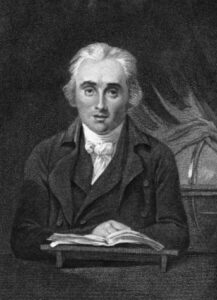
Portrait of Thomas Garnett M.D. published two years after his death in 1804 in Zoonomia
Thomas’s First Daughter – Louisa Cleveland Garnett (1796 – 1832)
Following the death of their father, the daughters returned to Barbon under the care of the family’s good friend Miss Mary Worboys, who had committed to raise the young orphans. They lived in relative obscurity for the next few years.
Available information about the eldest daughter is contradictory. In a book about the Romantic Women Poets discussing her sister, it mentions that Louisa ‘died in a fire while on honeymoon in Italy.’[38] In her sister’s biography noted below, her biographer mentions that this was in 1832 in Pistoia near Florence, ‘shortly after her marriage’.
An intriguing but contradicting document can be found on Ancestry. It shows that a Louisa Cleveland Garnett married a Henry Philip Lovelace, a Lieutenant in Her Majesty’s 16th Lancers in Calcutta, India on 8 April 1823. This might not be so far fetched. As we shall see, Thomas’s second daughter Catherine’s husband was Thomas Godwin who had worked for the East India Company. It is not inconceivable that the men were acquainted.
In Thomas Godwin’s and Catherine’s marriage settlement dated 24 July 1824 held at the Kendal Archives, it records that ‘Louisa Cleveland Garnett, sister of (2) now in India but unknown whether living or dead’.[39] Thus confirming that she was indeed in India.
Another document dated 26 and 27 November 1833 confirms that Louisa did indeed marry Henry Lovelace referencing a marriage settlement dated 8 April 1823. The same document also records that Louisa died August 1832 leaving no children and ‘leaving her sister, Catherine Grace Godwin, as heiress at law.’[40]
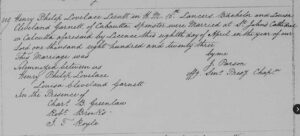
Record of the marriage of a Louisa Cleveland Garnett in 1823[41]
Thomas’s Second Daughter – Catherine Grace Garnett later Godwin (1798 – 1845)
Catherine in her own right became a personality significant enough to be included in the National Biography series. Incidentally, both Catherine and her fathers’ entry were written by Richard Garnett LL.D., not a relative. The National Biography derived much of its information about Catherine from a biography published in 1854 as part of a posthumous collection of her poems by Arthur Cleveland Wigan.[42] [43]
Interestingly, Wigan, her 1854 biographer, observed that at an early age from about 15, Catherine devoted a lot of time to her painting and poetry, ‘to an extent which seriously impaired her constitution.’[44] Thus echoing the behaviour of her father who similarly allowed excessive work to damage his health.
Her first published work in 1824, was titled appropriately enough The Night Before the Bridal, published just prior to her marriage. It brought her poetical talents to the attention of among others William Wordsworth, Joanna Baillie and Robert Southey.[45]

Frontispiece of Godwin’s book of poems titled Night Before the Bridal
Marriage
Catherine married Thomas Godwin on 11 Aug 1824 in Old Church, Saint Pancras, London. In a marriage settlement held at the Kendal Archives, it records that Thomas was from 13 Compton Street, St. Pancras and was ‘in civil service of the Honorable East India Co.’[46] He was 20 years older than Catherine. Her guardian Mary Worboys was recorded as being present on the marriage record and she was also a witness on the marriage settlement.
The Lake’s Romantic Poets
Despite her poor health Catherine was well enough to travel to the Lakes with her husband and became further acquainted with Southey and Wordsworth. Their advice and encouragement helped her to improve her writing. In 1829 she published a volume titled The Wanderer’s Legacy which she dedicated to William Wordsworth. In return, Wordsworth praised Catherine’s verse in a lengthy letter to her which was published in full in the 1854 memoir.
Wordsworth’s letter offered Catherine a detailed analysis of her poems, largely favourable, he did not shy away from criticism and constructive advice. In one section he wrote, ‘Wherever it is read, such poetry cannot but do you honour. It is neither wanting in feeling, nor in that much rarer gift which is the soul of poetry, Imagination.’[47] He ended the letter with friendship; ‘As, most likely, the beauties of this country will tempt you and Mr. Godwin to return to it, I need not say that I should be happy to renew my acquaintance with you both; and I should with pleasure avail myself of that opportunity…’.
Catherine’s biographer in the National Biography was not so impressed with her poems, her namesake wrote that her poems ‘indicate a highly refined and sensitive nature, but have more fluency than force, and in general merely reflect the style of Byron, of Wordsworth, or of Mrs. Hemans.’[48] [49]
Life in Barbon
Catherine’s health declined after the tragic death of her sister. She continued to write but her biographer Garnett merely considered that these were ‘little more, except fugitive poems in albums and stories for the young.’
The 1841 Census shows that Catherine and Thomas were living in Burnside Cottage, Barbon. The house is today situated opposite the war memorial in Barbon. The Head of the household was Thomas, aged 60, with him were Catherine aged 40 and Mary Worboys aged 77. Also living there were, what I presume to be three servants, Jane Tomlinson, aged 25, Elizabeth Marsden aged 14 and John Dister aged 24.
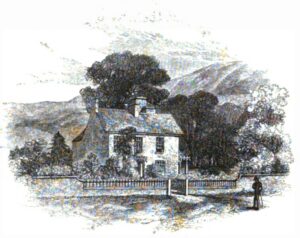
Engraving of Burnside, the Godwins’ house in Barbon, from an 1854 posthumous collection of poems, engraved by A. J. Mann from painting by L. Michael
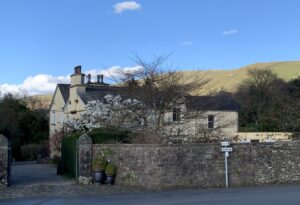
Burnside as it looks today, the house has changed but the silhouette of the hills behind remains the same.[50]
With her health declining, in 1844, Catherine travelled with her husband to Europe in the hope that the trip would restore it. While there, she wrote letters to Miss Worboys who had stayed in Barbon from Switzerland and Germany which were apparently published after Catherine’s death.[51]
Death
Catherine died in 1845 after a long period of ‘suffering from spinal irritation’. Her biographer Garnett described her as ‘persevering, discriminating, and endowed with a keen sense of the ludicrous. She had acquired considerable proficiency in painting.’[52]
In an obituary published in the Preston Chronicle immediately following her death it was noted that a few years before she had published a book titled Hints on the Formation of Character by ‘A Plain Spoken English Woman’. This may well be true; the book was printed in 1843 by the printers A. Foster of Kirkby Lonsdale. The obituary concluded ‘…the world of literature has lost an ornament; her circle of acquaintance, a real friend; and the poor, a sympathetic reliever of their necessities.’[53]
The Westmorland Gazette stated that ‘…her early transit from this vale of tears, where her amiable and benevolent disposition had won the esteem of all classes, will be long and severely felt.’[54]

Self portrait of Catherine Godwin from her posthumously published 1854 book, engraved by G. Stodart
Firbank Chapel
Catherine was buried at St John the Evangelist’s Church, Firbank, about 8 miles north of Barbon. The church had only been completed three years earlier.[55] The architect and builder was a Mr. Bateman of Dent. As it approached completion in 1843, the required funds were still more than £100 short.[56]
It is not hard to imagine that Thomas and Catherine were some of the donors that donated to ensure its completion. The chapel was consecrated by the Bishop of Chester on 1 July 1844. His sermon dwelt upon the topic that the congregation would have little hope in finding Christ in the building ‘if they were defiling with sin their own bodies, which in baptism were made temples of the Holy Ghost.’[57]
Catherine chose this resting place herself. The current church at Barbon was not built until the late 19th Century. There was an earlier one there, but it may have been in a state of disrepair.
Mary Worboys (1764 – 1845)
Mary Worboys was born in London around 1764. As noted above, she was recorded as living in Barbon in the 1841 Census. She was also there in 1851 listed as an annuitant and a visitor to the house of Thomas Godwin. Also listed as living there was Grace Lupton, hailing from Barbon, a 34-year-old servant. It was Grace who was the informant noted on Catherine’s death certificate 9 years earlier.
Also living there in 1851 were Ann Williams a 34-year-old cook who had been born in Glamorganshire and John Winster, a 37-year-old servant from Middleton, Westmorland.[58]
Mary died in Barbon on 21 January 1852 aged 88. She was also buried at Firbank. Her death certificate referred to her as a ‘Gentlewoman’. In attendance at her death was Thomas Godwin who, in a poignant role reversal, cared for her 52 years after she had first cared for his orphaned wife and sister-in-law.
Thomas Godwin (1781 – 1852)
Thomas moved to Barbon after he had married Catherine. He became a noted landowner. In an 1836 newspaper notifying readers of a proposed sale of land in Barbon, it records that Thomas Godwin owned some land there.[59] Two years later, he was one of the eight landowners who called a meeting of the landowners and tithe owners of Barbon to discuss general commutation of tithes.[60]
At Christmas 1848 he was recorded as offering a treat to all the boys and girls of the school at Barbon.[61] This appears to have been an annual event. In 1851 he ‘…gave a treat of tea and currant cake, to the scholars of the two mistress’ schools at Barbon. The schools are chiefly patronised by Mr. Godwin, in the success of which he takes a praiseworthy interest.’[62]
In the 1851 Census he is recorded as being a retired Surgeon.
He died from heart disease only six months after Mary on 12 Jul 1852 aged 71 years. His servant Grace Lupton was recorded as being present at his death, the same Grace had been present at Catherine’s death in 1845. He too was buried alongside his wife at Firbank.[63]
In October of that year, an auction was held selling the household goods, furniture and extensive library of Thomas Godwin. The library consisted of ‘about 2000 Volumes of English, French, Italian and Latin Works.’[64] One would presume that some of these works had previously belonged to his wife Catherine and father-in-law Thomas.
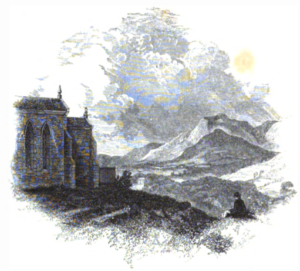
Sketch of Firbank Church from 1854 posthumous collection of poems, engraved by A. J. Mann from painting by L. Michael
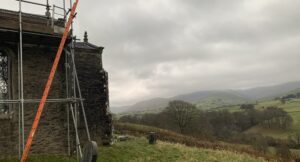
Viewed in 2023, the stylised hills in the engraving look more rugged, but the outline is largely unchanged[65]
Appendix 1
A Brief account of the life of Blind Jack of Knaresborough from the ghost writing of Thomas Garnett
John Metcalf was born in Knaresborough on 15 August 1717. As a child he contracted smallpox and was rendered totally blind. He soon learned to find his way around independently, play with his peers and even to ride his father’s horses. He also learned to play the fiddle, after living a full childhood, in 1732 he was invited to Harrogate to play the fiddle for the local gentry and in local public houses. In time he also became known for his horsemanship and won wagers with gentlemen who saw that he was blind and did not believe he had the skill. Being over 6 feet tall, he also managed to earn himself a reputation as a boxer, winning bouts and wagers against unbelieving punters.
Metcalf eloped with Dolly Benson, the daughter of the landlord of the Royal Oak in Knaresborough. Notwithstanding being married and being a restless person Jack joined a local militia force to participate in the quelling of Bonnie Prince Charlie’s Jacobite rebellion, an extraordinary episode that is covered in great detail in his biography. Following his exploits defeating the Scots and using the knowledge he had acquired on his expedition, Metcalfe started trading goods and horses, legally and illegally, causing him to travel around the north of England. This then led him to start in true entrepreneurial fashion, a stagecoach business between York and Knaresborough. At this time the roads were in very poor condition as noted in my Sketch about the Turnpike Road that runs through Casterton.[66] Turnpike Acts were passed to allow roads to be built or improved. Metcalf jumped at this opportunity and became a road builder, being involved in numerous Turnpike schemes as far south as Cheshire.
In 1778 after 39 years of happy marriage, Metcalf’s wife died having borne him four children. After the death of his wife, he continued his extensive road building activities and directed his energies into the weaving trade, helping his daughter set up a business. He died in 1810, well into his nineties, 15 years after the publication of his biography. He was buried in Spofforth Churchyard and in 2009 a statue was unveiled in Knaresborough.
Simon Drakeford
December 2023
References
[1] Thomas Garnett M.D., Popular Lectures on Zoonomia or the Laws of Animal Life in Health and Disease, 1804, Royal Institution, An Account of the Life of the Author pp v – xxii
[2] John Garnett (1610 – 1655) of Fell Garth Casterton, Thomas’s Great Great Grandfather
[3] Leslie Stephen (ed.), Dictionary of National Biography, Vol. 21, Garnett – Gloucester, Macmillan, 1890, pp 7 – 8
[4] Cumbria County Archives (Kendal), WDWHELP/4/3
[5] Photographs by the author 2023
[6] Cumbria County Archives (Kendal), WDCW/2/1/2/2
[7] Cumbria County Archives (Kendal), WDCW/2/1/2/8
[8] Cumbria County Archives (Barrow), BPR 2/O/12/16
[9] George Atkinson, The Worthies of Westmorland – Or Notable Persons Born in That County Since the Reformation, J. Robinson, 1850, pp205 – 16
[10] Garnett, Zoonomia, p v
[11] Alexander Chalmers, The General Biographical Dictionary Vol. XV, 1814, pp 295 – 97
[12] Leslie Stephen (ed.), Dictionary of National Biography. Vol. 21, Garnett – Gloucester, Macmillan, 1888, pp7 – 8
[13] Garnett, Zoonomia, p vi
[14] Garnett, Zoonomia, p vii
[15] Garnett, Zoonomia, p vii
[16] A treatise is a systematic argument in writing including a methodical discussion of the facts and principles involved and conclusions reached
[17] Thomas Garnett M.D., Experiments and Observations on the Horley-Green Spaw, George Nicholson, 1790
[18] M. D. Eddy, The University of Edinburgh natural history class lists 1782–1800, Archives of natural history, Vol 30 (1), pp 97–117, 2003
[19] Garnett, Horley-Green Spaw, p13
[20] Garnett, Horley-Green Spaw, p57
[21] Thomas Garnett M.D., Experiments and Observations on the Crescent Water at Harrogate, Thomas Gill, 1791
[22] Garnett, Crescent Water, p8
[23] Garnett, Crescent Water, p66
[24] Anon. (ghost writer Thomas Garnett), The Life of John Metcalf Commonly Called Blind Jack of Knaresborough, 1795, York. E and R Peck
[25] Atkinson, The Worthies of Westmorland p210
[26] Philalethes – The Journal of Masonic Research & Letters, Thomas Garnett, the Lodge of Lights, and the Radical Enlightenment. David Harrison, p147 – 151, 173
[27] See https://www.theglasgowstory.com/image/?inum=TGSE00394 . Accessed 29 November 2023
[28] T. Garnett, M.D., Outlines of a Course of Lectures on Chemistry, J. M’Creery, 1797
[29] T. Garnett, M.D., A Lecture on the Preservation of Health, J. M’Creery, 1797, p7
[30] T. Garnett, M.D., Observations on a Tour Through the Highlands and Part of the Western Isles of Scotland Vols. 1 & 2, Luke Hansard, 1800
[31] Garnett, Tour of Highlands, p. v
[32] Garnett, Zoonomia, p xiv to xv
[33] Garnett, Zoonomia, p xvii
[34] Atkinson, The Worthies of Westmorland, p213
[35] Garnett, Zoonomia, p xix
[36] Atkinson states that the date was 3 July 1802, p213. This is incorrect as the records show that he was buried on 2 July 1802
[37] Garnett, Zoonomia, pp 283 – 84
[38] Andrew Ashfield Ed., Romantic Women Poets 1770 – 1838: An Anthology, Manchester University Press, 1995, p236
[39] Cumbria County Archives (Kendal), WDWHELP/4/28
[40] Cumbria County Archives (Kendal), WDWHELP/4/29-30
[41] Sourced from https://www.ancestry.co.uk/family-tree/person/tree/173255764/person/362397665508/facts . Accessed 30 November 2023
[42] A. Cleveland Wigan, The Poetical Works of the Late Catherine Grace Godwin, Chapman & Hall, 1854, pp i to viii
[43] I wonder whether Arthur was a relative, Catherine’s sister’s second name was also Cleveland.
[44] Wigan, Poetical Works, p iii
[45] Joanna Baillie (1762 – 1851) – Scottish poet and dramatist. Robert Southey (1774 – 1843) – Romantic Lakes Poet
[46] Cumbria County Archives (Kendal), WDWHELP/4/28
[47] Wigan, Poetical Works, p v
[48] Leslie Stephen and Sidney Lee (eds.), Dictionary of National Biography. Vol. 22, Glover – Gravet, Macmillan, 1890, p55
[49] Felicia Dorothea Hemans (1793–1835) – Romantic poet
[50] Photograph by the author 2023
[51] I have been unable to find where they were published
[52] Stephen and Lee (eds.) National Biography, p55
[53] Preston Chronicle, 10 May 1845, p3
[54] Westmorland Gazette, 10 May 1845, p3
[55] See https://historicengland.org.uk/listing/the-list/list-entry/1086913?section=official-list-entry Accessed 6 December 2023
[56] Westmorland Gazette, 1 January 1842, p2
[57] Westmorland Gazette, 6 July 1844, p2
[58] I wonder whether John Winster in the 1851 Census was the same person as John Dinster living with them in the 1841 Census. The variation in the noted age and spelling was not unusual in early Census returns.
[59] Westmorland Gazette, 12 March 1836, p1
[60] Westmorland Gazette, 27 January 1838, p2
[61] Kendal Mercury, 6 January 1849, p2
[62] Kendal Mercury, 27 December 1851, p5
[63] There is no record of these burials at the church or signs of a stone in the graveyard.
[64] Kendal Mercury, 16 October 1852, p4
[65] Photograph by the author 2023
[66] See https://www.castertonparishcouncil.org.uk/a-sketch-of-the-turnpike-road-to-1825/
An excellent piece of work Simon Thanks for all you’ve done to compile this Sketch of Thomas and the History surrounding his life, Although a fairly short life he did a lot with it helping so many others along the way, A true inspiration to us all.
Thanks Adey, yes an amazing man!
Thank you for compiling this clear and full account of a remarkable polymathic man and of his daughter the poet. The London Richard Garnett (b. 1835) who wrote of Catherine was the distinguished son of a distinguished father, also Richard (1789-1850), who himself did correspond with Southey, and who worked as curate in the northwest before settling in London at the British Museum.Those Garnetts are mostly S.E. Lancs (Clitheroe) and S.W.Yorks (Otley) with branches from Liverpool/Manchester to York.
You are right to say that Richard G. and Catherine are not directly close relations, but they may yet be distantly related. If you can’t readily access the DNB then Wikipedia gives a fair intro to both Richards, and indeed to some of the brothers, [another] Thomas Garnett b. 1799 (manufacturer, naturalist, experimenter) and Jeremiah Garnett, creator of the [Manchester] Guardian. The Garnetts were brilliant folk and great achievers.
Hi Chris, Thank you for the additional information. I did wonder whether Garnett the biographer wrote the biographies because he knew that he was related, albeit remotely, or whether it was just a coincidence. Regards Simon
Thomas Garnett is my 2nd Cousin 6x Removed and Richard Garnett b.1835 Keeper of Books at the British Museum in London is my 1st cousin 1x removed of wife of 3rd cousin 4x removed, he was born in Litchfield, Staffordshire and died at Hampstead, London 1906. So there is a connection in the tree although distant, I have framed pictures of them both at home among others too of course. 🙂
I’ve added a link to here on my Tree for Thomas So others may read this wonderful piece.
Thanks again Simon.