

Introduction
This sketch is about the Turnpike Road that passes through Casterton from the time that it was turnpiked around 1762 until 1825, the year before a new Act of Parliament was passed which legislated inter alia that a Toll Gate would be situated in Casterton.
Next month, the Sketch will examine Casterton’s section of the Turnpike Road after 1825 and Toll Bar Cottage.
I am indebted to the previous research by Joyce Scobie about the history of the Sedbergh Turnpike Trust. Her history was published in three parts in the journal of the Sedbergh Historian in the early 1990s.[1] Her working papers are deposited in the Sedbergh & District History Society’s meeting room in Sedbergh.
Toll Roads
Before the introduction of turnpike roads, the parish in which a road was located was responsible for the maintenance of the road. Throughout the country, this led to a poorly maintained road network.
More specifically in Westmorland, in December 1749, a correspondent to the Agreeable Miscellany vociferously objected about the Turnpike Act for a road passing through Kendal from Eamont Bridge (south of Penrith) to Heron Syke (near Lancaster). He wrote ‘The particular Necessity there is for the Roads being mended in Westmorland wants no Demonstration to those that ever travelled a few Miles in any Part of the County. . . I believe it is universally allowed by all Parties that the Roads are excessively bad, and even in some places dangerous to be passed’.[2]
These objections came some 80 years after the first Toll Roads appeared in England. The first toll gate or ‘turnpike’ was erected at Wadesmill, north of Ware in Hertfordshire. However, it took another thirty years for the idea that the cost of highway maintenance should be borne by the users of the road paying a toll rather than the local parish, to bear fruit. During the period 1696 to 1714, only thirteen turnpike trusts were established, initiated by local Justices and financed by borrowing money against the credit expected from future tolls. This model proved unsatisfactory because the local Justices had many other responsibilities beyond road maintenance.
In 1706, an Act of Parliament was passed which became the model for almost all of the subsequent turnpike acts over the next 130 years. The 1706 Act stated that independent trustees were granted powers to borrow money, appoint officers and maintain roads.[3]
A parish was still responsible for the maintenance of the non turnpiked roads within its boundaries. Furthermore, if the Turnpike Trust was unable to fulfil its responsibilities, they defaulted to the parish.
The Turnpike Trusts were set up as temporary institutions and had to be renewed by an Act of Parliament every 21 years. It was intended that the Trusts would be dissolved as soon as the roads themselves were sufficiently improved and the Trust’s creditors had been repaid. The intention therefore was that ultimately, the supervision of road maintenance would revert back to the parish.[4]
By 1730, only ninety turnpike trusts had been established with a length of more than 2,000 miles, however in the period of ‘turnpike mania’ from 1751 to 1771, over 400 trusts were established -each requiring an Act of Parliament- bringing the total length of turnpikes across England to 15,000 miles.
The first Turnpike Trusts established in Westmorland were in 1753. In that year, three Trusts were established. One running from Kendal to Kirkby Lonsdale and to Milnthorpe, another from Brough to Eamont Bridge and a third, the above mentioned road, from Heron Syke to Eamont Bridge.[5] Our own Sedbergh Turnpike Trust was established in 1762.
The Sedbergh Turnpike Trust
The Sedbergh Turnpike Trust Act of Parliament was passed in 1762 ‘for repairing and widening the roads from Kirkby-Steven [sic] High-Lane-Head, in the County of Westmorland through Sedbergh, to Greeta-Bridge in the County Palatine of Lancaster; and from Bracken-Bar-Gate, near Askrigg, in the County of York, through Sedbergh, to Kirkby-Kendal; and also the Road from Four-Lane-Ends, in Marthwaite, to the Turnpike Road on Grayrigg-Hause, leading from Appleby to Kirkby-Kendal in the said County of Westmorland.’ It was observed that the roads ‘are very ruinous and in many places too narrow, and cannot be amended and widened by the ordinary course of Law.’
A long list of 326 Trustees consisting of 17 Gentry, 64 Esquires, 34 Clerks and 211 Gentlemen were listed in the Act of Parliament. To qualify as a Trustee, certain qualifications had to be met. Either you were required to receive £45 per annum in rents, had a personal estate of £800, or were an heir to someone receiving £80 pounds per annum in rents.
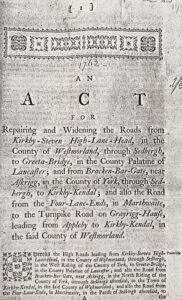
Front page of the 1762 Act of Parliament establishing the Sedbergh Turnpike Trust
Early Days
Trustees had powers to widen roads or alter the course of the existing ones. New roads close to the main road could be made and existing ones amended or repaired. The Trusts appointed a surveyor to view the condition of the road and to see that it was repaired properly.
At the first meeting of the Sedbergh Turnpike Trust, it was agreed inter alia, that Toll Collectors be appointed at Barnyhills, (near Castle Green, Kendal), Borret Bar (near Sedbergh), Garsdale and Pryhouse (both on the road to Askrigg) and Middleton Head, (halfway from Barbon to Sedbergh).
The 1762 Act specifically stated that ‘nothing in this Act contained, shall extend to impower the said Trustees to erect any Gate or Turnpike between Greeta-Bridge aforesaid or Middleton-Head, in the County of Westmorland.’ In other words, there was no Toll Gate in Casterton. It is not stated in the Act why this was specified, I would presume that it was because the gate would have been too close to other toll gates belonging to other Turnpike Trusts.
Map showing the approximate position of the Sedbergh Turnpike Trust’s Toll Roads (shaded), Toll Gates and end points marked X. The road shaded blue is approximately today’s A683, shaded purple is the A684.
Toll Charges
Also listed in detail in the Act of Parliament were the tolls to be charged. They were complex and there were many exceptions. For example, in the 1762 Act, a ‘coach, berlin, landau, chariot, chaise, calash, chair, caravan, chaise-marine, car or hearse’ would be charged 2 shillings and 6 pence if drawn by 6 horses, 2 shillings if drawn by 4 horses and 1 shilling if drawn by 3 or fewer horses. A ‘wagon, wain, cart, frame, dray or other carriage’ incurred a toll of 4 shillings if drawn by 4 or more horses reducing to just 6 pence if drawn by 1 horse. A single horse –laden or unladen- was charged 2 pence, a drove of oxen, cows or neat cattle cost 10 pence per score.
Exceptions, of which there were many, allowed certain categories of transport to travel without paying a charge. It included persons travelling to and from an election of a Knight in the counties of Westmorland, York and Lancaster, persons travelling to church on a Sunday or to a funeral, post horses carrying mail bags and horses, baggage and carriages of soldiers.
The temptation to travel on side roads or tracks near to gates or turnpikes to avoid paying tolls must have been very great. Owners of land adjoining the gates who allowed traffic to bypass the toll house could be prosecuted.
Statute Work
The first Act of 1762 did not alter the requirements for ‘statute work’, that is to say the parish’s obligations to provide a certain amount of days labour free of charge each year to maintain the road. Rather than providing labour, it was possible to pay the Trust an amount of money rather than provide the labour. Over time, this ‘account of composition’ became the norm.
In the 1825 accounts of the Sedbergh Turnpike Trust, Casterton paid nearly £11 to the Trustees ‘by Amount of Composition in lieu of Statute Labour’ for the section of the Turnpike Road that lay inside the Casterton parish borders.
Collecting Tolls
Initially, Toll Collectors were appointed by the Trustees and were responsible for collecting the tolls, determining exemptions and imposing fines. There was little or no audit of receipts and opportunities for fraud and bribery were many, especially as the salaries of the Toll Collectors were so low.
In order to circumvent the temptation for Toll Keepers to under declare their income, in 1771 the revenue system changed to one of ‘farming the tolls’. That is to say, leases for the right to collect tolls at specific Toll Gates were let by auction for a period of three years. Successful lessees contracted to pay the Trust one month’s rent in advance in return for the right to the proceeds from the Toll Gates within the Trust.
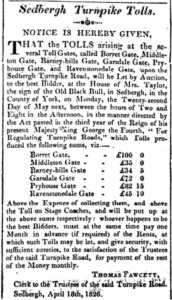
Example of a triennial notice of auction for tolls arising[6]
New Acts of Parliament
From time to time, the Trustees decided that tolls need to be increased or sections of the turnpiked road be altered. Rather cumbersomely, this required a new Act of Parliament. This was in addition to the requirement that the Trust must be renewed every 21 years by a new Act.
Sedbergh Trust’s first Act was renewed in 1784 in the 24th year of George III’s reign.[7] This Act was in turn renewed by a third Act in 1805 in the 45th year of George III’s reign.[8] The 1805 Act provided for an increase in the tolls between Sedbergh and Kendal, for example, carts laden with coals, cinders, wood, heath, furze, ling, turf and flaws, or sods for fuel, were no longer exempt from paying tolls, the Act stated that they had to pay a half toll.
All three Acts were repealed and new provisions made by a fourth Act in the 7th year of George IV’s reign in 1826.[9] This is the Act when Casterton was added as one of the places where tolls were collected. This will be discussed in next month’s Sketch.
Accidents
As a result of the establishment of the Sedbergh Turnpike Trust, the condition of the roads did improve. With the improvement in road surfaces and the development of modes of transport such as stage coaches, larger and more dangerous vehicles travelled along the routes and through the Toll Gates.
On 4 August 1819 the stage coach Lord Exmouth was on its way from Newcastle to Lancaster. After stopping at the Rose and Crown in Kirkby Lonsdale [The Royal Hotel], it set off again. Thirty year old William Elmire was driving with eleven passengers on board.[10] There was a fatal accident and William Elmire was taken to court.
At his trial, a local tailor named Todd told the court that the vehicle had left the Rose and Crown and was driven furiously through the town, so much so that he expected it to topple over. A passenger named William Johnson observed the victim William Howson -then from London but originally from near Wray- get on board the coach some 300 yards after it had left the Rose and Crown; the coach careering to a stop to let him do so. Johnson reported that the guard of the coach, William Parker, had told the driver to take care in case he ‘do a mischief, and lame some of the horses.’ Howson climbed onboard and sat at the front, up top, taking the middle seat.
Undeterred by the Guard’s exhortations, the Driver set off again at full speed. Another passenger recalled that when the stage coach reached the [Devils] bridge, the coach was on two wheels, before toppling over throwing the passengers from it. Another witness, Robert Ebbleth, found Howson lying on his belly, he turned him over to lay him on his back and went to help the others who were injured. Howson was placed on a cart and taken back to Kirkby Lonsdale.
He was attended by the local surgeon William Batty. It was reported that all the surgeons of Kirkby Lonsdale were employed that night in attending the wounded at Mrs Roper’s house, i.e. the Rose and Crown, from whence they had earlier left. Batty recalled that Howson had a wound over his eye and a severe contusion on his forehead. Despite the medical attention, Howson died the next day.
Other passengers were also badly hurt. ‘A gentleman from London attempted to walk into the town but was observed to whirl himself round quickly, as if delirious, and to fall; he then bled profusely; and got relief, but his head was found dreadfully fractured; he has been since trepanned, and now lies in a very dangerous state.’ There is no subsequent newspaper report that this unfortunate person died which would suggest that he survived the ordeal of having a hole drilled into his skull to relieve the pressure.
The Trial
At the trial there was agreement that the coach had been driven in ‘a furious manner’, but disagreement about whether Elmire was drunk while doing so. Several witnesses testified that they thought he was intoxicated whereas the Guard said that he was not.
Justice Bayley concluded that he was drunk in charge of his coach. Addressing Elmire Bayley said, ‘You have been found guilty of the crime for which you have been tried, and on such evidence as could not leave the smallest shadow of a doubt of your guilt upon any rational mind. The charge against you is of a very serious nature, viz., that of furiously driving the coach entrusted to your care, and violently causing the death of a fellow creature… There is reason to believe that you were in liquor at the time, and it is charitable to you to suppose that was the case, for I cannot for a moment suppose that any man is so devoid of humanity as to have committed such an action in his cool and deliberate hours. You see what a melancholy and painful event has arisen solely from your intoxication. I feel for you and your family, but I am bound to attend to the interests of the public, and should ill discharge my duties were I to permit you to escape. It is not so much for the punishment of the individual, as to guard against a repetition of such acts in future. I have a testimonial of your character that you are not devoid of humanity and I cannot imagine that you coolly premeditated or wished for the dreadful event. You have been the cause of sending a man into the other world for want of proper care; and as a warning to others, as well as to give greater security to travellers in future, the sentence is that you be confined in the county gaol for twelve calendar months.’
It was not the last time that people would die travelling along the Toll Road in Casterton.
Stage Coaches Passing Through Casterton
The accident above involved a coach named Lord Exmouth. This may well have been one of Bartholomew Bretherton’s stage coach fleet based out of Liverpool. The Bretherton coaching empire started in Liverpool in 1800 when it bought a M. Stantton and Co’s share in the stage coach ‘Expedition’, running from Liverpool to London as well as shares in coaches that ran to Bath, Bristol and Carlisle. The coaches all ran from the Crown Inn, Redcross Street in Liverpool. From this start, several brothers from the Bretherton family ran their own fleet of coaches. Bartholomew Bretherton (1775 – 1857), who operated from the Saracen’s Head on Dale Street, ran a fleet of coaches including the Lord Exmouth. One of Bartholomew’s more famous coaches was the Royal Umpire, sometimes called the Umpire or Liverpool Umpire.[11]
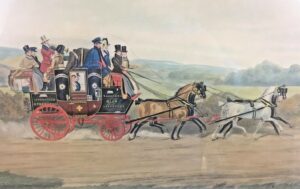
The Royal Umpire C. 1830
A Tale of Two Lord Exmouths – or is it Three?
The newspaper reports of the accident and trail expose an interesting side story. The 1819 accident report notes that five minutes after the dreadful accident, the ‘old Coach (Patrickson & Co.)’ arrived at the scene and gave assistance to the injured. This suggests that another coach company also ran along the road through Casterton. This was also hinted at in an early report on the accident which referred to the coach as the ‘the opposition Lord Exmouth coach (proprietors, Dunn, Loftus & Co.)’, confirming that there were at least two competing Lord Exmouths on the route.[12]
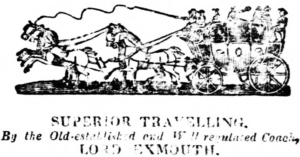
Immediately following the coach crash on Devils Bridge the proprietors of one of the Lord Exmouth, Patrickson and Co., advertised their coach service as part of a damage limitation exercise, and telling customers that they were the old and original (and safe) coach service.
Their newspaper advertisement informed potential customers that they could travel on the ‘old established and well-regulated Coach Lord Exmouth’ from the Commercial Inn, Lancaster to the Sun Inn, Newcastle upon Tyne in 16 hours, taking the route from Lancaster, to Kirkby Lonsdale, [through Casterton] onward to Sedbergh and Kirkby Stephen, thence to Barnard Castle and Bishop Auckland terminating at Newcastle, a distance of about 120 miles. Their service could be taken every Monday, Wednesday, Friday and Saturday morning at quarter to five. The advertisement stated that ‘The Proprietors respectfully return thanks to their Friends and a generous Public for the very liberal support they have experienced since their Coach was opposed on the above Road, and assure them that on no account whatever, will racing or furious driving be allowed: they will use every exertion to preserve their former safety and regularity towards their Passengers, and are extremely happy to state, that ever since the LORD EXMOUTH commenced on this line of Road, (which is now nearly Three Years) not the slightest accident ever happened; and they further beg to assure their Friends, that no exertion shall be wanting on their part, to make the establishment safe, respectable, and expeditious.’
The advertisement continued, ‘The Lord Exmouth commenced running from the Commercial Inn Lancaster (at which house it still continues) to the Swan Inn, Newcastle, in October, 1816 and continued to run to that house nearly twelve months, afterwards to the Turf Hotel, (Loftus’s) until 29th May, 1819, when it returned to the Sun Inn, and continues to run on the above days from that place. Having now no connection whatever with Mr. Loftus; and they also beg to add the names of their Proprietors on the Road, as many mistakes have arisen in consequences of their opponents having taken up the same [coach] name, in order to mislead the Public, and called theirs the old original Lord Exmouth, which is not correct.’[13]
There followed the names of the official Coaching Inns which in the case of Kirkby Lonsdale was not the Rose and Crown. Rather, the Proprietor was listed as ‘Harrison, Tiplady and Co – Green Dragon’ [The Snooty Fox]. This was possibly Nicholas Harrison (1792 – 1831) who was listed as innkeeper at the Green Dragon in an 1829 trade directory. Also listed as an official Proprietor for the Lord Exmouth was John Patrickson & Co, based out of the Commercial Inn at Lancaster.
In the same newspaper and on the same page, there was another advertisement for the Lord Exmouth asserting that their Lord Exmouth was the rightful vehicle, listing an entirely different group of Proprietors in each town including Mr Loftus’ in Newcastle, (but not mentioning who the Kirkby Lonsdale Proprietor was).
Where this left the Bretherton’s connection is anyone’s guess! An advertisement in December 1819 mentioning the Lord Exmouth run by Bretherton, lists it as stopping at Mr Loftus’ Turf Hotel in Newcastle.
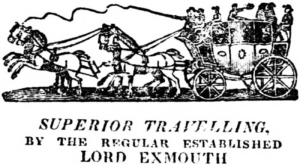
Spot the difference, above a header from the 1819 advertisement for ‘Loftus’ Lord Exmouth and below, and on the same page, the header for Patrickson’s Lord Exmouth.[14]
A Pause in the Road…
Next month, I will continue the history of the Turnpike Road in the years after 1825, look at the building and maintenance of the Toll Gate and the attached Toll Bar Cottage which sits beside the road to this day.
Simon Drakeford
March 2023
With thanks to Joyce Scobie
References
[1] Unless otherwise noted, this Sketch draws from, J. Scobie, History of The Sedbergh Turnpike Trust, Sedbergh Historian, Vol 2 (1991) pp 41 – 4, Vol 3 (1992) pp42 – 47 and Vol 4 (1993) pp31 – 35
[2] The Agreeable Miscellany, a fortnightly magazine published in Kendal, Vol. i, p389
[3] Turnpike Roads, Geoffrey N. Wright, Shire Library, 1992, p5
[4] Road Transport in Cumbria in the Nineteenth Century, L. A. Williams, George Allen & Unwin, 1975, p55
[5] Road Transport in Cumbria, Williams, Appendix A
[6] Westmorland Gazette, 26 April 1826, p1
[7] 24 George III, c. 70, 1784
[8] 45 George III, c. 27, 1805
[9] 7 George iv, c. 72, 1826
[10] Reports of the accident and subsequent trial compiled from, Westmorland Advertiser and Kendal Chronicle, 14 August 1819, p3, Westmorland Advertiser and Kendal Chronicle, 4 September 1819, p3 and Chester Courant, 14 September 1819, p2
[11] A History of Transport Through Rainhill, Florence Dickinson, M.Sc., Rainhill Civic Society, 1979, pp4-9
[12] Carlisle Patriot, 14 August 1819, p3
[13] Liverpool Mercury, 20 August 1819, p5
[14] Lancaster Gazette, 11 September 1819, p1